San Francisco Reports Fatal Overdose Involving MGM-15
post on 25 Oct 2026
post on 25 Oct 2026
 Medical Toxicologymedicaltoxic.com
https://medicaltoxic.com/news/san-francisco-fatal-mgm-15-overdose
San Francisco Reports Fatal Overdose Involving MGM-15
San Francisco health officials report the city's first known fatal overdose involving MGM-15, a semisynthetic kratom-derived opioid detected in both the decedent and associated product packaging.
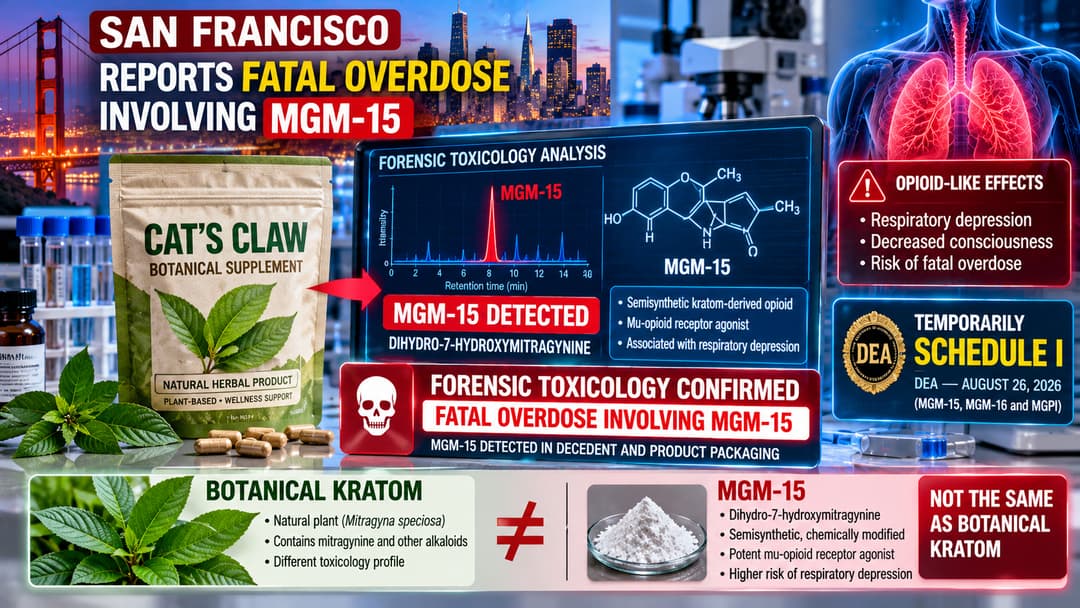
San Francisco public-health officials are warning clinicians and the public about dihydro-7-hydroxymitragynine, or MGM-15, after forensic toxicology identified the kratom-derived opioid in an adult who died of an overdose in late September.
The San Francisco Department of Public Health issued the alert on October 21, 2026, describing the case as the city's first known fatal overdose involving MGM-15. According to the health department, the Office of the Chief Medical Examiner detected MGM-15 in the decedent and in product packaging associated with the exposure. [1]
The San Francisco Police Department independently reported that an individual had died after consuming MGM-15 and described the substance as a kratom-derived semisynthetic opioid. [2]
This is an important shift in the human evidence around MGM-15. Until recently, the compound appeared mainly in emerging-drug surveillance, product testing, forensic toxicology and federal scheduling actions. The San Francisco event adds a documented fatal human overdose in which MGM-15 was analytically identified.
The confirmed findings are narrower than saying MGM-15 was necessarily the sole toxic agent responsible for the death.
SFDPH reported that:
an adult died of an overdose in late September;
MGM-15 was detected by forensic toxicology;
MGM-15 was also confirmed in the product packaging associated with the exposure;
the event represents the first known fatal MGM-15 overdose reported in San Francisco; and
the product involved was marketed under an herbal-style identity rather than clearly presenting itself as an opioid.
Publicly available health-department information does not provide a blood MGM-15 concentration, ingested dose, complete clinical course or comprehensive co-exposure profile.
The case should therefore be described as a fatal overdose involving MGM-15, rather than as proof that MGM-15 acted alone.
SFDPH identified the associated product as Script botanicals x Maui labs packaging and reported that the label made no reference to kratom or 7-hydroxymitragynine (7-OH). [1]
Health officials say MGM-15 has also appeared in products marketed as Uncaria tomentosa, commonly called “cat's claw,” and sold through smoke shops and gas stations.
That creates a particularly important toxicology problem: a consumer may believe they are taking an herbal product while actually receiving a chemically modified opioid.
The San Francisco finding should not, however, be generalized to every cat's claw product. Authorities identified MGM-15 in the product associated with this case; they did not state that all products marketed as Uncaria tomentosa contain MGM-15.
MGM-15 is also known as dihydro-7-hydroxymitragynine.
DEA describes MGM-15 as a synthetic derivative related to 7-hydroxymitragynine, produced through chemical modification of kratom-related alkaloid scaffolds. It acts at the mu-opioid receptor and is associated with opioid-type risks, including respiratory depression, dependence and withdrawal. [3]
This distinction matters because botanical kratom, concentrated 7-OH products and semisynthetic MGM compounds are not toxicologically interchangeable.
MedicalToxic's clinical owner, Kratom and 7-Hydroxymitragynine Poisoning, separately addresses botanical kratom, concentrated 7-OH, mitragynine pseudoindoxyl, MGM-15, MGM-16 and other modified products.
The San Francisco case should therefore not be used to imply that traditional botanical kratom has the same composition or risk profile as a product containing manufactured MGM-15.
The fatal event also occurred after MGM-15 had already undergone federal emergency scheduling.
On August 26, 2026, DEA temporarily placed MGM-15, MGM-16 and mitragynine pseudoindoxyl (MGPI) in Schedule I of the Controlled Substances Act after concluding that temporary control was necessary to avoid an imminent hazard to public safety. [3]
That order took effect immediately.
DEA subsequently issued a new notice on October 14 to separate MGM-15 and MGM-16 procedurally from its revised threshold approach for 7-OH and MGPI. Importantly, DEA stated that the existing August Schedule I order for MGM-15 and MGM-16 remains in force until it expires or is replaced by the new temporary order. [4]
The regulatory background is covered in DEA Revises Schedule I Plan for 7-OH and MGPI.
MGM-15 therefore should not be confused with the still-evolving federal threshold framework for 7-OH.
DEA and forensic toxicology sources characterize MGM-15 as a potent mu-opioid receptor agonist.
The clinically relevant concern is therefore a conventional opioid-type toxidrome, particularly depressed consciousness and respiratory depression, rather than a unique MGM-15 syndrome requiring an entirely different emergency approach. [3]
SFDPH advises giving naloxone and calling 911 when an MGM-15 or other opioid overdose is suspected. [1]
That recommendation should not be converted into an MGM-15-specific naloxone dose or redosing protocol from this case.
Basic opioid-emergency priorities remain recognition of respiratory compromise, emergency medical activation, naloxone when available and respiratory support when needed.
The San Francisco case also illustrates the value of advanced analytical toxicology.
MGM-15 is a relatively new compound, and standard toxicology workflows should not automatically be assumed to identify it.
The Center for Forensic Science Research and Education notes that analysis of dihydro-7-hydroxymitragynine can be challenging because MGM-15 may undergo analytical conversion to mitragynine during gas chromatography–mass spectrometry. CFSRE initially confirmed the substance using advanced analytical techniques and reference material. [5]
DEA has likewise noted that newer 7-OH-related substances may be underdetected because forensic laboratories require validated methods and appropriate analytical standards. [4]
A routine toxicology screen therefore should not be treated as definitive evidence that an emerging kratom-derived opioid was absent when the clinical and exposure history remains concerning.
On the same day the MGM-15 warning was publicized, SFPD reported recent searches of multiple San Francisco smoke shops.
Police said officers had seized hundreds of items, including more than 400 kratom products at one location, along with 7-OH products, suspected psilocybin products, flavored vapes, nitrous oxide and drug paraphernalia. [2]
But authorities have not established that the products seized in those searches contained MGM-15 or supplied the product involved in the fatal overdose.
The enforcement activity is therefore useful market context, not evidence linking a particular store or seizure to the death.
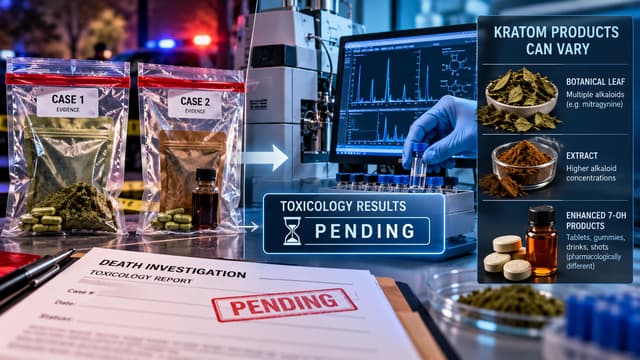
MedicalToxic previously covered Ole Miss Death Investigations Put Kratom in Spotlight—but Toxicology Results Are Still Pending.
That article deliberately avoided attributing the deaths to kratom because toxicology confirmation was unavailable.
The San Francisco event is different.
Here, forensic toxicology did identify MGM-15 in the decedent, and health officials also reported MGM-15 in the associated product packaging. [1]
That does not resolve every causal question, but it moves the evidence beyond mere product presence at a scene or an unverified history of use.
This distinction is exactly why emerging-drug reporting should separate:
suspected exposure → toxicology-confirmed exposure → attributed cause of death.
Those are not interchangeable evidence levels.
MGM-15 itself is not newly discovered.
CFSRE had already detected and characterized dihydro-7-hydroxymitragynine in forensic and drug-material testing, and DEA had already moved MGM-15 into temporary Schedule I control by August. [3] [5]
The genuinely new development is the San Francisco fatal human event.
Forensic toxicology identified MGM-15 in an adult who died of an overdose, while the same emerging opioid was associated with product packaging that did not clearly disclose kratom or 7-OH. [1]
This moves MGM-15 on MedicalToxic from primarily a regulatory and emerging-substance concern into a documented human fatal-toxicity event.
Important details remain unavailable.
Public-health authorities have not published:
an MGM-15 blood concentration;
the amount consumed;
a complete exposure timeline;
a full list of co-exposures;
the detailed clinical course;
or evidence establishing that MGM-15 was the sole toxic agent.
The San Francisco event also does not establish a national MGM-15 outbreak or permit calculation of an incidence or fatality rate.
Preclinical potency estimates should not be translated into a fixed human “times stronger than fentanyl” or similar comparison.
Likewise, the finding should not be generalized from semisynthetic MGM-15 products to botanical kratom.
San Francisco's October 21 alert marks an important change in the MGM-15 evidence base.
The city's medical examiner detected the semisynthetic kratom-derived opioid in an adult who died of an overdose in late September, and SFDPH reported MGM-15 in the associated product packaging. [1]
MGM-15 was already temporarily Schedule I under DEA's August 26 emergency order and remains controlled while DEA proceeds with its updated scheduling process. [3] [4]
The case does not show that all kratom products carry the same risk, nor does it establish MGM-15 as the sole cause of every fatal event in which it is detected.
Its clearest toxicology lesson is more specific:
a product presented with an herbal-style identity can conceal a chemically modified opioid exposure capable of producing a fatal opioid overdose.
1. San Francisco Department of Public Health. (2026, October 21). Fatal overdose involving kratom-derived opioid.
2. San Francisco Police Department. (2026, October 21). SFPD Seizes Hundreds of Items Illegally for Sale at City Smoke Shops #26-132.
3. U.S. Drug Enforcement Administration. (2026, August 26). Schedules of Controlled Substances: Temporary Placement of Mitragynine Pseudoindoxyl, MGM-15, and MGM-16 in Schedule I. Federal Register, 91, 54948–54956.
4. U.S. Drug Enforcement Administration. (2026, October 14). Schedules of Controlled Substances: Temporary Placement of MGM-15 and MGM-16 in Schedule I. Federal Register, 91, 65381–65387.
5. Center for Forensic Science Research and Education. (2025, November 11). Dihydro-7-Hydroxy Mitragynine.
Keep reading
Substance Abuse and Overdose
26 Oct 2026
Substance Abuse and Overdose
07 Oct 2026 · Updated 09 Oct 2026
Substance Abuse and Overdose
05 Oct 2026
Substance Abuse and Overdose
25 Sept 2026 · Updated 01 Oct 2026