PMMA Still Found in Ecstasy Pills Across Eight Countries
post on 26 Oct 2026

post on 26 Oct 2026
 Medical Toxicologymedicaltoxic.com
https://medicaltoxic.com/news/pmma-ecstasy-pills-europe-eight-countries
PMMA Still Found in Ecstasy Pills Across Eight Countries
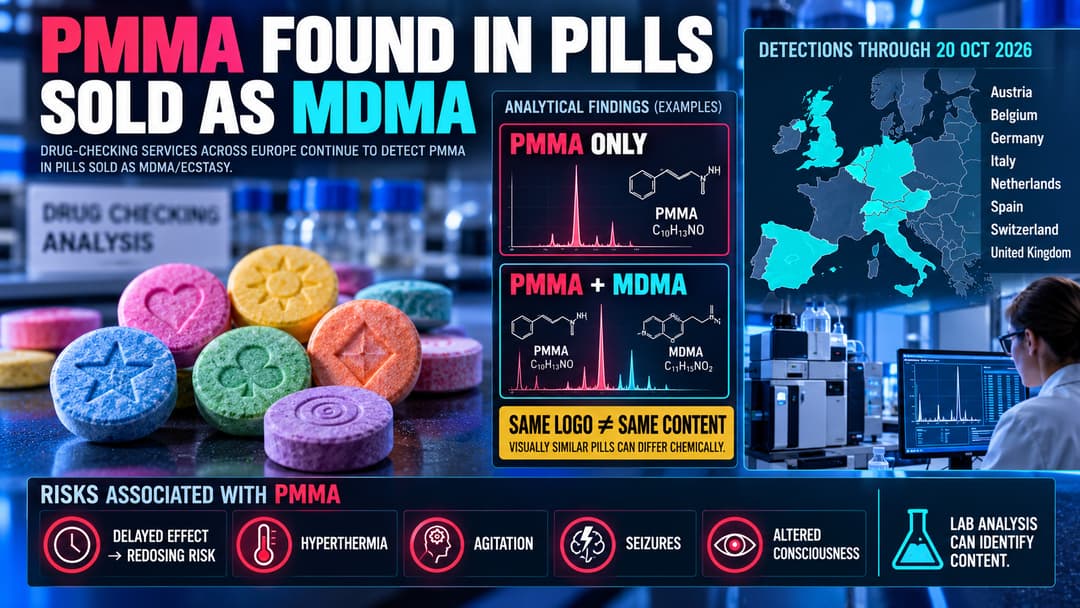
Drug-checking services across eight European countries continue to detect PMMA in pills sold as MDMA, sometimes alone and sometimes mixed with MDMA.
A multi-country European drug-checking warning involving paramethoxymethamphetamine, or PMMA, remains active months after the first 2026 detections.
The Trans-European Drug Information network, or TEDI, says drug-checking services in Austria, Belgium, Germany, Italy, the Netherlands, Spain, Switzerland and the United Kingdom have identified PMMA in pills sold as MDMA or ecstasy since late July. The network's warning was published October 1 and updated October 20, when PMMA was still being detected. [1]
Some samples contained PMMA without MDMA, while others contained PMMA together with MDMA. Several pills also contained other substances.
The continuing signal is important because the physical appearance of an ecstasy tablet—including its color, shape or stamped logo—does not reliably predict what the pill contains.
TEDI's October 20 compilation brings together independently confirmed results from drug-checking services across Europe.
The network lists detections reported by services including:
checkit! and Drogenarbeit Z6 in Austria;
DIZ Zurich / saferparty.ch in Switzerland;
Energy Control in Spain;
Legal-High-Inhaltsstoffe in Germany;
Modus Vivendi in Belgium;
Neutravel in Italy;
DIMS / Trimbos in the Netherlands; and
WEDINOS in the United Kingdom.
TEDI says seven pill logos have appeared among confirmed samples so far, including Trump, Red Bull, Club 555, Donkey Kong/Gorilla, Hulk, Abarth and Mitsubishi.
But those names should not be used as a list of “PMMA pills.”
The network specifically warns that the same logo can appear on pills with different compositions from different batches, and a pill not shown in the warning is not necessarily safer. [1]
This is not a brand-new October outbreak.
Austria's checkit! service reported PMMA in pills sold as ecstasy between late July and early August and continued finding PMMA in later samples during August and September. [2]
In the Netherlands, the Drugs Information and Monitoring System issued its highest-level Red Alert on August 28 after several two-colored ecstasy pills were found to contain very high amounts of PMMA. [3]
Swiss drug-checking services also reported PMMA in pills submitted as MDMA, while Spain's Energy Control confirmed MDMA plus PMMA in two pills analyzed in September. [4] [5]
The October 20 update therefore represents persistence and geographic spread of an existing drug-checking signal—not proof that PMMA incidence suddenly increased on October 20.
The analytical findings are not uniform.
TEDI reports that some samples—such as multiple Club 555 pills—contained PMMA without MDMA.
Other samples, including several Trump and Mitsubishi pills, contained PMMA together with MDMA, sometimes alongside additional compounds such as ketamine, caffeine or amphetamine. [1]
That variability matters clinically.
A person buying a tablet as MDMA cannot safely infer whether the pill contains MDMA, PMMA, both substances or another mixture based on the logo alone.
Energy Control reached the same conclusion after its Spanish detections, advising that pill color, shape and logo cannot establish composition. [4]
One of PMMA's most important hazards is its delayed onset relative to expected MDMA effects.
TEDI and national drug-checking services warn that people may interpret a slow or weak subjective effect as evidence that a pill is low-dose or inactive and take another tablet before the PMMA has fully taken effect. [1]
The Dutch Trimbos Institute similarly warns that PMMA can take effect later than expected, which can promote additional dosing before toxicity becomes apparent. [3]
That is particularly concerning when the pill also contains MDMA because the person may experience enough expected MDMA effect to believe the product is behaving normally while still receiving an unrecognized PMMA exposure.
The public-health message is therefore not simply “avoid one logo.”
It is that unexpected delay or weakness is not evidence that redosing is safe.
PMMA is an amphetamine-related substance with strong serotonergic toxic potential.
Drug-checking services identify concerning symptoms including:
marked hyperthermia;
rapid heart rate;
heavy sweating;
agitation or confusion;
muscle rigidity or abnormal movements;
nausea or vomiting;
seizures;
loss of consciousness; and
rapid clinical deterioration.
The underlying toxicology overlaps with severe serotonin excess and sympathomimetic toxicity.
MedicalToxic's Serotonin Syndrome (Serotonin Toxicity): Symptoms, Diagnosis, Drug Interactions, and Treatment reviews the clinical pattern of serotonin toxicity, including hyperthermia, neuromuscular excitation and severe complications.
This News does not create a separate PMMA treatment protocol. Severe hyperthermia, seizures, altered consciousness, respiratory difficulty or rapid deterioration after a suspected exposure require emergency medical evaluation.
The continuing 2026 signal also reinforces a practical limitation of visual identification.
TEDI states that pill appearance tells users little about chemical composition, and identical-looking tablets may differ from batch to batch. [1]
This is particularly important because illicit-tablet logos are easily copied and do not represent standardized manufacturing.
A “Red Bull,” “Trump” or “Gorilla” pill analyzed in one city cannot be assumed to contain the same substances as another visually similar pill elsewhere.
The logo should therefore be treated as a description of a tested sample—not a chemical identity.
Home reagent testing also has limitations.
TEDI warns that reagent tests may fail to identify PMMA when MDMA is also present and says analytical drug checking using chromatography is needed to reliably identify PMMA in mixed samples. [1]
Saferparty provides the same practical warning: PMMA itself may produce little useful reaction with common color testing, while the stronger MDMA reaction can mask its presence in a mixed pill. [5]
That is why the current warning is based on confirmed drug-checking analysis, not visual inspection or a simple home color test.
The eight-country pattern would be difficult to recognize from isolated emergency-department cases alone.
Each participating service identified samples within its own country. TEDI then aggregated those findings, revealing that PMMA was appearing in tablets sold as MDMA across multiple markets.
This is one of the major strengths of drug checking as a surveillance tool: it can identify unexpected drug composition before—or even without—a large clinically recognized poisoning cluster.
It also provides information that routine clinical toxicology may not capture when laboratories do not specifically test for PMMA.
The current warning should not be turned into a claim of a new European fatality outbreak.
TEDI states that no deaths linked to the specific pills in the 2026 warning had been confirmed as of October 20 in public sources or through its network. [1]
The network does report that poisonings have required hospital treatment, but it does not provide a denominator or incidence rate.
Historical PMMA outbreaks have been associated with severe poisonings and deaths, and the European Union's earlier risk assessment led to PMMA being placed under control across EU member states. [6]
Those historical outcomes establish that PMMA can be highly dangerous.
They should not be reassigned to the particular pills detected in 2026.
PMMA is not a newly discovered substance, and the current episode did not begin on October 20.
The important development is that a signal first identified during the summer has persisted across multiple European drug markets.
As of October 20:
eight countries had confirmed PMMA in pills sold as MDMA;
some pills contained PMMA alone;
others contained PMMA plus MDMA;
and
the same tablet logo could represent different chemical contents in different batches.
That combination makes the warning more clinically and public-health relevant than a single isolated pill alert.
Drug-checking detections do not establish population prevalence.
The available data do not show what percentage of ecstasy pills across Europe currently contain PMMA, whether the proportion is increasing or how many people consumed the identified tablets.
The geographic distribution of submitted samples is also influenced by access to drug-checking services and user behavior.
Likewise, logo counts should not be interpreted as separate manufacturing sources or standardized product lines.
There is no evidence that every pill carrying one of the listed logos contains PMMA.
And although severe PMMA poisonings have historically been fatal, the 2026 European network has not confirmed deaths linked to the specific pills in this warning.
Europe's 2026 PMMA signal remains active.
Drug-checking services have confirmed PMMA in pills sold as MDMA across Austria, Belgium, Germany, Italy, the Netherlands, Spain, Switzerland and the United Kingdom, with detections continuing through October. [1]
Some tablets contained PMMA alone; others contained both PMMA and MDMA.
The most important practical lesson is not the logo printed on a tablet.
It is the opposite:
appearance cannot reliably identify illicit-pill composition.
Delayed PMMA effects can encourage redosing, mixed MDMA/PMMA tablets can obscure what was taken, and simple reagent testing may not reliably detect PMMA in mixtures.
For clinicians and harm-reduction services, the ongoing signal reinforces the value of analytical drug checking and maintaining suspicion for unexpected serotonergic and hyperthermic toxicity when a reported “MDMA” exposure does not behave as expected.
1. TEDI Network. (2026, October 1; updated October 20).
PMMA found in pills sold as MDMA in eight European countries — MDMA Adulteration Warning
2. checkit! Vienna. (2026).
Drug Checking Results — PMMA warnings and 2026 ecstasy analyses
3. Trimbos Institute / DIMS. (2026, August 28).
Trimbos Red Alert: Zeer gevaarlijke XTC met PMMA aangetroffen
4. Energy Control. (2026, September 17).
Alerta en España: PMMA y MDMA en pastillas vendidas como MDMA
5. DIZ Zurich / saferparty.ch. (2026, August 31).
Warning: PMMA in MDMA Pills 2026
6. European Union Drugs Agency. (2003).
Report on the risk assessment of PMMA in the framework of the joint action on new synthetic drugs
Keep reading
Substance Abuse and Overdose
25 Oct 2026
Substance Abuse and Overdose
07 Oct 2026 · Updated 09 Oct 2026
Substance Abuse and Overdose
05 Oct 2026
Substance Abuse and Overdose
25 Sept 2026 · Updated 01 Oct 2026