Ole Miss Death Investigations Put Kratom in Spotlight—but Toxicology Results Are Still Pending
post on 25 Sept 2026 · Updated 01 Oct 2026
post on 25 Sept 2026 · Updated 01 Oct 2026
 Medical Toxicologymedicaltoxic.com
https://medicaltoxic.com/news/ole-miss-kratom-death-investigations
Ole Miss Death Investigations Put Kratom in Spotlight—but Toxicology Results Are Still Pending
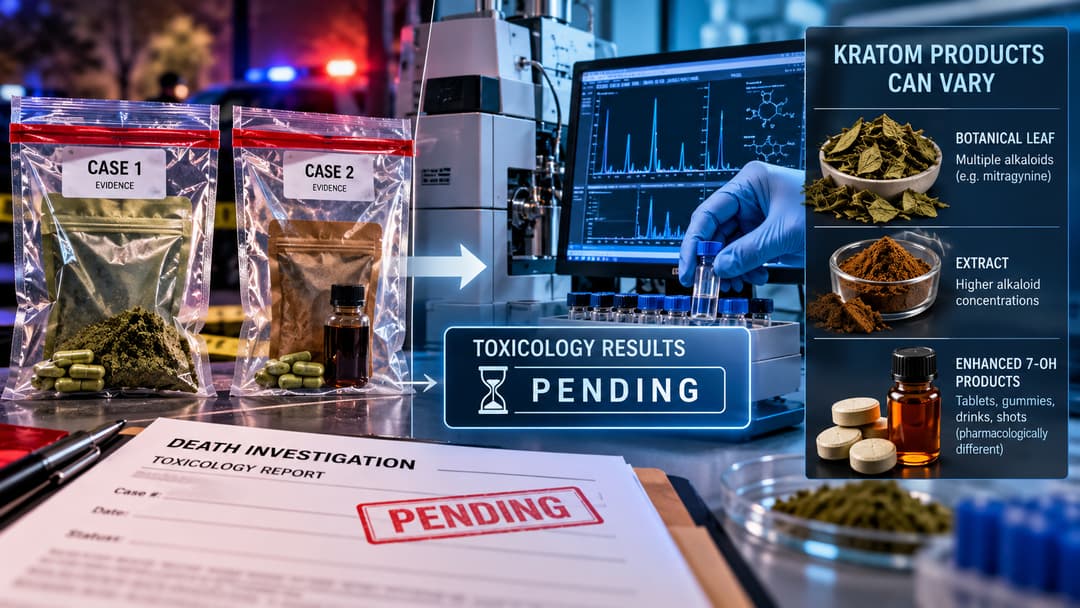
Packaged kratom was found in two separate University of Mississippi student death investigations, but toxicology results have not been released and kratom has not been established as a cause of either death.
Two University of Mississippi student deaths have placed kratom back in the national spotlight.
But the most important toxicology fact is also the simplest:
Finding a substance during a death investigation does not establish that the substance caused the death.
On September 21, two University of Mississippi students were found dead in separate locations, one on campus and the other off campus. Lafayette County Metro Narcotics subsequently reported that packages of kratom were found during both investigations and that the products had been sold at a retail store. [1]
Authorities said they had no confirmed information that kratom contributed to either death and no evidence that the two deaths were connected. State agencies were working to expedite toxicology reports. As of the latest reporting reviewed by MedicalToxic on September 25, those results had not been publicly released. [1]
For medical toxicology, that uncertainty is not a minor disclaimer.
It is the central story.
The confirmed facts remain limited.
Authorities have reported that:
two students died in separate incidents;
packaged kratom was found during both investigations;
the products had been sold through a retail store;
investigators have not established that the deaths are connected;
kratom has not been confirmed as contributing to either death; and
toxicology results have not yet been publicly released. [1]
That is very different from saying two students died from kratom.
The Mississippi State Department of Health reinforced the same broader principle in a September 23 warning about unregulated and counterfeit psychoactive products: packaging, appearance, labeling and place of purchase may not reliably reveal what a product contains, and determining which substance contributed to a serious illness or death may require laboratory testing, toxicology and investigation. [2]
A package found at a scene can be important investigative evidence.
It may indicate that a substance was available, possessed or potentially used.
It does not answer several separate toxicology questions:
Was the product actually consumed?
What did the product contain?
Which alkaloids were present?
At what concentrations?
Were other drugs or medications involved?
Did postmortem toxicology detect mitragynine, 7-OH or another substance?
If detected, did that substance materially contribute to death?
Those questions require analytical testing and interpretation.
Even a positive postmortem toxicology result would not automatically settle causation. Interpretation depends on the substance detected, concentration, specimen type, possible co-exposures, autopsy findings, medical history and circumstances surrounding the death.
That is why the pending toxicology reports matter.
Presence at a scene is evidence worth investigating. It is not a cause-of-death determination.
The second major problem with early speculation is the word kratom itself.
Products sold under that label can differ substantially.
Botanical kratom comes from Mitragyna speciosa leaves and contains multiple alkaloids, with mitragynine as the predominant psychoactive constituent.
The commercial market now also includes:
powders;
capsules;
extracts;
concentrated liquid shots;
tablets;
gummies; and
products containing added or enhanced 7-hydroxymitragynine, or 7-OH.
These should not automatically be treated as equivalent exposures.
FDA specifically distinguishes the trace amounts of 7-OH that occur naturally in kratom from products containing added or enhanced levels of 7-OH, including tablets, gummies, drink mixes and shots. FDA describes these concentrated products as potent opioid products and warns of serious harms. [3]
MedicalToxic reviews these distinctions in 7-OH vs. Kratom: Toxicity, Overdose Symptoms, Withdrawal, and Treatment.
That distinction matters in the Ole Miss investigations because the publicly available information describes the material only as packaged retail kratom.
No public report reviewed by MedicalToxic has established:
whether either product was botanical leaf, extract or another formulation;
its mitragynine concentration;
whether 7-OH was present at natural, enhanced or concentrated levels;
whether other kratom-related alkaloids were present; or
whether either student consumed the product.
The current investigation therefore should not be reframed as a 7-OH poisoning case unless toxicology or product testing eventually supports that conclusion.
7-OH still matters as context because the retail market has changed.
FDA warns that products containing added or enhanced 7-OH can produce serious adverse effects and reports harms including addiction, seizures and withdrawal symptoms. [3]
Retail availability does not guarantee product uniformity.
A professionally packaged product sold through a smoke shop, gas station or other retail outlet may contain a very different alkaloid profile from dried botanical leaf.
That is precisely why the product itself must be characterized before its toxicologic significance can be determined.
Federal regulators have increasingly distinguished concentrated or chemically modified kratom-related opioids from botanical kratom.
On July 1, 2026, DEA announced its intent to temporarily place 7-OH above a proposed specified threshold and three related substances under Schedule I controls. DEA explicitly stated that the proposed action would not apply to botanical kratom products containing naturally occurring 7-OH below the specified threshold. [4]
The regulatory paths subsequently diverged.
On August 26, DEA issued a temporary scheduling order placing three 7-OH-related substances—mitragynine pseudoindoxyl, MGM-15 and MGM-16—in Schedule I. The temporary order remains in effect through August 26, 2028 unless extended or replaced through the permanent scheduling process. [5]
That August action should not be interpreted as a blanket federal Schedule I designation for botanical kratom.
It also does not establish that any of those substances were present in the products found during the Ole Miss investigations.
No publicly available product testing has identified the formulation, alkaloid concentration or presence of concentrated 7-OH or those scheduled derivatives in either case.
The pending toxicology reports are not a formality.
Different results could lead to very different interpretations.
If kratom alkaloids are not detected, the presence of packaged product at the scene would become far less informative about the deaths themselves.
If mitragynine is detected, investigators would still need to interpret the concentration, specimen type, other substances and circumstances before assigning causal significance.
If 7-OH or another potent kratom-related opioid is identified, that would raise additional questions about product formulation, concentration and whether the exposure involved botanical kratom, a concentrated extract or a modified product.
If other opioids, sedatives, stimulants or medications are detected, the interpretation could shift again toward a mixed exposure or another cause entirely.
Toxicology could therefore strengthen, weaken or fundamentally change the current kratom-focused narrative.
The absence of a confirmed causal role in the Ole Miss investigations does not mean kratom-related products are uniformly benign.
FDA warns that products containing added or enhanced 7-OH can cause serious harm and has received reports involving addiction, seizures and withdrawal symptoms. FDA also distinguishes those products from the trace amounts of 7-OH naturally present in botanical kratom. [3]
For the Ole Miss investigations, however, the relevant question is not whether kratom or 7-OH can cause toxicity.
It is whether analytical and investigative evidence shows that a particular substance contributed to these specific deaths.
That evidence has not yet been publicly released.
At this stage, the investigations do not establish that:
kratom caused either death;
both deaths had the same cause;
the products found in the two investigations were identical;
either product contained concentrated 7-OH;
either product contained mitragynine pseudoindoxyl, MGM-15 or MGM-16;
either student consumed the product that was found;
another substance was not involved; or
the two cases represent a cluster of kratom-related fatalities.
These conclusions would require evidence that has not been released.
The fact that packaged kratom was found in both investigations is sufficient to justify attention and testing.
It is not sufficient to establish causation.
The news is not that kratom and concentrated kratom-related products can produce clinically significant toxicity. That is already established and covered elsewhere.
What is new is that packaged retail kratom was found during two separate University of Mississippi student death investigations occurring on the same day, prompting law-enforcement warnings and expedited toxicology testing. [1]
The toxicology significance lies largely in what has not yet been determined.
This is a real-time example of why four separate questions should not be collapsed into one:
Was a product present? → Was it consumed? → What was detected? → What contributed to death?
At present, only the first question has a publicly confirmed answer.
Several critical pieces of information remain unavailable:
final causes and manners of death;
toxicology findings;
concentrations of any detected substances;
full autopsy findings;
exact product names and formulations;
product alkaloid concentrations;
independent product testing;
whether the products found in the two investigations were the same;
timing and quantity of any exposure; and
possible co-exposures.
Authorities have also said there is no evidence that the two deaths are connected. [1]
Those uncertainties should remain explicit until official results are released.
The deaths of two University of Mississippi students have understandably drawn scrutiny after packaged kratom was found during both investigations.
But the evidence has not reached the point where kratom can be assigned a causal role.
Toxicology results have not been publicly released, the products have not been publicly characterized, and authorities have not confirmed that kratom contributed to either death or that the two deaths are connected.
The broader commercial market makes premature conclusions even more difficult because botanical kratom, extracts, enhanced 7-OH products and synthetic kratom-related opioids are not interchangeable exposures.
The strongest MedicalToxic interpretation is therefore one of evidence discipline:
Presence at a scene is evidence worth investigating. It is not a cause-of-death determination.
Until toxicology and product testing provide more information, that distinction should remain at the center of the story.
Thanawala, S. (Associated Press). (2026, September 24). Deaths of students at the University of Mississippi cast spotlight on kratom. Mississippi Today / Associated Press.
Mississippi State Department of Health. (2026, September 23). Beware of Counterfeit and Unregulated Drugs.
U.S. Food and Drug Administration. Products Containing 7-OH Can Cause Serious Harm.
U.S. Drug Enforcement Administration. (2026, July 1). DEA to Temporarily Schedule 7-OH and Related Substances to Protect Public Safety.
U.S. Drug Enforcement Administration. (2026, August 26). Schedules of Controlled Substances: Temporary Placement of Mitragynine Pseudoindoxyl, MGM-15, and MGM-16 in Schedule I. Federal Register.
Keep reading
Substance Abuse and Overdose
07 Oct 2026 · Updated 09 Oct 2026
Substance Abuse and Overdose
05 Oct 2026
Substance Abuse and Overdose
20 Sept 2026 · Updated 01 Oct 2026
Substance Abuse and Overdose
09 Sept 2026 · Updated 01 Oct 2026