Medetomidine: ASAM Guidance, 179 Suspected EMS Encounters
post on 15 Nov 2026
post on 15 Nov 2026
 Medical Toxicologymedicaltoxic.com
https://medicaltoxic.com/news/asam-medetomidine-guidance-ndews-ems-2026
Medetomidine: ASAM Guidance, 179 Suspected EMS Encounters
ASAM's first dedicated clinical considerations distinguish medetomidine intoxication from severe withdrawal, as NDEWS reports 179 suspected nonfatal overdose EMS encounters.
Two developments in November 2026 are sharpening the clinical and public-health response to medetomidine, a veterinary sedative increasingly identified in the unregulated U.S. opioid supply.
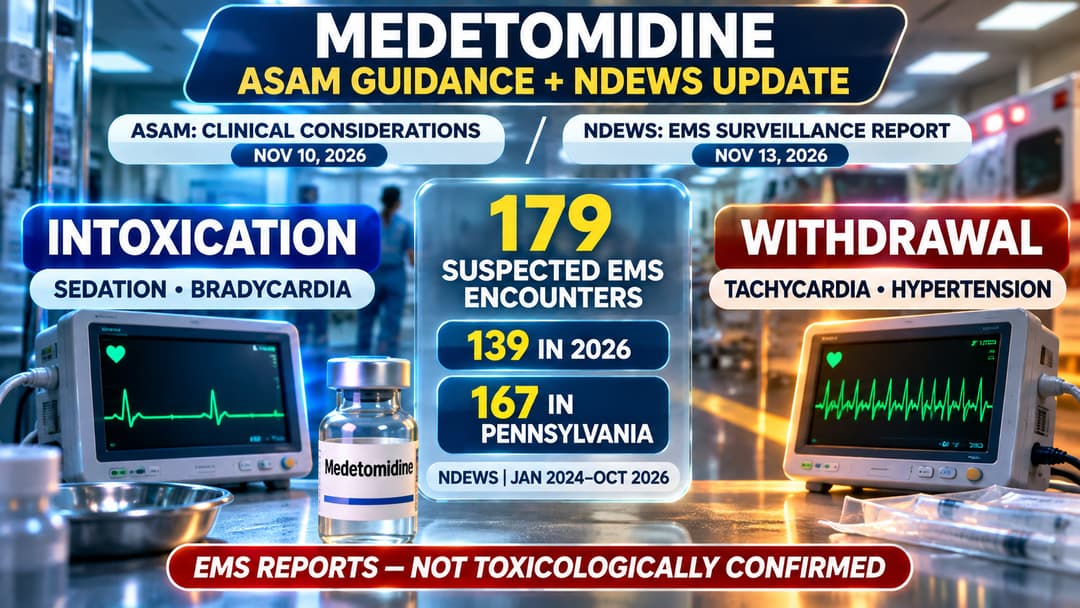
On November 10, the American Society of Addiction Medicine (ASAM) released its first dedicated guidance for recognizing and managing medetomidine intoxication and withdrawal. The resource addresses two distinct syndromes that can require very different clinical approaches. [1]
Three days later, the National Drug Early Warning System (NDEWS) published a surveillance report identifying 179 suspected nonfatal overdose emergency medical services (EMS) encounters mentioning medetomidine, including 139 occurring during 2026. Most were recorded in Pennsylvania. [2]
The developments are related but represent different evidence: a specialty-society clinical resource and a prehospital surveillance signal—not a controlled trial or 179 confirmed medetomidine poisonings.
ASAM's November 10 document, ASAM Clinical Considerations: Medetomidine Intoxication and Withdrawal, addresses recognition and management in hospitals, acute-care services and other treatment settings.
It distinguishes acute intoxication, which commonly involves prolonged sedation and bradycardia, from withdrawal, which can produce severe autonomic hyperactivity after regular exposure is interrupted.
ASAM explicitly states that the existing evidence is insufficient to support a formal clinical practice guideline. Its recommendations are instead expert-consensus clinical considerations, informed by a narrative literature review and clinical experience. Much of the available evidence comes from hospital settings, and the approaches described have not been prospectively validated as universal treatment protocols. [3]
Medetomidine is an alpha-2 adrenergic receptor agonist used in veterinary medicine. It is not approved for human use, although its dextro-isomer, dexmedetomidine, is an approved human sedative.
The two syndromes have contrasting manifestations.
Medetomidine intoxication is associated with profound or prolonged sedation, bradycardia and sometimes hypotension. In mixed opioid exposures, impaired consciousness may persist after opioid-related respiratory depression improves.
Medetomidine withdrawal can develop rapidly following interruption of repeated exposure. Reported manifestations include marked tachycardia, severe hypertension, nausea, vomiting, anxiety, agitation, diaphoresis and tremor. Severe cases can involve encephalopathy and other complications requiring intensive medical care. [3]
ASAM emphasizes that withdrawal may progress more quickly and become more severe than conventional opioid withdrawal. However, its clinical examples and severity framework are not validated diagnostic or disposition thresholds.
The distinction between opioid effects and medetomidine's non-opioid effects is central to the new guidance.
The CDC's April 2, 2026 Health Advisory identified medetomidine in the unregulated fentanyl supply and warned about both profound sedation and severe withdrawal. It also emphasized that opioid overdose reversal medication remains important when opioid-related respiratory depression is suspected. [4]
Naloxone reverses opioid effects when clinically indicated; it does not directly reverse medetomidine's alpha-2 agonist effects.
Therefore, persistent sedation after improvement in breathing does not necessarily mean that opioid reversal was ineffective.
ASAM also stresses the importance of continuing appropriate medication treatment for coexisting opioid use disorder rather than treating medetomidine withdrawal as a substitute for opioid-use-disorder care. [3]
The new document discusses specialized withdrawal management, but specific alpha-2 agonist dosing, infusion protocols and disposition algorithms are beyond the scope of this News.
NDEWS examined suspected nonfatal overdose EMS encounters from January 1, 2024, through October 31, 2026.
Its November 13 special report identified:
Surveillance measure | Finding |
|---|---|
Total suspected EMS encounters | 179 |
Encounters occurring during 2026 | 139 |
Encounters recorded in Pennsylvania | 167 |
States with identified encounters | Pennsylvania, New York, Colorado |
Counts for New York and Colorado were individually suppressed because they were below 10. [2]
These figures should not be interpreted as national prevalence estimates or evidence that Pennsylvania necessarily has the highest underlying exposure rate. Surveillance coverage and documentation vary by state.
The November report used prehospital data from biospatial.io.
Eligible records had to meet suspected-overdose surveillance criteria and include a documented mention of medetomidine in the patient complaint or EMS narrative.
NDEWS used overdose definitions associated with Florida's Enhanced State Opioid Overdose Surveillance program and the biospatial.io Nonfatal Overdose Syndrome.
Only nonfatal emergency-response encounters involving patient contact were included. Records in which medetomidine had been administered by EMS were excluded. [2]
Importantly, these were not laboratory-confirmed medetomidine poisonings.
The report does not supply confirmatory toxicology, hospital outcomes or a complete account of co-exposures. Classification may depend on clinical impressions, patient reports or bystander information.
An EMS record mentioning medetomidine does not establish that the substance caused the suspected overdose.
Pennsylvania previously documented a distinct clinical surveillance signal.
A September 14, 2026 Pennsylvania Department of Health advisory reported that 139 individuals had presented to emergency departments in Allegheny County for suspected medetomidine withdrawal beginning August 21, with cases reported to the Pittsburgh Poison Center. The cause of the local increase remained unknown. [5]
That figure and the 139 NDEWS encounters occurring during 2026 come from different surveillance definitions and reporting contexts.
They must not be treated as the same group, added together or assumed to represent entirely separate patients.
NDEWS previously reported 182 medetomidine-related EMS encounters in its May 22 weekly briefing, covering January 2023 through April 2026. The earlier search included mentions of medetomidine or “rhino tranq” and used CDC DOSE, Nonfatal Overdose and Substance Use Disorder composite surveillance definitions. [6]
A further source discrepancy deserves attention: the PDF linked from that May briefing reports 180 encounters, not 182. [7]
The November report begins in January 2024 rather than January 2023 and uses different selection criteria.
Accordingly, comparing 179 with either earlier figure does not establish an increase or decrease in medetomidine overdose incidence. The discrepancy between the earlier newsletter and its PDF also remains unresolved in the publicly reviewed documents.
The new ASAM resource gives clinicians a dedicated framework for distinguishing sedative intoxication from potentially severe withdrawal.
The NDEWS report provides a complementary surveillance snapshot showing that medetomidine has appeared repeatedly in suspected overdose EMS documentation, particularly in Pennsylvania.
Neither development proves that every exposure involved fentanyl. Although medetomidine has frequently been found alongside unregulated opioids, the actual substances involved in individual EMS encounters were not confirmed by this dataset.
For established information about mixed opioid and non-opioid sedative exposure, see MedicalToxic's Fentanyl + Xylazine (‘Tranq’): Why Naloxone Alone Isn’t Enough.
The broader principles of opioid reversal are covered separately in Naloxone in Xylazine, Nitazenes, and Fentanyl Analogue Overdose.
MedicalToxic has also reported a distinct Canadian warning in 70 Suspected Overdoses in Waterloo Region Highlight Complex Fentanyl Mixtures.
These earlier articles remain the owners of their respective clinical and local-alert topics. The new News concerns the November 10–13 ASAM and NDEWS developments.
The ASAM document is based primarily on expert consensus, descriptive clinical experience and observational evidence. It does not establish a universally validated medetomidine-withdrawal treatment protocol.
The NDEWS dataset lacks laboratory confirmation and hospital outcome information, and its geographical coverage is uneven.
The earlier and current NDEWS counts cannot support a longitudinal incidence comparison without harmonized case definitions and observation periods.
Additional research is needed to clarify withdrawal risk, identify reliable clinical predictors of severe deterioration and evaluate treatment effectiveness.
The November 2026 developments highlight an important distinction in contemporary medical toxicology.
Medetomidine intoxication may produce prolonged sedation and bradycardia, while medetomidine withdrawal can cause severe autonomic instability that requires a different clinical response.
ASAM has now published its first dedicated expert-consensus clinical considerations addressing both presentations.
At the same time, NDEWS has identified 179 suspected nonfatal overdose EMS encounters mentioning medetomidine, including 139 during 2026 and 167 in Pennsylvania.
The surveillance findings are not laboratory-confirmed poisoning counts, and the clinical guidance is not a validated universal treatment standard.
Together, however, they reinforce the need for clinicians, poison centers and public-health teams to recognize medetomidine's distinct effects while continuing appropriate care for coexisting opioid exposure and opioid use disorder.
American Society of Addiction Medicine. (2026, November 10). ASAM Releases New Guidance for Managing Medetomidine Intoxication and Withdrawal.
National Drug Early Warning System. (2026, November 13). EMS encounters for suspected nonfatal overdoses involving medetomidine: January 1, 2024–October 31, 2026. NDEWS Special Report.
American Society of Addiction Medicine. (2026, November 10). ASAM Clinical Considerations: Medetomidine Intoxication and Withdrawal. Full 31-page clinical considerations and supporting materials available through the official ASAM page.
Centers for Disease Control and Prevention. (2026, April 2). Medetomidine in the U.S. Illegal Fentanyl Supply Increasing Risk for Overdose and Severe Withdrawal Syndrome. Health Alert Network Advisory CDCHAN-00527.
Pennsylvania Department of Health. (2026, September 14). Suspected Medetomidine Withdrawal Increase Notification – Allegheny County. Health Alert Network Advisory PAHAN 839.
National Drug Early Warning System. (2026, May 22). NDEWS Weekly Briefing Issue 285 — This Week's Focus: Medetomidine.
National Drug Early Warning System. (2026, May 22). EMS encounters for nonfatal drug-related overdoses involving medetomidine in the US: January 1, 2023–April 30, 2026. NDEWS Special Report.
Keep reading
Substance Abuse and Overdose
07 Nov 2026
Substance Abuse and Overdose
26 Oct 2026
Substance Abuse and Overdose
25 Oct 2026
Substance Abuse and Overdose
07 Oct 2026 · Updated 09 Oct 2026