DEA Revises Schedule I Plan for 7-OH and MGPI
post on 15 Jul 2026 · Updated 16 Oct 2026

post on 15 Jul 2026 · Updated 16 Oct 2026
 Medical Toxicologymedicaltoxic.com
https://medicaltoxic.com/news/dea-concentrated-7-oh-schedule-i-poison-center-exposures
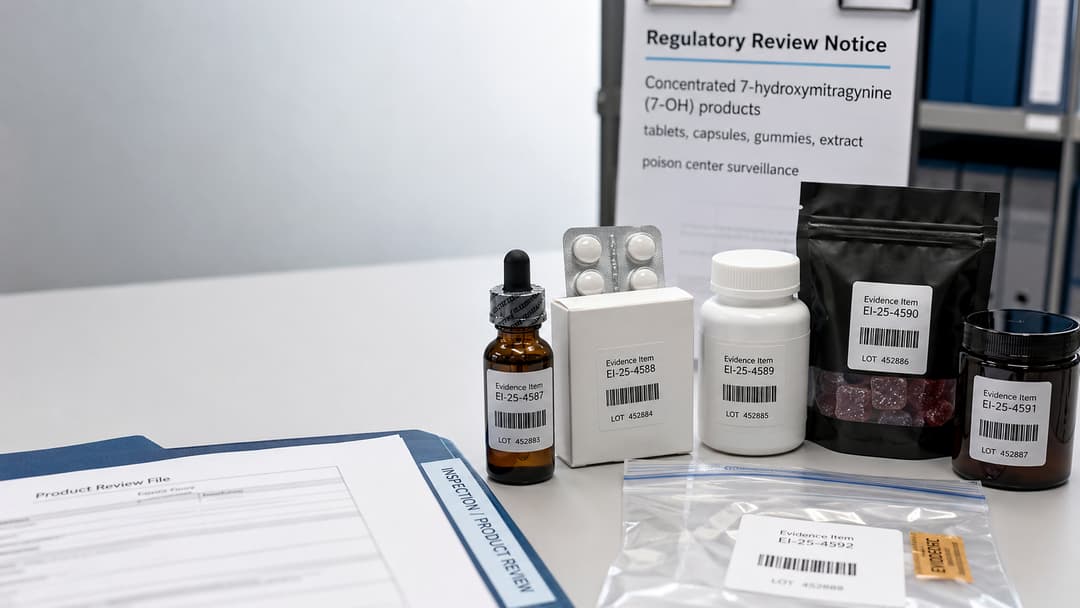
DEA Revises Schedule I Plan for 7-OH and MGPI
DEA has replaced its July 7-OH proposal with a new threshold framework covering 7-OH and MGPI, while MGPI remains temporarily Schedule I under the August order.
The U.S. Drug Enforcement Administration has substantially rewritten its federal scheduling plan for two potent kratom-related opioid compounds.
In a Federal Register notice published October 14, 2026, DEA announced a new proposed threshold framework for 7-hydroxymitragynine, or 7-OH, and mitragynine pseudoindoxyl, or MGPI. The agency intends to temporarily place the substances in Schedule I when either compound alone—or their combined amount when both are present—meets specified concentration or ratio criteria. [1] GovInfo
The development replaces DEA's earlier July proposal for 7-OH and also creates a future threshold-based framework for MGPI.
But the new framework is not yet in effect.
DEA states that the replacement temporary scheduling order will be published on or after November 13, 2026. Until that happens, MGPI remains temporarily Schedule I under the existing August 26 order, while 7-OH has not yet been federally placed into Schedule I under the new threshold framework. [1] [2] GovInfo
DEA's October notice adopts the threshold recommended by the Department of Health and Human Services on October 8.
Under the proposed framework, 7-OH and MGPI would fall under temporary Schedule I control when either substance alone, or their combined amount if both are present:
Test | Proposed federal threshold |
|---|---|
Solid powders, capsules or other solid forms | Greater than 1 mg per gram |
Liquid preparations | Greater than 1 mg per milliliter |
Mitragynine ratio | Mitragynine divided by 7-OH, MGPI, or their combined amount is less than 100 |
These are alternative criteria. Meeting the ratio criterion can therefore matter even when a product does not exceed the concentration threshold. [1] GovInfo
The ratio can be understood as a mitragynine-to-7-OH/MGPI ratio below 100:1.
Most importantly, these numbers are regulatory thresholds. They are not toxic doses, safe doses, overdose cutoffs or clinical disposition thresholds.
DEA explicitly warns that products falling below the proposed threshold should not be inferred to be safe for consumption. GovInfo
The existing MedicalToxic News originally reported DEA's July framework.
That July notice proposed control of botanical Mitragyna speciosa material containing more than 0.050% 7-OH by dry weight. For synthetic or further-processed products, the proposal also used the 0.050% criterion or more than 1 mg of 7-OH per article. [3] GovInfo
That threshold is now historical.
DEA's October notice states that it is withdrawing the earlier 7-OH notice and replacing it with the new 7-OH/MGPI framework based on HHS's October 8 recommendation. [1] GovInfo
For editorial purposes, the >0.050% threshold should no longer be presented anywhere on MedicalToxic as the current federal proposal.
MGPI is in a different legal position from 7-OH.
On August 26, DEA temporarily placed mitragynine pseudoindoxyl, MGM-15 and MGM-16 in Schedule I. That order took effect immediately and is scheduled to remain in force through August 26, 2028 unless superseded or otherwise changed. [2] GovInfo
The new October framework does not immediately narrow MGPI's existing control.
DEA states that the August MGPI order remains in effect until either it expires or the new threshold-based temporary order is published and the previous order is withdrawn, whichever occurs first. GovInfo
So the current status is:
7-OH: the new threshold proposal has been announced, but the temporary scheduling order is not yet effective.
MGPI: already temporarily Schedule I under the August order, without the new threshold limitation, until the replacement order takes effect.
This distinction is essential because describing the October threshold as already controlling MGPI would misstate current federal law.
DEA also published a separate October 14 notice covering MGM-15 and MGM-16.
Those substances were already placed temporarily in Schedule I with MGPI on August 26. The new notice is designed to keep MGM-15 and MGM-16 under Schedule I control without adopting the new 7-OH/MGPI threshold for them. [4] GovInfo
Their current August control remains in force until the replacement MGM-15/MGM-16 order is published or the existing order otherwise ends.
The new threshold therefore should not be extended to MGM-15 or MGM-16.
The sequence now looks very different from the version MedicalToxic published in July.
Date | Federal development |
|---|---|
July 6, 2026 | DEA publishes the original 7-OH notice using the >0.050% and per-article framework. [3] |
August 26, 2026 | MGPI, MGM-15 and MGM-16 are temporarily placed in Schedule I. [2] |
October 8, 2026 | HHS recommends a revised shared threshold for 7-OH and MGPI. [1] |
October 14, 2026 | DEA publishes the revised notice and replaces the previous 7-OH approach. [1] |
No earlier than November 13, 2026 | DEA may publish the new temporary scheduling order. [1] |
One date nuance is worth documenting: the original Federal Register publication is dated July 6, 2026, although DEA's October notice refers in several places to the earlier notice as having been published July 7. The original July Federal Register document is the stronger source for its own publication date. GovInfo
The October action should not be described as DEA “banning kratom.”
The proposed federal controls turn on the amount and relative proportion of 7-OH and MGPI, rather than simply whether a product is described as kratom.
FDA's updated 7-OH information explains that the revised approach is intended to distinguish products with trace amounts of these compounds from formulations that have been intentionally enhanced or concentrated. [5] U.S. Food and Drug Administration
That does not mean botanical material is automatically exempt regardless of chemistry, and it does not mean a below-threshold product is safe.
For detailed clinical distinctions between botanical kratom, extracts, concentrated 7-OH and modified products, see Kratom and 7-Hydroxymitragynine Poisoning.
The related overview 7-OH vs. Kratom: Toxicity, Overdose Symptoms, Withdrawal, and Treatment explains why products marketed under similar “kratom” terminology may represent very different toxicologic exposures. Medical Toxicology
The federal threshold does not tell clinicians whether an exposure is toxic.
DEA describes 7-OH and MGPI as opioid-active substances associated with public-health concerns including dependence and respiratory depression. The October notice characterizes MGPI as a potent mu-opioid receptor agonist and emphasizes the lack of established clinical safety for these commercial products. GovInfo
Clinical decisions should therefore remain based on the patient's presentation, respiratory status, level of consciousness, co-exposures and product history—not on whether the product falls above or below a DEA concentration threshold.
No treatment recommendation changes as a result of the October notice.
The regulatory framework has changed, but the poison-center signal that helped make the July story newsworthy remains relevant.
America's Poison Centers reported 3,803 kratom or kratom-derivative exposure reports during 2025 and 3,190 during the first six months of 2026. Reports specifically involving 7-OH rose from 593 in all of 2025 to 901 between January 1 and June 30, 2026. [6] Poison Centers
Among reported single-substance 7-OH exposures, 38.8% were associated with serious health problems, 63.8% received treatment at a healthcare facility and 20.5% resulted in hospitalization. Poison Centers
Those figures describe poison-center reports, not population incidence, and they do not establish that 7-OH caused every clinical outcome.
The October DEA thresholds likewise should not be interpreted as a response to a newly calculated toxic dose.
The central October development is that DEA has rewritten the proposed federal boundary for 7-OH and MGPI before a new 7-OH temporary scheduling order took effect.
The earlier 7-OH-only proposal has been withdrawn. The new framework considers both compounds individually and together, uses 1 mg/g and 1 mg/mL concentration criteria, and adds a mitragynine ratio below 100:1 as an alternative trigger. GovInfo
MGPI's August Schedule I status remains in force during the transition.
MGM-15 and MGM-16 remain separately controlled and are not being moved into the new threshold system.
The earliest stated date for the replacement temporary order is November 13, 2026. GovInfo
The most important remaining question is now when and in what final form DEA publishes the replacement temporary scheduling order.
Until that happens, 7-OH has not become Schedule I under the new October threshold, and MGPI remains subject to the existing August no-threshold order.
The new threshold also does not answer clinical questions about a toxic dose, safe dose, overdose threshold or disposition decision.
Those are separate medical questions and should remain separate from the regulatory framework.
DEA's October 14 action materially changes the federal scheduling story for kratom-related opioids.
The July 7-OH threshold is no longer the current proposal. DEA now intends to apply a shared concentration-and-ratio framework to 7-OH and MGPI, while leaving MGM-15 and MGM-16 under separate Schedule I controls. [1] [4]
But the transition is not complete.
7-OH is not yet Schedule I under the new threshold. MGPI remains Schedule I under the August order until that order is replaced. And DEA has not banned all botanical kratom.
The next key federal checkpoint is November 13, 2026 or later, when DEA may publish the new temporary scheduling order. GovInfo
1. U.S. Drug Enforcement Administration. (2026, October 14). Schedules of Controlled Substances: Temporary Placement of 7-Hydroxymitragynine and Mitragynine Pseudoindoxyl Above a Specified Threshold in Schedule I. Federal Register, 91, 65370–65381.
2. U.S. Drug Enforcement Administration. (2026, August 26). Schedules of Controlled Substances: Temporary Placement of Mitragynine Pseudoindoxyl, MGM-15, and MGM-16 in Schedule I. Federal Register, 91, 54948–54956.
3. U.S. Drug Enforcement Administration. (2026, July 6). Schedules of Controlled Substance: Temporary Placement of 7-Hydroxymitragynine Above a Specified Threshold in Schedule I. Federal Register, 91, 40917–40924.
4. U.S. Drug Enforcement Administration. (2026, October 14). Schedules of Controlled Substances: Temporary Placement of MGM-15 and MGM-16 in Schedule I. Federal Register, 91, 65381–65387.
5. U.S. Food and Drug Administration. (2026, updated October 2026). Hiding in Plain Sight: 7-OH Products.
6. America's Poison Centers. (2026, July 8). Health Advisory: Serious Illnesses Associated with Kratom and 7-OH Products.
Keep reading
Regulatory and Policy Updates
07 Oct 2026 · Updated 09 Oct 2026
Regulatory and Policy Updates
19 Sept 2026 · Updated 01 Oct 2026

Regulatory and Policy Updates
04 Sept 2026 · Updated 02 Oct 2026
Regulatory and Policy Updates
24 Oct 2025 · Updated 26 Sept 2026
