NDEWS Reports 82 EMS Encounters Mentioning Cat’s Claw
post on 07 Nov 2026
post on 07 Nov 2026
 Medical Toxicologymedicaltoxic.com
https://medicaltoxic.com/news/ndews-cats-claw-overdose-ems-encounters
NDEWS Reports 82 EMS Encounters Mentioning Cat’s Claw
NDEWS identified 82 suspected nonfatal overdose EMS encounters mentioning Cat’s Claw across eight states, while separate testing found hidden kratom-derived opioids in selected products.
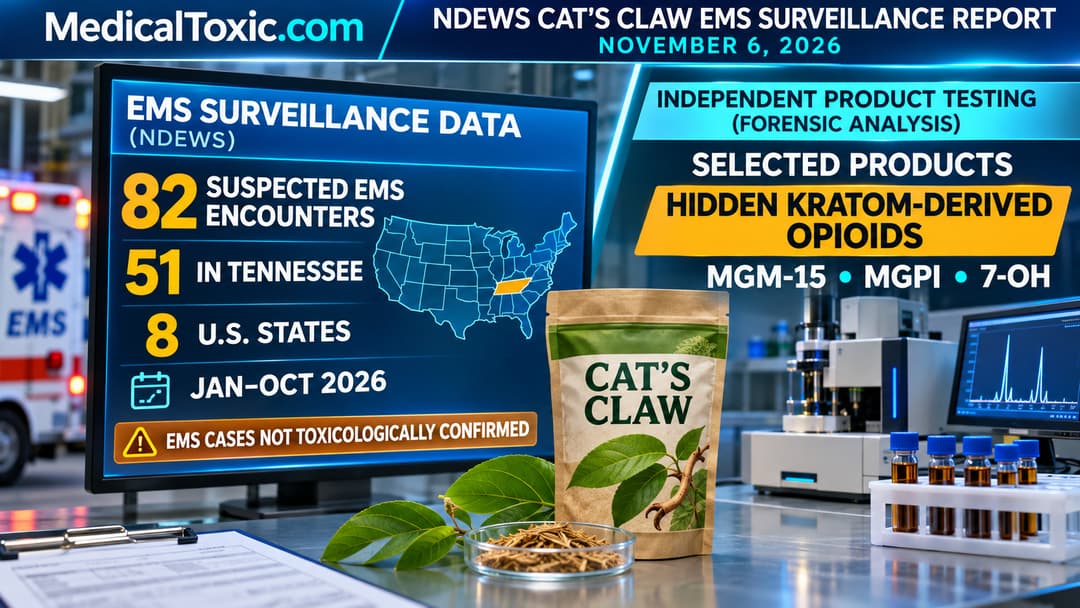
The National Drug Early Warning System (NDEWS) identified 82 suspected nonfatal overdose EMS encounters mentioning Cat’s Claw or related products during January–October 2026.
The findings, published on November 6, 2026, cover encounters recorded from January 1 through October 31. More than half were identified in Tennessee, which accounted for 51 encounters.
The 82 encounters are not 82 laboratory-confirmed opioid poisonings. NDEWS identified the records through suspected-overdose classification and documented product mentions, without confirming the chemical contents consumed in each encounter. [1]
NDEWS identified encounters in eight states:
State | Reported encounters |
|---|---|
Tennessee | 51 |
Alabama | Fewer than 10; exact count suppressed |
Arkansas | Fewer than 10; exact count suppressed |
Florida | Fewer than 10; exact count suppressed |
Georgia | Fewer than 10; exact count suppressed |
Illinois | Fewer than 10; exact count suppressed |
Kansas | Fewer than 10; exact count suppressed |
Pennsylvania | Fewer than 10; exact count suppressed |
The report does not provide individual counts for the seven states outside Tennessee because each had fewer than 10 identified encounters. It also maps the counties in which encounters were documented.
Unequal surveillance coverage and documentation prevent reliable state-level risk comparisons. [1]
NDEWS analyzed biospatial.io prehospital data.
Records were eligible when they met established suspected-overdose surveillance criteria and contained a documented mention of Cat’s Claw, alternative spellings, related botanical names or brands sold under that identity.
The search included:
Cat’s Claw;
Uncaria tomentosa;
Uncaria guianensis; and
associated commercial product names.
The relevant language could appear in the patient complaint or EMS narrative.
NDEWS used overdose-classification criteria developed through Florida’s Enhanced State Opioid Overdose Surveillance program and the biospatial.io Nonfatal Overdose Syndrome.
Only nonfatal EMS encounters with patient contact qualified. [1]
A product mention may reflect information supplied by a patient, companion or bystander. The record may not identify the actual formulation, co-ingestants or reason for symptoms.
Consequently, an EMS encounter mentioning Cat’s Claw cannot automatically be classified as confirmed MGM-15, 7-OH or mitragynine pseudoindoxyl poisoning.
NDEWS summarized 13 selected EMS narratives.
Five mentioned gas-station Cat’s Claw pills or supplements; another described unresponsiveness after reported use.
Others mentioned prolonged use, substitution for other substances or possible withdrawal.
One named a product called Buzzer.
Such descriptions suggest use as psychoactive products rather than conventional botanicals.
Nevertheless, the selected narratives are illustrative examples, not a representative clinical case series. They do not establish the proportion of all 82 encounters involving respiratory depression, withdrawal, naloxone administration or another specific clinical outcome. [1]
Genuine Cat’s Claw generally refers to Uncaria tomentosa, a woody vine traditionally used as an herbal preparation. It is botanically different from Mitragyna speciosa, the plant commonly known as kratom.
It is not expected to contain MGM-15 or mitragynine pseudoindoxyl.
However, in its November 6 weekly briefing, NDEWS highlighted reports of commercial products marketed as Cat’s Claw that contained undeclared compounds including:
MGM-15, also known as dihydro-7-hydroxymitragynine;
mitragynine pseudoindoxyl, also abbreviated MPI or MGPI; and
7-hydroxymitragynine, commonly called 7-OH.
NDEWS also described concerns involving products sold through smoke shops, gas stations, convenience stores and online retailers. [2]
These findings should not be generalized to all Cat’s Claw herbal products. The problem concerns specific commercial formulations whose marketed identity may not accurately reflect their chemical composition.
On July 30, 2026, Utah authorities warned about Buzzers Cat’s Claw tablets.
Testing found MGM-15 and mitragynine pseudoindoxyl in multiple flavors.
Utah also reported a death investigation and several severe incidents associated with the products. [3]
This does not identify the products involved in all NDEWS encounters.
A non-peer-reviewed medRxiv preprint released October 22, 2026 adds analytical evidence.
University of Mississippi researchers tested 46 products from 17 brands, purchased online and at three Mississippi gas stations.
None of the products declared kratom alkaloids or their derivatives on the label.
Chromatography and mass spectrometry detected several undeclared compounds:
Compound | Products in which it was detected |
|---|---|
Mitragynine | 41 of 46 |
7-hydroxymitragynine (7-OH) | 35 of 46 |
MGM-15 | 24 of 46 |
Mitragynine pseudoindoxyl | 22 of 46 |
Tianeptine | 5 of 46 |
Some products denying kratom or 7-OH content nevertheless contained those compounds.
Five contained tianeptine, which is not FDA-approved for medical use. [4]
Limitations: The study is not peer-reviewed, and its selected sample does not represent the U.S. market.
Its results cannot establish the prevalence of contamination across all Cat’s Claw products. The products tested were also not demonstrated to be the same products involved in the 82 NDEWS EMS encounters.
The same day NDEWS published its special report, Ohio authorities issued a separate warning about supplements marketed under misleading herbal identities.
On November 6, the Ohio Governor's Office reported that the Ohio Narcotics Intelligence Center and Bureau of Criminal Investigation had identified multiple products labeled as Cat’s Claw that actually contained illegal synthetic kratom.
One package, Happy Daze Botanical Mango, claimed 375 mg of Cat’s Claw.
It was found at a fatal-overdose scene.
Forensics confirmed synthetic kratom in the package, but death toxicology was pending. [5]
The packaging result is therefore confirmed product evidence, not proof that a particular compound caused the death. Ohio did not establish a definitive drug-specific cause of death in the publicly available announcement.
Ohio is not among NDEWS's eight states; its event is separate from the 82 encounters.
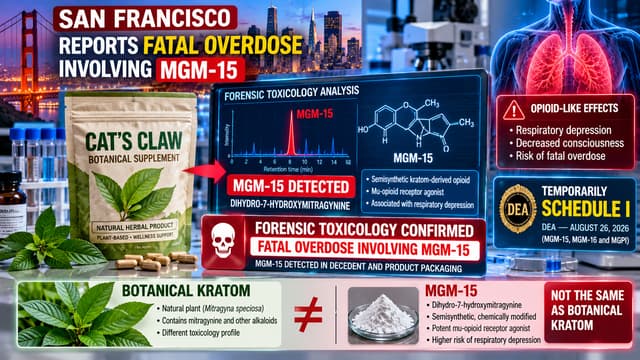
On October 21, 2026, the San Francisco Department of Public Health reported the city's first known fatal overdose involving MGM-15.
Forensic testing identified MGM-15 in a person who died in late September and in associated product packaging. The product was marketed with an herbal-style identity rather than clearly disclosing the opioid-active compound. [6]
MedicalToxic previously reported that event in San Francisco Reports Fatal Overdose Involving MGM-15.
The San Francisco investigation concerns a specific fatal event with forensic confirmation of MGM-15 exposure.
The NDEWS report identifies suspected nonfatal overdose encounters in which Cat’s Claw-related product names appeared in prehospital documentation.
The San Francisco event should not be assumed to be part of the NDEWS dataset, and the NDEWS cases should not be described as forensically confirmed MGM-15 poisonings.
The central clinical concern is unreliable exposure identification.
An herbal label may conceal an opioid-active ingredient.
For emergency clinicians, this creates a medication-history problem. Patients may report using Cat’s Claw without knowing that the commercial product contains a substance capable of producing opioid-type effects.
Depending on ingredients and co-exposures, effects may include impaired consciousness, respiratory depression, dependence or withdrawal.
Utah Poison Control advises naloxone for suspected overdoses involving its identified products; respiratory support, emergency evaluation and poison-center consultation remain important. [3]
NDEWS provides no product-specific naloxone dose or observation protocol.
Detailed clinical management belongs in MedicalToxic's existing guideline, Kratom and 7-Hydroxymitragynine Poisoning.
The NDEWS findings should not be used to calculate a U.S. incidence rate or to claim a nationwide increase in poisoning.
The report identifies suspected nonfatal overdose encounters documented in available EMS data.
Coverage varies substantially by state, and NDEWS explicitly notes incomplete underlying event coverage in several jurisdictions.
The records also lack hospital outcomes and confirmatory toxicology.
Classification may depend on clinical impressions, patient self-report or bystander descriptions.
As a result, some relevant encounters may have been missed, while others may have been misclassified.
The 82 encounters are therefore best understood as a multi-state prehospital surveillance signal associated with a reported product identity, not a definitive count of poisonings caused by one chemical or brand. [1]
Federal controlled-substance proceedings concern some modified kratom compounds, distinct from genuine Cat’s Claw.
For regulatory context, see MedicalToxic's DEA Revises Schedule I Plan for 7-OH and MGPI.
Legal status does not establish the exposure or cause of an EMS encounter.
Undeclared kratom derivatives in selected products were documented before November.
The new development on November 6 is the NDEWS assessment of suspected nonfatal overdose encounters across multiple states during a defined national surveillance period.
It establishes that:
82 relevant EMS encounters were identified;
51 occurred in Tennessee;
records were found in eight states; and
the encounters were selected through documented product mentions and suspected-overdose surveillance criteria.
The report therefore broadens the evidence from individual product investigations and local warnings to a multi-state EMS signal.
It does not confirm that the same product caused all encounters or that a particular kratom-derived opioid was present in every case.
The NDEWS dataset does not provide toxicological confirmation for the 82 encounters, detailed hospital outcomes or complete product identities.
It cannot determine which fraction involved MGM-15, 7-OH, MGPI or tianeptine.
The product study cannot identify EMS exposures.
Ohio's drug-specific cause of death remained unconfirmed.
These uncertainties prevent stronger conclusions about incidence, causation, geographic risk or the clinical severity of all reported events.
NDEWS adds a national surveillance perspective to concerns about mislabeled Cat’s Claw products.
NDEWS identified 82 suspected nonfatal overdose EMS encounters across eight states, including 51 in Tennessee.
Separate testing confirmed MGM-15 and MGPI in some commercial Cat’s Claw products.
None of this proves the 82 encounters were opioid poisonings or implicates genuine Uncaria tomentosa.
An herbal product name does not reliably identify the chemical exposure.
Clinicians and public-health teams must distinguish product names from chemical confirmation and surveillance signals from proven poisonings.
National Drug Early Warning System. (2026, November 6). National signals for EMS encounters of suspected nonfatal overdoses involving Cat’s Claw: January 1, 2026–October 31, 2026. NDEWS Special Report.
National Drug Early Warning System. (2026, November 6). NDEWS Weekly Briefing Issue 310: This Week’s Focus: Cat’s Claw.
Utah Department of Agriculture and Food. (2026, July 30). Illegal Kratom Product Sold in Utah County Linked to Death in Utah.
Avula, B., Katragunta, K., Tatapudi, K. K., Bae, J.-Y., Chittiboyina, A. G., & Khan, I. A. (2026, October 22). Undeclared Kratom Alkaloids and Tianeptine in Products Labeled as Cat’s Claw. medRxiv. Preprint, not peer-reviewed. https://doi.org/10.64898/2026.10.16.26365420.
Office of the Ohio Governor. (2026, November 6). Ohio Governor Mike DeWine Week in Review. Official governor's communication reproduced in a public email archive; includes the November 6 announcement about mislabeled products.
San Francisco Department of Public Health. (2026, October 21). Fatal overdose involving kratom-derived opioid.
Keep reading
Substance Abuse and Overdose
26 Oct 2026
Substance Abuse and Overdose
25 Oct 2026
Substance Abuse and Overdose
07 Oct 2026 · Updated 09 Oct 2026
Substance Abuse and Overdose
05 Oct 2026