Substance Abuse and Addiction
Fentanyl + Xylazine (‘Tranq’): Why Naloxone Alone Isn’t Enough
Omid Mehrpour
Post on 13 Dec 2025 · Updated 05 Oct 2026 · 16 min read
Omid Mehrpour
Post on 13 Dec 2025 · Updated 05 Oct 2026 · 16 min read
 Medical Toxicologymedicaltoxic.com
https://medicaltoxic.com/blogs/fentanyl-xylazine-overdose
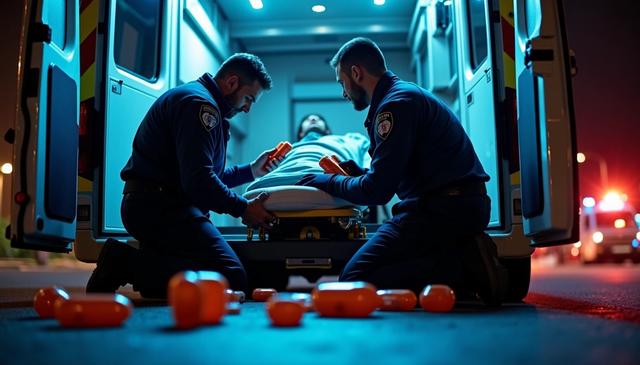
Xylazine has changed the clinical picture of fentanyl-associated overdose, but not because naloxone has stopped working.
Naloxone still reverses opioid effects when fentanyl or another opioid is involved. What naloxone does not reverse is xylazine itself—a non-opioid alpha-2 adrenergic agonist associated with central nervous system depression, bradycardia, hypotension, impaired breathing, and characteristic wounds. [1]
That distinction is the central clinical point. In a mixed fentanyl–xylazine exposure, opioid-related respiratory depression may improve after naloxone while substantial sedation or other non-opioid effects persist.
The U.S. drug supply also continues to evolve. Older seizure statistics remain historically useful, but percentages from 2022 or 2023 should not be presented as if they describe a fixed national prevalence in 2026. DEA data show broad geographic detection and changing xylazine patterns over time, while a May 2026 DEA advisory continued to identify xylazine among substances found with illicit fentanyl. [2] [3]
Naloxone remains essential whenever fentanyl or another opioid may be contributing to an overdose, but naloxone does not directly reverse xylazine. [1]
Persistent sedation after naloxone does not necessarily mean naloxone failed. The opioid component may have improved while xylazine or another co-intoxicant continues to produce CNS or cardiovascular effects.
Airway support, oxygenation, ventilation, circulation, and continued reassessment remain central when respiratory or hemodynamic abnormalities persist.
Xylazine exposure can be associated with CNS depression, bradycardia, hypotension, prolonged sedation, and distinctive chronic wounds.
DEA seizure data describe the drug supply, not the incidence of human exposure or the probability that any individual sample contains xylazine.
New 2026 poison-center research identified 109 pediatric xylazine-associated exposures reported during 2010–2024, concentrated among children aged 0–5 and adolescents aged 13–19. [9]
Fentanyl was the most common pediatric co-exposure, and all six reported deaths occurred in cases involving both fentanyl and xylazine. That finding does not establish xylazine alone as the cause of death. [9]
The investigators explicitly described pediatric xylazine exposures as relatively uncommon; NPDS reports should not be converted into national incidence estimates.
Xylazine is an alpha-2 adrenergic receptor agonist used in veterinary medicine as a sedative, analgesic, and muscle relaxant. It is not approved for human use in the United States. [4]
Its pharmacology differs fundamentally from fentanyl.
Fentanyl activates opioid receptors. Xylazine produces central sympatholytic effects through alpha-2 adrenergic receptors. Human exposure can therefore cause sedation, bradycardia, hypotension, and respiratory impairment without those effects being mediated through opioid receptors.
This difference explains why a fentanyl–xylazine overdose may respond only partly to naloxone.
Xylazine is often referred to as “tranq” or “tranq dope.” Stigmatizing labels such as “zombie drug” add little clinical value and can obscure the more useful toxicologic questions: what substances were present, what physiology is failing, and what supportive treatment is required.
Xylazine remains an important adulterant in the U.S. unregulated fentanyl supply, but current surveillance needs careful interpretation.

DEA's 2025 National Drug Threat Assessment reported xylazine in seized drug samples from every U.S. state, as well as the District of Columbia and Puerto Rico. It was encountered mainly with fentanyl or other opioids, although mixtures with cocaine and other drugs were also reported. [2]
The same report demonstrates why a single headline percentage is misleading.
The number of fentanyl exhibits containing xylazine reported by DEA was:
15,075 in 2022;
14,784 in 2023;
13,458 in 2024.
At the same time, DEA analyses indicated that the proportion of fentanyl samples containing xylazine had increased over the broader 2020–2024 period, particularly among powder samples. [2]
These observations are not contradictory. Absolute sample counts and percentages use different denominators and answer different surveillance questions.
Most importantly:
The percentage of seized fentanyl samples containing xylazine is not the percentage of people exposed to xylazine, the percentage of overdoses involving xylazine, or the probability that any specific street sample contains xylazine.
DEA's May 2026 public safety advisory continued to identify xylazine—along with substances such as medetomidine and nitazenes—as part of an increasingly unpredictable fentanyl supply. [3]
For a broader discussion of changing toxicologic threats, see Emerging Toxicological Threats in the U.S.: Xylazine, Nitazenes, Novel Sedatives, Synthetic Cannabinoids, Fentanyl Analogues, and Toxic Mushrooms.
Naloxone is an opioid receptor antagonist.
When fentanyl or another opioid is contributing to respiratory depression, naloxone can reverse that opioid component. Xylazine acts through a different receptor system, so naloxone does not directly reverse xylazine-induced sedation, bradycardia, or hypotension. [1]
This does not mean naloxone should be withheld when xylazine is suspected.
Xylazine is commonly encountered alongside fentanyl, and CDC continues to recommend naloxone when opioid overdose is possible. Emergency response must then continue beyond naloxone when breathing, consciousness, or circulation remains abnormal. [1]
The appropriate clinical endpoint is also not necessarily immediate full wakefulness.
If ventilation improves after naloxone but profound sedation persists, repeatedly escalating naloxone solely to force arousal may not address the remaining problem. Xylazine or another non-opioid sedative may still be active.
Clinicians needing detailed guidance on naloxone titration, repeated dosing, infusion, and re-narcotization should see Naloxone in Xylazine, Nitazenes, and Fentanyl Analogue Overdose.
Both fentanyl and xylazine can impair cardiorespiratory function, but through different mechanisms.
Recent experimental evidence helps explain how they may interact. A 2025 peer-reviewed mouse study found that xylazine reduced respiratory rate and heart rate and worsened several fentanyl-induced respiratory effects. However, adding xylazine did not further reduce the maximum oxygen saturation decrease produced by fentanyl in that model. [5]
The correct interpretation is therefore cautious.
The study supports a biologically plausible interaction between the two drugs, but an animal experiment cannot define the magnitude of risk in heterogeneous human polysubstance overdoses.
A separate 2026 animal study also found substantial respiratory suppression from fentanyl–xylazine combinations that was not fully reversed by naloxone alone. Those findings reinforce the pharmacologic distinction, but they should not be interpreted as evidence that experimental veterinary alpha-2 antagonists are established antidotes for poisoned humans.
FDA specifically advises that veterinary reversal agents such as yohimbine or tolazoline have not been established as safe and effective for human xylazine poisoning and should not be improvised as human antidotes. [4]
Until recently, much of what was assumed about xylazine duration in humans came indirectly from veterinary experience.
A 2026 study examined 13 adults presenting to two U.S. emergency departments after nonfatal opioid overdose. All 13 had detectable xylazine and fentanyl; five also had medetomidine. [6]
In the eight participants with sufficient serial measurements for pharmacokinetic analysis, the estimated mean xylazine elimination half-life was approximately 345 minutes, or about 5.8 hours. [6]
That finding is useful, but it should not be turned into a universal observation period or discharge rule.
The study was small, involved polysubstance exposure, and measured a naturally occurring overdose population rather than a controlled xylazine dose. Monitoring and disposition should therefore remain based on respiratory status, mental status, hemodynamics, co-exposures, clinical trajectory, and local toxicology guidance.
MedicalToxic reviewed this study in Overdose Research Update, 28 June 2026: Xylazine, Sedative Overdose and Naloxone Access.
There is no single finding that proves xylazine exposure.
Potential manifestations include:
depressed level of consciousness;
bradycardia;
hypotension;
impaired or slowed breathing;
prolonged sedation;
hypothermia;
opioid findings such as miosis when fentanyl is also present;
skin and soft-tissue wounds associated with repeated exposure.
Polysubstance exposure is common. Fentanyl, benzodiazepines, medetomidine, alcohol, stimulants, and other drugs may modify the presentation.
Clinicians should therefore avoid assigning every abnormality in a mixed overdose to xylazine alone.
Standard hospital toxicology panels do not routinely include xylazine.
FDA has advised clinicians to consider xylazine when overdose findings are compatible with opioid exposure but the response to naloxone is incomplete or atypical. Specialized analytical testing may be required when confirmation is clinically or epidemiologically important. [4]
A negative routine toxicology screen therefore does not exclude xylazine.
Xylazine-associated wounds are among the most distinctive complications of repeated exposure to xylazine-containing unregulated opioids.
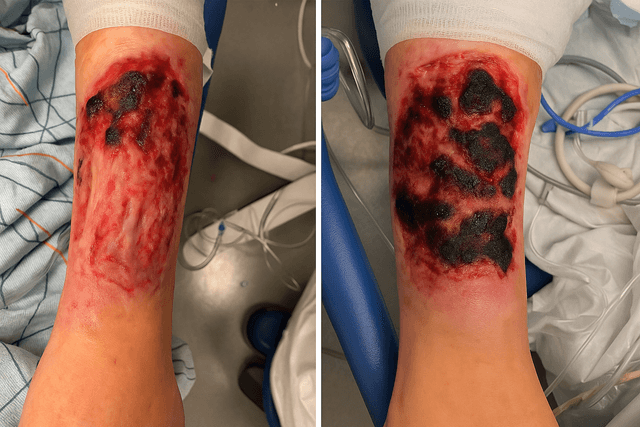
A 2025 multidisciplinary clinical guidance document emphasizes that these wounds are primarily found on the extremities but are not limited to injection sites. They can become chronic, develop eschar or deeper ulceration, and become secondarily infected. [7]
The mechanism is probably multifactorial. It should not be reduced to a simple claim that xylazine wounds occur only because of vasoconstriction.
Another important point is that:
necrotic-appearing tissue does not automatically mean bacterial infection.
Clinical evaluation should distinguish chronic xylazine-associated tissue injury from cellulitis, abscess, osteomyelitis, necrotizing infection, or systemic illness.
Current multidisciplinary guidance emphasizes longitudinal wound care, treatment of substance use disorder, and involvement of wound care, infectious diseases, surgery, or addiction medicine when appropriate. It also cautions against indiscriminate aggressive debridement. [7]
Large, worsening, deeply painful, foul-smelling, infected, or structurally deep wounds—particularly those involving exposed tendon or bone or accompanied by fever or systemic illness—require medical evaluation.
Xylazine withdrawal is increasingly recognized in clinical practice, but the evidence base remains much less developed than it is for opioid withdrawal.
A 2025 systematic review evaluated 34 published studies on xylazine intoxication, overdose, dependence, and withdrawal. The literature consisted largely of case reports, case series, and other limited human evidence. The authors found no established toxic dose, specific antidote, or standardized evidence-based treatment regimen for xylazine withdrawal or overdose. [8]
This means claims such as “xylazine withdrawal is always worse than opioid withdrawal” or that one specific medication regimen is established therapy are not supported.
Medications for opioid use disorder, including buprenorphine or methadone, remain important for coexisting opioid use disorder. They treat opioid dependence; they do not directly antagonize xylazine.
Patients with suspected xylazine dependence may require individualized symptom-directed care and specialist input, particularly when opioid withdrawal, wounds, pain, infection, or psychiatric illness coexist.
Pediatric xylazine exposure remains relatively uncommon in U.S. poison-center data, but a 2026 Clinical Toxicology study provides the clearest description so far of how these exposures differ by age. [9]
Investigators analyzed xylazine-associated exposures reported to America's Poison Centers' National Poison Data System from 2010 through 2024 among patients aged 0–19 years.
They identified 109 reported pediatric exposures:
57 (52.3%) occurred among children aged 0–5 years;
4 (3.7%) occurred among children aged 6–12 years;
48 (44.0%) occurred among adolescents aged 13–19 years. [9]
The distribution was therefore strongly concentrated at the youngest and oldest ends of the pediatric age range.
Most cases occurred during 2022–2024. Reports peaked at 45 in 2023 and fell to 20 in 2024. Although the overall analysis found an increase over the full study period, the authors still characterized pediatric xylazine-associated exposures as relatively uncommon. [9]
This is why the data should not be summarized as “pediatric xylazine poisoning is surging nationwide.”
Among infants and toddlers for whom the exposure reason was known, 49 of 50 exposures (98.0%) were unintentional.
Among those with a known exposure route, ingestion was predominant. [9]
The pattern is consistent with exploratory exposure in the home environment: a young child gaining access to veterinary xylazine, an adulterated opioid, pills, powder, or drug-related material.
That creates a prevention issue as much as a toxicology issue.
For broader household prevention principles, see How to Prevent Poisoning at Home: A Parent's Essential Safety Guide.
The adolescent pattern was different.
Among teenagers with a known exposure reason, misuse or abuse and suspected self-harm represented important categories, while unintentional exposures also occurred. [9]
This should not be simplified into the assumption that every adolescent xylazine exposure reflects recreational drug use.
Clinical assessment should consider polysubstance use, counterfeit or unregulated drug exposure, intentional self-harm, and other co-ingestants according to the individual circumstances.
Of the 109 pediatric cases:
36 (33.0%) were coded as xylazine-only exposures;
73 (67.0%) involved at least one additional substance;
55 (50.5% of all cases) involved fentanyl. [9]
Among xylazine-only exposures, the most commonly reported clinical finding was CNS depression, documented in 15 patients (41.7%). Bradycardia was reported in four (11.1%), and respiratory depression or arrest in two (5.6%). [9]
Among the 55 cases involving both xylazine and fentanyl, CNS depression occurred in 44 patients (80.0%) and respiratory depression or arrest in 38 (69.1%). [9]
Six patients died.
All six deaths occurred in cases involving both xylazine and fentanyl.
These data do not establish that xylazine alone caused those deaths, nor can poison-center reports determine the independent contribution of each substance to a fatal polysubstance exposure.
NPDS is a poison-center surveillance system, not a population-incidence registry.
Cases enter the system because a clinician, caregiver, patient, or other caller reports a known or suspected exposure. Not every exposure is reported. Information may be incomplete, and confirmatory xylazine testing was not available for every case.
More apparent or severe poisonings may also be more likely to generate a poison-center call.
The 109 cases therefore cannot tell us:
the national incidence of pediatric xylazine poisoning;
the true number of U.S. pediatric exposures;
the probability that a child exposed to xylazine will develop a particular outcome;
that xylazine independently caused every clinical finding in a polysubstance exposure.
The clinically useful conclusion is narrower:
Pediatric xylazine exposures reported to U.S. poison centers remain uncommon, but the pattern differs substantially by age, and fentanyl co-exposure is prominent among cases with serious respiratory outcomes.
A suspected overdose is a medical emergency.
When fentanyl or another opioid may be involved, administer naloxone. Do not withhold naloxone simply because xylazine is suspected. [1]
At the same time:
activate emergency medical services;
assess airway, breathing, and circulation;
provide oxygenation and ventilatory support when breathing is inadequate;
follow current resuscitation or emergency-dispatch guidance;
continue monitoring and reassessment after naloxone.
Persistent sedation, bradycardia, hypotension, or respiratory impairment after opioid reversal should prompt evaluation for xylazine and other co-intoxicants.
This article intentionally does not reproduce detailed naloxone titration, infusion, pediatric dosing, intubation thresholds, observation periods, or disposition algorithms. Clinician-level naloxone management belongs in Naloxone in Xylazine, Nitazenes, and Fentanyl Analogue Overdose.
There is currently no approved xylazine-specific reversal agent for humans. Veterinary alpha-2 antagonists should not be improvised as human antidotes without appropriate evidence and regulatory approval. [4]
Because the unregulated drug supply does not come with a reliable ingredient list, visual appearance cannot confirm whether fentanyl, xylazine, medetomidine, or another substance is present.
Risk-reduction strategies include:
carrying naloxone;
ensuring someone can recognize and respond to an overdose;
seeking urgent help when breathing is inadequate;
avoiding assumptions about the contents or potency of an unregulated product;
seeking care early for evolving wounds;
using established community drug-checking services when available. [1]
Xylazine test strips may provide useful harm-reduction information, but their results require context.
A 2025 evaluation compared commercial lateral-flow xylazine test strips from seven vendors. The investigators found meaningful differences between products and documented concentration-dependent false-positive results caused by cross-reactivity with several drugs and adulterants. [10]
Interfering substances varied by strip and included compounds such as lidocaine, levamisole, ketamine, methamphetamine, diphenhydramine, promethazine, and cetirizine. [10]
Therefore:
there is no single preparation volume, dipping time, or result-reading protocol that MedicalToxic should present as universal for every commercial xylazine strip.
Users should follow instructions validated for the specific product or local drug-checking program.
A negative result does not prove that a drug supply is safe, and a positive result can occasionally reflect cross-reactivity rather than xylazine.
The new pediatric poison-center evidence strengthens the prevention message for households in which veterinary xylazine, opioids, illicit drugs, counterfeit pills, powders, or drug-related equipment may be present.
These materials should be stored securely and completely inaccessible to children.
Very young children explore their surroundings by touching and placing objects in their mouths. The predominance of unintentional exposures and ingestion among young-child xylazine cases is therefore clinically plausible and preventable. [9]
Drug-related materials should not be left on floors, countertops, bedside tables, bags, vehicles, or other locations accessible to toddlers.
If a child may have been exposed to an opioid, xylazine, or an unknown drug product and develops unusual sleepiness, abnormal breathing, bradycardia, altered consciousness, or other concerning symptoms, emergency evaluation is warranted.
Yes—against the opioid component. Naloxone can reverse fentanyl or another opioid but does not directly reverse xylazine. Because xylazine commonly co-occurs with opioids, naloxone should still be administered in suspected opioid overdose while breathing and circulation are supported as needed. [1]
Naloxone blocks opioid receptors. Xylazine acts primarily through alpha-2 adrenergic receptors, so xylazine-related sedation, bradycardia, hypotension, or other effects can persist after the opioid component improves. Other sedative co-intoxicants may do the same.
Yes, although reported cases remain relatively uncommon. The 2026 NPDS study identified 109 xylazine-associated exposures among patients aged 0–19 years from 2010 through 2024. More than half involved children aged 0–5, while 44% involved adolescents aged 13–19. [9]
The study cannot establish that. All six deaths occurred in cases involving both xylazine and fentanyl. The independent contribution of each substance cannot be determined from those reports. [9]
No. Xylazine-associated wounds may contain eschar, necrotic tissue, or chronic ulceration without necessarily having bacterial infection. Clinical evaluation should distinguish underlying tissue injury from cellulitis, abscess, osteomyelitis, or other infectious complications. [7]
Fentanyl–xylazine exposure illustrates why modern overdose care increasingly requires a polysubstance approach.
Naloxone remains essential whenever an opioid may be contributing to respiratory depression. Its inability to reverse xylazine should not be mistaken for failure of naloxone; rather, it explains why sedation, bradycardia, hypotension, or other effects may persist after the opioid component improves.
Current drug-supply surveillance also requires careful interpretation. Xylazine has been identified widely across the United States and remained part of DEA's evolving fentanyl-threat messaging in 2026, but seizure percentages are not measures of population exposure or overdose incidence. [2] [3]
The 2026 pediatric poison-center study adds an important new dimension. Reported exposures remained uncommon but clustered in two different age groups: predominantly unintentional exposures among very young children and a different pattern among adolescents that included misuse, self-harm, and other intentional exposure circumstances. Fentanyl was the most common co-exposure, and all six reported deaths occurred when fentanyl and xylazine were both involved. [9]
The practical response remains consistent: recognize possible polysubstance exposure, give naloxone when an opioid may be involved, support airway, breathing, and circulation when necessary, identify persistent non-opioid effects, address xylazine-associated wounds appropriately, and prevent accidental access to drugs and drug-related materials in homes with children.
© All copyright of this material is absolute to Medical toxicology
Dr. Omid Mehrpour (MD, FACMT) is a senior medical toxicologist and physician-scientist with over 15 years of clinical and academic experience in emergency medicine and toxicology. He founded Medical Toxicology LLC in Arizona and created several AI-powered tools designed to advance poisoning diagnosis, clinical decision-making, and public health education. Dr. Mehrpour has authored over 250 peer-reviewed publications and is ranked among the top 2% of scientists worldwide. He serves as an associate editor for several leading toxicology journals and holds multiple U.S. patents for AI-based diagnostic systems in toxicology. His work brings together cutting-edge research, digital innovation, and global health advocacy to transform the future of medical toxicology.
Keep reading
 Substance Abuse and Addiction
Amirhosein Shabrang
 Substance Abuse and Addiction
Omid Mehrpour
 Substance Abuse and Addiction
Omid Mehrpour
 Substance Abuse and Addiction
Omid Mehrpour