70 Suspected Overdoses in Waterloo Region Highlight Complex Fentanyl Mixtures
post on 05 Oct 2026
post on 05 Oct 2026
 Medical Toxicologymedicaltoxic.com
https://medicaltoxic.com/news/waterloo-overdose-alert-fentanyl-medetomidine
70 Suspected Overdoses in Waterloo Region Highlight Complex Fentanyl Mixtures
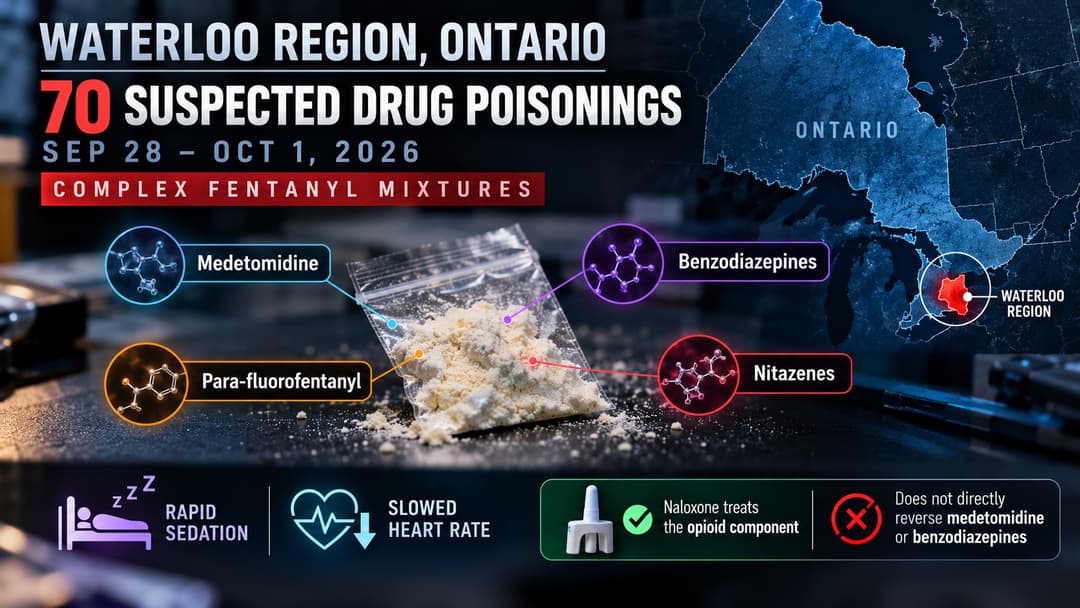
An Ontario community alert reports 70 suspected drug poisonings in four days as local drug checking finds fentanyl mixed with medetomidine, benzodiazepines, para-fluorofentanyl and nitazenes.
Public-health officials in Ontario's Waterloo Region have extended a community drug alert after 70 suspected overdoses or drug poisonings were reported between September 28 and October 1.
The October 2 alert describes episodes of very rapid, heavy sedation and warns that the local unregulated drug supply may contain multiple opioid and non-opioid substances that users did not expect. [1]
The alert extends an earlier warning issued September 18, when Waterloo Region recorded 48 suspected overdoses/drug poisonings and one suspected drug-related death between September 14 and 17. [1]
The toxicology message is broader than any one adulterant:
What a patient believes they used may not predict the toxidrome when the unregulated supply contains several pharmacologically different drugs.
The Region of Waterloo says Sanguen Health Centre's Drug Checking Program identified fentanyl samples containing:
medetomidine and benzodiazepines, both non-opioid sedatives;
para-fluorofentanyl and nitazenes, which are opioids; and
fentanyl described as stronger than expected. [1]
Local officials also identified yellow powdered drugs as a colour of concern.
That should not be interpreted as a chemical identification method. Colour can serve as a local surveillance clue, but it cannot reliably determine which drugs or concentrations are present in a sample.
The extended alert reports very strong sedation developing rapidly after street-drug use, in some cases after a single inhalation, with reports that more naloxone was needed.
It also describes sedation after reported stimulant use, including cocaine and methamphetamine. [1]
The earlier September 18 alert was even more specific: officials reported episodes of unresponsiveness, very slow breathing and pinpoint pupils after reported cocaine use. [1]
For emergency clinicians, that mismatch is important.
A patient reporting cocaine or methamphetamine exposure who instead presents with profound sedation, slowed breathing or pinpoint pupils should prompt consideration of unexpected opioid or sedative co-exposure, rather than assuming the reported stimulant alone explains the presentation.
Waterloo's current warning lists complex overdose presentations involving:
profound sleepiness or difficulty waking;
very low heart rate; and
seizures. [1]
It separately describes severe withdrawal presentations requiring hospital care, including:
repeated vomiting;
chest pain;
fluctuating awareness;
very rapid heart rate; and
very high blood pressure. [1]
The public-health alert does not prove which individual substance caused each manifestation.
But the combination of opioid agonists, benzodiazepines and a potent alpha-2 adrenergic agonist such as medetomidine provides a plausible framework for why some presentations may not resemble a straightforward fentanyl-only overdose.
Medetomidine is a potent alpha-2 adrenergic agonist sedative used in veterinary medicine and increasingly detected in the unregulated fentanyl supply.
CDC describes two clinically important patterns.
During intoxication, medetomidine can produce profound and sometimes prolonged sedation, marked bradycardia and hypotension. [2] [3]
After repeated exposure, abrupt cessation can produce a very different syndrome dominated by sympathetic activation, including tachycardia, severe hypertension, vomiting, chest pain and fluctuating alertness. [3]
That intoxication-versus-withdrawal contrast is clinically important:
sedation + bradycardia may point toward alpha-2 agonist intoxication, while tachycardia + severe hypertension after repeated exposure may indicate withdrawal.
Medetomidine's role should still not be overstated.
A 2026 multicenter Toxicology Investigators Consortium study examined 964 emergency-department patients with opioid and/or stimulant overdose across 17 U.S. medical centers. Medetomidine was detected in 27 cases.
After adjustment, medetomidine exposure was associated with greater odds of bradycardia, but the study did not find significantly greater sedation, hypotension, intubation or naloxone use compared with medetomidine-negative overdoses. [4]
That finding is especially relevant to Waterloo's reports of additional naloxone.
Medetomidine itself should not be invoked to explain a need for more naloxone.
Waterloo's alert makes an important pharmacologic distinction.
Fentanyl, para-fluorofentanyl and nitazenes are opioids and can respond to naloxone.
Medetomidine and benzodiazepines are not opioids, and naloxone does not directly reverse their effects. [1]
CDC gives the same guidance for medetomidine-involved overdose: naloxone should be used to restore breathing when opioid exposure is suspected, but persistent medetomidine sedation may remain even after the opioid-mediated respiratory depression improves. [3]
Therefore, the Waterloo reports that some patients needed more naloxone could reflect the opioid component, opioid dose, potency or duration of the mixture.
They should not be interpreted as evidence that naloxone is treating medetomidine.
Likewise, persistent sleepiness after ventilation improves does not automatically mean that naloxone has “failed.”
For detailed clinical context, see Naloxone in Xylazine, Nitazenes, and Fentanyl Analogue Overdose.
The severe withdrawal pattern in the Waterloo warning also has support from recent human data.
A 2026 multicenter Philadelphia study described 209 hospitalized patients with fentanyl withdrawal complicated by severe sympathetic activation during a period when medetomidine had become a prominent fentanyl adulterant.
The syndrome included marked hypertension, tachycardia, vomiting and agitation or tremor, and many patients required intensive care. Confirmatory testing in a subset identified fentanyl and medetomidine metabolites. [5]
The study supports medetomidine withdrawal as a clinically important phenomenon.
It does not prove that the severe withdrawal cases reported in Waterloo were caused by medetomidine.
This News does not establish a new treatment protocol.
For patients with profound sedation or suspected mixed exposure, the immediate assessment remains focused on:
airway patency and adequacy of ventilation;
oxygenation;
cardiovascular status;
response of respiratory depression to naloxone;
persistent sedation after ventilation improves;
bradycardia or hypotension suggesting a possible alpha-2 agonist component; and
later development of severe hypertension, tachycardia, vomiting, chest pain or fluctuating awareness that may suggest withdrawal.
The Waterloo alert also emphasizes emergency evaluation for deep sedation, very low heart rate, seizures or severe withdrawal symptoms. [1]
For broader context on non-opioid sedatives mixed with fentanyl, see Fentanyl + Xylazine (‘Tranq’): Why Naloxone Alone Isn’t Enough.
Several limitations are essential to interpreting this cluster.
The 70 events are suspected overdoses/drug poisonings, not 70 analytically confirmed cases involving the same drug combination.
The Sanguen drug-checking findings describe substances detected in the local drug supply. The public alert does not establish that each tested sample was directly linked to an individual overdose patient.
No public concentration data are available for every reported exposure.
The cluster therefore does not establish that medetomidine, nitazenes, benzodiazepines or any single contaminant caused the full increase.
Likewise:
the colour of a powder does not reliably establish its contents;
the alert does not establish a national or Canadian incidence trend;
reported stimulant use does not prove that every stimulant sample contained an opioid; and
reports of additional naloxone do not demonstrate that medetomidine caused greater naloxone requirements.
This is local surveillance designed to warn the community about a rapidly changing drug supply—not a controlled epidemiologic attribution study.
Medetomidine, benzodiazepines, nitazenes and fentanyl analogues in the unregulated drug supply are not themselves new discoveries.
What is new is the October Waterloo cluster:
70 suspected poisonings over four days, continued rapid heavy sedation, reports of unexpected opioid-like effects after stimulant use, and local drug checking showing multiple opioid and non-opioid compounds in fentanyl samples. [1]
The event demonstrates why modern overdose assessment increasingly has to follow the observed toxidrome, not just the substance name supplied by the patient or bystander.
Waterloo Region's October 2 alert highlights the clinical consequences of an increasingly unpredictable unregulated drug supply.
Seventy suspected overdoses or drug poisonings were reported between September 28 and October 1, while local drug checking identified fentanyl containing medetomidine, benzodiazepines, para-fluorofentanyl and nitazenes. [1]
The alert does not prove that any one adulterant caused the cluster.
But it reinforces an important bedside principle:
When the reported drug and the toxidrome do not match, trust the physiology enough to investigate unexpected co-exposures.
Naloxone remains essential when opioid-mediated respiratory depression is possible.
It treats the opioid component.
It does not directly reverse medetomidine or benzodiazepines, and persistent sedation after breathing improves should trigger continued supportive assessment rather than automatic interpretation as naloxone failure.
Region of Waterloo. (2026, October 2). Community Drug Alerts.
Centers for Disease Control and Prevention. (2026, April 2). Medetomidine Situation Summary.
Centers for Disease Control and Prevention. (2026, April 2). Medetomidine in the U.S. Illegal Fentanyl Supply Increasing Risk for Overdose and Severe Withdrawal Syndrome. Health Alert Network Advisory CDCHAN-00527.
Stolbach, A., Culbreth, R., Falise, A., et al. (2026). Medetomidine-Involved Overdoses Among Emergency Department Patients: Results From a US Multicenter Sentinel Surveillance Program. Journal of Addiction Medicine. https://doi.org/10.1097/ADM.0000000000001665
London, K. S., Huo, S., Murphy, L., et al. (2026). Severe Fentanyl Withdrawal Associated With Medetomidine Adulteration: A Multicenter Study From Philadelphia, PA. Journal of Addiction Medicine, 20(2), 231–237. https://doi.org/10.1097/ADM.0000000000001560
Keep reading
Substance Abuse and Overdose
25 Sept 2026
Substance Abuse and Overdose
20 Sept 2026
Substance Abuse and Overdose
09 Sept 2026
Substance Abuse and Overdose
05 Aug 2026