Substance Abuse and Addiction
Naloxone in Xylazine, Nitazenes, and Fentanyl Analogue Overdose
Omid Mehrpour
Post on 13 Dec 2025 · Updated 29 Sept 2026 · 7 min read
Omid Mehrpour
Post on 13 Dec 2025 · Updated 29 Sept 2026 · 7 min read
 Medical Toxicologymedicaltoxic.com
https://medicaltoxic.com/blogs/naloxone-in-xylazine-nitazenes-and-fentanyl-analogue-overd
Clinician addendum: effect, duration mismatch, and practical ED dosing (including infusion)
Disclaimer: This educational content is not a substitute for local protocols, clinical judgment, or poison center consultation. For epidemiology, harm reduction, and prehospital step-by-step response in suspected ‘tranq’ exposure, (See: Fentanyl + Xylazine (‘Tranq’): Why Naloxone Alone Isn’t Enough)
Key bedside rules(1,2,3,5)
· Treat the airway first. Ventilate and oxygenate while naloxone is being prepared or while naloxone is being repeated.
· Dose naloxone to ventilation, not to wakefulness.
· If ventilation improves but coma persists, do not reflexively keep escalating naloxone. Consider xylazine or other CNS depressants.
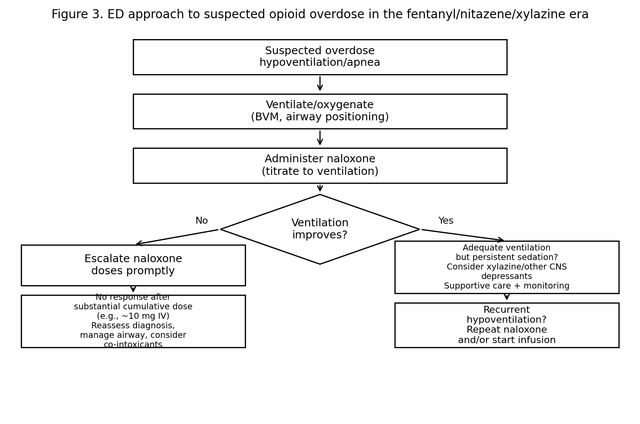
· If repeated boluses are needed to maintain ventilation, start a naloxone infusion rather than chasing recurrent hypoventilation.
· Plan monitoring around a short naloxone duration and longer or uncertain opioid effect (re-narcotization risk).
This post is a clinician addendum focused on naloxone titration, infusion triggers, and monitoring for re-narcotization in the fentanyl/nitazene era. For background epidemiology and practical xylazine (‘tranq’) response guidance, see our dedicated Fentanyl + Xylazine blog, and for the full emerging-threats overview, see the umbrella article. (See: Fentanyl + Xylazine (‘Tranq’): Why Naloxone Alone Isn’t Enough.)
Naloxone is a competitive mu-opioid receptor antagonist that reverses opioid-induced respiratory depression when opioids are the driver of hypoventilation or apnea(1,2).
In practice, naloxone endpoints should be adequate ventilation, not full arousal; persistent coma after ventilation improves should prompt evaluation for co-intoxicants and supportive care rather than endless naloxone escalation.3,5 (See: Fentanyl + Xylazine (‘Tranq’): Why Naloxone Alone Isn’t Enough).
Naloxone is fast-on and short-acting. Its clinical effect can wane while opioid effects persist, creating a predictable risk of recurrent respiratory depression(1,4)
For clinicians, the practical question is not 'how long does naloxone last' in isolation, but 'how long does clinically meaningful opioid effect persist relative to naloxone' in this patient(1,2).
Some fentanyl analogues may produce a longer-than-expected course in individual cases, reinforcing that “naloxone duration” is only meaningful relative to the patient’s ongoing opioid effect and ventilatory requirement.
Figure 1. Conceptual mismatch: opioid effect can outlast naloxone (risk window for re-narcotization).

Public health guidance explicitly notes that more than one dose of naloxone may be required when stronger opioids like fentanyl are involved.3
In practice, repeated boluses are often necessary because of high potency, unpredictable dose and route, delayed absorption from counterfeit pills, and common co-intoxicants. The endpoint remains restoration of ventilation, not full awakening(2,3).
Clinical discussion from a pharmacist–physician team described a carfentanil case with an estimated terminal half-life ~5.7 hours and a prolonged course requiring ~31 hours of ventilatory support before spontaneous breathing reliably returned (clinician-reported experience).
The key bedside implications are:
Expect recurrent or prolonged respiratory depression despite initial reversal.
Some fentalogs may be less “reversible-looking” because of high μ-receptor affinity: prioritize airway/ventilation and use naloxone as needed to maintain ventilation.
Have a low threshold for naloxone infusion (and ICU-level monitoring) when repeated boluses are required to maintain ventilation.
Nitazene presentations may require higher cumulative naloxone dosing and earlier infusion readiness than typical fentanyl-only cases, even when initial reversal occurs(6,7,8)
U.S. surveillance and ED cohort data suggest higher in-hospital naloxone requirements compared with fentanyl-only cases, and multiple doses may be needed because of potency(6,7).
In published clinical experience, some patients required prolonged naloxone infusions because opioid effects persisted beyond the initial reversal, reinforcing the need for longer monitoring and infusion readiness(8,9).
In suspected fentanyl–xylazine exposure, titrate naloxone to restore ventilation but avoid escalating solely to achieve arousal(5,10).
If ventilation improves yet profound sedation or hemodynamic instability persists, shift to supportive care and monitoring rather than repeatedly escalating naloxone; detailed xylazine clinical management is covered in our Fentanyl + Xylazine post(3,5).

Note: Table summarizes expected response patterns described in CDC clinical materials and published nitazene cohorts(3,5,6,8,9)
Bolus strategy: In suspected opioid-dependent patients, many references recommend starting with small IV increments (e.g., 0.04-0.4 mg) and titrating every 1-3 minutes to reverse respiratory depression while minimizing severe withdrawal.2
Escalate quickly in apneic patients. If there is no meaningful response after a substantial cumulative dose (often cited around 10 mg IV in multiple clinical references), reassess the diagnosis and consider major co-intoxicants or non-toxicologic causes while managing the airway.2
Infusion trigger: If repeated boluses are required to maintain ventilation, transition to a continuous naloxone infusion rather than chasing recurrent hypoventilation(1,2).
One commonly cited approach is to start the infusion at two-thirds of the initial effective (wake-up) dose per hour, with additional boluses if respiratory depression recurs.1
· Patient required a total of 2 mg IV naloxone in divided doses to maintain ventilation.
· Start infusion at ~2/3 of the effective dose per hour (~1.3 mg/hour) and titrate to respiratory endpoints.
· Continue close monitoring; give additional bolus naloxone and increase the infusion rate if hypoventilation returns.
Because naloxone is short-acting, ongoing monitoring is recommended after reversal, especially when long-acting opioids or potent synthetics are suspected(1,2).
A practical concern raised in clinician discussions is that many hospital opioid immunoassays primarily detect morphine-class opioids (e.g., morphine/codeine) and may miss fentanyl and fentanyl analogues (including carfentanil). Nitazenes also frequently require specialized testing. Therefore:
Do not let a negative screen override an opioid toxidrome or naloxone-responsive ventilation pattern.
If confirmation matters (public health reporting, unusual course, ICU planning), ask the lab about fentanyl-specific assays or confirmatory testing (e.g., mass spectrometry, where available).
Manage based on clinical trajectory and ventilatory requirement, not the tox screen.
StatPearls guidance suggests observation on the order of hours for patients who fully reverse and remain stable, and longer monitoring (and often admission) when larger IV doses are required, an infusion is needed, or longer-acting opioids are possible(1,2).
With suspected nitazenes or fentanyl analogues, published cohorts reinforce that higher naloxone requirements and persistence of opioid effect can occur, supporting a low threshold for prolonged observation and infusion-based management(6,8,9).
With suspected xylazine co-exposure, persistent sedation and hemodynamic effects may outlast naloxone; disposition should be based on airway protection, ventilation, and stability rather than level of arousal alone(5,10).
· Naloxone works on opioids (including nitazenes and fentanyl analogues) but is short-acting(1,2,6).
· Dose naloxone to ventilation. Full awakening is not the endpoint.2
· More than one dose may be required with fentanyl-class exposures.3
· If ventilation improves but coma persists, shift to supportive care and evaluate co-intoxicants; (See: Fentanyl + Xylazine (‘Tranq’): Why Naloxone Alone Isn’t Enough) for the xylazine-pattern specifics(5,10).
· If repeated boluses are required, start an infusion. Monitor for re-narcotization after any reversal(1,4).
© All copyright of this material is absolute to Medical toxicology
Dr. Omid Mehrpour (MD, FACMT) is a senior medical toxicologist and physician-scientist with over 15 years of clinical and academic experience in emergency medicine and toxicology. He founded Medical Toxicology LLC in Arizona and created several AI-powered tools designed to advance poisoning diagnosis, clinical decision-making, and public health education. Dr. Mehrpour has authored over 250 peer-reviewed publications and is ranked among the top 2% of scientists worldwide. He serves as an associate editor for several leading toxicology journals and holds multiple U.S. patents for AI-based diagnostic systems in toxicology. His work brings together cutting-edge research, digital innovation, and global health advocacy to transform the future of medical toxicology.
1. Jordan MR, Patel P, Morrisonponce D. Naloxone. In: StatPearls [Internet]. Treasure Island (FL): StatPearls Publishing; 2025 Jan-. Last update: May 5, 2024. Available from: https://www.ncbi.nlm.nih.gov/books/NBK441910/
2. Regina AC, Goyal A, Mechanic OJ. Opioid Toxicity. In: StatPearls [Internet]. Treasure Island (FL): StatPearls Publishing; 2025 Jan-. Last update: January 22, 2025. Available from: https://www.ncbi.nlm.nih.gov/books/NBK470415/
3. Centers for Disease Control and Prevention. Lifesaving Naloxone. Updated June 11, 2025. Available from: https://www.cdc.gov/stop-overdose/caring/naloxone.html
4. Clarke SFJ, Dargan PI, Jones AL. Naloxone in opioid poisoning: walking the tightrope. Emerg Med J. 2005;22(9):612-616. doi:10.1136/emj.2003.009613. Available from: https://pubmed.ncbi.nlm.nih.gov/16113176/
5. Centers for Disease Control and Prevention. Xylazine: Clinical Management and Harm Reduction Strategies for Patients. (Clinician fact sheet PDF). 2024. Available from: https://www.cdc.gov/overdose-prevention/media/pdfs/2024/07/Xylazine-Clinical-Management-and-Harm-Reduction.pdf
6. Amaducci A, Aldy K, Campleman SL, et al; Toxicology Investigators Consortium (ToxIC) Fentalog Study Group. Naloxone Use in Novel Potent Opioid and Fentanyl Overdoses in Emergency Department Patients. JAMA Netw Open. 2023;6(8):e2331264. doi:10.1001/jamanetworkopen.2023.31264. Available from: https://jamanetwork.com/journals/jamanetworkopen/fullarticle/2808868
7. Roberts A, Korona-Bailey J, Mukhopadhyay S. Notes from the Field: Nitazene-Related Deaths - Tennessee, 2019-2021. MMWR Morb Mortal Wkly Rep. 2022;71(37):1196-1197. doi:10.15585/mmwr.mm7137a5. Available from: https://www.cdc.gov/mmwr/volumes/71/wr/mm7137a5.htm
8. Pereira JRP, Quintas A, Neng NR. Nitazenes: The Emergence of a Potent Synthetic Opioid Threat. Molecules. 2025;30(19):3890. doi:10.3390/molecules30193890. Available from: https://pubmed.ncbi.nlm.nih.gov/41097311/
9. Stangeland M, Dale O, Skulberg AK. Nitazenes: review of comparative pharmacology and antagonist action. Clin Toxicol (Phila). 2025. doi:10.1080/15563650.2025.2504133. Available from: https://pubmed.ncbi.nlm.nih.gov/40422647/
10. Centers for Disease Control and Prevention. What You Should Know About Xylazine. Updated May 16, 2024. Available from: https://www.cdc.gov/overdose-prevention/about/what-you-should-know-about-xylazine.html
11. Roberts DM, Tisdell B, Sajeev MF, et al. Clinical Experiences With the Nitazene Class of Synthetic Opioids: A Cohort Study. Ann Emerg Med. 2025;86(5):475-483. doi:10.1016/j.annemergmed.2025.06.619. Available from: https://pubmed.ncbi.nlm.nih.gov/40810707/
Keep reading
 Substance Abuse and Addiction
Amirhosein Shabrang
 Substance Abuse and Addiction
Omid Mehrpour
 Substance Abuse and Addiction
Omid Mehrpour
 Substance Abuse and Addiction
Omid Mehrpour