NSW Health Warns of High-Dose MDMA Drug Mixtures
post on 24 Nov 2026
post on 24 Nov 2026
 Medical Toxicologymedicaltoxic.com
https://medicaltoxic.com/news/nsw-high-dose-mdma-packets-warning
NSW Health Warns of High-Dose MDMA Drug Mixtures
Laboratory testing in New South Wales found unusually high MDMA content in sealed packets containing unpredictable combinations of other psychoactive drugs, raising concerns about severe mixed-drug toxicity.
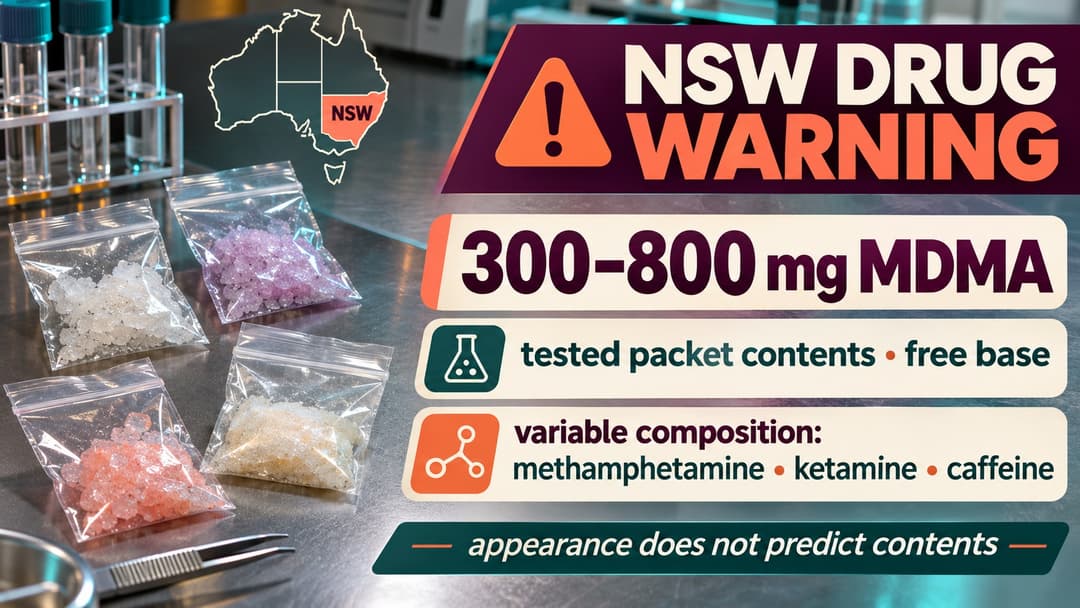
Health authorities in New South Wales, Australia, have issued a public drug warning after laboratory analysis identified sealed packets containing unusually large amounts of MDMA (3,4-methylenedioxymethamphetamine), alongside variable combinations of methamphetamine, ketamine and caffeine.
The analytical warning was issued on November 20, 2026. NSW Health reported that tested packets contained 300–800 mg of MDMA, expressed as MDMA free base, with substantial differences in composition between samples. [1]
A separate media release on November 21 reinforced the warning ahead of upcoming music festivals. Authorities highlighted the potential for severe stimulant toxicity and unpredictable effects from mixed-drug exposure. [2]
The findings represent a laboratory-confirmed product-safety signal, not a documented outbreak of clinical poisoning.
The NSW Health investigation identified two related concerns: unusually high MDMA content and inconsistent chemical composition.
Analytical finding | Reported result |
|---|---|
MDMA content | 300–800 mg per tested packet, expressed as free base |
Additional substances | Methamphetamine, ketamine and caffeine |
Chemical composition | Different combinations across tested samples |
Physical presentation | Small, sealed packets containing crystalline material |
Clinical outcomes | Not reported for these specific packets in the warning |
NSW Health cautions that packets may circulate under the name “happy water.” Their physical appearance does not reliably establish their chemical contents. [1]
The reported MDMA quantities describe the contents of tested packets. They do not establish how much any individual consumed, the absorbed dose or a validated threshold for clinical toxicity.
The warning also does not establish that every packet contains all four substances or that products sold under the same name have identical formulations.
MDMA has both sympathomimetic and serotonergic effects. Acute toxicity can involve cardiovascular, neurological and thermoregulatory disturbances.
Recognized manifestations include tachycardia, hypertension, agitation, excessive sweating and hyperthermia. Severe intoxication may involve seizures, cardiac dysrhythmias, rhabdomyolysis, electrolyte abnormalities and organ dysfunction. [3]
Elevated body temperature is particularly concerning because severe hyperthermia can contribute to systemic complications. Physical exertion and hot environments, including crowded music festivals, may further increase the risk of heat-related harm.
These are established toxicological hazards of MDMA exposure. They are not confirmed clinical outcomes from the packets identified in the November NSW warning.
The presence of methamphetamine and caffeine creates a further medication- and drug-safety concern.
When multiple stimulants are present, overlapping pharmacological effects may increase cardiovascular and thermoregulatory stress. NSW Health specifically warns that combining MDMA with other stimulant substances can increase the likelihood of serious harm. [2]
The analytical findings do not establish the magnitude of any such interaction in individual patients. Actual effects depend on the substances present, their quantities, other exposures and individual susceptibility.
The central problem is that neither consumers nor clinicians can reliably reconstruct the chemical exposure from a product name or its packaging.
Ketamine differs pharmacologically from MDMA, methamphetamine and caffeine.
As a dissociative anesthetic, ketamine can alter perception, consciousness and coordination. Acute toxicity may include confusion, agitation, impaired responsiveness and cardiovascular disturbances. [4]
Its presence in selected samples raises the possibility of a mixed clinical presentation rather than an isolated stimulant toxidrome.
For example, altered consciousness in a person reporting MDMA use may reflect more than one pharmacologically active substance. However, the NSW Health warning provides no patient-level evidence showing how often such presentations have occurred with these packets.
The analytical results support awareness of possible mixed-drug toxicity, not a packet-specific clinical syndrome.
MDMA's serotonergic activity makes serotonin toxicity an important consideration in symptomatic patients, particularly when other serotonergic exposures are involved.
Agitation, autonomic instability, hyperthermia and neuromuscular abnormalities may occur in clinically significant serotonin toxicity. However, stimulant intoxication and serotonin toxicity can overlap, and hyperthermia alone does not establish the diagnosis. [3]
MedicalToxic's existing clinical resource, Serotonin Syndrome (Serotonin Toxicity): Symptoms, Diagnosis, Drug Interactions, and Treatment, explains the diagnostic importance of findings such as clonus and hyperreflexia.
The new NSW warning does not document confirmed serotonin toxicity cases associated with the tested packets or establish a new treatment protocol.
NSW Health advises people to seek immediate medical assistance if concerning symptoms develop after drug use. Warning signs include:
Severe overheating or excessive sweating.
Rapid heartbeat or faintness.
Muscle rigidity, involuntary movements or seizures.
Vomiting, confusion or severe agitation.
Reduced responsiveness or unconsciousness.
In Australia, suspected overdose or severe symptoms warrant an emergency call to Triple Zero (000). NSW Health emphasizes that people should not delay seeking medical care because of concerns about drug use. [1]
The NSW Poisons Information Centre (13 11 26) provides information about adverse drug effects. Confidential alcohol and drug support is available through the Alcohol and Drug Information Service (1800 250 015).
The November 21 media release also highlights drug-checking services and onsite medical support available at participating music festivals. [2]
The Australian alert follows other international drug-checking investigations demonstrating that products marketed as MDMA may contain unexpected substances.
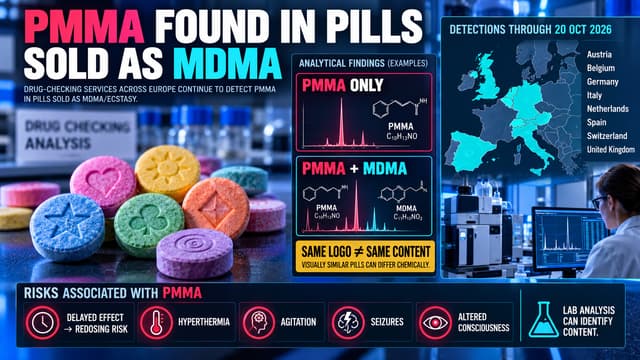
MedicalToxic previously reported a separate European warning in PMMA Still Found in Ecstasy Pills Across Eight Countries, which concerned laboratory detections of paramethoxymethamphetamine (PMMA) in products sold as ecstasy.
The two events have a shared public-health implication: marketed drug identity does not reliably predict chemical composition.
However, their analytical findings are different. The November NSW warning concerns high MDMA content and variable combinations involving methamphetamine, ketamine and caffeine. It does not report PMMA detection.
There is no established connection between the Australian packets and the European samples.
NSW Health had previously warned about high-strength MDMA tablets and capsules.
The November 20 alert adds evidence involving a different product presentation: sealed packets of crystalline material with high measured MDMA content and inconsistent mixtures of psychoactive substances. [2]
The clinically important development is not simply the detection of high amounts of MDMA. It is the combination of uncertain strength and exposure to additional substances with distinct pharmacological effects.
This reinforces the value of drug-checking surveillance for identifying emerging hazards before their full clinical impact is known.
The publicly available NSW Health warning does not establish:
How widespread the implicated packets are across the unregulated drug market.
The amount consumed or absorbed by any individual.
A representative distribution of ingredient concentrations across circulating products.
Confirmed hospitalizations, deaths or poisoning cases attributable to the tested packets.
A clinical risk estimate for any particular packet.
The reported analytical quantities must not be interpreted as recommended consumption amounts or universal toxic-dose thresholds.
The findings are specific to samples investigated in New South Wales and cannot establish the prevalence of similar products elsewhere in Australia or internationally.
NSW Health's November 20–21, 2026 warning provides laboratory evidence of a potentially serious emerging drug-supply hazard: sealed packets containing high amounts of MDMA and variable combinations of methamphetamine, ketamine and caffeine.
The principal toxicological concerns include hyperthermia, cardiovascular toxicity, neurological disturbances and unpredictable mixed-drug effects.
No specific clinical poisoning or death has been established in the reviewed warning as attributable to these packets.
For clinicians and public-health professionals, the key message is that the appearance, packaging and reported name of an unregulated drug cannot reliably establish its strength or chemical composition.
NSW Health. (2026, November 20). Small, sealed packets containing very high doses of MDMA (ecstasy) mixed with methamphetamine and ketamine found in NSW. Public drug warning.
NSW Health. (2026, November 21). Warning: Novel high-dose MDMA (ecstasy) packets circulating in NSW. Media release.
Figurasin, R., Lee, V. R., & Maguire, N. J. (2024). 3,4-Methylenedioxymethamphetamine (MDMA) Toxicity. In StatPearls. StatPearls Publishing.
Orhurhu, V. J., Vashisht, R., Claus, L. E., & Cohen, S. P. (2023). Ketamine Toxicity. In StatPearls. StatPearls Publishing.
Keep reading
Substance Abuse and Overdose
15 Nov 2026
Substance Abuse and Overdose
07 Nov 2026
Substance Abuse and Overdose
26 Oct 2026
Substance Abuse and Overdose
25 Oct 2026