Toxic Agents and Antidotes
2,4-Dinitrophenol (DNP) Poisoning: Mechanism, Hyperthermia, Diagnosis, and Treatment
Amirhosein Shabrang
Post on 07 Sept 2026 · Updated 01 Oct 2026 · 20 min read

Amirhosein Shabrang
Post on 07 Sept 2026 · Updated 01 Oct 2026 · 20 min read
 Medical Toxicologymedicaltoxic.com
https://medicaltoxic.com/blogs/dnp-poisoning
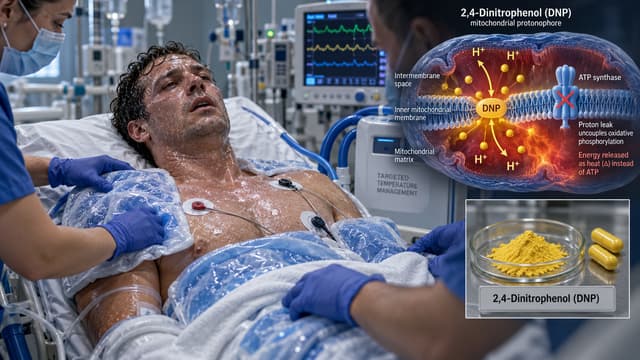
2,4-Dinitrophenol (DNP) poisoning is a rare but potentially catastrophic toxicologic emergency caused by mitochondrial uncoupling.
Unlike poisons that primarily affect one receptor or organ system, DNP disrupts cellular energy metabolism itself. Oxidative metabolism continues, but ATP generation becomes increasingly inefficient and more of the energy released from fuel oxidation is dissipated as heat. Oxygen consumption, carbon-dioxide production, and metabolic demand can rise dramatically. [1]
The result can be a rapidly escalating hypermetabolic syndrome characterized by profuse diaphoresis, tachycardia, tachypnea, hyperthermia, metabolic derangement, cardiovascular instability, and ultimately multiorgan failure.
There is no established specific antidote that reliably reverses DNP-mediated mitochondrial uncoupling. [1] Early recognition, active temperature control, and coordinated critical-care support therefore remain central to management.
DNP is a mitochondrial protonophore and uncoupler of oxidative phosphorylation.
It does not instantly stop ATP production. Instead, mitochondrial respiration becomes progressively less efficient at generating ATP while more energy is released as heat.
Characteristic toxicity includes profuse sweating, tachycardia, tachypnea, hyperthermia, agitation or altered mental status, and metabolic abnormalities.
Severe poisoning can deteriorate rapidly, but no single onset or progression timeline applies to every exposure.
Diagnosis is usually clinical during the emergency phase. Routine toxicology screens do not identify DNP.
Specialized analytical testing can confirm exposure but should not delay treatment of severe hyperthermia or metabolic deterioration.
No specific DNP antidote is established.
Active cooling, respiratory and circulatory support, seizure treatment, and management of metabolic and electrolyte abnormalities form the core of care.
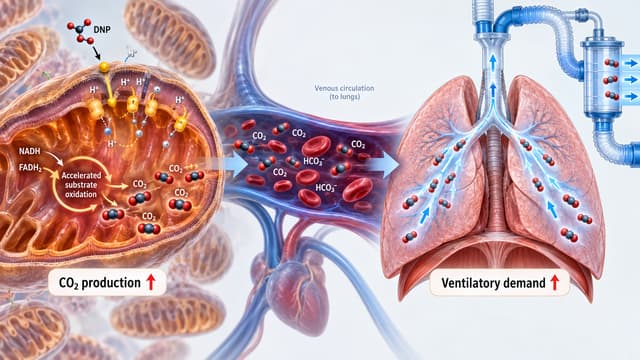
Severe DNP poisoning can generate unusually high CO₂ production and ventilatory demand, but published ventilation strategies are based largely on individual cases rather than validated protocols.
Dantrolene remains unproven and should not delay established supportive care.
Conventional dialysis is not established as a reliable method of DNP clearance. Resin hemoperfusion has only limited observational evidence.
No DNP-specific evidence supports a rigid activated-charcoal protocol.
A single “safe dose” or universally lethal dose should not be used for individual risk prediction.
DNP is an industrial chemical with a long toxicologic history. Its ability to raise metabolic rate led to its use as a weight-loss agent in the 1930s, but severe adverse effects and deaths demonstrated a dangerously narrow margin between the intended metabolic effect and serious toxicity. Medical use was subsequently abandoned. [2]
DNP later re-emerged through illicit and unregulated markets, particularly as a so-called “fat burner” used for weight loss or bodybuilding. Modern exposures have involved powders, capsules, tablets, and products obtained online. [3]
In the United States, FDA states that DNP is not approved for any use. [12]
The durable clinical issue is not its history, but the fact that DNP remains accessible enough for severe poisoning to continue occurring despite decades of recognition of its toxicity.
Normally, mitochondria convert energy from nutrients into ATP through oxidative phosphorylation. Electron transport establishes a proton gradient across the inner mitochondrial membrane, and ATP synthase uses the return of those protons to capture that energy as ATP.
DNP disrupts this coupling.
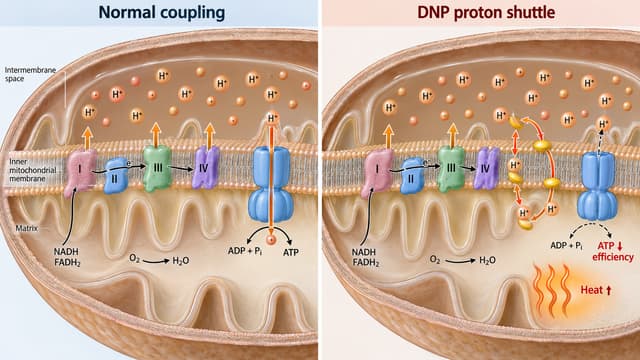
DNP is a lipophilic weak acid capable of transporting protons across the inner mitochondrial membrane. Protons can therefore bypass the normal ATP-synthase pathway, allowing part of the electrochemical gradient to dissipate without efficiently producing ATP.
The respiratory chain can continue consuming oxygen and oxidizing fuel, but a smaller proportion of that energy is captured as usable ATP. [1]
More energy is instead released as heat.
Cells still require ATP. As ATP generation becomes less efficient, metabolism accelerates in an attempt to compensate. Oxygen consumption, carbon-dioxide production, substrate oxidation, and glycolysis may all increase, while heat production continues to rise.
This is why severe DNP poisoning is better understood as a hypermetabolic mitochondrial crisis than as a conventional stimulant overdose.
A common simplification is that DNP simply “stops ATP production.”
That is too absolute.
DNP uncouples mitochondrial respiration from efficient ATP synthesis. ATP production becomes increasingly inefficient, and profound cellular energy failure can eventually develop in severe poisoning, but the defining process is not an instantaneous complete cessation of ATP generation. [1]
Hyperthermia is not merely another symptom of DNP poisoning. It follows directly from the mechanism.
The body continues oxidizing fuel while capturing less of its energy as ATP. More energy is released as heat, while compensatory metabolism further increases energy turnover. Heat production can eventually exceed the body's ability to dissipate it.
This also explains an important bedside paradox: profuse sweating does not mean temperature control is succeeding. A patient can be drenched in sweat and still become critically hyperthermic.
A 2026 report combined detailed clinical observations with mitochondrial measurements from two patients with DNP poisoning. One patient developed catastrophic hyperthermia, respiratory acidosis, hyperkalemia, rigidity, and cardiovascular collapse, while the second developed substantial but reversible hypermetabolism. [4]
The investigators proposed that extreme mitochondrial CO₂ production and local acidosis might increase mitochondrial DNP uptake and further accelerate uncoupling—a potential self-reinforcing process they termed “runaway uncoupling.”
This is an important contemporary hypothesis, but it arises from two deeply characterized cases. It should not yet be treated as a universally established mechanism of every DNP poisoning.
Human DNP literature consistently describes a hypermetabolic pattern dominated by hyperthermia, diaphoresis, tachycardia, and tachypnea. More severe poisoning may progress to metabolic disturbance, neurological deterioration, cardiovascular instability, and organ failure. [2]
Clinical course | Findings that may occur |
|---|---|
Early / evolving toxicity | Profuse sweating, feeling intensely hot, tachycardia, tachypnea, nausea or vomiting, agitation |
Progressive toxicity | Marked hyperthermia, increasing ventilatory demand, altered mental status, metabolic acidosis, electrolyte abnormalities, hemodynamic instability |
Severe toxicity | Seizures, muscle rigidity, rhabdomyolysis, severe electrolyte disturbance, shock, renal or hepatic injury, multiorgan dysfunction, cardiovascular collapse |
This table is a clinical orientation framework, not a validated staging system. Individual patients may not follow a linear progression and may not develop every manifestation.
There is no single reliable time-to-deterioration.
Some severe poisonings have progressed within hours, while others have produced prolonged hypermetabolic effects. In the 2026 Swedish report, the fatal patient deteriorated rapidly, whereas the surviving patient experienced sustained but reversible metabolic abnormalities over a considerably longer course. [4]
A separate 2026 case report described survival after a deliberate severe overdose following coordinated intensive care that included early cooling and unusually high mechanical-ventilation requirements. [5]
These cases illustrate the potential range of DNP toxicity. They do not establish a universal onset time, observation interval, or management protocol.
In severe acute poisoning, DNP is primarily a clinical diagnosis during the emergency phase.
A patient developing dangerous hyperthermia and a compatible hypermetabolic syndrome should not wait for specialized laboratory confirmation before supportive treatment begins.
Ask specifically about weight-loss products, “fat burners,” bodybuilding products, powders or capsules purchased online, substances obtained outside routine pharmacy channels, occupational chemicals, and deliberate self-poisoning.
The patient may know only a product name rather than the chemical contents.
That distinction matters because hidden DNP has been documented in commercially marketed weight-loss products.
Suspicion should increase when a plausible exposure is accompanied by a combination of:
rising core temperature;
marked diaphoresis;
persistent tachycardia;
disproportionate tachypnea;
escalating metabolic demand;
worsening acid-base disturbance;
cardiovascular instability.
No single feature confirms the diagnosis. The combination of exposure history and physiology is more useful.
Laboratory testing helps assess severity and detect complications rather than providing one diagnostic signature.
Depending on clinical severity, evaluation may include:
serial core temperature;
arterial or venous blood gas;
electrolytes;
glucose;
lactate;
renal function;
creatine kinase;
hepatic tests;
calcium, magnesium, and phosphate where indicated;
coagulation testing in severe hyperthermia or organ dysfunction;
ECG;
urine output.
Serial measurements are particularly important because severe metabolic abnormalities can evolve rapidly.
Severe DNP toxicity can create exceptionally high metabolic and respiratory demands. Acidemia may reflect increased metabolic activity, lactate generation, tissue hypoperfusion, evolving organ dysfunction, or failure of ventilation to match excessive CO₂ production.
The recent “runaway uncoupling” work raises the possibility that acidosis itself could interact with DNP distribution in severe poisoning. [4]
That remains hypothesis-generating evidence. It does not establish a DNP-specific bicarbonate threshold, pH target, or ventilation algorithm.
Yes, but not with a routine emergency toxicology screen.
Specialized chromatographic and mass-spectrometric methods can identify DNP and its metabolites in biological specimens. A 2026 investigation developed and validated an LC-MS/MS method for DNP and its metabolites in plasma and urine. [7]
Such testing may be useful for exposure confirmation, forensic investigation, or difficult diagnostic cases. Its limitation is availability and turnaround time.
Confirmatory testing should never delay treatment of dangerous hyperthermia or physiological deterioration.
DNP poisoning overlaps with several hyperthermic and hypermetabolic emergencies.
Both conditions can produce agitation, diaphoresis, tachycardia, tachypnea, hyperthermia, and metabolic abnormalities. DNP differs because mitochondrial uncoupling rather than adrenergic receptor stimulation drives the core toxicology.
Serotonin toxicity can also produce severe hyperthermia and autonomic activation. Clonus and hyperreflexia strongly favor serotonin toxicity.
For the complete diagnostic framework, see Serotonin Syndrome (Serotonin Toxicity): Symptoms, Diagnosis, Drug Interactions, and Treatment.
Salicylates also disrupt mitochondrial energy metabolism and can cause tachypnea, hyperthermia, and complex acid-base abnormalities. Tinnitus, characteristic acid-base patterns, serum salicylate measurement, and the broader salicylate toxidrome help distinguish the diagnosis.
For detailed management, see Salicylate (Aspirin) Toxicity: Clinical Manifestations, Evaluation, and Management—Evidence-Based Guideline.
Malignant hyperthermia usually occurs in a characteristic anesthetic-trigger context and has a different primary mechanism.
Dantrolene is established treatment for malignant hyperthermia. That evidence should not automatically be transferred to DNP poisoning.
Neuroleptic malignant syndrome, thyroid storm, severe sepsis, environmental heat illness, and other causes of hyperthermia should be considered when the exposure history or examination is uncertain.
Severe suspected DNP poisoning requires urgent toxicologic and critical-care management.
Because no established antidote can reliably reverse uncoupling, treatment focuses on controlling dangerous hyperthermia and supporting organ function while the toxic effect persists.
Early consultation with a medical toxicologist or poison center is appropriate for significant suspected exposures.
Current mechanistic and clinical literature does not identify a specific therapy capable of reliably reversing DNP-mediated mitochondrial uncoupling. [1]
The core treatment framework therefore consists of:
preventing further exposure;
controlling dangerous hyperthermia;
supporting ventilation and oxygenation when needed;
maintaining circulation;
treating seizures;
identifying and correcting dangerous electrolyte or metabolic abnormalities;
treating evolving organ injury.
In DNP poisoning, supportive care is active definitive treatment, not passive observation.
Dangerous hyperthermia should be treated promptly.
Contemporary DNP case literature repeatedly describes active cooling as a central component of critical care. [4] [5]
Broader 2025 resuscitation guidance for life-threatening hyperthermia also supports initiating active cooling alongside standard resuscitation. [6]
That broader guidance is not DNP-specific. It should therefore support the principle of rapid active cooling, not be used to invent DNP-specific temperature thresholds, device mandates, or cooling-rate targets.
The practical clinical message is:
when DNP is producing dangerous hyperthermia, effective active cooling should begin promptly while resuscitation continues.
Cooling strategy should reflect severity, hemodynamic status, available resources, and the clinical environment.
Intubation should follow physiological need rather than the diagnosis alone.
Potential indications include loss of airway protection, seizures, severe altered mental status, respiratory failure, exhaustion, or inability to sustain the extraordinary ventilatory demand created by severe hypermetabolism.
DNP presents a particular challenge after intubation because CO₂ production may be extremely high.
The 2026 Australian survivor report described high-volume mechanical ventilation as part of successful management, and the Swedish cases also documented substantial ventilatory demand. [4] [5]
These observations are clinically valuable but remain case-level evidence.
If invasive ventilation is required, clinicians should follow serial blood gases, PaCO₂, acid-base trajectory, actual minute-ventilation requirements, and lung mechanics rather than copying ventilator settings from an individual survivor.
Profuse sweating, hyperthermia, vasodilation, vomiting, and critical illness can produce significant volume and electrolyte disturbances.
Fluid therapy should therefore be individualized according to perfusion, volume status, blood pressure, urine output, renal function, and ongoing losses. No validated DNP-specific fluid target exists.
Electrolytes may change rapidly in severe toxicity. Potassium deserves particular attention during escalating hyperthermia, acidosis, rhabdomyolysis, or renal injury. Severe hyperkalemia was documented during catastrophic toxicity in the 2026 Swedish report. [4]
Persistent shock should be managed according to standard critical-care principles. Current evidence does not establish a preferred DNP-specific vasopressor.
Seizures have been reported in severe poisoning.
Active seizures should be treated promptly according to standard toxicologic and critical-care practice while clinicians simultaneously address hyperthermia, glucose abnormalities, electrolyte disturbances, ventilation, oxygenation, and other reversible contributors.
Anticonvulsant therapy does not reverse the underlying mitochondrial uncoupling.
Dantrolene is often discussed because DNP poisoning can resemble malignant hyperthermia. The mechanistic similarity, however, is incomplete.
Dantrolene reduces calcium release from skeletal-muscle ryanodine receptors and is established treatment for malignant hyperthermia. DNP's primary heat-generating process is mitochondrial uncoupling.
Published human experience with dantrolene in DNP poisoning is inconsistent.
A 2018 fatal case demonstrated continued temperature escalation despite invasive cooling and dantrolene, leading the authors to question the mechanistic rationale for routine use. [8]
A 2019 report described two DNP poisonings treated with dantrolene. Hyperthermia improved in both patients, but one survived and one died. [9]
These reports are insufficient to establish efficacy.
Dantrolene should therefore not be described as a DNP antidote or standard therapy.
If clinicians consider it during catastrophic hyperthermia, that decision should involve expert toxicology and critical-care input. Most importantly, dantrolene should never delay active cooling, ventilatory support, or circulatory resuscitation.
Extracorporeal therapy requires equally careful interpretation.
A patient may receive dialysis or continuous renal replacement therapy and survive. That does not prove the intervention removed DNP effectively.
Renal replacement therapy may be needed for conventional critical-care indications such as severe electrolyte abnormalities, refractory metabolic derangement, acute kidney injury, or fluid-management problems.
Current evidence does not establish conventional dialysis or CRRT as a reliably effective DNP-clearance strategy.
Its role should therefore be considered primarily supportive unless clinically important toxin removal has been demonstrated.
A 2015 observational study examined 16 patients with occupational DNP poisoning and measured serial plasma DNP concentrations. Among the 14 survivors, more intensive resin hemoperfusion was associated with faster decline in measured plasma DNP concentrations. [10]
The evidence is limited by the small sample, nonrandomized treatment allocation, occupational exposure setting, differences between treatment groups, and absence of evidence establishing a survival advantage.
Accordingly, resin hemoperfusion remains a limited-evidence, nonstandard strategy, not established routine therapy for acute oral DNP poisoning.
DNP-specific evidence for activated charcoal is insufficient to justify a rigid protocol.
The 2026 Clinical Toxicology Recommendations Collaborative developed poison-specific recommendations for activated charcoal across numerous substances, but DNP was not among the agents for which a specific recommendation was established. [11]
Therefore, MedicalToxic should not promote a rule such as “give charcoal to every DNP ingestion within one hour.”
For a recent potentially significant oral exposure, charcoal may be considered according to general toxicology principles after assessing:
time since ingestion;
likely toxic burden;
formulation;
expected severity;
vomiting or aspiration risk;
mental status;
airway protection;
possibility of ongoing gastrointestinal absorption.
Significant exposures warrant early poison-center or medical-toxicology consultation.
Gastrointestinal decontamination should never delay cooling or resuscitation in an unstable hyperthermic patient.
Complications reflect a combination of excessive heat production, metabolic stress, cellular energy failure, and secondary critical illness.
Reported complications include:
extreme hyperthermia;
metabolic acidosis;
major electrolyte abnormalities;
dehydration;
rhabdomyolysis;
acute kidney injury;
hepatic injury;
seizures;
muscle rigidity;
dysrhythmias;
shock;
neurological injury;
multiorgan failure;
cardiovascular collapse.
Not every patient follows the same progression. Serial reassessment is therefore more useful than assigning a static early severity category.
MedicalToxic should not provide one.
Historical reports contain serious and fatal poisonings across variable reported exposures, and individual dose estimates may be unreliable. [2] [3]
Risk prediction is complicated by product purity, inaccurate labeling, repeated dosing, uncertainty about the amount actually ingested, individual susceptibility, and variable toxicokinetics.
Publishing one “lethal dose” can create false reassurance below that number.
The clinically defensible conclusion is:
DNP has a dangerously narrow and unpredictable margin between intended metabolic effects and severe poisoning. No dose should be presented as reliably safe for nonmedical weight-loss use.
A current U.S. regulatory event illustrates an additional diagnostic challenge: the patient may not know DNP was present in the product.
On June 4, 2026, FDA warned consumers not to use Lipofit Extreme 2.0 Fat Burner after laboratory testing found undeclared fluoxetine in the daytime/AM tablets and undeclared 2,4-dinitrophenol in the nighttime/PM tablets. FDA also reiterated that DNP is not approved for any use. [12]
The manufacturer later initiated a nationwide consumer-level recall. The company announcement was dated August 27, 2026, and FDA published the notice on August 31, 2026. The recalled product was Lot 25M12F, expiration September 2027. [13]
MedicalToxic covers the dated regulatory event in FDA Toxicology Update: Injectafer Boxed Warning and DNP Recall.
The lesson should remain appropriately narrow. FDA's finding applies to the tested Lipofit product and should not be generalized to all weight-loss supplements.
It does, however, demonstrate why clinicians evaluating an unexpected hypermetabolic syndrome should consider the possibility that the contents of a weight-loss product may not match what the patient believes they took.
The undeclared fluoxetine represents a separate toxicologic exposure and should not be used to explain DNP's mitochondrial-uncoupling syndrome.
There is no validated universal observation period for suspected DNP exposure.
Monitoring and disposition should reflect the overall trajectory, including exposure certainty, symptoms, core-temperature pattern, respiratory demand, acid-base status, electrolyte trends, cardiovascular stability, renal and hepatic function, creatine kinase, and evidence of ongoing hypermetabolism.
Patients with significant hyperthermia, persistent marked tachypnea, evolving acidosis, altered mental status, seizures, cardiovascular instability, serious electrolyte abnormalities, organ injury, or need for mechanical ventilation require high-acuity care.
Severe DNP poisoning should be managed in an environment capable of continuous temperature and cardiovascular monitoring, rapid active cooling, advanced respiratory support, frequent laboratory reassessment, and escalation of multiorgan support when required.
No single temperature, DNP concentration, pH, lactate, or other laboratory value should function as a universal ICU or discharge criterion.
The patient may look stimulant-poisoned because of hyperthermia, sweating, tachycardia, and tachypnea. The core mechanism, however, is mitochondrial uncoupling rather than conventional adrenergic stimulation.
DNP makes oxidative phosphorylation increasingly inefficient. That is not the same as instantaneous complete cessation of ATP synthesis.
Routine toxicology screening does not identify DNP. Specialized confirmation should not delay treatment of severe hyperthermia or metabolic deterioration.
It does not. Heat generation may exceed even maximal physiological heat loss.
It is not. Evidence remains case-based, inconsistent, and mechanistically uncertain.
High ventilatory requirements reported in recent survivors are clinically informative but do not constitute a validated protocol.
Renal replacement for organ support and extracorporeal toxin removal are different concepts.
In an unstable hyperthermic patient, resuscitation and temperature control take priority.
The available evidence does not support a dependable individualized threshold.
FDA confirmed DNP in a specific tested product. That finding does not mean all weight-loss products contain DNP.
DNP poisoning is a mitochondrial energy crisis, not simply a hyperthermia diagnosis.
Profuse diaphoresis can coexist with uncontrolled heat generation.
Extreme tachypnea may reflect massive metabolic CO₂ production rather than anxiety alone.
A reassuring early laboratory panel does not guarantee a benign course; follow the trajectory.
Cooling is active treatment.
If ventilation becomes necessary, follow CO₂ production and acid-base status rather than relying only on routine default settings.
Dantrolene remains unproven and should not delay established supportive care.
Renal replacement for complications is not the same as proven toxin removal.
There is no established specific DNP antidote.
There is no reliably safe nonmedical weight-loss dose.
2,4-Dinitrophenol is an industrial chemical and potent mitochondrial uncoupler. It was historically used for weight loss but abandoned because of severe toxicity and deaths. It continues to appear in illicit or unregulated weight-loss and bodybuilding contexts.
DNP dissipates the mitochondrial proton gradient without allowing that energy to be captured efficiently as ATP. Oxidative metabolism continues and may accelerate, while increasing amounts of energy are released as heat. [1]
No established specific antidote currently exists. Treatment centers on active cooling when dangerous hyperthermia develops, respiratory and cardiovascular support, and management of metabolic and organ complications.
Its efficacy remains unproven. Published cases include both apparent temperature improvement and clear treatment failure, and controlled evidence demonstrating improved clinical outcomes does not exist. [8] [9]
Conventional dialysis and CRRT have not been established as reliable DNP-clearance therapies. They may still be necessary for severe electrolyte, acid-base, renal, or fluid complications.
Limited observational evidence suggests resin hemoperfusion may increase measured DNP clearance, but this has not established it as standard therapy. [10]
The diagnosis is usually clinical initially. Specialized LC-MS/MS and related analytical techniques can confirm DNP in biological samples, but they may not be rapidly available and should not delay emergency treatment. [7]
There is no universal evidence-based observation period. Symptoms, temperature trajectory, respiratory and metabolic demand, cardiovascular stability, organ function, and likelihood of ongoing toxicity should determine monitoring and disposition.
DNP poisoning is fundamentally a disorder of cellular energy efficiency. By uncoupling mitochondrial respiration from efficient ATP production, DNP allows fuel oxidation and oxygen consumption to continue while an increasing proportion of metabolic energy is released as heat. As the body attempts to compensate for inefficient ATP generation, metabolic and respiratory demand can rise further, creating the potential for a rapidly escalating hypermetabolic crisis.
Clinically, this explains why a patient can be profoundly diaphoretic yet continue to become dangerously hyperthermic, why tachypnea may become extreme, and why acid-base disturbance, electrolyte abnormalities, rhabdomyolysis, organ injury, and cardiovascular collapse can evolve despite intensive supportive care.
There is no established antidote capable of reliably switching mitochondrial uncoupling off. Management therefore depends on recognizing the syndrome early, preventing further exposure, controlling dangerous hyperthermia, supporting ventilation and circulation according to the patient's physiology, monitoring metabolic abnormalities closely, and treating complications as they emerge. Proposed interventions such as dantrolene, hemoperfusion, or unconventional ventilation strategies should be interpreted according to their limited evidence and should not distract from established supportive priorities.
The 2026 Lipofit recall adds a modern diagnostic lesson: sometimes the patient may not know that DNP was present in the product they used. That possibility makes a careful exposure history—and attention to unexpected hypermetabolic physiology—even more important.
The central toxicology principle is simple: when mitochondrial fuel oxidation becomes uncoupled from efficient ATP production, the body can generate heat faster than it can safely dissipate it. Early recognition and aggressive physiologic support remain the foundation of DNP poisoning management.
© All copyright of this material is absolute to Medical toxicology
As the Growth & Content Lead at MedicalToxic.com, I work on content strategy, development, and digital growth. My focus is on making MedicalToxic’s content clear, practical, and accessible, while helping expand the platform’s reach and strengthen its position as a trusted resource in clinical toxicology.
Keep reading
 Toxic Agents and Antidotes
Amirhosein Shabrang
 Toxic Agents and Antidotes
Amirhosein Shabrang
 Toxic Agents and Antidotes
Amirhosein Shabrang
 Toxic Agents and Antidotes
Omid Mehrpour