Toxic Agents and Antidotes
Plant Cardiac Glycoside Poisoning: Oleander, Foxglove, ECG Findings, and Treatment
Amirhosein Shabrang
Post on 18 Aug 2026 · Updated 02 Oct 2026 · 19 min read

Amirhosein Shabrang
Post on 18 Aug 2026 · Updated 02 Oct 2026 · 19 min read
 Medical Toxicologymedicaltoxic.com
https://medicaltoxic.com/blogs/plant-cardiac-glycoside-poisoning
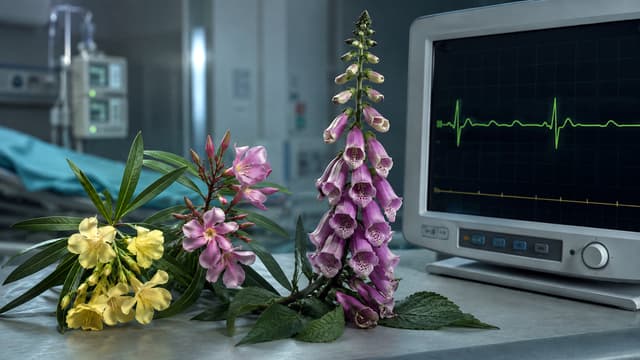
Plant cardiac glycoside poisoning can look strikingly similar to pharmaceutical digoxin toxicity, but clinicians should resist treating the two as interchangeable. Yellow oleander, common oleander, and foxglove contain structurally related cardiac glycosides capable of producing gastrointestinal illness, neurologic symptoms, bradycardia, atrioventricular conduction abnormalities, ventricular dysrhythmias, hyperkalemia, hypotension, and cardiac arrest. The 2025 American Heart Association guideline specifically addresses yellow oleander and other nondigoxin cardiac glycosides within its recommendations for life-threatening poisoning. [1]
The topic also has renewed contemporary relevance. In August 2026, the U.S. Food and Drug Administration expanded its warning about products found to contain toxic yellow oleander. [2] MedicalToxic covered that regulatory development separately in FDA Finds Toxic Yellow Oleander in Three Weight-Loss Products, Raising Digoxin-Like Poisoning Risk. This Blog addresses the broader and more durable clinical problem: how plant cardiac glycoside poisoning behaves and how it should be evaluated and managed.
Plant cardiac glycosides can simultaneously slow impulse formation or conduction and increase myocardial automaticity, producing a wide range of bradyarrhythmias, AV blocks, ectopy, and ventricular dysrhythmias.
Nausea and vomiting combined with otherwise unexplained bradycardia, conduction disease, hypotension, or potassium abnormalities should prompt consideration of a cardiac glycoside exposure.
Hyperkalemia is an important severity signal in acute poisoning, but no single serum potassium threshold has been validated as a universal prognostic or treatment cutoff for all plant glycosides.
A serum digoxin immunoassay may be positive, low, or even negative depending on the plant glycoside and laboratory assay. The numerical result should not be interpreted as a quantitative plant-toxin concentration.
Digoxin immune Fab has the strongest direct human trial evidence in serious yellow-oleander cardiotoxicity. Current AHA guidance considers Fab reasonable for life-threatening yellow-oleander poisoning and potentially reasonable for other cardiac glycosides.
Drug-label digoxin dosing equations should not automatically be transferred to oleander or foxglove poisoning. The optimal empirical Fab dose for nondigoxin glycosides remains uncertain.
Current toxicology recommendations support activated charcoal after cardiac glycoside ingestion and multiple-dose charcoal for enhanced elimination in selected cases, but yellow-oleander clinical-outcome trials have produced conflicting results.
Clinically significant poisoning requires serial ECGs, continuous rhythm monitoring, repeated electrolyte assessment, and disposition based on the evolving clinical course rather than a single laboratory value or rigid observation interval.
Several toxic plants contain cardenolides or related compounds capable of inhibiting the same cellular target affected by digoxin.
Plant | Common toxicology name | Important clinical point |
|---|---|---|
Cascabela thevetia | Yellow oleander; historically Thevetia peruviana | Strongest plant-specific clinical evidence, including prospective cohorts and a randomized Fab trial |
Nerium oleander | Common oleander | Contains cardiac glycosides such as oleandrin; exposure can produce a digitalis-like toxidrome |
Digitalis species | Foxglove | Botanical source of digitalis glycosides; poisoning can cause evolving conduction abnormalities and ventricular dysrhythmias |
Yellow oleander appears in older toxicology literature as Thevetia peruviana, while current literature also uses Cascabela thevetia. The AHA guideline recognizes both names. [1]
Exposure circumstances vary. Patients may ingest plant material, teas or botanical preparations, or mislabeled products containing plant-derived glycosides. Because the glycoside content of plants and preparations is variable, estimating risk solely from a reported amount of plant material is unreliable and should not replace clinical assessment.
Cardiac glycosides are not limited to plants. Bufadienolides in some toad toxins act on the same sodium-potassium pump. That related toxicology is discussed separately in Human Poisoning by Toxic Frogs and Toads.
The central molecular target is the Na+/K+-ATPase on the cell membrane. Cardiac glycosides inhibit this pump, disrupting normal transmembrane sodium and potassium gradients. Intracellular sodium rises, which alters sodium-calcium exchange and increases intracellular calcium. These changes can increase myocardial contractility but, in poisoning, also promote abnormal automaticity and triggered electrical activity. [3]
At the same time, cardiac glycosides affect autonomic and conduction physiology. Increased vagal influence and direct effects on nodal tissue can suppress sinus-node activity and slow AV-node conduction. [3]
This produces one of the defining paradoxes of cardiac glycoside toxicity:
conduction may slow while abnormal automaticity increases.
A patient can therefore move from sinus bradycardia or AV block to junctional rhythms, ventricular ectopy, or ventricular tachyarrhythmia. The ECG may evolve substantially during the admission.
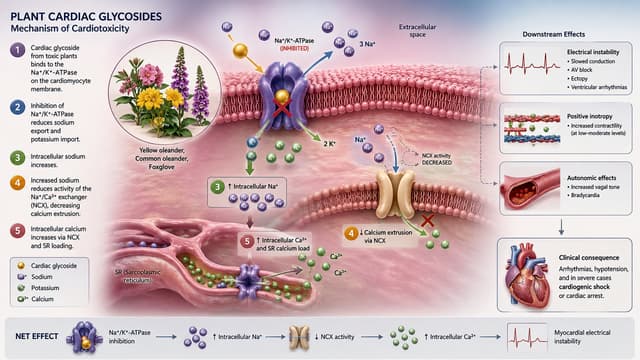
Nausea and vomiting are common early manifestations of cardiac glycoside poisoning. Abdominal discomfort and diarrhea can also occur.
These symptoms are nonspecific when considered alone. Their importance increases when they appear with bradycardia, an abnormal ECG, hypotension, or potassium disturbance.
Patients may develop:
weakness;
dizziness;
lethargy;
confusion; or
other alterations in mental status.
Visual disturbances classically associated with digitalis exposure may occur, but their absence does not meaningfully exclude plant glycoside poisoning.
Cardiovascular findings determine severity in many patients. Important manifestations include:
sinus bradycardia;
sinus pauses or sinus arrest;
PR prolongation;
first-, second-, or third-degree AV block;
junctional rhythms;
AV dissociation;
ventricular ectopy;
atrial tachyarrhythmias;
ventricular tachycardia;
ventricular fibrillation;
hypotension;
asystole.
The AHA guideline specifically identifies AV nodal block, ventricular tachycardia, ventricular fibrillation, and asystole among severe manifestations of cardiac glycoside poisoning. [1]
There is no single ECG pattern that confirms plant cardiac glycoside poisoning. The diagnostic value comes from recognizing a compatible pattern of conduction slowing, abnormal automaticity, and clinical context.
A prospective study of 192 patients with yellow-oleander poisoning found serious arrhythmias at presentation in 46 patients, with another 11 developing new serious arrhythmias during follow-up. Sinus bradycardia was the most frequent rhythm abnormality, followed by second-degree AV block. PR prolongation and an ECG “digoxin effect” were associated with serious dysrhythmias. [4]
ECG finding | Toxicologic interpretation | Practical implication |
Sinus bradycardia | Sinus-node suppression and vagal effects | Assess perfusion and look for progression |
Sinus pauses/arrest | Significant nodal toxicity | Requires continuous monitoring |
PR prolongation | Slowed AV conduction | May precede higher-grade AV block |
Second- or third-degree AV block | Advanced conduction toxicity | Potentially life-threatening, especially with instability |
Junctional rhythm / AV dissociation | Sinus or AV conduction failure with escape activity | May evolve as toxicity progresses |
Ventricular ectopy | Increased myocardial automaticity | Can coexist with bradycardia or conduction disease |
Ventricular tachycardia or VF | Severe myocardial electrical instability | Requires immediate resuscitation and antidotal consideration |
ST-T “digoxin effect” | Compatible with cardiac glycoside effect | Not sufficient by itself to establish poisoning severity |
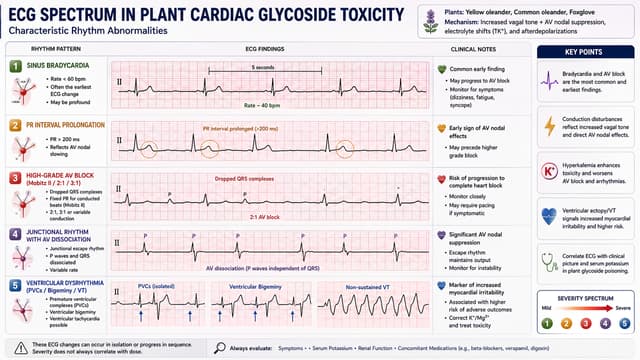
Foxglove cases illustrate how dynamic these rhythms can be. In a published pair of confirmed Digitalis purpurea exposures, ECG evolution included first-degree AV block and sinus pauses, sinus bradycardia, accelerated junctional rhythm with AV dissociation and complete heart block, and later monomorphic ventricular tachycardia. This remains case-level evidence rather than a population estimate, but it demonstrates why a reassuring initial rhythm does not necessarily define the entire course. [5]
Bidirectional ventricular tachycardia is strongly associated with digitalis toxicity in teaching materials, but clinicians should not wait for this uncommon pattern before considering cardiac glycoside poisoning. Bradycardia and conduction abnormalities may be much more prominent, particularly in yellow-oleander toxicity.
Acute inhibition of Na+/K+-ATPase reduces cellular potassium uptake and can produce hyperkalemia. In severe acute cardiac glycoside poisoning, an elevated potassium concentration can therefore reflect significant pump inhibition.
Yellow-oleander studies support potassium as a useful severity signal. In the 192-patient prospective study, serum potassium correlated with cardiac glycoside concentrations and overall serious dysrhythmias. However, potassium did not independently predict the development of new serious arrhythmias, and it should not be converted into a universal plant-poisoning prognostic cutoff. [4]
Interpret potassium in context with:
ECG findings;
blood pressure and perfusion;
symptom progression;
renal function;
acid-base status;
preceding vomiting;
other electrolyte disturbances; and
treatments already administered.
Conversely, low potassium can increase myocardial susceptibility to cardiac glycosides. The direction and significance of a potassium abnormality therefore depend partly on whether the exposure is acute, on coexisting illness, and on previous therapy.
Serial measurements are more informative than a single value.
Diagnosis usually begins with the combination of exposure history, clinical findings, ECG, and laboratory assessment.
Initial evaluation should include:
repeated vital signs and perfusion assessment;
12-lead ECG;
continuous cardiac monitoring when toxicity is suspected;
serum potassium;
magnesium and other clinically relevant electrolytes;
renal function;
glucose and other laboratory testing guided by the presentation;
assessment for co-exposures.
The exposure history should specifically ask about botanical remedies, supplements, teas, garden plants, and products marketed as “natural.” A conventional prescription-medication history alone can miss the source.
A standard serum digoxin concentration can be misleading in plant poisoning.
Oleandrin and other nondigoxin glycosides may cross-react with some digoxin immunoassays, but the degree of cross-reactivity is assay dependent. A comparative laboratory study demonstrated substantial differences among five commonly used digoxin assays: some produced measurable apparent digoxin concentrations after exposure to oleander material, while another assay showed no cross-reactivity. [6]
This leads to three important rules:
A measurable “digoxin” concentration does not prove pharmaceutical digoxin ingestion.
The numerical value is not a quantitative measurement of total oleander or foxglove toxin burden.
A negative result cannot reliably exclude plant cardiac glycoside poisoning.
The assay may serve as a supportive clue when its analytical characteristics are known, but clinical management should not be anchored to the number.
Yellow-oleander pharmacokinetic research using digoxin cross-reacting substances has also demonstrated variable and prolonged apparent glycoside kinetics, supporting caution against assuming that exposure has ended simply because the initial examination is reassuring. [7]
For a medication-specific comparison, Chronic Digoxin Toxicity Triggered by Acute Kidney Injury: A Case of Confusion and Bradycardia illustrates how renal dysfunction and conventional digoxin exposure can produce bradycardia and neurologic symptoms. Plant poisoning shares important physiology but differs substantially in exposure assessment and interpretation of serum assays.
Management should be driven by clinical severity, not by the botanical name alone or a serum digoxin number.
Patients with significant toxicity should be managed with early poison-center or medical-toxicology consultation whenever available.
Immediate priorities remain airway, breathing, circulation, hemodynamic support, and rhythm recognition.
Obtain continuous ECG monitoring in symptomatic patients and those with ECG or electrolyte abnormalities. Repeat 12-lead ECGs when the rhythm changes or toxicity appears to be progressing.
Establish IV access and reassess potassium, renal function, and other relevant electrolytes serially.
Digoxin-specific antibody fragments bind digoxin and can also bind structurally related cardiac glycosides. The evidence, however, is not equally strong across every plant.
The 2025 AHA guideline states that digoxin-Fab is reasonable for adults and children with life-threatening poisoning from yellow oleander or Bufo toad toxins. For life-threatening poisoning from other cardiac glycosides, which includes plant exposures such as foxglove, administration may be reasonable, but the evidence is less robust. [1]
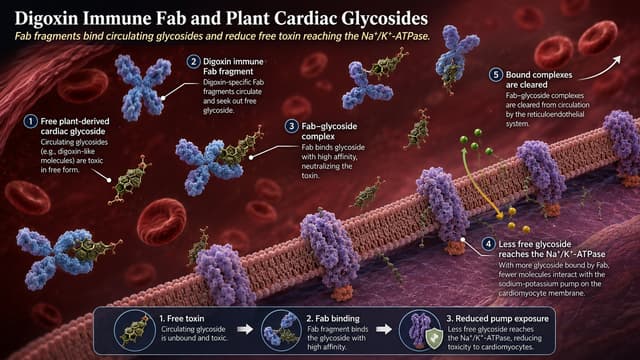
Plant toxicology has an unusually important randomized trial in this area.
A randomized controlled trial enrolled 66 patients with serious yellow-oleander arrhythmias. Thirty-four received anti-digoxin Fab and 32 received placebo. Complete resolution of the presenting arrhythmia at two hours occurred in 15 Fab-treated patients versus two controls; by eight hours, 24 Fab-treated patients and five controls were in sinus rhythm. Heart rate also increased and serum potassium fell in the Fab group. [8]
This trial provides direct human evidence that anti-digoxin Fab can reverse serious yellow-oleander cardiotoxicity.
It does not, however, establish a universal Fab regimen for all oleander or foxglove exposures. The trial used a fixed 1200-mg protocol, but that study dose should not be copied as a general plant-poisoning dosing rule.
Current AHA guidance explicitly notes that the ideal empirical dose for cardiac arrest from cardiac glycosides is unknown and is likely to differ between digoxin and related glycosides. [1]
The current U.S. DigiFab label provides vial calculations and concentration-based dosing rules for digoxin toxicity. It does not establish equivalent dosing formulas for yellow oleander, common oleander, or foxglove. [9]
In plant poisoning, Fab decisions should therefore integrate:
severity of dysrhythmia;
hemodynamic instability;
potassium trend;
evidence of progressive toxicity;
suspected plant or preparation;
response to treatment; and
poison-center or medical-toxicology guidance.
Potentially life-threatening presentations include unstable severe bradycardia or high-grade AV block, ventricular dysrhythmia, shock, and cardiac arrest.
After Fab, potassium can decrease rapidly as cardiac glycoside effects are reversed. The current product label for DigiFab specifically warns about rapid declines in serum potassium after treatment, reinforcing the need for close serial monitoring. [9]
Standard advanced-life-support measures remain appropriate when clinically indicated.
The AHA notes that atropine and electrical pacing have variable effectiveness in cardiac glycoside poisoning. [1]
For unstable bradycardia or advanced AV block:
support perfusion;
administer Fab promptly when the poisoning is life-threatening and Fab is indicated;
use standard bradycardia resuscitation measures as needed;
involve toxicology and cardiology early when pacing is being considered.
Fab treats the underlying toxicologic mechanism in susceptible glycosides; pacing or atropine does not neutralize the toxin.
Life-threatening ventricular dysrhythmias require immediate resuscitative care and consideration of Fab.
The AHA states that lidocaine or phenytoin may be reasonable for ventricular arrhythmias caused by digoxin and related cardiac glycosides while Fab is being obtained or administered, although supporting evidence is limited. [1]
Management should remain individualized because patients may simultaneously have conduction disease, electrolyte disturbance, hypotension, and abnormal automaticity.
When hyperkalemia accompanies severe acute cardiac glycoside poisoning, reversing the glycoside effect with Fab is a central therapeutic priority when Fab is indicated.
Immediately dangerous hyperkalemia may still require standard emergency stabilization and temporizing treatment while definitive toxicologic therapy is being arranged. Serial potassium measurement is essential because concentrations can decline as cardiac glycoside activity is neutralized.
Avoid basing Fab treatment solely on a plant-poisoning potassium threshold borrowed from pharmaceutical digoxin labeling. Those label criteria were developed for digoxin and should not be automatically extrapolated to heterogeneous plant glycosides.
Decontamination requires a more nuanced interpretation than older “charcoal versus no charcoal” rules suggest.
The 2026 Clinical Toxicology Recommendations Collaborative concluded that activated charcoal is an appropriate option after cardiac glycoside ingestion and that multiple-dose activated charcoal is appropriate for enhanced elimination in cardiac glycoside poisoning. The recommendations emphasize individualized assessment of the poison, timing, clinical severity, airway safety, and available treatment alternatives. [10]
This contemporary recommendation must be interpreted alongside conflicting clinical-outcome evidence specific to yellow oleander.
A 2003 randomized, placebo-controlled trial of 401 yellow-oleander patients reported fewer deaths in the multiple-dose activated-charcoal group than in the placebo group. [11]
A substantially larger randomized trial published in 2008 enrolled 4,632 acute self-poisoning patients, including 1,647 yellow-oleander exposures, and compared multiple-dose charcoal, a single charcoal dose, and no charcoal. It found no significant mortality difference overall and no demonstrated benefit for the individual poison subgroups. [12]
The practical conclusion is not that charcoal is useless, nor that every oleander ingestion requires repeated charcoal.
Instead:
consider activated charcoal when a clinically important ingestion is suspected and administration can be performed safely;
protect the airway when aspiration risk is relevant;
consider whether ongoing absorption or enhanced elimination makes additional doses useful;
individualize the decision with toxicology input rather than applying a rigid time rule;
recognize that the clinical-outcome evidence in yellow oleander remains mixed despite contemporary expert-consensus support for charcoal in cardiac glycoside poisoning. [10,11,12]
Hemodialysis, hemofiltration, hemoperfusion, and plasmapheresis should not be expected to provide clinically useful removal of cardiac glycosides.
The AHA classifies these extracorporeal approaches as no benefit for life-threatening digoxin and related cardiac glycoside poisoning. [1]
Renal dysfunction may still matter clinically for electrolyte balance and for pharmaceutical digoxin pharmacokinetics, but dialysis is not an antidotal substitute for Fab.
Plant cardiac glycoside poisoning is an important example of why toxicology recommendations should not be presented as though all compounds have the same evidence base.
Clinical question | Best evidence available | Interpretation |
Does Fab reverse serious yellow-oleander cardiotoxicity? | Randomized controlled trial plus AHA recommendation | Direct human efficacy evidence exists |
Does Fab work in foxglove and other plant glycosides? | Case reports, mechanistic plausibility, guideline extrapolation | Reasonable in life-threatening toxicity, but evidence is weaker |
Can potassium help assess severity? | Prospective yellow-oleander cohorts | Useful severity signal, not a universal independent prognostic cutoff |
Can a digoxin assay diagnose plant glycoside poisoning? | Laboratory cross-reactivity studies and clinical data | Assay dependent; supportive at most, not quantitative |
Should activated charcoal be considered? | 2026 consensus recommendations plus conflicting RCTs | Current recommendations support selected use; clinical-outcome evidence is heterogeneous |
Does dialysis remove these glycosides effectively? | Systematic evidence incorporated into AHA guideline | Not recommended for toxin removal |
This distinction matters clinically. Evidence is strongest for some aspects of yellow-oleander management and much thinner for common oleander or foxglove. Management of the latter often requires careful extrapolation from digitalis physiology, related cardiac glycosides, case reports, and specialist experience rather than plant-specific randomized trials.
Patients with symptoms, ECG abnormalities, hypotension, potassium disturbances, or a concerning exposure should receive continuous cardiac monitoring.
Serial evaluation should include:
heart rate and blood pressure;
rhythm and conduction;
repeat 12-lead ECGs;
potassium;
other relevant electrolytes;
renal function;
perfusion and mental status.
A single normal ECG should not automatically terminate evaluation if the exposure history is concerning, because absorption and clinical evolution can be variable. [7]
ICU-level care is appropriate for patients with features such as:
hemodynamic instability;
severe or progressive bradycardia;
high-grade AV block;
ventricular dysrhythmias;
clinically significant hyperkalemia associated with toxicity;
need for Fab because of life-threatening manifestations;
recurrent arrhythmias;
requirement for pacing, advanced airway support, or resuscitation.
There is no single evidence-based observation duration that can safely be applied to every plant, preparation, and exposure.
Factors affecting disposition include:
exact or suspected plant;
form of exposure;
reliability of the history;
symptoms;
initial and serial ECGs;
potassium trend;
co-exposures;
timing of ingestion;
possibility of delayed or ongoing absorption.
An asymptomatic patient with a credible exposure should therefore be discussed with a poison center or medical toxicologist to determine an appropriate observation strategy.
Discharge should be considered only after an adequate individualized observation period with clinical stability, reassuring serial rhythm assessment, stable electrolytes, no emerging symptoms, and no other indication for continued care.
Cross-reactivity differs among assays. A number reported as “digoxin” may reflect only partial immunoreactivity with an oleander glycoside and cannot be translated directly into total toxin burden. [6]
Some assays may have little or no cross-reactivity with particular nondigoxin glycosides. A negative test cannot overrule a convincing toxidrome.
The DigiFab label is written for digoxin, while current AHA guidance acknowledges uncertainty around optimal empirical dosing for related cardiac glycosides. [1,9]
Yellow-oleander poisoning often presents predominantly with sinus-node and AV-node conduction abnormalities. Serious toxicity does not require bidirectional VT or another textbook digitalis rhythm. [4]
Potassium is clinically important, but its prognostic value varies with timing, severity, renal function, and treatment. Plant-specific evidence does not justify a single universal threshold. [4]
Serial ECG monitoring matters. Both prospective yellow-oleander data and documented foxglove cases show that rhythm abnormalities can evolve over time. [4,5]
Current expert recommendations support charcoal for cardiac glycoside poisoning, while clinical trials in yellow oleander have produced conflicting outcome data. The decision should remain individualized. [10,11,12]
Think cardiac glycoside poisoning when gastrointestinal illness and bradycardia occur together. Vomiting plus an unexpected conduction abnormality is a more meaningful combination than either finding in isolation.
Read the ECG longitudinally. The rhythm may progress from PR prolongation or sinus bradycardia to higher-grade block or ventricular irritability.
Trend potassium rather than treating one value as destiny. The trajectory can change with progression of poisoning and after Fab.
Treat the patient, not the digoxin assay. Plant glycosides and laboratory immunoassays interact inconsistently.
Fab evidence is not uniform across plants. Yellow oleander has direct randomized trial evidence; foxglove and many other glycosides rely more heavily on case reports and extrapolation.
Do not delay antidotal treatment for confirmatory botanical or specialized laboratory testing when life-threatening toxicity is clinically evident.
No. The syndromes overlap because the toxins inhibit Na+/K+-ATPase and share related electrophysiologic effects, but plant glycosides differ in composition, pharmacokinetics, assay cross-reactivity, and antibody affinity. Treatment principles overlap, but pharmaceutical digoxin thresholds and dosing formulas should not automatically be transferred to plant poisoning.
Not reliably. Some digoxin immunoassays cross-react with oleander glycosides and others do not. A measurable concentration can support the diagnosis in the right context, but the numerical result does not quantify the plant glycoside burden. A negative result also cannot rule out exposure. [6]
No. Fab is primarily relevant when clinically important or life-threatening cardiac glycoside toxicity is present. Evidence is strongest for serious yellow-oleander arrhythmias. The AHA considers Fab reasonable for life-threatening yellow-oleander poisoning and potentially reasonable for other life-threatening cardiac glycoside poisonings. [1,8]
No. Potassium is one component of severity assessment. ECG findings, hemodynamics, progression of symptoms, renal function, timing, and serial laboratory results all matter. In prospective yellow-oleander data, potassium was associated with overall serious dysrhythmias but was not an independent predictor of new serious arrhythmia. [4]
There is no universal observation period that fits every plant preparation and exposure. Symptomatic patients and those with ECG abnormalities, hypotension, electrolyte disturbances, or concerning exposures require continued monitored care. Observation of asymptomatic patients should be individualized with poison-center or medical-toxicology guidance.
Plant cardiac glycoside poisoning is best recognized as a dynamic electrophysiologic toxidrome, not simply as “natural digoxin exposure.”
Yellow oleander, common oleander, and foxglove can produce gastrointestinal symptoms followed by sinus-node dysfunction, AV conduction abnormalities, potassium disturbances, hypotension, and potentially fatal ventricular dysrhythmias. The ECG and clinical trajectory are more useful than any single laboratory result.
Digoxin assays can provide misleading quantitative information. Hyperkalemia is an important severity signal but should not be reduced to a universal plant-specific cutoff. Digoxin immune Fab has direct randomized evidence for serious yellow-oleander cardiotoxicity and is supported by current AHA guidance for life-threatening yellow-oleander poisoning, while evidence for other plants is less certain.
The safest approach is therefore integrated: recognize the toxidrome early, monitor the rhythm and potassium serially, use Fab when clinically indicated, individualize decontamination, and involve a poison center or medical toxicologist in significant exposures.[1][2][3][4][5][6][7][8][9][10][11][12]
© All copyright of this material is absolute to Medical toxicology
As the Growth & Content Lead at MedicalToxic.com, I work on content strategy, development, and digital growth. My focus is on making MedicalToxic’s content clear, practical, and accessible, while helping expand the platform’s reach and strengthen its position as a trusted resource in clinical toxicology.
Keep reading
 Toxic Agents and Antidotes
Amirhosein Shabrang
 Toxic Agents and Antidotes
Amirhosein Shabrang
 Toxic Agents and Antidotes
Amirhosein Shabrang
 Toxic Agents and Antidotes
Omid Mehrpour