Toxic Agents and Antidotes
Methanol vs. Ethylene Glycol Poisoning: Osmol Gap, Fomepizole & Dialysis Guide
Amirhosein Shabrang
Post on 27 Jul 2026 · Updated 30 Sept 2026 · 20 min read
Amirhosein Shabrang
Post on 27 Jul 2026 · Updated 30 Sept 2026 · 20 min read
 Medical Toxicologymedicaltoxic.com
https://medicaltoxic.com/blogs/toxic-alcohol-poisoning-methanol-ethylene-glycol
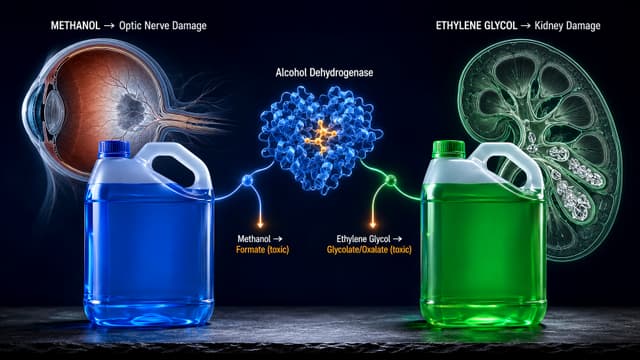
Photorealistic containers of blue windshield washer fluid and green antifreeze with medical overlays showing methanol-related optic nerve injury and ethylene glycol–related kidney injury.
A clear liquid sits in an unmarked drink bottle in a garage. Someone takes a swallow, feels dizzy, and assumes the danger has passed when nothing dramatic happens immediately.
Hours later, severe metabolic acidosis may develop.
This delayed progression is one of the defining dangers of toxic alcohol poisoning. Methanol and ethylene glycol may initially resemble ethanol intoxication—or cause few obvious symptoms. Much of the serious injury occurs after alcohol dehydrogenase begins converting the parent compounds into toxic organic acids.
Methanol is associated with windshield washer fluid, industrial solvents, contaminated alcoholic beverages, and improperly manufactured products. Ethylene glycol is commonly found in automotive antifreeze and coolant.
Both exposures can cause high anion-gap metabolic acidosis. Both may require fomepizole. Both may require hemodialysis.
However, they are not clinically interchangeable.
Methanol is particularly associated with formate-mediated visual and neurological injury. Ethylene glycol is associated with glycolate-driven acidosis, calcium abnormalities, calcium oxalate formation, and acute kidney injury. Diagnosis and treatment therefore require shared toxic-alcohol principles combined with toxin-specific assessment. [A] [B]
Educational safety note: This article does not provide individualized medical advice or a substitute for bedside toxicology consultation. Suspected ingestion of methanol, antifreeze, windshield washer fluid, or another toxic alcohol requires immediate Poison Control or emergency medical evaluation.
Methanol and ethylene glycol usually become more dangerous as they are metabolized into toxic organic acids.
Early intoxication may resemble ethanol exposure, while severe acidosis and organ injury can develop later.
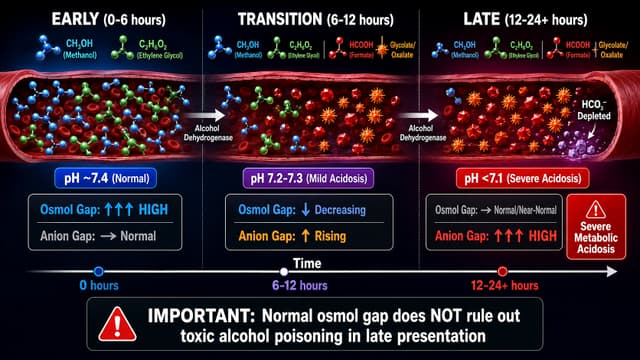
The osmol gap may be elevated early and become normal later. The anion gap often rises as toxic metabolites accumulate.
A normal osmol gap does not exclude methanol or ethylene glycol poisoning.
When ethanol is present, its osmotic contribution must be included or appropriately subtracted before the osmol gap is interpreted.
Fomepizole inhibits alcohol dehydrogenase and prevents additional toxic metabolite formation.
Fomepizole does not remove toxic metabolites already present or reverse established organ injury.
Extracorporeal treatment may be required for severe acidosis, visual or neurological toxicity, acute kidney injury, high toxin concentrations, or other EXTRIP-defined indications.
Methanol and ethylene glycol have different EXTRIP thresholds for extracorporeal treatment.
Treatment may need to begin before definitive toxic-alcohol concentrations become available.
The first misconception is that a toxic alcohol must smell, taste, or look unusual.
It may not.
Methanol and ethylene glycol are colorless liquids. Ethylene glycol has traditionally been described as having a sweet taste, while methanol may resemble beverage alcohol or a solvent-containing fluid. Commercial dyes may help identify a product in its original container, but a liquid transferred into a beverage bottle may provide no useful visual warning.
The second misconception is that a patient who appears mildly intoxicated can safely sleep off the exposure.
Early methanol or ethylene glycol toxicity may cause drowsiness, poor coordination, nausea, vomiting, confusion, or slurred speech. These findings overlap with ethanol intoxication. The distinction may become clearer only after toxic metabolites accumulate.
The timing of presentation and the extent of metabolism determine the clinical and laboratory pattern.
The third misconception is that one normal laboratory result rules out toxic alcohol poisoning.
A normal osmol gap does not exclude the diagnosis.
The osmol gap is a time-sensitive clue rather than a universal toxic-alcohol detector. A patient presenting early may have an elevated osmol gap before substantial acidosis develops. A patient presenting later may have metabolized much of the parent alcohol, leaving severe anion-gap acidosis with little or no remaining osmol-gap elevation.
The laboratory pattern changes as the parent alcohol is converted into acidic metabolites.
Methanol and ethylene glycol are absorbed relatively quickly after ingestion. The parent compounds can depress the central nervous system, but much of the characteristic delayed organ injury is caused by their metabolites.
Alcohol dehydrogenase initiates the metabolism of both compounds into their respective toxic products.
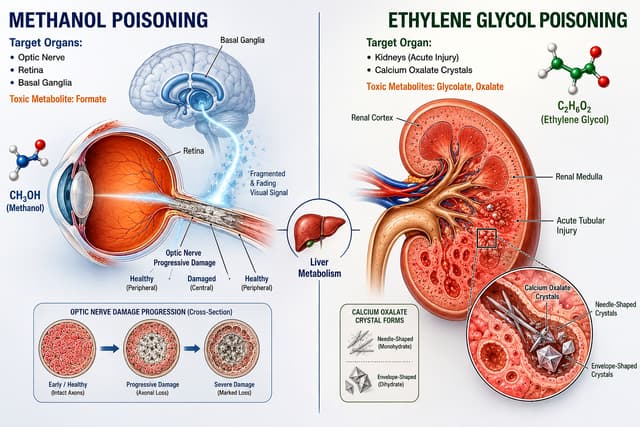
Methanol predominantly threatens vision and the brain; ethylene glycol predominantly threatens acid–base balance and the kidneys.
Methanol is converted first to formaldehyde and then to formic acid, which circulates primarily as formate at physiological pH.
Formate interferes with mitochondrial energy production. Tissues with high metabolic requirements, particularly the retina and optic nerve, are especially vulnerable. Severe poisoning may also injure basal-ganglia structures and cause coma, seizures, or permanent neurological disability.
Visual manifestations may include:
blurred or dim vision;
reduced visual acuity;
visual-field abnormalities;
altered color perception;
a hazy or “snowfield” visual sensation;
partial or complete blindness.
Formate accumulation also contributes to profound metabolic acidosis. The official U.S. fomepizole label identifies formic acid as the metabolite primarily responsible for methanol-related acidosis and visual toxicity. [E]
Ethylene glycol follows a different metabolic pathway:
glycolaldehyde;
glycolic acid or glycolate;
glyoxylic acid;
oxalic acid or oxalate.
Glycolate is a major contributor to high anion-gap metabolic acidosis. Oxalate can bind calcium and form calcium oxalate crystals that may deposit in renal tubules and contribute to acute kidney injury.
Ethylene glycol poisoning may therefore produce:
metabolic acidosis;
altered consciousness;
rapid or deep breathing;
hypocalcemia;
muscle spasms, tetany, or seizures;
calcium oxalate crystals in urine;
flank discomfort;
reduced urine output;
acute kidney injury.
Urinary crystals can support the diagnosis, but they are neither universally present nor sufficient by themselves to establish ethylene glycol poisoning.
Clinical evidence supports early alcohol-dehydrogenase inhibition because limiting glycolate and oxalate formation can reduce further renal injury, especially when treatment begins before substantial kidney damage has developed. [D]
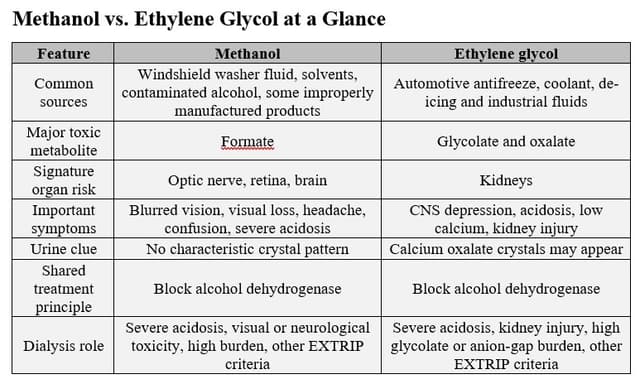
Methanol and ethylene glycol share important diagnostic and treatment principles but produce different patterns of organ injury.
This comparison is an educational guide, not a substitute for bedside consultation.
Mixed exposures occur. Product ingredients vary. Ethanol co-ingestion can delay the anticipated clinical timeline. A patient may also have trauma, medication effects, ketoacidosis, renal failure, sepsis, or another cause of altered mental status and metabolic acidosis.
When the exposure history, laboratory findings, and clinical course are discordant, a single reassuring result should not end the evaluation.
Two laboratory concepts dominate discussions of methanol and ethylene glycol poisoning: the osmol gap and the anion gap.
They reflect different parts of the toxicokinetic process.
Measured serum osmolality represents the actual concentration of dissolved particles in the blood.
Calculated osmolality estimates the expected contribution of measured solutes such as sodium, glucose, and urea.
When ethanol is present, its osmotic contribution must be included in the calculation—or subtracted appropriately—before the osmol gap is interpreted. Failure to adjust for ethanol may incorrectly attribute part of the measured gap to methanol or ethylene glycol.
The difference between measured and calculated osmolality is called the osmol gap, often referred to as the osmolar gap in clinical conversation.
An elevated gap suggests that one or more unmeasured osmotically active substances may be present. Methanol and ethylene glycol can create this pattern while substantial amounts of the parent alcohol remain in circulation.
Other causes of an elevated osmol gap include:
ethanol;
isopropanol;
ketoacidosis;
renal dysfunction;
shock;
some medication vehicles;
laboratory and calculation-method variation.
An elevated osmol gap is therefore a clue, not a diagnosis.
The anion gap estimates the concentration of unmeasured negatively charged substances in the blood.
As methanol is converted into formate—or ethylene glycol is converted into glycolate and other acidic metabolites—serum bicarbonate falls and the anion gap usually rises.
The classic progression is:
Early exposure: The parent alcohol is present, and the osmol gap may be elevated.
Ongoing metabolism: Toxic acids begin to accumulate.
Later exposure: Anion-gap acidosis worsens as the osmol gap may decline.
A normal osmol gap is not a clearance test.
Both gaps may also be abnormal simultaneously. The transition is not a clean handoff, and co-ingested ethanol can delay metabolism because ethanol competes for alcohol dehydrogenase.
Because direct toxic-alcohol concentrations are frequently send-out tests, treatment decisions may be required before definitive results are available.
Strong clinical suspicion should be assessed using the complete pattern:
exposure history;
acid–base status;
mental status and neurological findings;
visual symptoms;
kidney function;
measured serum osmolality;
ethanol concentration;
available methanol or ethylene glycol concentrations.
EXTRIP recommendations emphasize clinical severity and the full biochemical picture rather than dependence on one isolated screening value. [A] [B]
Early manifestations may resemble ethanol intoxication:
dizziness;
headache;
nausea or vomiting;
slurred speech;
impaired coordination;
drowsiness;
confusion;
abdominal discomfort.
Early findings may be mild and nonspecific.
Methanol exposure becomes particularly concerning when the patient develops:
blurred or dim vision;
visual-field loss;
abnormal color perception;
severe headache;
rapid or deep breathing;
worsening confusion;
seizures;
coma;
severe metabolic acidosis.
Symptoms may be delayed, particularly when ethanol was consumed at the same time.
CDC documented hospitalizations, deaths, and persistent visual impairment during a 2020 U.S. cluster involving ingestion of alcohol-based hand sanitizers containing methanol. The outbreak demonstrated that a product intended for external use can cause severe systemic poisoning when swallowed. [F]
Ethylene glycol poisoning may cause:
increasing sedation;
rapid or deep breathing;
severe metabolic acidosis;
hypocalcemia;
muscle twitching or tetany;
seizures;
cardiac instability;
declining kidney function;
reduced urine output.
Traditional teaching divides ethylene glycol poisoning into neurological, cardiopulmonary, and renal stages. This framework can support learning, but real patients do not necessarily progress through clearly separated stages. The phases may overlap, treatment may change the timeline, and co-ingestants may alter the presentation.
For a public-facing explanation focused specifically on antifreeze exposure, see What Happens If You Drink Antifreeze: Critical Symptoms You Can't Ignore.
Evaluation combines exposure history, physical examination, acid–base interpretation, and targeted laboratory testing.
Depending on the presentation, clinicians may consider:
venous or arterial blood gas;
electrolytes and bicarbonate;
measured serum osmolality;
ethanol concentration;
glucose;
renal function;
calcium;
lactate;
liver tests;
urinalysis;
ECG;
direct methanol or ethylene glycol concentration.
A negative routine toxicology screen does not exclude methanol or ethylene glycol poisoning. Standard urine immunoassays are not designed to identify most toxic alcohols.
This limitation is discussed further in Drug Screens Lie: A Clinician’s Guide to Interpreting Toxicology Tests Safely.
Laboratory values should always be interpreted within the full clinical context.
Direct toxic-alcohol concentrations are highly valuable, but many hospitals cannot provide them rapidly. When the exposure history and biochemical pattern strongly suggest toxic alcohol poisoning, treatment may need to begin before laboratory confirmation.
The official fomepizole label allows initiation for suspected ingestion based on the history and compatible findings, including anion-gap acidosis, an increased osmol gap, visual disturbances, or urinary oxalate crystals. [E]
Treatment has several simultaneous goals:
stabilize the airway, breathing, and circulation;
prevent additional toxic metabolite formation;
correct dangerous acid–base and electrolyte abnormalities;
remove the parent alcohol and toxic metabolites when indicated;
protect threatened organs;
monitor for delayed deterioration.
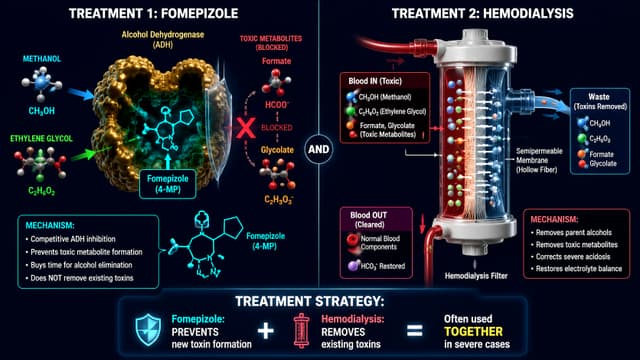
Fomepizole blocks further toxic metabolite formation; hemodialysis removes parent alcohols and circulating toxic metabolites.
Fomepizole competitively inhibits alcohol dehydrogenase.
Earlier American Academy of Clinical Toxicology practice guidelines also support prompt alcohol-dehydrogenase inhibition when methanol poisoning is suspected on the basis of a compatible exposure history, metabolic acidosis, an elevated osmol gap, or a measurable methanol concentration. [C]
It prevents methanol and ethylene glycol from undergoing further conversion into their more dangerous metabolites. It does not immediately remove the parent alcohol, remove toxic metabolites already present, or reverse established organ injury.
Clinical studies have demonstrated suppression of glycolate and formate formation after fomepizole administration. In the landmark ethylene glycol study, early treatment was associated with prevention of new renal injury among patients treated before substantial kidney damage had occurred. [D]
Fomepizole is generally preferred over ethanol in many U.S. clinical settings because its pharmacology is more predictable and it does not intentionally produce additional intoxication. The official U.S. label identifies it as an antidote for confirmed or suspected methanol or ethylene glycol poisoning, alone or in combination with hemodialysis. [E]
Ethanol also competes for alcohol dehydrogenase and has historically been used as an antidote.
It remains a potential hospital-based alternative when fomepizole is unavailable. However, ethanol therapy requires careful monitoring because it can cause sedation, hypoglycemia, vomiting, fluctuating concentrations, and additional difficulty assessing mental status.
Beverage alcohol should never be used as a home antidote.
Attempting to self-treat with beverage alcohol can delay emergency care, worsen altered consciousness, increase aspiration risk, and produce an unreliable degree of alcohol-dehydrogenase inhibition.
Severe acidemia is not simply an abnormal laboratory result. It impairs cardiovascular function, disrupts cellular metabolism, and often reflects a substantial burden of toxic metabolites.
Supportive management may include bicarbonate therapy while definitive antidotal and extracorporeal treatment is arranged. Exact thresholds, targets, and administration strategies depend on the toxin, severity, patient characteristics, and institutional protocol.
Folate or folinic acid may be administered in methanol poisoning to support formate metabolism.
Thiamine and pyridoxine may be used in ethylene glycol poisoning to encourage metabolism of glyoxylic acid toward less toxic products.
These cofactors are adjunctive therapies. Their clinical evidence is less robust than the evidence supporting alcohol-dehydrogenase inhibition and extracorporeal treatment when indicated. They should not delay fomepizole, ethanol therapy when appropriate, or dialysis.
EXTRIP uses the broader term extracorporeal treatment, abbreviated ECTR.
When ECTR is indicated, intermittent hemodialysis is generally preferred because it can rapidly remove the parent alcohol and circulating toxic metabolites while correcting acid–base and electrolyte abnormalities. Continuous kidney replacement therapy is an alternative when intermittent hemodialysis is unavailable. [A] [B]
The reported amount ingested should not be used as the sole basis for an ethylene glycol dialysis decision. EXTRIP instead considers clinical findings, biochemical severity, toxin or metabolite concentration, kidney function, and the antidote being used.
EXTRIP recommends ECTR when any of the following criteria are present:
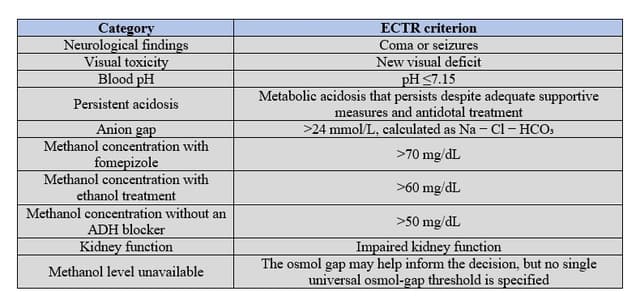
These recommendations apply to severe methanol poisoning and should be interpreted alongside the complete clinical picture. [A]
The ethylene glycol recommendations distinguish between situations in which ECTR is recommended and those in which it is suggested.
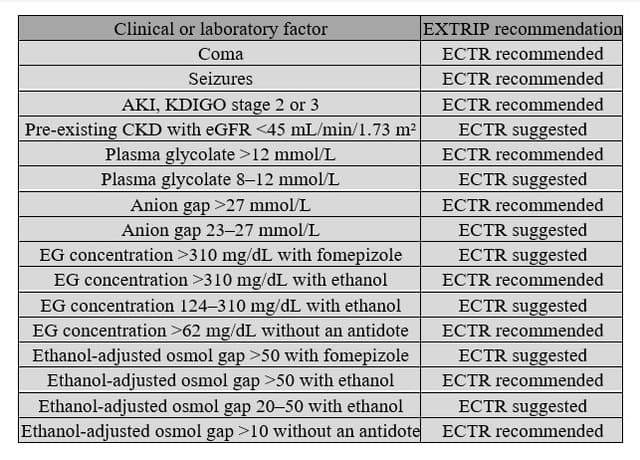
The osmol-gap criteria above apply when there is evidence of ethylene glycol exposure and the gap has been adjusted for ethanol. [B]
Important anion-gap calculation note: EXTRIP’s methanol threshold uses an anion gap calculated as Na − Cl − HCO₃, whereas its ethylene glycol recommendations use Na + K − Cl − HCO₃. Many laboratories report anion gap without potassium. Clinicians must confirm how the laboratory calculated the reported value before applying the numerical EXTRIP thresholds.
The official U.S. fomepizole prescribing information advises considering hemodialysis when a patient has:
renal failure;
significant or worsening metabolic acidosis; or
a measured methanol or ethylene glycol concentration of at least 50 mg/dL.
The product label therefore uses broader criteria and may be more conservative in some clinical situations.
EXTRIP provides toxin-specific recommendations that incorporate:
whether fomepizole, ethanol, or no ADH blocker is being used;
toxin and metabolite concentrations;
anion-gap severity;
osmol-gap findings;
neurological manifestations;
kidney function.
The fomepizole product label and EXTRIP recommendations should not be presented as interchangeable protocols. They should be interpreted with Poison Control, medical-toxicology, nephrology, and institutional guidance. [A] [B] [E]
For methanol poisoning, EXTRIP states that ECTR may be stopped when:
the methanol concentration is below 20 mg/dL; and
clinical improvement is present.
For ethylene glycol poisoning, EXTRIP:
recommends stopping ECTR when the anion gap—calculated as Na + K − Cl − HCO₃—is below 18 mmol/L;
suggests also confirming that the ethylene glycol concentration is below 25 mg/dL;
suggests confirming that acid–base abnormalities have been corrected.
Alcohol-dehydrogenase inhibition must continue during ECTR. Fomepizole is dialyzable and therefore requires protocol-based dosing adjustment during hemodialysis. [A] [B] [E]
The broader role of specialist case assessment, transfer planning, laboratory trending, and antidote coordination is discussed in The Role of Poison Center Calls: Managing Poisoning Cases from Emergency Calls to Critical Decisions.
Methanol and ethylene glycol can cause delayed organ injury.
Waiting for visual symptoms, profound acidosis, or kidney failure defeats the purpose of early alcohol-dehydrogenase inhibition.
Inducing vomiting can cause aspiration and does not reliably remove an absorbed toxic alcohol.
Activated charcoal does not meaningfully bind simple alcohols such as methanol and ethylene glycol.
The 2026 Clinical Toxicology Recommendations Collaborative guidance states that activated charcoal has no role in methanol or ethylene glycol poisoning. [H]
Antifreeze may be green, yellow, orange, red, blue, or nearly clear, depending on the product.
Color does not establish chemical composition or toxicity.
Ethanol can delay the metabolism of methanol or ethylene glycol and postpone the development of acidosis and organ injury.
It does not make the exposure harmless. Toxicity may emerge as the ethanol concentration falls.
Calcium oxalate crystals can support a diagnosis of ethylene glycol poisoning, but their absence does not exclude it.
Isopropanol is another toxic alcohol, but its metabolic pattern differs from methanol and ethylene glycol.
It is converted into acetone and commonly produces:
CNS depression;
vomiting;
abdominal pain;
ketosis;
an elevated osmol gap.
Unlike methanol and ethylene glycol, uncomplicated isopropanol poisoning generally does not produce major high anion-gap metabolic acidosis through an acidic metabolite.
Fomepizole is therefore not routinely used for uncomplicated isopropanol poisoning because blocking metabolism may prolong the presence of the more intoxicating parent compound.
“Toxic alcohol” describes a chemical family, not a single toxidrome or treatment protocol.
Young children may swallow automotive products that have been transferred into drink containers or left unsecured in garages.
Because the amount may be unknown and early symptoms may be mild, immediate Poison Control consultation is appropriate after suspected ingestion.
The National Capital Poison Center emphasizes original-container storage, prompt assessment, and immediate expert consultation after antifreeze exposure. [G]
Adults may ingest toxic alcohols intentionally or use them as substitutes for beverage alcohol.
After emergency stabilization and toxicology treatment, intentional exposure should be followed by mental-health evaluation and measures addressing access to hazardous chemicals.
Methanol outbreaks can occur when illegally produced, counterfeit, or improperly manufactured alcoholic beverages are contaminated.
These incidents may affect multiple people and require coordination among hospitals, poison centers, laboratories, public-health agencies, and regulatory authorities.
Routine brief skin contact is generally less concerning than ingestion, especially when contaminated skin is washed promptly.
However, concentrated exposure, damaged skin, eye contact, inhalation, and uncertain industrial formulations require product-specific assessment.
Risk depends on the route, concentration, dose, duration, and product formulation.
Do not wait for symptoms.
In the United States:
call Poison Control at 1-800-222-1222;
call emergency services immediately if the person is unconscious, seizing, severely confused, having difficulty breathing, or experiencing visual symptoms;
keep the original product container or label available;
do not induce vomiting;
do not give alcohol as a home treatment;
do not rely on an online calculator to declare the exposure safe.
Poison Control: Your Lifeline in Emergencies explains how the national hotline connects callers with regional poison specialists.
Many accidental toxic-alcohol exposures can be prevented through secure storage and original-container use.
Keep antifreeze, windshield washer fluid, solvents, and fuels in their original containers.
Never transfer automotive or industrial chemicals into beverage bottles.
Lock garage and workshop chemicals away from children.
Clean spills promptly.
Do not consume alcohol from unverified, unsealed, or informal sources.
Check product labels rather than assuming that every coolant contains the same chemical.
Follow local hazardous-waste requirements when disposing of unused products.
Transferring automotive chemicals into beverage containers creates a preventable risk of accidental ingestion and diagnostic uncertainty.
Methanol and ethylene glycol poisoning are dangerous because their early presentation may be deceptively mild while metabolism produces toxic organic acids.
Methanol predominantly threatens the optic nerves, retina, brain, and acid–base balance. Ethylene glycol predominantly threatens acid–base balance, calcium regulation, and the kidneys.
The osmol gap may be more useful early, while the anion gap often becomes more prominent later. Neither value should be interpreted in isolation.
Fomepizole prevents further formation of toxic metabolites. It does not remove metabolites already present or reverse established organ injury.
Hemodialysis removes the parent alcohol and circulating toxic metabolites while correcting severe metabolic abnormalities when clinical or laboratory severity justifies extracorporeal treatment.
In summary:
A normal early examination—or a normal late osmol gap—does not exclude toxic alcohol poisoning.
Strong suspicion warrants urgent toxicology consultation and may justify treatment before definitive concentrations return.
Methanol and ethylene glycol have different EXTRIP dialysis criteria.
DailyMed and EXTRIP should not be presented as identical decision frameworks.
Fomepizole blocks additional toxic metabolite formation; dialysis is used when rapid removal and metabolic correction are required.
Methanol is particularly associated with formate-mediated optic nerve, retinal, and brain injury. Ethylene glycol is associated with glycolate-driven acidosis, calcium oxalate formation, hypocalcemia, and acute kidney injury. Both can cause severe high anion-gap metabolic acidosis.
No. The osmol gap may decline as the parent alcohol is converted into acidic metabolites. Late poisoning can therefore cause severe acidosis despite a normal or minimally elevated osmol gap.
Ethanol is itself osmotically active. When ethanol is present, its contribution must be incorporated into or appropriately subtracted from the calculated osmolality before attributing an elevated gap to methanol or ethylene glycol.
Fomepizole is a competitive alcohol-dehydrogenase inhibitor. It prevents methanol and ethylene glycol from undergoing further metabolism into their more toxic products.
No. Fomepizole prevents additional toxic metabolite formation. It does not directly remove metabolites already present or reverse established visual, neurological, or renal injury.
No. ECTR decisions depend on the specific toxic alcohol, neurological and visual findings, acid–base status, measured concentrations, kidney function, antidote use, and current toxicology recommendations.
The U.S. product label uses a broad threshold of at least 50 mg/dL for either methanol or ethylene glycol, together with criteria such as renal failure or significant or worsening metabolic acidosis. EXTRIP provides more detailed toxin-specific thresholds and incorporates the ADH blocker being used.
Hospital-administered ethanol can inhibit alcohol dehydrogenase and may be used when fomepizole is unavailable. It requires careful monitoring and should never be attempted as home treatment.
No. Activated charcoal does not meaningfully bind methanol or ethylene glycol and is not recommended for these exposures.
Symptoms can begin within hours, but severe metabolic, visual, neurological, or renal injury may be delayed. Co-ingested ethanol can further postpone the expected progression.
Contact Poison Control or emergency medical services immediately. Do not wait for symptoms, do not induce vomiting, and do not attempt home treatment with alcohol.
© All copyright of this material is absolute to Medical toxicology
As the Growth & Content Lead at MedicalToxic.com, I work on content strategy, development, and digital growth. My focus is on making MedicalToxic’s content clear, practical, and accessible, while helping expand the platform’s reach and strengthen its position as a trusted resource in clinical toxicology.
A. EXTRIP Workgroup. Methanol: Executive Summary of Extracorporeal-Treatment Recommendations.
B. Ghannoum, M., Gosselin, S., Hoffman, R. S., et al. (2023). Extracorporeal treatment for ethylene glycol poisoning: Systematic review and recommendations from the EXTRIP Workgroup. Critical Care, 27, 56.
C. Barceloux, D. G., Bond, G. R., Krenzelok, E. P., Cooper, H., & Vale, J. A. (2002). American Academy of Clinical Toxicology practice guidelines on the treatment of methanol poisoning. Journal of Toxicology: Clinical Toxicology, 40(4), 415–446.
D. Brent, J., McMartin, K., Phillips, S., et al. (1999). Fomepizole for the treatment of ethylene glycol poisoning. New England Journal of Medicine, 340(11), 832–838.
E. DailyMed. (Updated November 20, 2025). Fomepizole Injection, Solution: Official Prescribing Information. U.S. National Library of Medicine.
F. Yip, L., Bixler, D., Brooks, D. E., et al. (2020). Serious Adverse Health Events, Including Death, Associated with Ingesting Alcohol-Based Hand Sanitizers Containing Methanol—Arizona and New Mexico, May–June 2020. Morbidity and Mortality Weekly Report, 69, 1070–1073.
G. National Capital Poison Center. Antifreeze: Bad for Your Kids and Pets.
H. Clinical Toxicology Recommendations Collaborative. (2026). Recommendations from the Clinical Toxicology Recommendations Collaborative on the Administration of Activated Charcoal in Acute Oral Overdose.
Keep reading
 Toxic Agents and Antidotes
Amirhosein Shabrang
 Toxic Agents and Antidotes
Amirhosein Shabrang
 Toxic Agents and Antidotes
Amirhosein Shabrang
 Toxic Agents and Antidotes
Omid Mehrpour