FDA Toxicology Update: Injectafer Boxed Warning and DNP Recall
post on 04 Sept 2026 · Updated 02 Oct 2026

post on 04 Sept 2026 · Updated 02 Oct 2026
 Medical Toxicologymedicaltoxic.com
https://medicaltoxic.com/news/fda-toxicology-update-injectafer-dnp-recalls
FDA Toxicology Update: Injectafer Boxed Warning and DNP Recall
FDA's September safety roundup now includes dexmedetomidine particulate contamination and a serious saline-flush sterility issue that has propagated into multiple procedural and convenience kits.
Last updated: September 27, 2026
September has produced several FDA actions with very different toxicologic implications.
The month began with a Boxed Warning for ferric carboxymaltose-associated symptomatic hypophosphatemia and a recall involving hidden DNP in a weight-loss product. It then expanded into a series of injectable-product quality failures involving particulate matter, compromised container integrity, sterility assurance and downstream procedural kits.
The important point is not that these events share one cause.
They do not.
The useful toxicology framework is:
What defect occurred → what unintended exposure could result → what clinical consequence could follow?
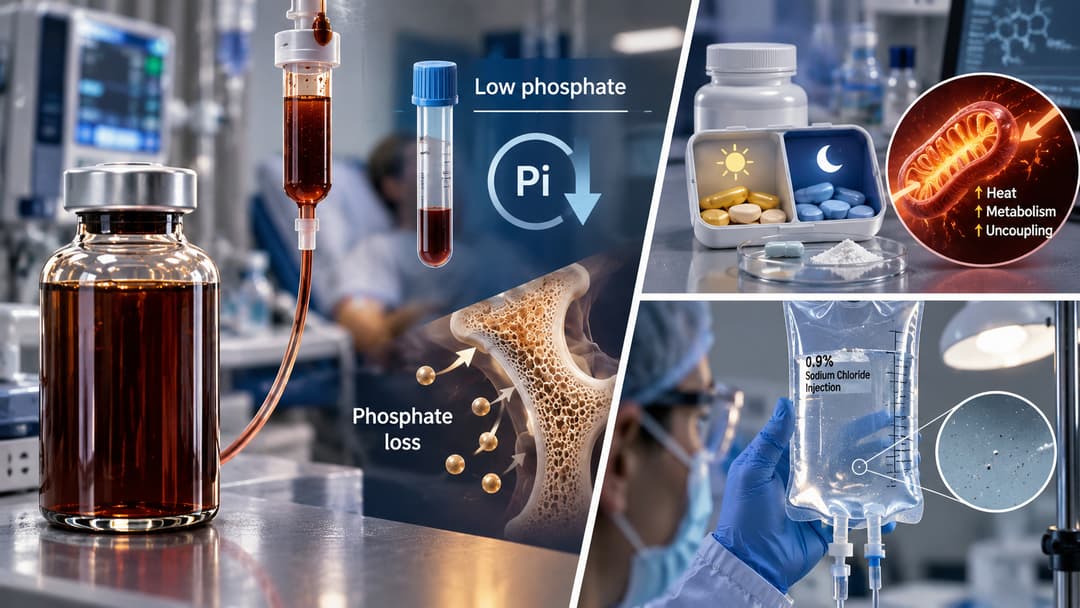
On September 1, FDA added a Boxed Warning for symptomatic hypophosphatemia to ferric carboxymaltose injection, currently marketed as Injectafer. The drug had appeared in FDA's January–March 2026 AEMS table as a potential hypophosphatemia safety signal under evaluation. [1] [2]
FDA says symptomatic cases continued despite earlier labeling changes. Severe or prolonged hypophosphatemia can cause weakness, pain, fatigue, tremor, confusion, seizures, cardiac arrhythmias, osteomalacia and fractures. FDA recommends phosphate monitoring in patients at risk and before repeat courses given within three months. [1]
The mechanism is biologically plausible. Ferric carboxymaltose can increase biologically active FGF23, promoting renal phosphate wasting and reducing calcitriol. In a randomized trial, hypophosphatemia below 2.0 mg/dL occurred in 50.8% of ferric-carboxymaltose recipients versus 0.9% of patients receiving ferumoxytol. [3]
For pharmacovigilance, the sequence is notable:
AEMS safety signal → additional FDA review → Boxed Warning
That does not mean spontaneous reports alone established causality or incidence. MedicalToxic explains that distinction in What Is FAERS and Why It Matters in Medical Toxicology.
A different toxicology problem emerged from Lipofit Extreme Fat Burner 2.0.
FDA posted a nationwide recall on August 31 after laboratory testing found undeclared fluoxetine in daytime tablets and undeclared 2,4-dinitrophenol (DNP) in nighttime tablets. No known adverse events related to the recall had been reported at the time of the announcement. [4]
DNP uncouples oxidative phosphorylation, dissipating metabolic energy as heat rather than efficiently producing ATP. Severe poisoning can produce hyperthermia, diaphoresis, tachycardia, tachypnea, seizures, cardiovascular collapse and death; there is no established specific antidote. [5]
This is fundamentally different from the injectable recalls that followed.
Lipofit's problem was an undeclared pharmacologically active toxin.
The injectable events involve failures in the physical quality, sterility or integrity of products intended to enter the vascular system.
The first major cluster involved products already covered in this article.
American Regent recalled three lots of epinephrine injection after complaints involving cracked or leaking vials. Investigation identified particulates including nylon, cellulosic material, acrylic, polyethylene and glass, while damaged container integrity meant sterility could not be assured. No recall-related adverse events had been reported at announcement. [6]
B. Braun's September 3 saline recall involved three lots containing particulate matter described in the updated FDA-posted announcement as iron oxide, inorganic material, cellulose or polystyrene. FDA-listed potential consequences include pulmonary emboli, vascular occlusion, tissue or organ injury and phlebitis. No serious injury, death or other associated adverse event had been reported. [7]
Baxter separately recalled two lots of 500 mL 0.9% sodium chloride because of potential fiberglass particulate matter. No associated adverse events had been reported as of August 25. [8]
The September safety picture has now expanded again.
FDA posted Par Health's nationwide recall of two lots of Dexmedetomidine HCl in 0.9% Sodium Chloride Injection, 400 mcg/100 mL (4 mcg/mL) on September 21.
The affected lots are:
87558 — expiration February 2027
88802 — expiration April 2027
The product is being recalled because particulate matter was identified as cellulose or stopper material. The two lots were distributed nationwide to wholesalers between May 13 and June 29, 2025. [9]
FDA-posted risk language states that administration of an affected IV product has a reasonable probability of life-threatening consequences including pulmonary emboli, occlusion of other blood vessels with possible tissue death or organ injury, and venous-wall inflammation that may lead to clotting. [9]
Those are potential consequences of intravascular particulate exposure, not reported outcomes in this recall.
As of the announcement, Par Health had received no adverse-event reports associated with the recall. [9]
The toxicologic mechanism therefore fits the same broad category as the B. Braun and Baxter recalls:
foreign material unintentionally delivered into the vascular system.
It does not require a separate dexmedetomidine-specific toxicology explanation.
The Spectra/Huons issue is different.
FDA's September 18 communication concerns Sodium Chloride Injection 0.9%, USP, 10 mL flush ampules distributed by Elevaris Medical Devices, doing business as Spectra Medical Devices, and manufactured by Huons Co., Ltd. [10]
Huons initiated the underlying recall after an FDA inspection identified manufacturing-quality problems.
FDA states that if sterility is compromised, patients could be exposed to:
viable microorganisms;
endotoxins; and/or
foreign material generated during manufacturing.
Potential consequences include systemic inflammatory reactions, infection, micro-clots and organ failure, particularly in vulnerable patients. [10]
FDA identifies the Spectra removal as the most serious type of recall. Spectra instructed customers to immediately identify affected stock and discard or return unused ampules.
As of July 6, Spectra had reported no serious injuries or deaths associated with the issue. [10]
The key development is that these ampules were not used only as stand-alone flush products.
They were also incorporated into downstream procedural and convenience kits.
FDA's current recall communications show the affected saline ampules appearing inside products from several downstream kit manufacturers.
Medical Action Industries issued corrections for epidural kits containing recalled Huons/Spectra sodium chloride ampules. FDA updated the communication on September 10 to state that the action had been classified as a Class I Recall. The specific concern is amplified by use near the spine, where compromised sterility could lead to infection, abscess formation or other serious complications. As of July 23, the company had reported no serious injuries or deaths associated with the issue. [11]
AVID Medical also issued corrections for convenience kits containing recalled Huons sodium chloride ampules. FDA updated that communication on September 21 to reflect Class I status. Customers are instructed to remove and discard the affected saline ampules; the remaining kit components may continue to be used after correction. As of August 10, AVID had reported no serious injuries or deaths. [12]
On September 24, FDA updated the Becton Dickinson communication to classify its convenience-kit and procedure-tray correction as Class I and clarify the reason for correction. BD states that the recalled sodium chloride ampule is the affected component; other components can remain in use after the ampule is removed according to the correction instructions. As of July 29, BD had reported no serious injuries or deaths associated with the issue. [13]
A Class I classification describes the seriousness of the potential risk.
It does not mean that serious injury or death necessarily occurred.
Product | Main issue | Key distinction |
|---|---|---|
Dexmedetomidine IV | Cellulose or stopper particulate | Direct intravascular foreign-material exposure |
Spectra/Huons saline flush | Sterility, endotoxin and foreign-material concern | Manufacturing-quality issue propagated into downstream kits |
Epinephrine Injection | Multiple particulates + lack of sterility assurance | Cracked/leaking vials add container-integrity risk |
B. Braun saline | Iron oxide, inorganic, cellulose or polystyrene particles | Multiple characterized particulates |
Baxter saline | Potential fiberglass particulate | Separate lot-specific particulate recall |
The common feature is not a common contaminant.
It is the vulnerability created when a product intended for injection or vascular access contains something that should not be there—or cannot be assured to remain sterile.
The recent FDA actions involve several distinct mechanisms.
Foreign particulate exposure includes the dexmedetomidine, B. Braun, Baxter and part of the American Regent recalls.
Container-integrity and sterility assurance are central to the cracked or leaking American Regent epinephrine vials.
Sterility, endotoxin and foreign-material concerns drive the Huons/Spectra saline-flush recall and its downstream kit corrections.
These should not be conflated with the separate compounded-glutathione investigation.
MedicalToxic's FDA Warns After Endotoxin-Consistent Reactions Reported in at Least 30 Patients Given Compounded IV Glutathione concerns a different pathway: ingredient quality in sterile compounding and excessive endotoxin exposure.
Different products. Different defects. Different exposure pathways.
The current cluster does not establish that injectable contamination is increasing nationally.
FDA has issued several recalls in a short period, but recall frequency alone does not provide a denominator, incidence rate or evidence of a national trend.
Likewise, FDA's descriptions of emboli, organ injury, infection, inflammatory reactions or death in recall risk statements describe possible consequences if affected products are used.
They should not be rewritten as outcomes that actually occurred unless patient cases are documented.
The same restraint applies to Class I device recalls.
“Most serious type” reflects the potential for serious injury or death—not proof that either outcome occurred.
The information gain from the latest update is not simply that two more recalls exist.
Two different safety patterns have become clearer.
First, dexmedetomidine adds another independently documented example of direct IV particulate exposure, this time involving cellulose or stopper material.
Second, the Huons/Spectra saline-flush problem demonstrates downstream propagation: one manufacturing-quality issue can travel into procedural kits assembled and sold by other companies, requiring corrections across multiple product lines and care settings.
That creates a broader medication- and device-safety lesson:
An injectable-quality failure can begin upstream but remain clinically relevant far downstream from the original manufacturer.
FDA's September toxicology actions now span very different forms of risk.
Injectafer illustrates a postmarketing drug-safety signal progressing to a Boxed Warning. Lipofit demonstrates the danger of undeclared active substances. The latest injectable recalls involve foreign particulates, container-integrity failures and sterility concerns that can propagate into downstream procedural kits.
Par Health's dexmedetomidine recall adds cellulose or stopper particulate to the recent series of intravascular foreign-material concerns, while the Huons/Spectra saline issue shows how a manufacturing-quality problem can spread through convenience, epidural and procedural kits.
None of these events establishes a national contamination outbreak or an increasing incidence of injectable defects.
Their shared lesson is more precise:
For products entering the bloodstream, manufacturing quality, container integrity, sterility and supply-chain traceability are themselves clinically important toxicology safeguards.
U.S. Food and Drug Administration. (2026, September 1). FDA Adds Boxed Warning to Labeling for Ferric Carboxymaltose Injection (Injectafer) to Describe Risk of Low Phosphate Levels.
U.S. Food and Drug Administration. (2026). January–March 2026: New Safety Information or Potential Signals of Serious Risks Identified by the FDA Adverse Event Monitoring System (AEMS).
Wolf, M., Chertow, G. M., Macdougall, I. C., Kaper, R., Krop, J., & Strauss, W. (2018). Randomized trial of intravenous iron-induced hypophosphatemia. JCI Insight, 3(23), e124486. DOI: 10.1172/jci.insight.124486.
U.S. Food and Drug Administration. (2026, August 31). Ana Salazar Modela Tu Cuerpo Inc. Issues Nationwide Voluntary Recall of Lipofit Extreme Fat Burner 2.0 Due to Presence of Undeclared Fluoxetine and 2,4-Dinitrophenol (DNP).
Grundlingh, J., Dargan, P. I., El-Zanfaly, M., & Wood, D. M. (2011). 2,4-Dinitrophenol (DNP): A weight loss agent with significant acute toxicity and risk of death. Journal of Medical Toxicology, 7(3), 205–212. DOI: 10.1007/s13181-011-0162-6.
U.S. Food and Drug Administration. (2026, September 3). American Regent, Inc. Issues Voluntary Nationwide Recall of Three Lots of Epinephrine Injection, USP 30 mg/30 mL (1 mg/mL) Due to the Presence of Particulate Matter and Lack of Assurance of Sterility.
U.S. Food and Drug Administration. (2026, September 3). B. Braun Medical Inc. Issues Voluntary Nationwide Recall of 0.9% Sodium Chloride Injection USP, 100 mL, in a 150 mL PAB® Container Due to the Presence of Particulate Matter.
U.S. Food and Drug Administration. (2026, August 26). Baxter Issues Voluntary Nationwide Recall for Two Lots of 0.9% Sodium Chloride Injection Due to Potential Presence of Particulate Matter.
U.S. Food and Drug Administration. (2026, September 21). Par Health Issues Voluntary Nationwide Recall of Two Lots of Dexmedetomidine HCl in 0.9% Sodium Chloride Injection Due to the Presence of Particulate Matter.
U.S. Food and Drug Administration. (2026, September 18). Sodium Chloride Flush Recall: Spectra Medical Removes Sodium Chloride Injection USP Ampules.
U.S. Food and Drug Administration. (2026, updated September 10). Epidural Kit Correction: Medical Action Industries Issues Correction for Epidural Kits Containing Spectra Medical Devices Lidocaine Ampules.
U.S. Food and Drug Administration. (2026, updated September 21). Convenience Kit Correction: AVID Medical Issues Correction for Kits Containing Huons Sodium Chloride Ampules.
U.S. Food and Drug Administration. (2026, updated September 24). Convenience Kit Correction: Becton Dickinson Issues Correction for Kits and Procedure Trays Containing Recalled Sodium Chloride Ampules.
Keep reading
Regulatory and Policy Updates
07 Oct 2026 · Updated 09 Oct 2026
Regulatory and Policy Updates
19 Sept 2026 · Updated 01 Oct 2026

Regulatory and Policy Updates
15 Jul 2026 · Updated 16 Oct 2026
Regulatory and Policy Updates
24 Oct 2025 · Updated 26 Sept 2026
