Why Can Sulfonylurea Hypoglycemia Recur After Dextrose?

Amirhosein Shabrang
Post on 22 Nov 2026

Amirhosein Shabrang
Post on 22 Nov 2026
 Medical Toxicologymedicaltoxic.com
https://medicaltoxic.com/tox-spotlight/sulfonylurea-hypoglycemia-after-dextrose
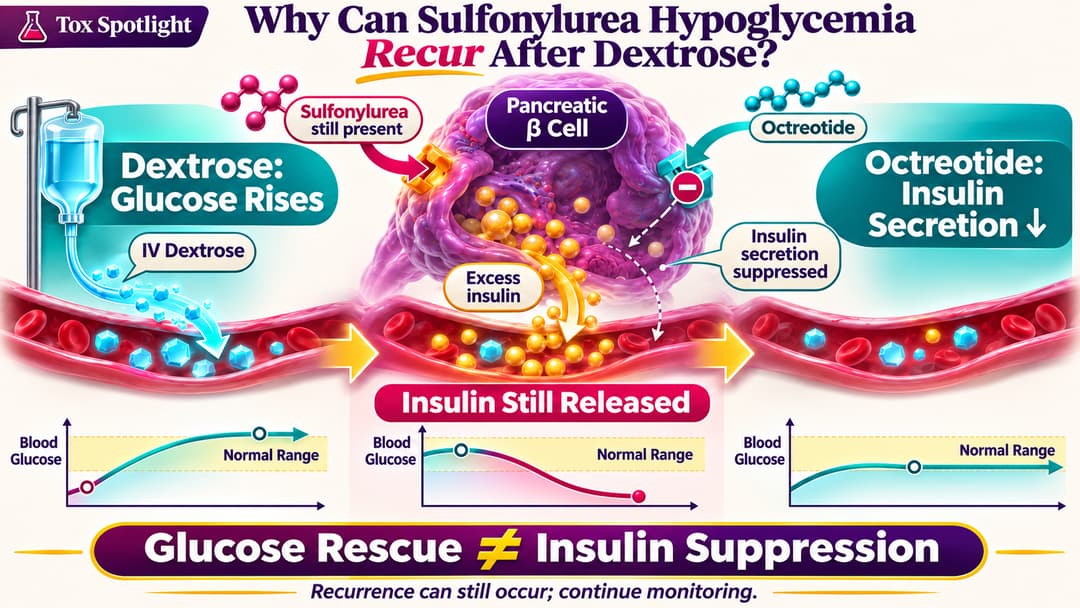
Why Can Sulfonylurea Hypoglycemia Recur After Dextrose?
Why Can Sulfonylurea Hypoglycemia Recur After Dextrose?
BODY
Dextrose can promptly correct sulfonylurea-induced hypoglycemia without stopping the excess insulin secretion that caused it. That is why glucose may fall again after an initially successful rescue.
Sulfonylureas stimulate pancreatic insulin release. Intravenous dextrose raises blood glucose, but the resulting glucose rise can further stimulate insulin secretion while the sulfonylurea remains active. An improved glucose measurement does not mean the underlying drug effect has ended. [1]
Dextrose remains essential for immediate correction of clinically important hypoglycemia. Octreotide is used in established sulfonylurea-induced hypoglycemia to suppress further insulin secretion and reduce recurrence. [2]
Sulfonylureas promote insulin release from pancreatic beta cells even when blood glucose is already low.
Giving dextrose supplies glucose to the circulation, but it does not switch off the drug-driven insulin response.
As the administered glucose is consumed, persistently elevated insulin can drive blood glucose down again. Repeated dextrose alone may therefore produce a cycle of temporary correction followed by recurrent hypoglycemia. [1]
Octreotide inhibits pancreatic insulin secretion.
In a prospective randomized study of patients with sulfonylurea-associated hypoglycemia, adding octreotide to standard treatment improved glucose control during the early observation period. [2]
This does not eliminate the need for glucose monitoring or guarantee that hypoglycemia cannot recur. The duration of the sulfonylurea effect, the patient's clinical course, and the response after treatment stops remain important.
For the full antidote, glucose-monitoring, observation, and disposition pathway, see Sulfonylurea Poisoning: Recurrent Hypoglycemia, Dextrose, Octreotide, and Monitoring.
Dextrose corrects the glucose; octreotide addresses the excess insulin.
A normal glucose after rescue is a treatment response—not proof that sulfonylurea toxicity has resolved.
Klein-Schwartz W, Stassinos GL, Isbister GK. Treatment of sulfonylurea and insulin overdose. British Journal of Clinical Pharmacology. 2016;81(3):496–504. doi:10.1111/bcp.12822
Fasano CJ, O'Malley G, Dominici P, Aguilera E, Latta DR. Comparison of octreotide and standard therapy versus standard therapy alone for the treatment of sulfonylurea-induced hypoglycemia. Annals of Emergency Medicine. 2008;51(4):400–406. doi:10.1016/j.annemergmed.2007.07.018
As the Growth & Content Lead at MedicalToxic.com, I work on content strategy, development, and digital growth. My focus is on making MedicalToxic’s content clear, practical, and accessible, while helping expand the platform’s reach and strengthen its position as a trusted resource in clinical toxicology.
Keep reading

Toxic Agents and Antidotes
24 Nov 2026
Amirhosein Shabrang

Toxic Agents and Antidotes
29 Oct 2026
Amirhosein Shabrang
Toxic Agents and Antidotes
28 Oct 2026
Amirhosein Shabrang
Toxic Agents and Antidotes
26 Oct 2026
Amirhosein Shabrang
We would like to use analytics and session-replay tools to understand how this site is used. They are optional and the site works fully without them. Signing in still needs its own cookie either way. Our Privacy Policy names each one.