Sulfonylurea Poisoning: Recurrent Hypoglycemia, Dextrose, Octreotide, and Monitoring
Published on 10 Nov 2026

Published on 10 Nov 2026
 Medical Toxicologymedicaltoxic.com
https://medicaltoxic.com/guidelines/sulfonylurea-poisoning-octreotide-management
Sulfonylurea poisoning can produce profound, delayed, and recurrent hypoglycemia after intentional overdose, accidental pediatric ingestion, therapeutic error, or accumulation during treatment. Young children may develop severe toxicity after a small exposure. Older adults and patients with renal or hepatic dysfunction, reduced oral intake, or interacting glucose-lowering therapy are at increased risk of prolonged hypoglycemia. [1], [2]
The defining management problem is persistent pancreatic insulin secretion. Intravenous dextrose corrects the immediate glucose deficit but can also stimulate further insulin release while the sulfonylurea remains active. After initial correction of sulfonylurea-induced hypoglycemia, octreotide is used to suppress further insulin secretion and reduce recurrence. [1], [2], [3], [4]
No single tablet count, mg/kg threshold, serum drug concentration, octreotide route or interval, or fixed observation period applies safely to every sulfonylurea exposure. Product formulation, patient age, renal and hepatic function, oral intake, co-medications, and the clinical course must guide management. [1], [4]
This guideline distinguishes recommendations based on direct clinical evidence, expert consensus, or conservative safety policy. Recommendations based on safety policy rather than evidence are identified as such.
Scope: This pathway addresses sulfonylurea exposure and strongly suspected sulfonylurea-associated hypoglycemia. It is not a universal hypoglycemia algorithm. Repaglinide and nateglinide are meglitinides: emergency glucose correction may be similar, but observation requirements must be assessed separately; interactions can markedly extend repaglinide toxicity. Unexplained hypoglycemia without credible exposure requires independent diagnostic evaluation. [5], [6], [7], [8]
Clinical warning
Sulfonylureas can cause delayed or recurrent hypoglycemia. Check bedside glucose immediately. Give IV dextrose for severe hypoglycemia, neuroglycopenia, seizure, coma, or inability to swallow; use oral glucose only when alert and swallowing safely. Start octreotide after correction of clinically significant, persistent, or recurrent sulfonylurea-associated hypoglycemia, particularly when IV dextrose was required. A single mild oral-corrected episode requires serial checks and individualized toxicology assessment, not automatic octreotide. Do not give prophylactic IV dextrose to normoglycemic patients. Pediatric ingestion requires poison-center assessment, usually with facility observation. After IV dextrose or octreotide, generally observe at least 12 hours after whichever treatment ended later; extend for long-acting agents, renal impairment, recurrence, or other risks.
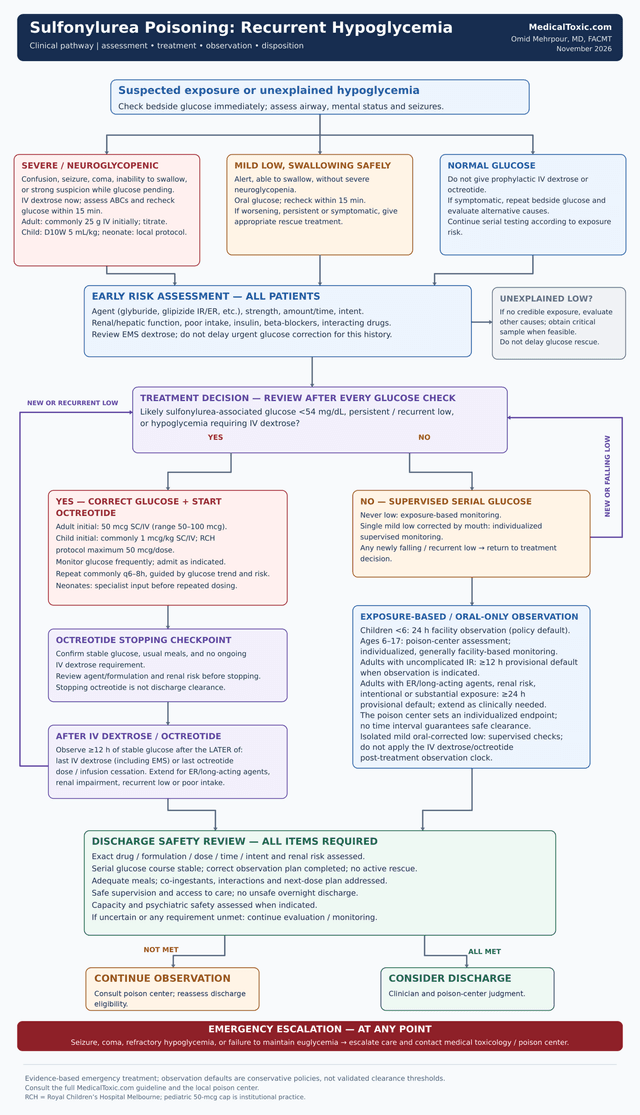
Sulfonylurea poisoning treatment and monitoring pathway.
Figure interpretation: This is an operational decision pathway. The age-based 24-hour pediatric policy, proposed 12/24-hour adult observation defaults, and post-treatment monitoring intervals are conservative safety policies rather than validated clearance thresholds. The full written clinical pathway appears below.
Treat the mechanism early. Following initial correction of clinically significant, persistent, or recurrent sulfonylurea-induced hypoglycemia, use octreotide when indicated, particularly if IV dextrose was required. An isolated mild oral-corrected episode requires repeated glucose assessment and individualized toxicology guidance. [1], [2], [3], [4]
Match treatment to severity. Mild hypoglycemia in an alert patient who can swallow may be treated with oral carbohydrate; severe or neuroglycopenic hypoglycemia requires immediate IV dextrose.
No prophylactic IV dextrose for an asymptomatic normoglycemic patient. It can stimulate insulin secretion and delay recognition of the natural time course. [1]
Feed alert patients normally, but do not give extra carbohydrate to prevent hypoglycemia, deliberately fast patients, or treat carbohydrate tolerance as proof that toxicity has passed.
Young children may become severely hypoglycemic after one or two tablets. This guideline proposes a conservative 24-hour facility-observation default for credible ingestion in children younger than 6 years. Ages 6–17 require poison-center assessment and individualized observation, ordinarily with a low threshold for facility monitoring; intentional ingestions require ED assessment at any age. These are safety-policy choices, not validated age-based clearance thresholds. [1], [9], [10], [11], [12]
Octreotide dosing is not standardized. Every 6–8 hours is the most commonly reported intermittent regimen; no interval or route has been proved superior. [3], [4], [13]
The 2026 route study included 29 patients, only four of whom received an infusion. Although its findings suggested possible infusion inferiority, they cannot establish comparative route efficacy or determine preferred therapy. [13] Continuous infusion remains an option in selected severe or refractory cases under specialist protocol. [4], [12]
Observation follows the patient's clinical course: exposure-based monitoring if never hypoglycemic, supervised assessment after an isolated oral-corrected low, and post-treatment monitoring after IV dextrose or octreotide. Stopping octreotide is a separate clinical decision, not discharge authorization. [1]
Dialysis is not a toxin-removal treatment for sulfonylurea poisoning. Management rests on glucose correction, suppression of insulin release, monitoring, and supportive care.
Sulfonylureas stimulate endogenous insulin release and are used for type 2 diabetes mellitus. Poisoning may result from acute overdose, accidental ingestion, dosing errors, drug accumulation, reduced caloric intake, or continued therapeutic use in a patient whose clearance or physiologic reserve has changed.
Agent | Formulation / context | Toxicology relevance |
|---|---|---|
Glipizide | Immediate- and extended-release formulations | IR and ER tablets differ in delivery; glipizide ER may require prolonged observation despite initially normal glucose. [1], [10], [14] |
Glyburide / glibenclamide | Second-generation sulfonylurea | Active hypoglycemic metabolites and renal dysfunction increase concern for prolonged or recurrent hypoglycemia. [15], [16] |
Glimepiride | Once-daily agent | Effects may be prolonged; renal impairment affects metabolite elimination and increases recurrence risk. [17] |
Gliclazide | Common outside the United States | Can cause recurrent or prolonged hypoglycemia, especially with impaired clearance or reduced intake. [1], [2] |
Chlorpropamide and older agents | Less commonly encountered | Long-acting agents may cause delayed or prolonged toxicity requiring individualized observation. [1] |
Reconstruct the exact medication, strength, formulation (IR vs ER), available amount, ingestion time, last usual dose, renal and hepatic function, nutritional status, and co-medications.
Agent-specific risk and kidney function must be considered at each disposition decision, not merely documented.
Sulfonylureas bind to the SUR1 component of pancreatic beta-cell ATP-sensitive potassium channels. Channel closure causes membrane depolarization, calcium influx, and insulin secretion. [1]
This explains the characteristic therapeutic problem:
Sulfonylurea remains active → insulin secretion continues → glucose falls → IV dextrose raises glucose → rising glucose stimulates additional insulin release → glucose falls again.
Octreotide interrupts this cycle by activating somatostatin receptors and reducing calcium-dependent insulin secretion from pancreatic beta cells. [1], [2]
Therapy | Primary role |
|---|---|
Dextrose | Correct the immediate glucose deficit |
Octreotide | Suppress ongoing insulin secretion and reduce recurrence |
Oral carbohydrate | Treat mild hypoglycemia in an alert patient; maintain nutrition after correction |
Glucagon | Temporary rescue if IV access is unavailable; not preferred for ongoing therapy |
There is no validated universal toxic dose across sulfonylureas. Risk assessment should not rely solely on the number of tablets. Young children are particularly vulnerable; profound hypoglycemia has occurred after ingestion of only one or two tablets. [10]
Healthcare-facility assessment is recommended in the following circumstances. These are conservative clinical recommendations rather than a validated prediction rule:
Pediatric patient younger than 18 years with credible sulfonylurea ingestion; structured exceptions require a poison-center protocol
Intentional overdose
Extended-release or long-acting product
Unknown amount or uncertain timing
Symptoms or documented hypoglycemia
Concurrent insulin exposure
Suspected sulfonylurea toxicity or credible excess exposure with renal or hepatic dysfunction, especially with glyburide, glimepiride, or long-acting agents
Additional factors that increase risk, lengthen observation, or lower the admission threshold include:
Older age or frailty
Renal or hepatic dysfunction
Reduced oral intake, vomiting, fasting, or malnutrition
Other glucose-lowering medications
Previous hypoglycemic episodes
Unreliable history or inability to monitor safely
[1], [9], [14], [15], [16], [17]
These factors should inform treatment and observation planning early, not only the final discharge decision.
Pre-discharge safety review
Confirm and document:
Exact agent, IR/ER formulation, dose, timing, and intent
Renal or hepatic disease
Co-ingestants, insulin, interactions, and possible masking of adrenergic symptoms, including beta-blockers
Serial glucose trajectory and any EMS glucose treatment
Applicable observation period and last IV dextrose/octreotide administration
Oral intake, home supervision, reliable follow-up, and nighttime safety
If clinically important uncertainty remains, continue assessment or observation.
No validated agent-by-eGFR discharge-hour matrix exists. [1], [14], [15], [16], [17]
Early adrenergic manifestations include sweating, tremor, palpitations, hunger, and anxiety.
Progressive neuroglycopenia may produce:
Dizziness or headache
Abnormal behavior or confusion
Lethargy
Dysarthria
Visual disturbance
Focal neurologic findings
Seizures
Coma
Older adults, patients with autonomic neuropathy, and patients taking beta-blockers may have less prominent adrenergic warning symptoms.
The severity of neurologic dysfunction depends more on the depth and duration of hypoglycemia than on reported drug dose. [1], [2]
Determine:
Exact medication and tablet strength
Immediate-release versus extended-release formulation
Maximum possible amount
Exposure time
Acute ingestion versus repeated therapeutic dosing
Intent
Current diabetes regimen, including insulin
Recent GLP-1 receptor agonist or other antihyperglycemic use
Renal and hepatic disease
Reduced food intake, vomiting, fasting, alcohol use, or acute illness
Recent medication changes or dosing errors
Co-ingestants
Carbohydrate or IV dextrose already administered
In a young child, inspect medication containers and consider whether drugs belonging to more than one household member may be missing.
Operational glucose definitions
According to ADA definitions:
<70 mg/dL (3.9 mmol/L): hypoglycemia alert threshold
<54 mg/dL (3.0 mmol/L): clinically significant hypoglycemia
Severe hypoglycemia: altered mental or physical status requiring assistance, independent of a numerical glucose threshold
Definitions differ across toxicology studies; several pivotal studies used glucose <60 mg/dL. [3], [9], [11]
Start octreotide early after initial correction of sulfonylurea-associated hypoglycemia requiring IV dextrose or when hypoglycemia is clinically significant, persistent, or recurrent.
Operational distinction: A single mild low corrected with oral carbohydrate alone does not automatically require octreotide. Repeat glucose assessment and risk review remain essential. This distinction is not a validated treatment threshold. [1], [2], [3], [4]
Bedside glucose is the most important immediate test.
Check glucose promptly after suspected exposure and repeatedly throughout the risk period.
During active hypoglycemia, IV dextrose therapy, or octreotide treatment, check glucose at least hourly after initial stabilization, and more frequently during active correction. Lengthen intervals only after a stable trajectory has been established. [1]
Do not use one normal glucose measurement to determine disposition.
Test | Clinical purpose |
|---|---|
Serum/plasma glucose | Confirm hypoglycemia and correlate with bedside results |
Electrolytes and bicarbonate | Identify concurrent or treatment-related abnormalities |
Potassium, magnesium, phosphate | Detect shifts during insulin- and glucose-directed treatment |
BUN/creatinine | Identify impaired clearance and prolonged-risk states |
Hepatic tests | Evaluate suspected hepatic dysfunction or alternative diagnoses |
Acetaminophen and other co-ingestant testing | Appropriate after intentional or uncertain overdose |
ECG | Appropriate in intentional overdose, suspected co-ingestion, or significant illness |
Avoid reflexively overcorrecting potassium when the reduction is predominantly due to insulin-mediated intracellular redistribution.
These tests are most useful when the cause of hypoglycemia is uncertain.
During a spontaneous episode, obtain a critical sample when feasible, including:
Laboratory glucose
Insulin
C-peptide
Proinsulin
Beta-hydroxybutyrate
Sulfonylurea/meglitinide screen
When possible, obtain the sample from the initial venipuncture before dextrose administration. Avoid sampling through glucose-contaminated lines.
Never delay emergency glucose correction, airway management, or seizure treatment to obtain diagnostic samples. Document timing when treatment must precede sampling. [5], [8]
Sulfonylurea-induced hypoglycemia typically produces endogenous hyperinsulinemia with insulin and C-peptide inappropriately present during hypoglycemia.
Exogenous insulin usually produces elevated insulin with suppressed C-peptide, although interpretation depends on assay characteristics, timing, prior glucose treatment, and kidney function. [5]
Historical numerical insulin/C-peptide thresholds should not be treated as universally applicable diagnostic cutoffs.
Sulfonylurea screens may have delayed turnaround and should not determine immediate treatment.
Sulfonylurea versus exogenous insulin
Both can produce profound recurrent hypoglycemia.
Octreotide suppresses endogenous pancreatic insulin secretion but does not reverse injected insulin. Exogenous insulin poisoning may require prolonged IV dextrose support.
Meglitinides — separate scope
Repaglinide and nateglinide are insulin secretagogues but are not sulfonylureas.
Emergency glucose correction is similar when indicated, but sulfonylurea observation periods should not be applied automatically.
Drug interactions can substantially extend toxicity. Gemfibrozil increases repaglinide exposure approximately eightfold and can prolong its effects. [6], [7]
GLP-1 receptor agonists
Isolated GLP-1 receptor agonist exposure usually differs from classic sulfonylurea poisoning because insulin secretion remains substantially glucose dependent.
Hypoglycemia is more important with concomitant insulin, sulfonylurea therapy, reduced intake, or another exposure.
For the separate clinical pathway, see GLP-1 Receptor Agonist Toxicity: Semaglutide, Tirzepatide, and Related Agents.
Other causes of hypoglycemia
Consider exogenous insulin, ethanol, sepsis, severe hepatic failure, adrenal insufficiency, malnutrition, insulinoma, other medications, and factitious or surreptitious exposure.
Unexplained-hypoglycemia exit
When exposure is unconfirmed or another cause is plausible, treat hypoglycemia promptly while pursuing an independent diagnostic evaluation. Obtain critical samples if feasible without delaying rescue. [5], [8]
Diagnostic pitfalls
“Dextrose worked, so the patient is safe.” A transient increase in glucose does not mean the sulfonylurea effect has ended.
“The child has been eating, so delayed toxicity is excluded.” Pediatric data document onset up to 18 hours after ingestion among children receiving prophylactic food. [9]
“No symptoms means no hypoglycemia.” Young children, sleeping patients, older adults, and beta-blocked patients may have subtle or absent warning symptoms.
The core sequence is:
Recognize hypoglycemia → correct glucose according to severity → suppress ongoing insulin secretion with octreotide when indicated → maintain normal nutrition → monitor for recurrence → observe after treatment stops.
Airway, breathing, circulation, seizures, and other immediate life threats take priority.
For general poisoned-patient stabilization, see Comprehensive Guidelines for Managing Poisoning in Adults.
Contact a poison center or medical toxicologist early for:
Pediatric exposure
Intentional overdose
Recurrent hypoglycemia
Extended-release ingestion
Uncertain product or dose
Renal or hepatic dysfunction
Repeated octreotide or continuous dextrose requirements
Consideration of continuous octreotide infusion
An unusual or prolonged clinical course
The 2026 Clinical Toxicology Recommendations Collaborative (CTRC) provides the most current sulfonylurea-specific activated-charcoal recommendations. [19]
Scenario | Recommendation | Evidence grade |
|---|---|---|
≥5 therapeutic doses, ≤1 hour | Recommend single-dose activated charcoal | 1, D |
≥5 therapeutic doses, ≤2 hours | Suggest single-dose activated charcoal | 2, D |
Other dose/time combinations | Individualized risk assessment considering formulation, airway, and aspiration risk | — |
≥5 therapeutic doses, >6 hours | Suggest against routine single-dose charcoal | 2, D |
Additional-dose charcoal | Not routine; specifically suggested against for ≤9 therapeutic doses | 2, D |
Multiple-dose activated charcoal | Suggest against | 2, D |
“Five therapeutic doses” is the threshold used in the 2026 CTRC recommendations, not a validated boundary between safe and toxic exposure.
The recommendation against routine charcoal beyond six hours is conditional on the specified dose category.
Other dose/time combinations require individualized assessment.
Activated charcoal should be considered only when expected benefit exceeds aspiration and procedural risks.
Never delay treatment of hypoglycemia or resuscitation to administer charcoal.
Do not intubate solely for charcoal unless the expected case-specific benefit and poisoning severity justify the associated risks. [19]
Severe or neuroglycopenic hypoglycemia
In patients with confusion, seizure, coma, inability to swallow, or strongly suspected neuroglycopenia while testing is pending:
Stabilize airway, breathing, and circulation.
Treat seizures.
Give IV dextrose immediately.
Mild hypoglycemia with safe swallowing
Oral carbohydrate is appropriate when the patient is alert and can swallow safely.
Recheck glucose in 15 minutes.
Administer IV dextrose if there is inadequate response or clinical deterioration.
Oral treatment must not delay urgent treatment in a deteriorating patient.
Symptoms despite normal bedside glucose
Repeat testing if the bedside result does not fit the clinical presentation.
Evaluate other causes or co-ingestants.
Do not give dextrose or octreotide solely for nonspecific symptoms with confirmed normoglycemia.
If the patient is unstable and severe hypoglycemia is strongly suspected while testing is pending, emergency correction must not be delayed.
Patient | Initial IV dextrose |
|---|---|
Adult | Common initial dose 25 g IV, equivalent to 50 mL of D50W; published usual range 25–50 g, titrated to clinical response and glucose. [1] |
Child | 0.5 g/kg IV, for example D10W 5 mL/kg; reassess promptly. Published range 0.5–1 g/kg. [1] |
Neonate or young infant | Follow the local neonatal hypoglycemia protocol, generally using smaller D10W volumes. |
Recheck glucose within 15 minutes of each bolus.
Aim for euglycemia rather than marked hyperglycemia.
Repeated large dextrose boluses without suppression of ongoing insulin secretion may perpetuate the glucose–insulin–hypoglycemia cycle.
When a dextrose infusion is necessary, titrate to the lowest effective rate while octreotide and appropriate nutrition address ongoing insulin-driven hypoglycemia.
After correction, provide a normal meal or complex carbohydrate when the patient is alert and can swallow safely.
Do not repeatedly force large carbohydrate loads to avoid octreotide in patients with recurrent sulfonylurea-associated hypoglycemia.
Clinical role
Octreotide suppresses endogenous pancreatic insulin secretion and reduces recurrent hypoglycemia following initial glucose correction.
Start early when clinically significant, persistent, or recurrent sulfonylurea-associated hypoglycemia is established or strongly suspected, especially when IV dextrose was required. Do not wait for repeated severe rebound episodes.
Operational distinction: An isolated mild episode corrected orally requires serial reassessment and individualized toxicology advice, not mandatory immediate octreotide.
This distinction is not a validated treatment threshold.
Prophylactic octreotide is not indicated solely because an asymptomatic, normoglycemic exposure occurred. [1], [2], [3], [4]
In a double-blind trial involving 40 adults with sulfonylurea-associated hypoglycemia, standard treatment plus a single 75 mcg subcutaneous octreotide dose was compared with standard treatment plus placebo.
Mean glucose was higher with octreotide during the first eight hours, and recurrent hypoglycemia was less frequent. A significant glucose difference was not sustained beyond that period. [3]
This supports short-term efficacy but does not establish an optimal repeated-dose interval.
Patient | Initial dose | Repeat dosing | Evidence interpretation |
|---|---|---|---|
Adult | Common initial 50 mcg SC or IV; published range 50–100 mcg | Every 6–8 hours when recurrence is expected or occurs | SC 50–100 mcg every 6–8 hours is the most commonly reported adult approach; no interval proven superior. [4] |
Child | 1 mcg/kg SC or IV, published range 1–2 mcg/kg; maximum 50 mcg per dose under the cited institutional protocol | Every 6–8 hours according to recurrence risk | IV 1 mcg/kg is frequently reported; the 50 mcg maximum follows RCH institutional pediatric practice. [4], [12], [20] |
Two approaches are used according to anticipated clinical risk.
1. Scheduled dosing every 6–8 hours
Consider when continuing insulin secretion is expected, including:
Intentional or large ingestion
Extended-release or long-acting agent
Impaired clearance
Recurrent hypoglycemia after the initial octreotide dose
Reassess the need for ongoing dosing at least daily.
2. Initial single dose with re-dosing if recurrence develops
May be considered for selected small unintentional pediatric ingestions with stable serial glucose.
In one national pediatric series, 73% required only one dose. [20]
In either strategy, reassess the glucose trend. Re-dose when falling glucose suggests renewed sulfonylurea-induced hypoglycemia; do not wait for another severe neuroglycopenic event.
Repeat treatment depends on drug formulation, clearance, clinical response, and toxicology advice.
An observational comparison in the 2025 systematic review found no significant differences in several outcomes between 4–6-hour and 8–12-hour intervals. These small nonrandomized comparisons do not establish equivalence. [4]
Short-term effects may include:
Nausea
Abdominal discomfort
Diarrhea
Hyperglycemia
Injection-site discomfort
Bradycardia
Clinically important adverse events have been uncommon in the poisoning literature. [4], [20]
In a retrospective cohort of hospitalized infants receiving octreotide for various indications, Testoni et al. reported:
Chylothorax: 50%
Pleural effusion: 32%
Hypoglycemia: 22%
Necrotizing enterocolitis was reported during 9 of 490 treatment courses, approximately 2%.
A causal association with octreotide was not established, and the cohort does not measure risk from a single antidotal dose after poisoning. [21]
Neonates and medically fragile young infants requiring repeat doses or an infusion warrant neonatology and medical-toxicology consultation.
Never delay emergency IV glucose correction for severe hypoglycemia.
Intermittent subcutaneous dosing
Has the longest history in published poisoning management and is practical in stable patients.
Intermittent IV bolus
Is a reasonable alternative, especially when IV access is established.
The 2025 systematic review found broadly similar hypoglycemia control with intermittent SC and IV approaches, but heterogeneous evidence and small groups prevent a definitive ranking. [4]
Continuous IV infusion
Has been used in severe or recurrent poisoning and in some local protocols.
No universally validated infusion rate exists, and high-quality evidence does not establish superiority over intermittent treatment.
If used, follow a standardized pharmacy and medical-toxicology protocol.
Before stopping scheduled doses or an infusion, reassess:
Serial glucose stability
Ongoing IV dextrose requirement
Ability to maintain ordinary oral intake
Drug and formulation
Renal function
Likelihood of continued insulin secretion
Coordinate the decision with the poison center or local protocol.
Stopping octreotide is not equivalent to clearance for discharge.
After treatment, the general observation interval is measured from the later of the final IV dextrose administration or infusion cessation, including prehospital treatment, and the final octreotide dose or infusion cessation. [1], [12]
Gupta and colleagues conducted a multicenter retrospective review involving 29 patients treated with octreotide for suspected sulfonylurea-induced hypoglycemia. [13]
Outcome (median) | IV bolus | IV infusion | SC |
|---|---|---|---|
Number of patients | 10 | 4 | 15 |
Post-octreotide hypoglycemic events | 0 | 1.5 | 0 |
Total octreotide dose (mcg) | 50 | 693 | 100 |
Post-octreotide dextrose (g) | 115 | 256 | 80 |
Length of stay (hours) | 40 | 60 | 62 |
The authors suggested that infusion might be inferior and called for further investigation.
However, only four patients received an infusion. Treatment route was not randomized, and clinicians may have selected infusion because of greater baseline illness severity or recurrence risk.
The greater total octreotide dose in the infusion group is partly inherent to continuous administration and does not prove greater pretreatment severity.
No route performed best on every outcome. The SC group had the longest median hospital stay.
Clinical interpretation: These findings are hypothesis-generating. They do not establish that IV infusion causes worse outcomes or identify an optimal route.
Infusion remains a specialist option in selected severe or refractory poisoning. [13]
Glucagon
May provide temporary rescue when IV access is unavailable.
It is not preferred as ongoing treatment because it may stimulate additional insulin release and can be less effective when hepatic glycogen is depleted.
Establish IV access and provide dextrose and octreotide when indicated. [1]
Diazoxide
Historically used to inhibit insulin secretion.
Octreotide is generally preferred because of greater toxicology experience. Diazoxide is not a routine first-line substitute; consult medical toxicology if octreotide is unavailable or contraindicated.
Enhanced elimination
Hemodialysis, hemoperfusion, and related techniques are not established toxin-removal treatments for sulfonylurea poisoning.
Substantial protein binding limits dialytic clearance.
Kidney replacement therapy may still be appropriate for conventional organ-support indications, not as a substitute for glucose correction, octreotide, and monitoring. [1], [2]
Any credible sulfonylurea ingestion in a patient younger than 18 years requires poison-center assessment.
For children younger than 6 years, this guideline uses 24-hour healthcare-facility observation as a conservative default.
For children and adolescents 6–17 years, healthcare-facility evaluation is generally favored, with observation individualized according to agent, formulation, dose, intent, clinical course, and reliable monitoring.
Any shorter or home-based approach requires documented poison-center protocol selection. Intentional ingestions require emergency and safety assessment at any age.
These are operational safety policies, not validated age-specific clearance thresholds. [1], [9], [10], [11], [12]
A California Poison Control System study of children younger than 6 years reported:
300 of 1,943 consultations developed hypoglycemia, defined as glucose below 60 mg/dL.
10% had hypoglycemia occurring or persisting at least 12 hours after ingestion despite treatment.
Mean onset was 2.0 hours without prophylactic treatment.
Onset ranged from 1 to 18 hours among children given prophylactic food only.
Seven of 40 children in that subgroup (18%) developed hypoglycemia after eight hours.
All five seizures occurred before hospital presentation in previously unrecognized ingestions.
A separate national NPDS analysis of 121 children treated with octreotide found a median of two hypoglycemic episodes before octreotide and zero afterwards.
In this series, 73% received a single octreotide dose, and no adverse events were attributed to the drug. [20]
All patients younger than 18 years with credible ingestion should undergo poison-center assessment, usually with healthcare-facility serial glucose monitoring.
A major toxicology review considers approximately 12 hours of observation reasonable in asymptomatic children and advises avoiding nighttime discharge. [1]
The Royal Children's Hospital Melbourne recommends 24 hours for any child with possible sulfonylurea exposure. [12]
This guideline adopts the 24-hour facility-observation default for children younger than 6, while patients aged 6–17 undergo individualized poison-center-directed observation, frequently in a healthcare facility.
The age distinction and recommended minimums are conservative policies rather than validated safe-discharge thresholds. Clinicians may use the more conservative RCH all-children approach.
Allow normal meals when alert and swallowing safely.
Do not administer prophylactic IV dextrose.
Do not deliberately give extra carbohydrate to prevent anticipated hypoglycemia.
Do not deliberately fast the child.
The delayed onset described in pediatric studies shows that hypoglycemia can develop after 12 hours. It does not establish the incidence of entirely new hypoglycemia after 12 hours or prove that normal meals independently delay onset. [9]
For selected children younger than 6, a shorter observation period may be considered only through a documented poison-center protocol reviewing the exact drug, formulation, exposure time, serial glucose values, and follow-up reliability.
Older children and adolescents require individualized assessment, especially with intentional ingestion, modified-release products, or recurrent low glucose.
Avoid nighttime discharge.
Temple and colleagues reported 135 selected children aged five years or younger initially managed at home through an established Oregon Poison Center protocol using home glucose-meter checks.
Most (85%) had reportedly ingested no more than one tablet of a second-generation sulfonylurea.
Ten children (7%) were subsequently referred to a healthcare facility.
Five developed uncomplicated asymptomatic hypoglycemia; no seizures or coma occurred. [11]
These findings support carefully selected protocol-based exceptions, not routine home management of pediatric sulfonylurea exposure.
Children requiring IV dextrose or octreotide follow the post-treatment monitoring pathway.
An isolated mild low corrected orally requires supervised serial testing and exposure-based assessment. Any new or falling value requires a renewed treatment decision.
Not every serious sulfonylurea poisoning involves acute overdose.
Toxicity can occur during prescribed treatment when exposure coincides with:
Acute kidney injury or chronic renal impairment
Hepatic dysfunction
Reduced food intake
Acute illness
Frailty
Medication changes
Interacting glucose-lowering treatment
A case-control series involving patients with end-stage renal disease reported glyburide-associated hypoglycemia requiring IV glucose for 28–256 hours, illustrating potentially prolonged toxicity in high-risk patients. [15]
Current product information similarly identifies renal impairment, older age, malnutrition, hepatic dysfunction, and inadequate caloric intake as clinically relevant risks. [14], [16], [17]
These patients should not automatically receive the shortest observation period designed for uncomplicated acute ingestion.
Clinical scenario | Recommended disposition |
|---|---|
Child younger than 6 with credible ingestion | Poison-center assessment and facility serial glucose monitoring; 24-hour observation is the conservative default, not a validated cutoff |
Child/adolescent aged 6–17 with credible ingestion | Poison-center assessment and generally healthcare-facility evaluation; individualized duration; intentional ingestion requires ED assessment |
Intentional overdose, any age | ED evaluation; assess co-ingestants and self-harm risk |
Symptomatic patient or documented hypoglycemia | ED or hospital management |
Recurrent hypoglycemia requiring octreotide or IV dextrose | Admission to a monitored setting |
Seizure, coma, refractory hypoglycemia, airway compromise, intensive glucose support | ICU or critical-care evaluation |
ER/long-acting agent, significant renal or drug risk, uncertain amount/time | Facility evaluation and extended individualized observation |
Minor inadvertent therapeutic error in asymptomatic adult | Home management only after documented poison-center low-risk assessment, with reliable glucose monitoring and follow-up |
Asymptomatic adult requiring facility observation | Provisional planning default of ≥12 hours for uncomplicated immediate-release exposure or ≥24 hours for ER/long-acting, renal-risk, intentional, or substantial exposure; extend when required |
All intentional overdoses require medical and appropriate psychiatric/safety assessment before discharge. [1]
A normal initial glucose does not exclude delayed poisoning.
Assess and document decision-specific capacity and relevant medical or psychiatric risks.
Involve emergency medicine and medical toxicology, and follow applicable institutional and legal requirements.
Refusal is not evidence of toxicologic clearance.
For an adult whose exposure requires observation, this guideline proposes the following provisional planning defaults:
≥12 hours after a reliably timed uncomplicated immediate-release ingestion.
≥24 hours, often longer, for modified-release or long-acting agents, significant renal impairment or other high-risk conditions, and intentional or substantial overdoses.
These are conservative planning intervals, not validated agent-specific clearance times. Review and authorize the endpoint case by case with the poison center.
Selected low-risk asymptomatic adults with minor inadvertent therapeutic errors may qualify for poison-center-directed home management.
For children younger than 6, the default is 24-hour facility observation.
For ages 6–17, use individualized poison-center guidance, generally favoring facility evaluation.
Count exposure-based monitoring from the known ingestion time or last plausible exposure time. When timing is uncertain, use a more conservative plan.
Any low glucose requires reassessment of treatment and observation.
Continue supervised serial glucose assessment.
Review:
Drug and formulation
Renal function
Glucose trend
Oral intake
Other clinical risks
Do not apply the last-IV-dextrose/last-octreotide clock when neither intervention was used.
Persistent, recurrent, or clinically significant hypoglycemia requires prompt treatment reassessment, including octreotide when indicated.
Do not discharge solely because the initial oral carbohydrate response was satisfactory.
Generally observe for at least 12 hours of stable serial glucose after the later of:
The final IV dextrose dose or infusion cessation, including EMS or prehospital treatment; and
The final octreotide dose or infusion cessation.
Any new administration of IV dextrose or octreotide updates the applicable last-treatment time.
Extend monitoring for recurrent hypoglycemia, ER/long-acting agents, renal dysfunction, inadequate intake, or other clinical risks.
Completion of a timer alone does not authorize discharge. [1]
Recurrent hypoglycemia
Extended-release or long-acting agent
Renal or hepatic dysfunction
Prolonged therapeutic toxicity
Pediatric uncertainty
Uncertain ingestion timing
Substantial intentional overdose
Inability to maintain adequate nutrition
Unreliable follow-up or supervision
Consider discharge only after every relevant item has been assessed and found satisfactory.
No recurrent hypoglycemic symptoms
Exact agent, IR/ER formulation, dose, timing, and intent adequately documented
Renal and hepatic function considered in the disposition decision
Serial glucose values stable without IV dextrose
Prehospital treatment and possible blunting of adrenergic symptoms reviewed
Appropriate exposure-based or post-treatment observation completed
Normal diet tolerated
No unresolved dangerous co-ingestant
Safe home supervision and access to medical care
Home glucose monitoring and caregiver reliability assessed
Overnight safety considered
Daytime discharge when appropriate, especially for children
Intentional exposures have received appropriate psychiatric and safety assessment
Individualized plan for withholding, adjusting, or restarting sulfonylurea therapy agreed with the treating clinician
Unresolved concerns require further observation, diagnostic assessment, or specialist consultation—not automatic discharge.
Step 1 — Assess and correct immediate threats
Assess airway, breathing, circulation, mental status, seizures, and bedside glucose.
Correct severe or neuroglycopenic hypoglycemia promptly with IV dextrose.
Adult: commonly 25 g IV initially
Child: commonly D10W 5 mL/kg
Neonate: follow local neonatal protocol
Use oral carbohydrate only for mild hypoglycemia when swallowing is safe. Recheck glucose after 15 minutes.
Do not give prophylactic IV dextrose to normoglycemic patients.
When hypoglycemia is unexplained, obtain critical samples if this will not delay emergency treatment and evaluate other causes.
Step 2 — Review exposure and clinical risk
After immediate stabilization, assess:
Drug, strength, IR/ER formulation
Dose, timing, and intent
Renal and hepatic function
Co-medications, including insulin and beta-blockers
Oral intake
Prehospital glucose treatment
Uncertain exposure requires parallel diagnostic evaluation.
Do not delay required dextrose or octreotide while gathering these details.
Step 3 — Reassess after each glucose measurement
Clinically significant (<54 mg/dL), persistent, or recurrent sulfonylurea-associated hypoglycemia, or hypoglycemia requiring IV dextrose, generally warrants early octreotide following initial correction and monitored care.
Adult: commonly 50 mcg SC or IV initially (published range 50–100 mcg)
Child: commonly 1 mcg/kg; 50 mcg maximum under the referenced RCH protocol
For a single mild episode corrected orally, continue serial glucose monitoring without automatic octreotide, but reassess immediately if glucose falls or symptoms recur.
Step 4 — Determine the observation plan
After IV dextrose or octreotide, stop treatment only when glucose stability, oral intake, formulation, and renal risk support doing so.
Then observe generally at least 12 hours after the later of the final IV dextrose or octreotide administration, including prehospital therapy.
For patients who were never hypoglycemic, use exposure-based monitoring.
Proposed adult planning defaults are ≥12 hours for uncomplicated IR exposure and ≥24 hours or longer for higher-risk exposure.
For isolated oral-corrected hypoglycemia, use individualized supervised observation rather than the post-treatment clock.
Apply the pediatric policy described above.
Step 5 — Review discharge eligibility
Document:
Drug, formulation, dose, timing, and intent
Renal and interacting-drug risks
Serial glucose trajectory
Last IV dextrose and octreotide treatment
Completed individualized observation
Ability to maintain oral intake
Co-ingestant assessment
Supervision and access to care
Nighttime safety
Next-dose medication plan
Capacity and psychiatric evaluation when indicated
If any item remains unsafe or uncertain, continue evaluation and monitoring.
A completed observation interval alone is insufficient for clearance.
Emergency escalation at any point
New or recurrent hypoglycemia requires reassessment of glucose correction and octreotide treatment.
Seizures, coma, refractory hypoglycemia, failure to maintain euglycemia, or dangerous co-ingestion require escalation and medical-toxicology consultation.
Refusal of observation requires individualized capacity and safety evaluation; it does not constitute medical clearance.
Sulfonylureas can produce severe hypoglycemia even during therapeutic use.
Medication-safety counseling should cover:
Secure child-resistant medication storage
Keeping pill organizers out of children's reach
Instructions after missed or duplicate doses
Reassessment when kidney function, food intake, or health status changes
Recognition of subtle hypoglycemia in older adults
Specific risks associated with frailty, renal impairment, and reduced caloric intake
Dextrose corrects glucose; octreotide addresses the continuing insulin secretion that drives recurrence.
Treat by severity: oral carbohydrate for mild hypoglycemia with safe swallowing; IV dextrose for severe or neuroglycopenic hypoglycemia.
Normal glucose after dextrose does not mean poisoning has resolved.
Do not give prophylactic IV dextrose to asymptomatic normoglycemic patients.
Distinguish exposure-based monitoring, observation after oral-only correction, and post-treatment observation after IV dextrose/octreotide.
Stopping octreotide is not a discharge decision.
No tablet count, observation clock, or 29-patient octreotide route study defines a universal management rule.
Before discharge, review the agent, formulation, timing, kidney function, serial glucose course, completed observation plan, and follow-up safety.
Young children, extended-release products, renal/hepatic dysfunction, poor intake, intentional overdose, and recurrent hypoglycemia generally require more conservative monitoring.
Keep reading