Why Can Hydroxocobalamin Trigger a False Blood-Leak Alarm?

Amirhosein Shabrang
Post on 26 Oct 2026

Amirhosein Shabrang
Post on 26 Oct 2026
 Medical Toxicologymedicaltoxic.com
https://medicaltoxic.com/tox-spotlight/hydroxocobalamin-false-blood-leak-alarm
Why Can Hydroxocobalamin Trigger a False Blood-Leak Alarm?
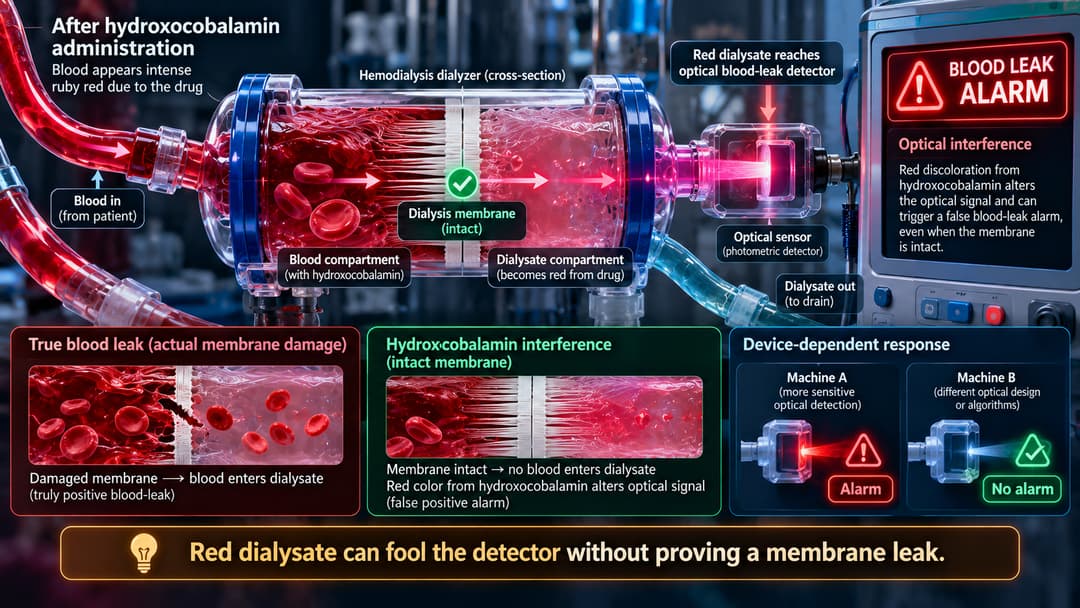
Hydroxocobalamin can turn plasma and dialysate intensely red. On some hemodialysis machines, that color can fool the optical blood-leak detector even when the dialyzer membrane is intact.
Hydroxocobalamin is a deeply colored chromophore. Some dialysis machines use optical or colorimetric sensors to detect blood entering the dialysate, and hydroxocobalamin-related discoloration can trigger that sensor even without a true membrane leak. [1] [2]
The effect is machine-dependent.
A blood-leak alarm after hydroxocobalamin may be false—but it should never be assumed to be false before a real circuit leak has been evaluated.
Blood-leak detectors are designed to identify blood crossing a damaged dialyzer membrane into the effluent.
Some systems do this by measuring how light passes through the dialysate. Hydroxocobalamin's intense red color can alter that optical signal enough to resemble blood.
In experimental testing, hydroxocobalamin triggered the blood-leak alarm on a Fresenius 2008K machine, while a Gambro Phoenix X36 did not alarm under the same conditions. The dialyzer membranes remained intact. [2]
That is why the phenomenon should not be generalized to every dialysis platform.
A persistent false alarm can repeatedly interrupt dialysis and delay extracorporeal treatment.
A 2026 case report described recurrent false blood-leak alarms after hydroxocobalamin administration; dialysis was ultimately continued after switching to a different type of hemodialysis machine. [3]
The correct response is not to ignore or disable the alarm.
It is to:
recognize hydroxocobalamin as a possible source of optical interference, evaluate whether a true blood leak exists, and involve the dialysis team early when the exposure history fits.
For the broader antidote, laboratory-interference, and cyanide-management context, see Cyanide Poisoning: Hydroxocobalamin, Antidotes, and Emergency Management.
Hydroxocobalamin can make the dialysate look like blood to the machine even when the membrane is intact.
Treat the alarm as real until assessed—but remember that the detector, not the dialyzer, may be the problem.
U.S. National Library of Medicine. CYANOKIT (hydroxocobalamin) Prescribing Information. DailyMed.
Sutter ME, Clarke ME, Cobb J, et al. Blood leak alarm interference by hydoxocobalamin is hemodialysis machine dependent. Clinical Toxicology. 2012;50(10):892–895. doi:10.3109/15563650.2012.744031
Razzouk R, Fadel AZ, Hoo Sang G, Lok CE, Malavade T. Blood Leak Alarms With Hydroxocobalamin Administration. American Journal of Kidney Diseases. Published online September 25, 2026. doi:10.1053/j.ajkd.2026.05.026
As the Growth & Content Lead at MedicalToxic.com, I work on content strategy, development, and digital growth. My focus is on making MedicalToxic’s content clear, practical, and accessible, while helping expand the platform’s reach and strengthen its position as a trusted resource in clinical toxicology.
Keep reading

Toxic Agents and Antidotes
29 Oct 2026
Amirhosein Shabrang
Toxic Agents and Antidotes
28 Oct 2026
Amirhosein Shabrang

Toxic Agents and Antidotes
16 Sept 2026 · Updated 02 Oct 2026
Amirhosein Shabrang