Why Does Chewing a Castor Bean Increase Ricin Risk?

Amirhosein Shabrang
Post on 24 Nov 2026
Amirhosein Shabrang
Post on 24 Nov 2026
 Medical Toxicologymedicaltoxic.com
https://medicaltoxic.com/tox-spotlight/chewed-castor-beans-ricin-risk
Why Does Chewing a Castor Bean Increase Ricin Risk?
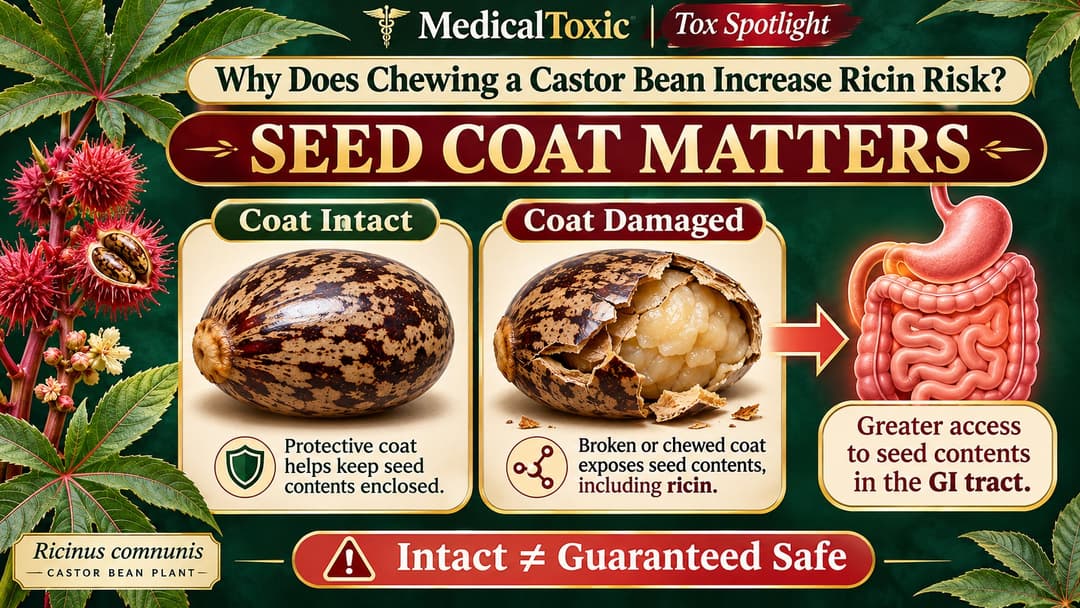
Whether a castor bean was chewed or swallowed intact is an important exposure detail. Damaging the seed coat can increase contact with ricin-containing seed material.
Ricin is contained within castor bean seeds. When a bean is chewed or crushed, disruption of its protective outer coat can make the toxic contents more available in the gastrointestinal tract. [1]
Chewing increases concern, but swallowing a bean intact does not guarantee safety.
The severity of exposure cannot be determined reliably from the number of beans reported or the apparent absence of early symptoms. [2]
An intact outer coat can limit contact between digestive fluids and the inner seed contents.
Chewing or otherwise damaging that coat changes the exposure by allowing ricin-containing material to become available for gastrointestinal contact.
This is one reason two reported ingestions involving the same number of beans may produce different outcomes.
However, whether a seed coat remained intact may be uncertain, especially in children, and published human exposure reports show considerable variability. [2]
Ask whether the beans were swallowed whole, chewed, or visibly damaged. Clarify the number involved, the time of ingestion, and whether vomiting, diarrhea, abdominal pain, or systemic symptoms have developed.
Do not interpret an unchewed exposure as automatically harmless, or use a fixed bean count as a validated toxicity threshold.
A credible castor bean ingestion warrants prompt poison-center assessment, particularly in children or when the seed condition is uncertain.
For the full assessment, supportive management, monitoring, and disposition framework, see Ricin and Castor Bean Poisoning: Clinical Assessment, Treatment, and Disposition.
With castor beans, the condition of the seed can matter as much as the reported count.
Chewing raises concern—but no simple bean-count rule reliably determines the outcome.
Centers for Disease Control and Prevention. Ricin. Chemical Emergencies.
Ricin Poisoning after Oral Ingestion of Castor Beans: A Case Report and Review of the Literature and Laboratory Testing. Journal of Medical Toxicology. 2017. PMID: 28987302.
As the Growth & Content Lead at MedicalToxic.com, I work on content strategy, development, and digital growth. My focus is on making MedicalToxic’s content clear, practical, and accessible, while helping expand the platform’s reach and strengthen its position as a trusted resource in clinical toxicology.
Keep reading
Toxic Agents and Antidotes
22 Nov 2026
Amirhosein Shabrang
Toxic Agents and Antidotes
29 Oct 2026
Amirhosein Shabrang
Toxic Agents and Antidotes
28 Oct 2026
Amirhosein Shabrang
Toxic Agents and Antidotes
26 Oct 2026
Amirhosein Shabrang
We would like to use analytics and session-replay tools to understand how this site is used. They are optional and the site works fully without them. Signing in still needs its own cookie either way. Our Privacy Policy names each one.