Why Observe After an Eastern Coral Snake Bite With No Symptoms?

Amirhosein Shabrang
Post on 29 Oct 2026

Amirhosein Shabrang
Post on 29 Oct 2026
 Medical Toxicologymedicaltoxic.com
https://medicaltoxic.com/tox-spotlight/asymptomatic-eastern-coral-snake-bite
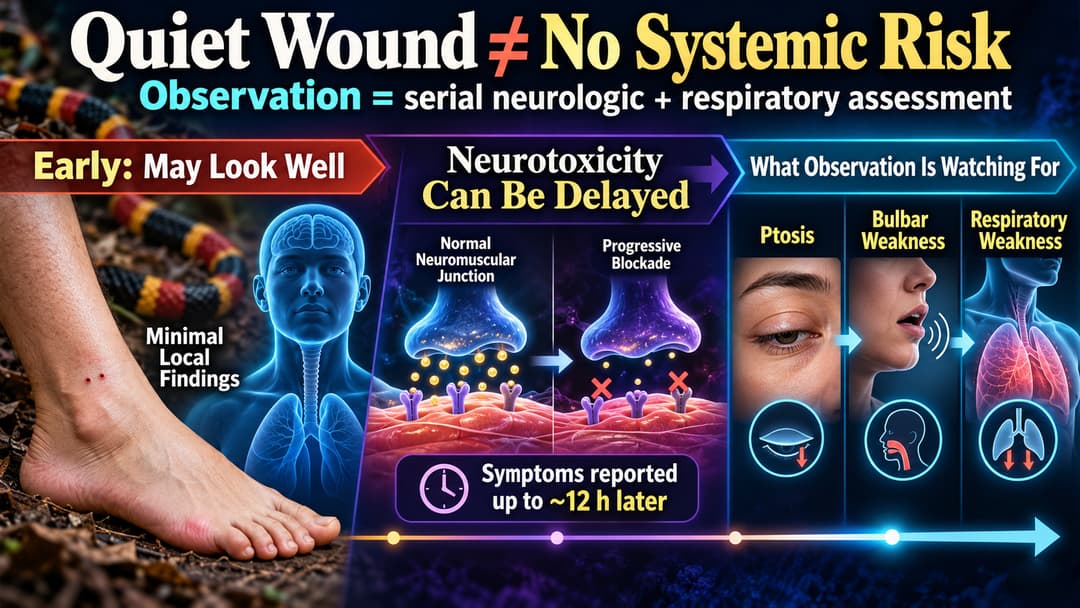
Why Observe After an Eastern Coral Snake Bite With No Symptoms?
An Eastern coral snake bite can look deceptively benign before neurotoxicity appears. Minimal local findings and a normal early examination do not reliably exclude later weakness or respiratory compromise.
Eastern coral snake envenomation can cause delayed neuromuscular toxicity with little local tissue injury. In a classic series of 39 victims, neurologic symptoms were delayed for as long as 12 hours and could then progress rapidly. [1]
That is why a patient with a confirmed or credible suspected Eastern coral snake bite may require monitored observation even when initially asymptomatic.
A quiet bite site is not proof that systemic toxicity will not develop.
Eastern coral snake bites may produce little pain, swelling, or tissue injury at the bite site.
The major threat is neurotoxicity. Ptosis, diplopia, dysarthria, dysphagia, generalized weakness, and respiratory-muscle paralysis can emerge after an initially symptom-free interval. [1]
The key distinction is:
minimal local injury does not equal minimal systemic risk.
Serial neurologic and respiratory assessment matters more than the appearance of the wound alone.
No.
A Florida poison-center study compared 301 initially asymptomatic patients managed with either empiric North American Coral Snake Antivenin or a wait-and-see approach. Empiric treatment was associated with more ICU admissions and substantially more antivenin reactions, while no statistically significant difference in intubation was detected. [2]
Because the study was retrospective, it does not prove that the strategies are equivalent. It does, however, support an important distinction:
monitored observation is not the same as automatic prophylactic antivenin.
If neurologic, bulbar, or respiratory findings emerge, the management question changes.
For the complete species-specific approach to observation, neurologic monitoring, airway management, and antivenin use, see Eastern Coral Snake (Micrurus fulvius) Envenomation: Clinical Management Guideline.
The quiet wound is not the reassurance—the serial neurologic examination is.
After an Eastern coral snake bite, absence of early symptoms does not mean the risk period is over.
Kitchens CS, Van Mierop LHS. Envenomation by the Eastern coral snake (Micrurus fulvius fulvius). A study of 39 victims. JAMA. 1987;258(12):1615–1618. doi:10.1001/jama.1987.03400120065026
Simmons R, Ubani C, Garvan G, et al. Retrospective Comparison of Empiric Antivenom vs. Expectant Treatment for Eastern Coral Snakebites. Western Journal of Emergency Medicine. 2025;27(1):167–176. doi:10.5811/westjem.45709
As the Growth & Content Lead at MedicalToxic.com, I work on content strategy, development, and digital growth. My focus is on making MedicalToxic’s content clear, practical, and accessible, while helping expand the platform’s reach and strengthen its position as a trusted resource in clinical toxicology.
Keep reading
Toxic Agents and Antidotes
28 Oct 2026
Amirhosein Shabrang
Toxic Agents and Antidotes
26 Oct 2026
Amirhosein Shabrang
Toxic Agents and Antidotes
16 Sept 2026 · Updated 02 Oct 2026
Amirhosein Shabrang