Why Should Atropine Be Titrated to the Chest, Not Pupils?

Amirhosein Shabrang
Post on 28 Oct 2026

Amirhosein Shabrang
Post on 28 Oct 2026
 Medical Toxicologymedicaltoxic.com
https://medicaltoxic.com/tox-spotlight/atropine-chest-not-pupils-organophosphate
Why Should Atropine Be Titrated to the Chest, Not Pupils?
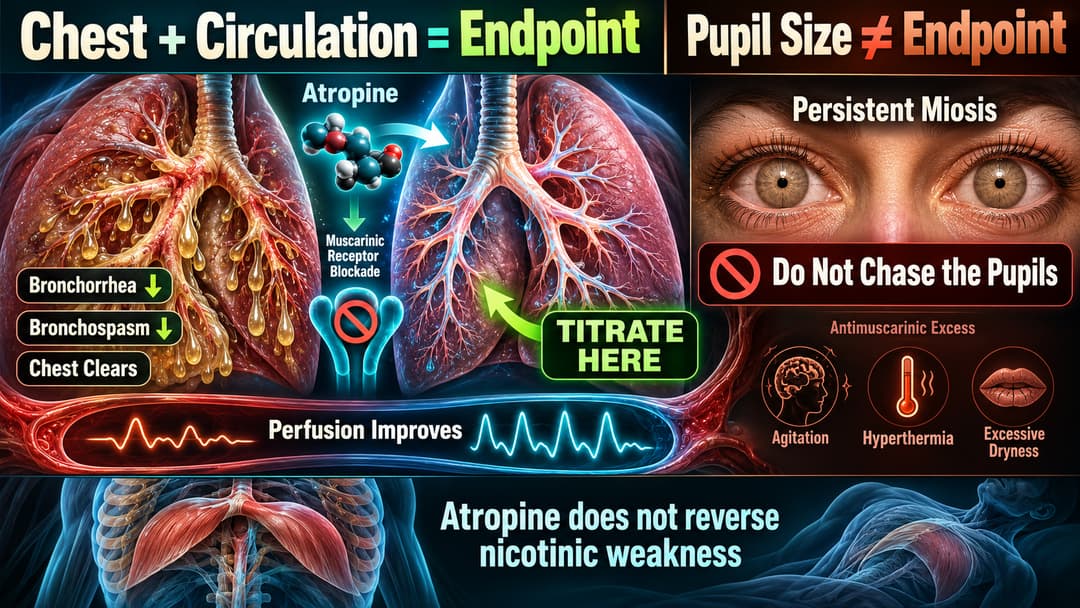
In organophosphate poisoning, persistent miosis does not mean more atropine is needed. The clinically important endpoints are control of bronchorrhea and bronchospasm with adequate circulation.
Atropine reverses the muscarinic effects that threaten ventilation and perfusion in organophosphate poisoning. Dose escalation should therefore be guided primarily by a clearing chest—especially improving bronchorrhea and bronchospasm—and adequate hemodynamic perfusion. [1]
Do not keep escalating atropine simply because the pupils remain constricted.
Pupil size can lag behind clinical recovery and is an unreliable atropinization endpoint. [2]
Miosis is a familiar feature of cholinergic poisoning, but it is not a reliable marker of whether life-threatening muscarinic toxicity has been adequately treated.
Pupillary response may be delayed, and direct ocular pesticide exposure can produce persistent local miosis even as systemic muscarinic effects improve. Competing autonomic effects can also make pupil size less predictable.
Continuing to increase atropine solely to normalize the pupils can therefore expose the patient to unnecessary antimuscarinic toxicity without improving the problem that matters most.
Follow the physiology atropine is intended to correct.
The most useful bedside endpoint is improvement in bronchial secretions and bronchospasm, producing a clearer chest. Circulation should improve as clinically important muscarinic bradycardia or hypotension resolves. [1]
That does not mean every abnormal finding should disappear.
Atropine does not reverse nicotinic neuromuscular weakness. A patient whose chest is clearing but whose neck flexion, tidal volume, cough, or respiratory effort is deteriorating may still be developing respiratory-muscle failure and requires ventilatory assessment—not simply more atropine.
For the full atropine escalation, airway, oxime, decontamination, and delayed-neuromuscular management framework, see Organophosphate Poisoning: Recognition, Atropine, Oximes, and Emergency Management.
Titrate atropine to the chest and circulation—not to the pupils.
Persistent miosis can coexist with adequate atropinization; persistent bronchorrhea cannot.
American Heart Association. Part 10: Adult and Pediatric Special Circumstances of Resuscitation: 2025 American Heart Association Guidelines for CPR and ECC. Circulation. 2025.
Eddleston M, Buckley NA, Eyer P, Dawson AH. Management of acute organophosphorus pesticide poisoning. Lancet. 2008;371(9612):597–607. doi:10.1016/S0140-6736(07)61202-1
As the Growth & Content Lead at MedicalToxic.com, I work on content strategy, development, and digital growth. My focus is on making MedicalToxic’s content clear, practical, and accessible, while helping expand the platform’s reach and strengthen its position as a trusted resource in clinical toxicology.
Keep reading
Toxic Agents and Antidotes
29 Oct 2026
Amirhosein Shabrang
Toxic Agents and Antidotes
26 Oct 2026
Amirhosein Shabrang
Toxic Agents and Antidotes
16 Sept 2026 · Updated 02 Oct 2026
Amirhosein Shabrang