Ricin and Castor Bean Poisoning: Clinical Assessment, Treatment, and Disposition
Published on 13 Nov 2026

Published on 13 Nov 2026
 Medical Toxicologymedicaltoxic.com
https://medicaltoxic.com/guidelines/ricin-castor-bean-poisoning
Ricin poisoning is an uncommon but potentially life-threatening toxicologic emergency. Ricin is a ribosome-inactivating protein derived from the seeds of Ricinus communis (castor bean plant). Clinical manifestations depend strongly on the route and circumstances of exposure. Ingestion most often causes gastrointestinal illness, whereas credible aerosol or parenteral exposure can cause delayed pulmonary injury, shock, and multiorgan dysfunction. [1], [2], [3]
Management begins with airway, breathing, circulation, prevention of secondary contamination, and early poison-center consultation. A normal initial examination does not exclude subsequent deterioration after a significant exposure.
Important 2026 regulatory development: Ricimed®, an equine-derived anti-ricin F(ab′)₂ antibody preparation, received national marketing authorization in France on January 5, 2026. The current French Summary of Product Characteristics (SmPC), revised June 13, 2026, provides indication-specific dosing and timing guidance. Ricimed is an adjunct to supportive care. Its efficacy in ricin-poisoned humans remains unproven, and French authorization does not establish U.S. FDA approval or availability. [4], [5]
Scope and evidence statement: This evidence-informed clinical reference is intended for poison-center specialists, emergency clinicians, medical toxicologists, and public-health responders. Its route-specific triage criteria and suggested monitoring periods are expert-derived operational approaches, not prospectively validated ricin-specific prediction rules. Use exposure credibility, clinical severity, patient vulnerabilities, trajectory, and local resources to guide care. [2], [3], [6], [7], [8], [9], [10], [11]
MedicalToxic.com | Evidence-informed clinical guideline | Source revision: November 11, 2026 | Author: Omid Mehrpour, MD, FACMT
Clinical warning
Credible significant ricin exposure requires urgent medical evaluation and early poison-center consultation. Stabilize airway, breathing, and circulation; prevent secondary exposure from suspicious powders, aerosols, or contaminated clothing. A normal initial examination does not exclude delayed pulmonary, gastrointestinal, or systemic injury. Never induce vomiting. Do not delay critical care while awaiting laboratory confirmation or antitoxin access. In France, Ricimed is authorized for confirmed or strongly suspected acute ricin poisoning as an adjunct to supportive care; initial treatment should begin as soon as possible, ideally within 4–6 hours of exposure. Six hours is not an established futility cutoff. Repeat dosing requires individual specialist assessment, not automatic scheduling. Human treatment efficacy remains unproven.
Stabilize first. Manage airway, ventilation, circulation, seizures, shock, and severe fluid loss without waiting for confirmation of ricin exposure.
The exposure route determines the pathway. Oral, inhalational, parenteral, and isolated skin/eye exposure have different clinical risks. [1], [2]
No validated lethal bean count or universal observation interval exists. Chewed or disrupted castor seeds raise concern but do not independently predict outcome. [6]
Credible aerosol, concentrated toxin, or parenteral exposure requires urgent medical assessment, generally with monitored hospital observation even when initially asymptomatic.
Ricimed is authorized in France. It has not demonstrated efficacy in poisoned human patients, and its availability and authorization must be checked in each jurisdiction. [4]
Two treatment clocks must remain separate: first treatment ideally within 4–6 hours after exposure; possible second dose 4–6 hours after the first dose following individual specialist review. Neither is a validated automatic treatment rule.
Supportive care remains essential. Antitoxin access, laboratory testing, and public-health investigation must not delay resuscitation.
Stabilize: Assess airway, breathing, circulation, oxygenation, mental status, and perfusion. Treat respiratory distress, shock, seizures, or substantial fluid loss immediately.
Protect and decontaminate: Prevent exposure to suspicious powders, aerosols, or contaminated surfaces. Use appropriate incident-command and hazardous-materials procedures. Skin and ocular decontamination should not delay resuscitation.
Identify the exposure: Distinguish routine castor-bean ingestion, credible concentrated ricin, aerosol exposure, injection/puncture, and isolated skin or eye contact.
Consult early: Contact the regional poison center and medical toxicology. For credible deliberate exposure or multiple casualties, involve public-health authorities and incident command. In France, urgently assess Ricimed eligibility and hospital access. [4], [12]
Monitor progression: Look for dehydration after ingestion, pulmonary deterioration after inhalation, shock or tissue injury after injection, and organ dysfunction after severe systemic exposure.
Determine disposition by route and risk: Selected low-concern exposures may qualify for poison-center follow-up. Symptomatic or uncertain exposures generally require ED assessment; significant aerosol, parenteral, or deliberate contamination events require urgent hospital-level assessment.
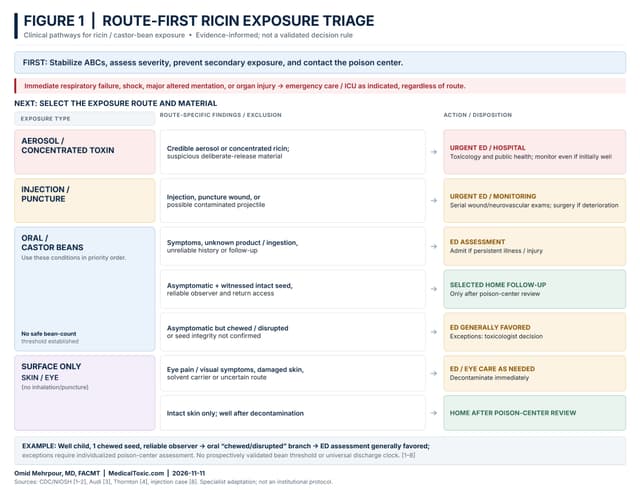
The figure presents five practical routes: aerosol/concentrated toxin, injection/puncture, oral/castor beans, surface-only skin/eye exposure, and emergency escalation.
Its oral-exposure branches must be interpreted in priority order. A witnessed intact-seed ingestion may qualify for poison-center-managed follow-up only after a reliable low-risk assessment. Chewed or disrupted seeds generally favor ED evaluation, without implying a validated bean-count cutoff.
The figure is an expert-derived decision aid, not a prospectively validated clinical rule. [1], [2], [3], [6]
Ricin is a type II ribosome-inactivating protein. Its B chain facilitates cell attachment and internalization. Its A chain removes an adenine residue from 28S ribosomal RNA, disabling protein synthesis and promoting cell injury and death. [3]
An intact seed coat may limit release of ricin into the gastrointestinal tract. Chewing, crushing, or otherwise disrupting seeds makes toxin exposure more plausible.
However, seed disruption is not a validated severity predictor. In a 2014 retrospective poison-center study, 49 of 84 reported castor-bean ingestions involved chewed or crushed seeds, yet no serious outcomes were documented. Laboratory testing was recorded in only a minority of patients, limiting detection of subclinical abnormalities. [6]
Do not use a fixed bean-count threshold to define safe ingestion or expected lethality.
Ricin does not normally partition into castor oil. Ordinary commercially processed castor oil is therefore not equivalent to castor-bean ingestion.
Unknown, contaminated, or noncommercial preparations require independent product assessment. [13]
Abrin is a different type II ribosome-inactivating toxin found in Abrus precatorius, the jequirity or rosary pea plant.
Confirm plant identity when feasible. Red-and-black decorative seeds may suggest Abrus rather than Ricinus. [14]
Gastrointestinal symptoms commonly include:
Nausea
Abdominal cramping
Repeated vomiting
Diarrhea
Occasionally gastrointestinal bleeding
Symptoms in clinically apparent ingestion commonly begin within the first several hours, often within approximately 10–12 hours. Severe illness may progress to dehydration, electrolyte disturbance, hypovolemia, hypotension, shock, and hepatic or renal dysfunction. [1], [3]
Published human outcomes vary considerably.
In Thornton and colleagues' poison-center series, 84 castor-bean ingestions produced no reported serious outcomes. The absence of serious outcomes in this selected retrospective group does not establish that disrupted seeds are universally safe. [6]
A 2026 Iranian hospital series described 12 patients who generally developed gastrointestinal illness and recovered with supportive care. The median recorded observation duration was 22 hours, ranging from 12 to 45 hours. These are observed care durations, not validated discharge thresholds. [7]
A 2024 adult case report described clinically important illness after ingestion of six castor beans, followed by recovery after treatment and hospitalization. The case does not establish a universal lethal-dose threshold. [9]
Ricin inhalation may cause:
Cough
Fever
Chest tightness
Dyspnea
Hypoxemia
Noncardiogenic pulmonary edema
Respiratory failure
Symptoms may initially be absent and subsequently appear over several hours, occasionally as late as approximately 24 hours.
A normal initial chest radiograph or oxygen saturation does not exclude later pulmonary injury after credible aerosol exposure. [1], [2]
Parenteral exposure can produce serious systemic toxicity despite minimal early local findings.
An important published case described initially limited erythema, swelling, and pain after ricin injection, followed by refractory shock approximately 24 hours later, multiorgan dysfunction, rhabdomyolysis, tissue necrosis, and concern for compartment syndrome. The patient ultimately survived following prolonged hospitalization and surgical treatment. [10]
This single case supports vigilance, not an incidence estimate.
Perform serial wound and neurovascular examinations and obtain urgent surgical evaluation for:
Increasing pain or swelling
Skin necrosis
Reduced distal perfusion
Sensory or motor abnormalities
Suspected compartment syndrome
Progressive systemic toxicity
Systemic absorption across intact skin is generally unlikely. Damaged skin, puncture wounds, or solvent carriers may increase concern.
Skin or eye exposure may produce irritation or allergic effects.
Castor-related occupational dust may cause rhinitis, asthma, or sensitization without systemic ricin poisoning.
Ricin is not contagious, but contaminated clothing, powders, or surfaces may cause secondary exposure before decontamination. [1], [2]
Confusion, somnolence, or disorientation may accompany severe gastrointestinal illness, dehydration, metabolic abnormalities, or systemic poisoning.
A 2026 pediatric case described transient somnolence and disorientation after ingestion of five chewed seeds, followed by recovery. A single favorable outcome does not make altered mental status an expected or benign feature. [8]
Hemolysis and hemorrhagic organ injury have appeared in selected fatal or near-fatal cases, but these findings cannot be generalized to routine castor-bean ingestion. [11]
Document:
Source and certainty of identification
Exposure route
Time and duration
Material type and whether concentrated toxin is credible
Seed integrity, chewing, crushing, or puncture
Symptoms and their progression
Co-exposures
Treatment already administered
Whether multiple patients are affected
Physical assessment should include:
Serial vital signs
Airway and respiratory status
Fluid balance and perfusion
Abdominal tenderness and gastrointestinal losses
Mental status and glucose where indicated
Injection-site findings and distal neurovascular status
Eye symptoms and examination when relevant
Maintain a broad differential including infectious gastroenteritis, other plant toxins, chemical inhalation, aspiration, sepsis, traumatic injury, and bacterial soft-tissue infection.
Move the patient to a safe location and follow incident-command precautions for suspicious material.
Remove contaminated clothing while minimizing dust generation. Wash exposed skin and hair with soap and water.
Do not use bleach, caustic agents, or household disinfectants on patients.
Irrigate exposed eyes promptly with water or saline for at least 15 minutes and seek ophthalmology evaluation for persistent pain, visual disturbance, or significant injury.
Routine whole-body decontamination is unnecessary after ingestion without external contamination. [1], [2]
Do not induce vomiting.
Single-dose activated charcoal may be considered after a very recent, clinically consequential ingestion when:
The toxin exposure is credible.
The patient is not actively vomiting.
The airway is intact or appropriately protected.
An experienced clinician judges the expected benefit to outweigh aspiration risk.
The conventional opportunity is generally within approximately one hour of ingestion, with exceptional case-specific decisions outside that interval.
No human evidence demonstrates that charcoal improves ricin-poisoning outcomes.
Gastric lavage, cathartics, and whole-bowel irrigation are not routine ricin treatments. Gastric lavage should be considered only in exceptional, potentially life-threatening, very recent ingestions with appropriate airway protection and specialist guidance. [2], [3]
Depending on severity, provide:
Oral or enteral rehydration when tolerated
Antiemetics
IV crystalloid for significant dehydration or shock
Electrolyte correction
Oxygen or assisted ventilation
Vasopressors after appropriate assessment of fluid responsiveness
Standard treatment of seizures, organ dysfunction, coagulopathy, and rhabdomyolysis
Avoid excessive fluid administration when capillary leak or pulmonary edema is present.
Dialysis may be indicated for conventional renal-replacement indications, but it is not established as a ricin-removal intervention.
Corticosteroids, prophylactic antibiotics, and N-acetylcysteine have no established ricin-specific efficacy. Antibiotics remain appropriate when an independent bacterial infection or necrotizing wound process is suspected. [2], [3], [10]
Ricimed® is a purified polyclonal equine anti-ricin F(ab′)₂ antibody preparation.
France granted early access in December 2025 and national marketing authorization on January 5, 2026.
Its authorized indication is confirmed or strongly suspected acute ricin poisoning, as an emergency adjunct to supportive medical care.
The current French SmPC is dated June 13, 2026.
Ricimed is restricted to hospital use in France.
French authorization is not equivalent to U.S. FDA approval. Local authorization, stock, and access must be checked independently. [4], [5], [12]
The current French SmPC recommends initiating Ricimed as soon as possible, ideally within 4–6 hours after exposure.
This is a preferred initiation target—not a proven six-hour futility cutoff or a contraindication after six hours.
Later presentation requires urgent specialist evaluation rather than automatic exclusion. [4]
For an inadequate clinical response or severe evolving poisoning, the French SmPC permits consideration of a second dose 4–6 hours after the first administration, potentially up to 24–36 hours after exposure.
Repeat treatment requires:
Reassessment of severity and trajectory
Assessment of adverse reactions
Multidisciplinary benefit–risk review
Close monitoring, preferably in intensive care
This is not an automatic every-4–6-hour repeat-dose regimen.
There are no human clinical trial data establishing the efficacy or optimal spacing of repeated Ricimed doses. [4]
Clinical clock | Label-based timing | Clinical limitation |
|---|---|---|
Exposure → first dose | Start immediately, ideally within 4–6 hours | No validated six-hour exclusion or futility cutoff |
First dose → possible second dose | Consider after 4–6 hours; potentially through 24–36 hours after exposure | Conditional specialist decision; no validated repeat-dose schedule |
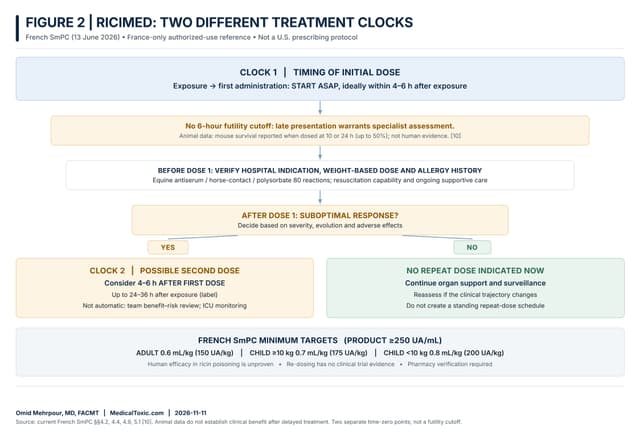
The first clock begins at the time of exposure. The second begins after the first Ricimed administration.
The figure describes French authorized-use guidance and must not be interpreted as a U.S. dosing protocol.
In the French SmPC's experimental evidence:
Intranasally exposed mice treated at four hours had 100% survival in the reported model versus 0% for placebo.
Delayed treatment at 10 or 24 hours produced survival of up to 50% in certain studied mouse groups.
Intratracheally exposed cynomolgus macaques treated four hours after exposure had survival of 8/8 versus 1/8 in controls.
These findings support biological plausibility but do not establish benefit magnitude, time windows, or clinical effectiveness in ricin-poisoned humans. [4]
The animal experiment involving doses at four and 18 hours after exposure corresponds to a 14-hour interval between administrations; it should not be confused with the separate conditional human-label discussion.
The following values reproduce the current French product label. They are not a MedicalToxic prescription order set or a U.S. treatment protocol.
Ricimed contains at least 250 activity units (UA) per mL.
Population | French SmPC minimum volume | Minimum activity |
|---|---|---|
Adults | 0.6 mL/kg | 150 UA/kg |
Children ≥10 kg | 0.7 mL/kg | 175 UA/kg |
Children <10 kg | 0.8 mL/kg | 200 UA/kg |
Authorized prescribers and hospital pharmacists must independently verify weight, product potency, preparation, infusion instructions, hypersensitivity precautions, and current labeling before administration. [4]
Before administration, review:
Previous reactions to equine antiserum or immunoglobulin products
Horse-related allergy or contact reactions
Polysorbate 80 hypersensitivity
Availability of immediate anaphylaxis treatment
Monitor during and after infusion for hypersensitivity, pseudo-allergic reactions, hemodynamic deterioration, and other adverse effects.
The human safety evidence consists of a small phase 1 healthy-volunteer study, not clinical treatment data in ricin-poisoned patients.
The French SmPC reports 24 healthy volunteers, including 16 who received Ricimed, with no reported dose-limiting toxicity at studied doses up to 30 mg/kg.
These data do not establish safety or efficacy in poisoned patients, children, older adults, pregnancy, or repeated dosing. [4]
Outside France, including the United States:
Do not assume Ricimed is authorized or stocked.
Confirm current regulatory status and access.
Coordinate with medical toxicology, hospital pharmacy, and public-health authorities.
Do not delay supportive or critical care while investigating access.
Other antibody products and intracellular countermeasures remain investigational. RiVax has undergone early human study, but there is no routinely available ricin vaccine for general clinical use. [16]
Diagnosis is based mainly on the exposure circumstances and clinical findings.
There is no routine emergency-department assay that can rapidly exclude ricin poisoning or validate discharge.
Clinical setting | Evaluation |
|---|---|
Low-concern, asymptomatic plant exposure | Often no immediate laboratory testing after poison-center assessment |
Symptomatic ingestion or credible systemic exposure | CBC, glucose, electrolytes, bicarbonate, renal function, AST/ALT, hydration assessment |
Shock, severe dehydration, organ injury, or bleeding | Repeat CBC and metabolic/hepatic tests; blood gas, lactate, coagulation testing, CK and urinalysis when indicated |
Suspected hemolysis or unexplained anemia/AKI | LDH, indirect bilirubin, haptoglobin, reticulocytes and smear when indicated |
Respiratory symptoms or credible aerosol exposure | Serial oxygenation and respiratory examination; chest radiography and blood gas when appropriate |
Injection with worsening pain or swelling | Serial wound/neurovascular assessment, CK, renal function, imaging and urgent surgery when indicated |
Normal early testing does not reliably exclude evolving organ injury after significant exposure. [2], [3], [10]
CDC and selected Laboratory Response Network laboratories may coordinate urinary ricinine testing.
Ricinine is a biomarker of exposure to castor-bean material, not the ricin toxin itself.
It does not establish a quantitative toxin dose, prognosis, or discharge readiness.
Testing requires appropriate public-health and laboratory coordination, including specimen handling and chain-of-custody procedures where relevant. [1], [17]
Do not delay emergency treatment for testing.
No prospectively validated ricin-specific observation period exists.
Earlier reviews suggested that selected entirely asymptomatic oral or inhalational exposures might be considered for discharge after approximately 12 hours. However, clinically important pulmonary symptoms may emerge later, and severe systemic effects can evolve beyond early observation.
Therefore, 12 hours must not be treated as a universal discharge rule, particularly after concentrated aerosol, parenteral, symptomatic, or uncertain exposures. [1], [2], [3]
Exposure scenario | Suggested disposition | Important qualifications |
|---|---|---|
Brief contact with intact seeds, no ingestion or symptoms | Selected home management after poison-center review | Confirm no inhalation, puncture, eye injury, or suspicious substance |
Witnessed small ingestion of an intact, undamaged seed; asymptomatic | Home follow-up may be reasonable in carefully selected cases | Reliable history, supervision, return access; no bean-count cutoff |
Chewed/crushed seeds or uncertain ingestion | ED evaluation generally favored | Individual exceptions require toxicologist review |
Symptomatic ingestion with significant vomiting/diarrhea or inability to maintain hydration | Hospital observation/admission | ICU if shock or organ dysfunction |
Credible concentrated aerosol exposure, parenteral exposure, or deliberate contaminated-material incident | Urgent ED evaluation; admission/monitored observation usually appropriate | Conservative supervised reassessment for an initial 24 hours or longer may be reasonable |
Pulmonary injury, shock, seizure, altered mentation, major organ injury, or necrotizing/compartment concern | Admission; ICU or surgical consultation when indicated | Continue until sustained clinical improvement |
All suggested periods and triage boundaries are expert-derived and not validated ricin-specific clearance rules.
Low-concern home management requires:
Verified source and exposure route
No symptoms
No credible suspicious or deliberate exposure
No respiratory or neurologic complaints
Reliable observer
Prompt ED access
Poison-center callback plan
Calls during the first 6–12 hours and another check through approximately 24 hours may be useful under local protocol.
These callback timings are expert practice rather than validated observation endpoints.
Discharge requires:
Sustained improvement or resolution of symptoms
Adequate oral hydration
Stable hemodynamics
No evolving organ injury
Review of any indicated laboratory tests
Clear return precautions
Documented poison-center or medical-toxicology recommendation
Ongoing severe gastrointestinal symptoms, abnormal laboratory results, unreliable follow-up, or uncertain exposure favor admission.
For hospitalized symptomatic or high-risk patients, serially reassess clinical condition, vital signs, hydration, and organ function.
Consider repeating CBC, electrolytes, renal function, and hepatic tests approximately 12–24 hours after baseline, earlier in unstable patients and again if symptoms or laboratory abnormalities evolve.
For high-concern exposures or abnormal findings, additional testing over 24–72 hours is reasonable.
These are practical expert-derived intervals, not validated ricin-specific schedules.
For well patients with verified low-concern exposure, routine follow-up laboratory testing is not established.
After documented organ injury, significant systemic symptoms, or unresolved concern, arrange reassessment within approximately 48–72 hours, with further review when abnormalities persist.
One reported asymptomatic patient had elevated liver enzymes approximately one week after castor-bean ingestion. This single observation does not justify universal day-seven laboratory testing. [6]
Provide return precautions for:
New or worsening cough or dyspnea
Persistent vomiting or diarrhea
Blood in stool
Syncope or confusion
Dark urine or reduced urine output
Rapidly increasing injection-site pain or swelling
Fever with deterioration
Inability to maintain oral fluids
Distinguish touching or tasting a seed, swallowing an intact seed, and ingestion of chewed or fractured seeds.
Assess choking or aspiration risks separately.
In children, prioritize hydration, glucose when mental status is altered, age-appropriate vital signs, caregiver reliability, and timely access to medical care.
A reported pediatric case involving five chewed seeds produced severe GI symptoms and transient disorientation, followed by full recovery. This does not establish that neurologic symptoms are benign. [8]
Evidence is insufficient to establish a pregnancy-specific toxic dose or outcome threshold.
Prioritize maternal stabilization and involve obstetrics for gestational-age-appropriate fetal assessment after significant exposure.
Where Ricimed is authorized, the French SmPC supports individualized treatment when maternal life-threatening poisoning warrants it; decisions require specialist review. [4]
Determine whether seeds were handled, pierced, fractured, chewed, swallowed, or caused a puncture wound.
Similar-appearing decorative seeds may contain abrin instead of ricin.
Castor-related occupational rhinitis or bronchospasm may reflect sensitization rather than systemic poisoning.
Promptly notify appropriate poison-center and public-health authorities for:
Credible deliberate poisoning
Suspicious powder
Contaminated food or environmental exposure
Suspected aerosolization
Multiple patients with similar exposure histories
Ricin is not normally volatile, but contaminated dust or powder can become airborne.
Do not open, sniff, handle, or transport suspicious material for routine testing.
Use approved incident-command, hazardous-materials, and clinical specimen procedures.
Once external contamination is appropriately addressed, ricin poisoning is not transmitted from person to person. [1], [2]
Evidence | Supported conclusion | What it cannot establish |
|---|---|---|
Thornton 2014; 84 poison-center cases | Many castor-bean ingestions had mild outcomes; chewing occurred in 58% | Universal safety of chewed seeds |
Moshiri 2026; 12 hospital cases | Supportive-care recovery and observed hospital durations | A validated 22-hour observation minimum |
Pineda Pulla 2026; pediatric case | Transient neurologic symptoms may accompany GI illness | Frequency or safety of neurologic manifestations |
Noumi Noumi 2024; adult case | Several seeds may cause illness requiring hospitalization | A universally lethal seed count |
Bucaretchi 2021; injection case | Severe delayed systemic/wound injury is possible | Incidence or expected prognosis |
Aquila & Sacco 2026; fatal/near-fatal review | Severe systemic injury and hemolysis may occur | Expected manifestations in routine mild plant ingestion |
French Ricimed SmPC 2026 | Authorized dose, administration details, and two separate timing concepts | Proven clinical efficacy, a six-hour futility cutoff, or an automatic second-dose schedule |
No. Published poison-center and hospital series include many mild cases. However, severity depends on exposure route, material, individual circumstances, and clinical progression.
No. Chewing or crushing can increase the possibility of ricin release, but no validated bean-count or chewing-based severity rule exists.
Ricimed is nationally authorized in France for confirmed or strongly suspected acute ricin poisoning. Human efficacy remains unproven. Its use must follow the current French label and authorized clinical pathway.
No. It can help document exposure to castor-bean material but does not provide a validated severity or clearance threshold.
No. Ricin poisoning is not transmitted person to person. Residual material on clothing or surfaces may still cause secondary exposure before decontamination.
Commercial castor oil is not expected to contain ricin. Unknown or noncommercial products require separate assessment.
Consider Abrus precatorius, which contains abrin rather than ricin. Verify plant identification where possible.
Scope: This appendix summarizes selected items in the French June 13, 2026 SmPC. It is not a substitute for the complete label, authorized prescribing pathway, hospital pharmacy verification, or local emergency protocol. It does not establish a U.S. dosing recommendation. [4]
Ricimed contains at least 250 UA/mL of equine anti-ricin F(ab′)₂.
Each 14-mL vial supplies at least 3,500 UA.
Minimum label dose targets:
Adults: 0.6 mL/kg, corresponding to 150 UA/kg
Children ≥10 kg: 0.7 mL/kg, corresponding to 175 UA/kg
Children <10 kg: 0.8 mL/kg, corresponding to 200 UA/kg
The French SmPC specifies rounding of calculated product volumes. The actual product concentration, patient weight, rounding, available vial quantity, and label instructions must be checked by the treating hospital pharmacist.
Do not calculate a clinical safety margin from the separate mg/kg healthy-volunteer study, because these are different quantities from the label's mL/kg and UA/kg therapeutic dosing.
Under the French authorized hospital procedure:
Calculate the required product volume from weight and the applicable label category.
Prepare aseptically according to the current SmPC.
For conventional dilution, remove an equal volume of 0.9% sodium chloride from a 100-mL infusion bag and replace it with the calculated Ricimed volume.
The SmPC describes an IV infusion rate of 200 mL/hour.
Use a dedicated IV line; do not admix unrelated drugs.
Flush the infusion line afterward as specified.
Follow the manufacturer's guidance for larger volumes and alternative bags.
Administer prepared solution within six hours, including preparation time.
Supervise infusion and monitor for at least 30 minutes afterward.
Screen for:
Previous reactions to equine antiserum/immunoglobulins
Horse-associated allergy
Polysorbate 80 reactions
Each 14-mL vial contains approximately 700 mcg polysorbate 80.
Severe immediate hypersensitivity or pseudo-allergic reactions are possible.
Ensure immediate availability of resuscitation equipment and treatment for anaphylaxis.
For a significant infusion reaction:
Stop infusion.
Provide appropriate emergency assessment and treatment.
Use intramuscular epinephrine as first-line therapy for anaphylaxis.
Consider any treatment resumption only after specialist assessment and stabilization.
The French SmPC describes carefully supervised restart at 5–10 mL/hour, increasing according to tolerance; this is not an automatic instruction to restart after a severe reaction.
Serum-sickness-type reactions remain possible with equine-derived products.
Counsel patients to seek assessment for:
Fever
Urticaria
Joint pain
Other delayed hypersensitivity symptoms
The French SmPC describes potential symptoms approximately:
7–10 days after primary exposure
2–4 days in previously sensitized patients
Document the product name and batch number.
The phase 1 healthy-volunteer study involved 24 adults, of whom 16 received Ricimed.
The small study did not establish clinical efficacy in poisoning.
No demonstrated human benefit, reliable human treatment window, or repeat-dose safety guarantee can be derived from these observations.
Pediatric dosing is supported by modeling rather than controlled poisoning-efficacy trials.
All Ricimed treatment decisions require current national labeling, authorized clinical oversight, and independent specialist/pharmacy verification.
Ricin management is primarily exposure-route assessment, supportive resuscitation, appropriate decontamination, and risk-based observation.
The new French Ricimed authorization creates a specific hospital-based treatment option, but its human efficacy remains uncertain.
The two Ricimed treatment clocks must never be confused: an ideal first-dose window is not a futility cutoff, and conditional second-dose timing is not an automatic repeat schedule.
Keep reading