Unapproved Injectables: Bacteria and Mislabeled Peptides
post on 09 Nov 2026

post on 09 Nov 2026
 Medical Toxicologymedicaltoxic.com
https://medicaltoxic.com/news/unapproved-peptides-bacteria-mislabeled-products
Unapproved Injectables: Bacteria and Mislabeled Peptides
New laboratory findings in Canada and Australia reveal two different failures in unauthorized injectable products: bacterial contamination and ingredients that do not match the label.
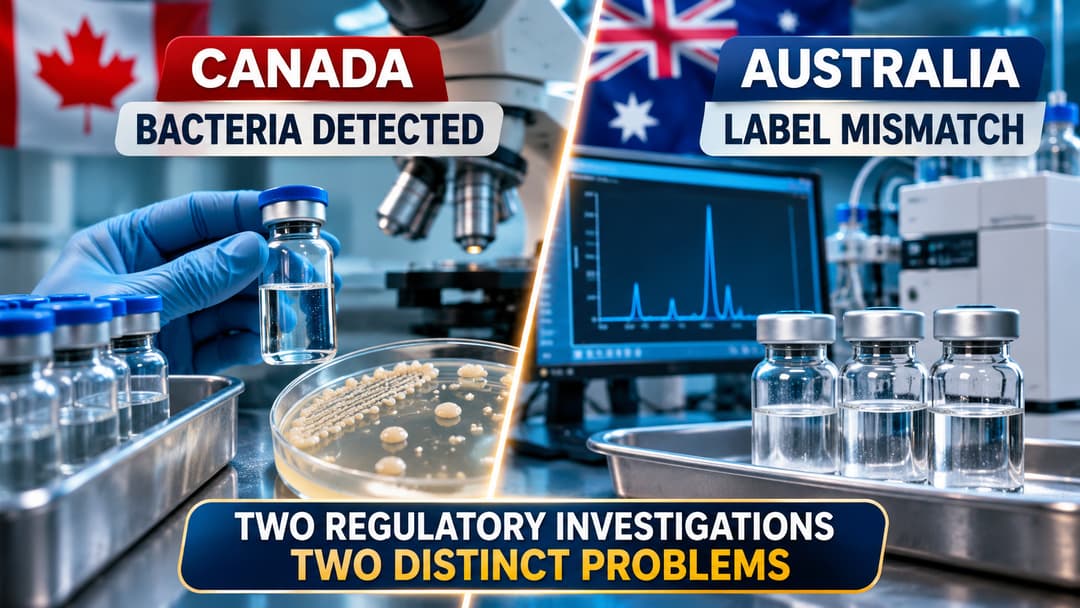
Regulators in Canada and Australia have released separate laboratory findings that expose two distinct hazards in the market for unauthorized injectable peptide and related products.
On November 6, 2026, Health Canada warned that testing had found bacteria in unauthorized injectables associated with Shanghai ERP Peptide Biotechnology Co., Ltd. The agency seized more than 11,400 vials from the supplier and two Canadian online retailers. That is a seizure total—not the number of vials tested or found contaminated. [1]
A day earlier, on November 5, Australia's Therapeutic Goods Administration (TGA) reported that tested Synedica products failed to match their labels. Three products had no detectable TB-500, while tested Retatrutide 10 mg samples contained less retatrutide than claimed, with considerable variation between samples. [2]
These are separate suppliers and investigations. The shared public-health problem is unreliable injectable-product quality, not evidence of a single multinational contamination event.
Health Canada's November 6 public advisory concerns injectable peptide and non-peptide drugs sold online by Shanghai ERP Peptide Biotechnology Co., Ltd.
The agency says laboratory testing of seized unauthorized injectable peptides detected organisms including:
Acinetobacter seifertii;
Acinetobacter nosocomialis; and
Propionibacterium (Cutibacterium) acnes.
These are identified bacterial findings in tested material. They do not establish that every seized vial, every product marketed by the supplier, or every customer shipment contained those organisms. Health Canada did not provide a tested-vial denominator or product-specific contamination rates.
The agency identified two Canadian retailers: True North Bio Labs and BC Axiom Peptide. It obtained entry warrants, seized unauthorized drugs and reported that both retailer websites were inactive after enforcement.
More than 11,400 vials were seized in total from ERP Peptide and the two retailers. The number describes enforcement scope, not microbiological test results.
Health Canada lists hCG, MOTS-C, NAD+, retatrutide, tesamorelin and tirzepatide as examples of unauthorized injectable products sold online by ERP Peptide. The advisory does not establish that each named product was independently laboratory-positive for bacteria. Nor does it identify every tested lot or the proportion of seized vials that failed testing.
Injection bypasses barriers that ordinarily help protect against microbial exposure. A contaminated preparation may cause an injection-site infection or more serious systemic illness, particularly in people with impaired immune defenses.
Health Canada warns that contaminated injections can cause serious infection, hospitalization and, in severe cases, life-threatening sepsis. People developing fever, chills, injection-site redness, pain, swelling or feeling unwell after use should seek immediate medical attention. [1]
The public advisory does not document a patient-infection count or a confirmed clinical outbreak attributable to these products. Laboratory detection of bacteria and a proven case of infection are different levels of evidence. The report also does not establish that the seized products caused bloodstream infection in any specified patient.
The November 5 TGA safety advisory describes a different analytical failure. Products branded Synedica, identified during TGA assistance to New South Wales Police's Strike Force Antree, were found not to contain what their labels claimed. [2]
Tested Synedica product | TGA laboratory finding |
|---|---|
BPC 157 & TB 500 10 mg | No TB-500 detected |
KLOW 80 mg | No TB-500 detected |
BARBIE KLOW 100 mg | No TB-500 detected |
Retatrutide 10 mg | Less retatrutide than labeled; substantial variation between samples |
TGA states that KLOW is labeled as containing GHK-Cu, BPC-157, TB-500, KPV and vitamin B12. BARBIE KLOW also lists melanotan I. The regulator's reported findings focus on TB-500 in the first three products and retatrutide quantity in the fourth; the notice does not establish the identity or quantity of every other labeled ingredient. [2]
The TGA did not report bacterial detection in the Synedica samples. The Australian finding concerns ingredient identity and quantity, not confirmed microbial contamination.
For tested Synedica Retatrutide 10 mg, TGA found less retatrutide than the label stated, as well as considerable sample-to-sample variation. It did not publish individual measured quantities in the advisory.
That is evidence of unreliable labeling and variable exposure, not evidence that those tested samples delivered a retatrutide overdose. Without reliable product strength, clinicians cannot confidently reconstruct the administered amount from the package alone. The finding also does not establish the clinical outcome of any individual consumer.
TGA says retatrutide remains under investigation in human clinical trials and had not been approved by the TGA or a comparable international regulator at the time of its announcement.
The new laboratory reports should be read alongside, but not merged with, recent Australian clinical surveillance.
Bacterial contamination is the confirmed quality defect described in the Canadian testing. Infection and sepsis are potential clinical consequences—not confirmed counts in that advisory.
Missing ingredients are demonstrated when a claimed compound, such as TB-500, is not detected in a tested product. This finding does not establish the identity of all remaining contents.
Inaccurate concentration is demonstrated by the TGA's retatrutide findings. It makes pharmacological exposure assessment less reliable without proving excessive dosing.
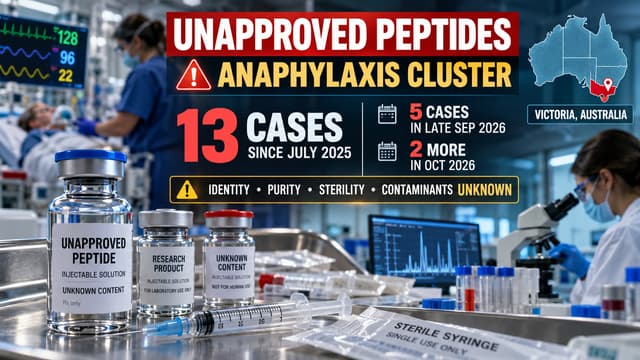
Immediate hypersensitivity is a separate clinical problem. Victoria's Department of Health reported 13 anaphylaxis notifications associated with unapproved peptides since July 2025, including five in the second half of September 2026 and two in October. The precise trigger was not established. [3]
MedicalToxic covers that clinical event in 13 Anaphylaxis Cases Reported With Unapproved Peptides. Neither Victoria's cases nor the Canadian bacterial findings establish that bacteria caused the reported anaphylaxis.
A separate NSW Health report, released in October, identified 1,180 emergency-department presentations among people aged 16 and older in which unapproved peptide use was mentioned at triage between July 1, 2025 and September 30, 2026. The report used keyword searches of triage text across 88 reporting hospitals. [4]
These were presentations, not necessarily 1,180 different patients or 1,180 confirmed injuries caused by peptides. The report states that peptide use may have been historical, that the same person could present repeatedly, and that a mention at triage cannot prove the cause of the visit.
The NSW dataset cannot attribute presentations to ERP Peptide, Synedica or any specific contaminated vial.
Peptide-based treatments are established parts of modern medicine. Authorized, prescription-supplied medicines should not be conflated with unauthorized research-market injectables whose source, sterility, composition or concentration may be uncertain.
The name tirzepatide, for example, appears on Health Canada's list of unauthorized products sold by ERP Peptide. That does not call into question authorized tirzepatide medicines obtained through regulated supply channels. Similarly, TGA's findings about unauthorized Synedica retatrutide do not establish that legitimate investigational clinical-trial material has the same quality defects.
The clinical owner for verified GLP-1 receptor agonist dosing errors and toxicity remains MedicalToxic's GLP-1 Receptor Agonist Toxicity: Semaglutide, Tirzepatide, and Related Agents. This News concerns product-quality evidence, not a new GLP-1 treatment algorithm.
Health Canada advises against purchasing or using unauthorized injectable drugs and recommends obtaining prescription medicines through licensed pharmacies. In Canada, authorized drugs carry an eight-digit Drug Identification Number (DIN). Anyone feeling ill after an unauthorized injection—particularly with fever, chills or injection-site symptoms—should seek prompt medical attention. [1]
The TGA specifically advises consumers not to use Synedica-branded peptide products, to take remaining products to a pharmacy for safe disposal, and to consult a healthcare professional if they have health concerns. Suspected adverse events can be reported to the TGA. [2]
For clinicians assessing a possible adverse exposure, the label should be treated as an unverified description. The product name, supplier, lot or packaging details, route, timing and reported symptoms may assist evaluation and public-health reporting. This article does not provide a sepsis, anaphylaxis or overdose treatment protocol.
A separate injectable-quality mechanism is covered in FDA Glutathione Endotoxin Investigation Expands With Greenwich Rx Recall. Endotoxin-related inflammatory reactions are not the same finding as detection of bacteria in Canada's tested products, and the two investigations must not be linked without evidence.
The developments on November 5–6, 2026 add direct laboratory evidence to a field previously dominated by warnings about uncertain product quality and adverse-event reports.
Canada: Health Canada identified specific bacterial organisms in tested unauthorized injectables associated with ERP Peptide and disclosed enforcement seizures totaling more than 11,400 vials.
Australia: TGA documented three Synedica products with no detectable claimed TB-500 and a fourth with underlabeled, variable retatrutide content.
The combined lesson is not that all peptides are unsafe or that the same contamination occurred in both countries. It is that unregulated injectable products can fail in fundamentally different ways: microbiological safety and truthful identification of their contents.
Health Canada did not publish a complete tested-vial denominator, product-specific bacterial-positive counts, an organism-by-product map or a number of confirmed patient infections.
TGA did not publish numerical retatrutide concentrations or demonstrate infection in the tested Synedica products. Its laboratory findings cannot establish the dose or outcome for every person who used them.
The November actions also do not identify a shared manufacturer or supply chain between Canada and Australia. Victoria's anaphylaxis cases and NSW's broader triage dataset cannot be assigned to either supplier on the available evidence.
Two regulators have provided independent analytical evidence of serious quality problems in unauthorized injectable products.
Health Canada found bacteria in tested ERP Peptide-associated injectables and seized over 11,400 vials. TGA found missing TB-500 and underlabeled, variable retatrutide in selected Synedica products.
Neither announcement establishes an outbreak attributable to the tested products, contamination in every vial or a general safety defect in authorized peptide medicines. The clinically important finding is narrower and actionable: with unauthorized injectable products, the label may not reliably indicate either microbiological safety or pharmacological contents.
Health Canada. (2026, November 6). Health Canada warns about contaminated unauthorized injectable peptides and non-peptide drugs.
Therapeutic Goods Administration. (2026, November 5). TGA testing finds unapproved peptides do not contain what their labels claim.
Victoria Department of Health. (2026, October 27). Increase in anaphylaxis notifications related to unapproved peptides in Victoria.
NSW Ministry of Health, Centre for Epidemiology and Evidence. (2026, October). Emergency department presentations mentioning unapproved peptide use: NSW, July 2025 to September 2026.
Keep reading
Public Health Warnings and Recalls
10 Nov 2026
Public Health Warnings and Recalls
06 Nov 2026
Public Health Warnings and Recalls
05 Nov 2026
Public Health Warnings and Recalls
28 Oct 2026