GLP-1 Receptor Agonist Toxicity: Semaglutide, Tirzepatide, and Related Agents
Published on 17 Jan 2025 · Updated 01 Oct 2026

Published on 17 Jan 2025 · Updated 01 Oct 2026
 Medical Toxicologymedicaltoxic.com
https://medicaltoxic.com/guidelines/guidelines-for-ozempic-semaglutide-toxicity-epidemiology
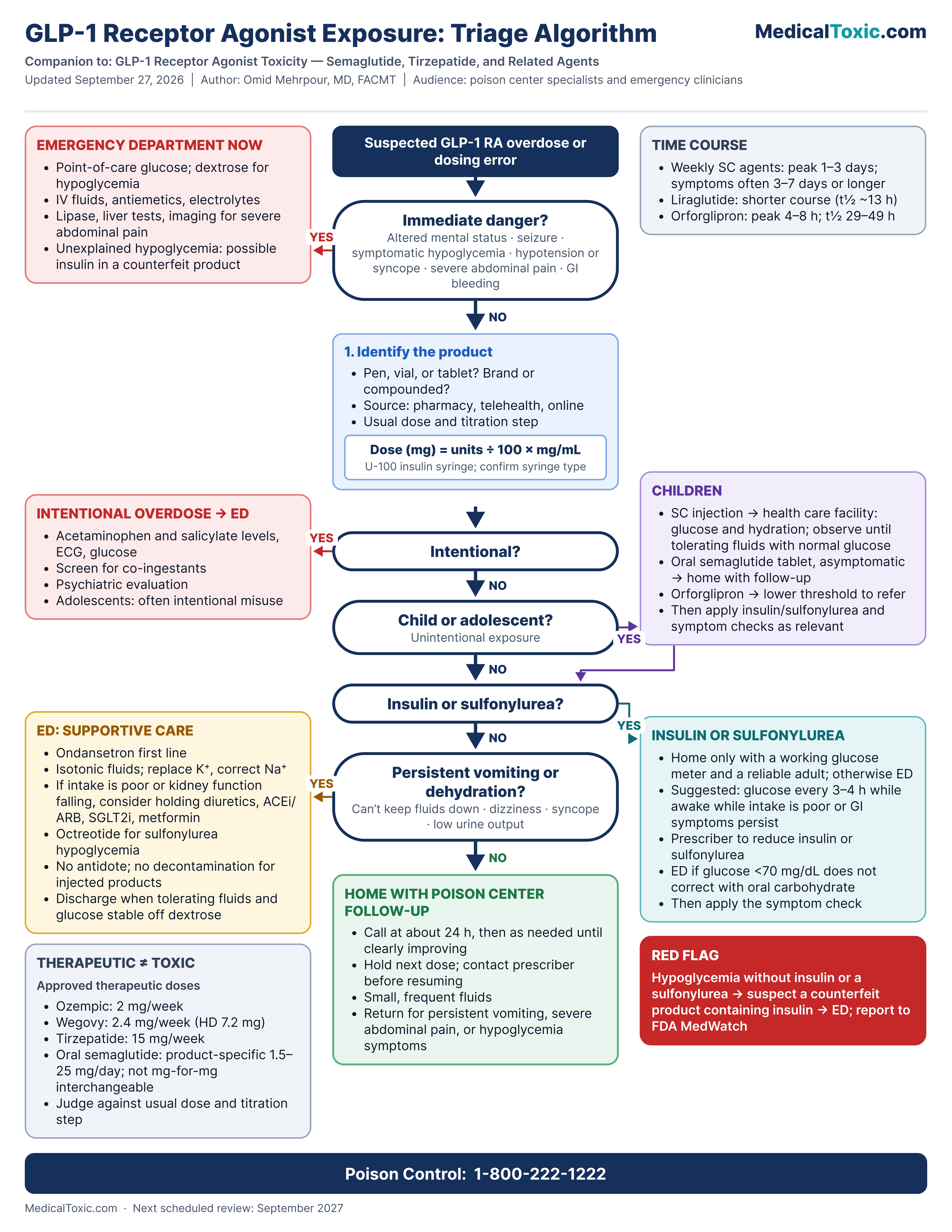
Most GLP-1 receptor agonist (GLP-1 RA) exposures reported to poison centers are unintentional dosing errors that cause days of gastrointestinal toxicity, not life-threatening poisoning.
This guideline updates the January 2025 MedicalToxic.com Ozempic guideline and covers the principal marketed GLP-1 RAs, with semaglutide and tirzepatide as the dominant agents.
The main exposure is a therapeutic error, often a 5- to 20-fold overdose from compounded vials dosed in “units” with insulin syringes.
Toxicity is delayed and prolonged: effects can begin hours to a day after injection and last 3 to 7 days or longer, because semaglutide peaks at 1 to 3 days and has a half-life of about 1 week.
Hypoglycemia is uncommon after an isolated GLP-1 RA overdose in a person without diabetes. It is a real risk with insulin or sulfonylureas, and in any unexplained case consider a counterfeit product containing insulin.
Management is supportive: antiemetics, fluids, electrolyte correction, and glucose monitoring when indicated. There is no antidote, and decontamination has no role for injected products.
A therapeutic dose is not a toxic dose. Approved weekly doses now reach 2 mg for Ozempic, 2.4 mg and 7.2 mg for Wegovy/Wegovy HD, and 15 mg for tirzepatide. Judge an exposure by the patient's usual dose and titration step, not by a fixed milligram threshold.
Most asymptomatic or mildly symptomatic patients can be managed at home with poison-center follow-up. Refer patients with persistent vomiting, dehydration, hypoglycemia, severe abdominal pain, or intentional overdose.
Clinical warning
Do not use a fixed milligram dose or a short symptom-free observation period to declare a GLP-1 receptor agonist exposure safe. Weekly agents have long half-lives, symptoms may be delayed, and gastrointestinal toxicity may persist for days.
Hypoglycemia after an isolated GLP-1 RA exposure is uncommon in a patient not using insulin or a sulfonylurea. Unexplained or recurrent hypoglycemia—particularly after an online-sourced or suspected counterfeit product—should prompt evaluation for possible insulin exposure.
Persistent vomiting, inability to maintain oral hydration, reduced urine output, syncope, significant hypoglycemia, severe or focal abdominal pain, GI bleeding, or intentional overdose requires healthcare-facility evaluation.
Assess every exposure against the patient's intended dose and current titration step.
The same milligram amount can be a starting-dose overdose for one patient and a maintenance dose for another.
Agent (brand) | Route and frequency | Approved dose range | Approx. half-life | Toxicology notes |
|---|---|---|---|---|
Semaglutide (Ozempic) | SC, weekly pen | 0.25 mg start; maintenance 0.5, 1, or 2 mg | ~1 week | Type 2 diabetes, cardiovascular and CKD risk reduction; often used off-label for weight loss |
Semaglutide (Wegovy, Wegovy HD) | SC, weekly pen | 0.25 to 2.4 mg; 7.2 mg HD | ~1 week | 7.2 mg is used after tolerance of the lower maintenance regimen according to current labeling |
Semaglutide tablets (Rybelsus; Ozempic tablets) | Oral, daily | 3, 7, or 14 mg Rybelsus; 1.5, 4, or 9 mg Ozempic tablets | ~1 week | Type 2 diabetes; very low oral bioavailability; tablet formulations are not interchangeable mg for mg |
Semaglutide (Wegovy tablets) | Oral, daily | 1.5 mg start, then 4 mg and 9 mg; 25 mg maintenance | ~1 week | Obesity; oral formulation approved in late 2025 |
Tirzepatide (Mounjaro, Zepbound) | SC, weekly pen or vial | 2.5 to 15 mg | ~5 days | Dual GIP/GLP-1 agonist; also encountered as compounded product |
Dulaglutide (Trulicity) | SC, weekly pen | 0.75 to 4.5 mg | ~5 days | Type 2 diabetes |
Liraglutide (Victoza, Saxenda) | SC, daily pen | Up to 1.8 mg Victoza; 3 mg Saxenda | ~13 hours | Shorter course of effects than weekly agents |
Orforglipron (Foundayo) | Oral, daily tablet | 0.8 to 17.2 mg | ~29–49 hours | Nonpeptide small molecule; high oral bioavailability; CYP3A4 substrate; obesity |
Compounded semaglutide or tirzepatide | SC, multidose vial with syringe | Variable concentration, often labeled in “units” | As parent drug | Highest risk of major measurement errors |
Doses are from current product labeling and regulatory sources. [11–15,22,23]
The FDA declared the semaglutide injection shortage resolved on February 21, 2025 and established transition periods for compounders producing copies of approved products. [17]
Compounded, fraudulent, and online-sourced products remain in circulation, so ask about the source of every product.
GLP-1 RA exposures reported to U.S. poison centers have risen steeply since semaglutide's 2021 obesity approval, and most remain therapeutic errors with mild effects.
A National Poison Data System analysis of 10,033 exposures from 2012 to 2023 found semaglutide accounted for 64.2% of cases after July 2021. The proportion managed in or referred to a healthcare facility increased from 23.0% to 33.5%. [1]
Reported GLP-1 RA exposures rose from approximately 2,500 in 2022 to about 8,500 in 2024, with 10,745 reported through September 2025. [20]
Among 5,713 single-substance cases reported from 2017 through 2022:
79.9% were therapeutic errors;
22.4% were evaluated in a healthcare facility;
0.9% were admitted to critical care;
6.2% had a serious outcome;
one death was reported. [2]
Single-poison-center and statewide studies show a similar predominance of mild therapeutic errors. [3,4,7]
In July 2024, FDA reported patients administering 5 to 20 times the intended semaglutide dose from compounded vials because of unfamiliar syringes and confusion among milliliters, milligrams, and “units.”
Some healthcare professionals also made conversion errors. [16]
Poison-center case series have described similar 10-fold errors. [5,6]
An NPDS comparison of pediatric patients aged 6 to 17 years and adults from 2017 through 2024 included 13,924 single-substance cases.
Most, 91.7%, had no or mild effects, but children aged 6–17 years were approximately eight times more likely than adults to have an exposure related to intentional misuse. [8]
Poison-center databases rarely provide complete dose, product-strength, or compounding information. These figures therefore describe reported exposure patterns, not a validated dose-response relationship.
For a detailed discussion of measurement and concentration errors, see GLP-1 Overdose and Dosing Errors: Why Poison Control Calls Are Rising.
Toxicity reflects exaggerated receptor effects combined with prolonged drug exposure. Symptoms can begin late and may outlast a conventional short observation period.
GLP-1 receptor agonism:
delays gastric emptying;
reduces appetite through central mechanisms;
suppresses glucagon;
increases insulin secretion in a glucose-dependent manner.
Tirzepatide additionally activates the GIP receptor.
Insulin secretion falls as glucose approaches normal.
Therefore, an isolated overdose in a person without diabetes rarely produces clinically important hypoglycemia.
Risk rises when:
insulin is also used;
a sulfonylurea is present;
oral intake is poor;
the product is counterfeit or contaminated.
Subcutaneous semaglutide has approximately 89% bioavailability and reaches peak concentrations about 1–3 days after injection.
Oral semaglutide has very low bioavailability.
Orforglipron is a nonpeptide oral agent with high oral bioavailability and reaches peak concentration within several hours. [22]
Approximate half-lives:
semaglutide: ~1 week;
tirzepatide: ~5 days;
dulaglutide: ~5 days;
liraglutide: ~13 hours;
orforglipron: ~29–49 hours.
Peptide GLP-1 agonists undergo proteolytic degradation rather than CYP450 metabolism.
Orforglipron is metabolized primarily through hepatic CYP3A4. [22]
Enhanced elimination is not expected to provide clinically useful removal for either group.
After a large overdose of a weekly agent, nausea and vomiting may begin within hours and persist for several days.
In the NPDS analysis, effects lasting more than 8 hours became 2.7 times more likely after 2021. [1]
Clinically actionable serum GLP-1 RA concentrations are not routinely available and do not guide overdose management.
Gastrointestinal toxicity dominates.
Serious harm generally results from complications of prolonged gastrointestinal symptoms, glucose-lowering co-medications, or another exposure.
Effect | How it presents | Frequency and notes |
|---|---|---|
Nausea, vomiting, food intolerance | Starts within hours and may last days; inability to tolerate fluids | Most common reported effects; vomiting occurred in 28.5% of post-2021 NPDS cases [1] |
Abdominal pain, diarrhea, constipation | Cramping, bloating, early satiety | Common; severe or focal pain requires evaluation for pancreatitis, gallbladder disease, or obstruction |
Dehydration, electrolyte loss, AKI | Orthostasis, oliguria, hypokalemia, hyponatremia, rising creatinine | Usually follows prolonged vomiting/diarrhea; risk increases with CKD and medications affecting renal perfusion or volume |
Hypoglycemia | Sweating, confusion, seizure | Uncommon after isolated exposure; more important with insulin or sulfonylureas and with suspected counterfeit products |
Headache, dizziness, fatigue, syncope | Often related to volume depletion | Reported with dosing errors involving compounded products |
Acute pancreatitis | Severe epigastric pain, often radiating to back, elevated lipase | Labeled risk; poison-center databases may incompletely capture laboratory-confirmed cases |
Gallbladder disease | Right-upper-quadrant pain, fever | Labeled risk; also reported in compounded-product safety reports |
Ileus or bowel obstruction | Distension, obstipation | Recognized serious GI complication; evaluate clinically rather than assuming symptoms are simple medication intolerance |
Retained gastric contents | Increased aspiration risk during sedation or anesthesia | Relevant for procedures occurring within days of a large or recent dose [9] |
Disposition depends on symptoms, glucose-lowering co-medications, exposure intent, and ability to maintain hydration—not on a fixed milligram threshold or universal observation period.
No prospective trial validates a single observation duration. The following is a suggested poison-center approach based on pharmacokinetics and published poison-center experience.
Scenario | Main risk | Disposition | Follow-up and monitoring |
|---|---|---|---|
Unintentional extra/excess dose; no insulin or sulfonylurea; asymptomatic or mild nausea; tolerating fluids | Delayed GI toxicity | Home | Suggested poison-center call at ~24 h, then as needed until clearly improving. Weekly-agent effects may persist for several days. Hold the next dose and contact prescriber before restarting. |
Persistent vomiting, inability to keep fluids down, dizziness, syncope, or reduced urine output | Dehydration, electrolyte loss, AKI | ED | Evaluate and treat as below. |
Any excess dose in patient taking insulin or sulfonylurea | Hypoglycemia plus reduced intake | Home only with working glucose meter and reliable adult; otherwise ED | Suggested glucose checks every 3–4 h while awake while intake remains poor or GI symptoms persist. This may exceed 48 h with weekly agents. Medication adjustment should be clinician-directed. |
Hypoglycemia after GLP-1 product without insulin/sulfonylurea, especially online-sourced or suspected counterfeit | Possible insulin-containing counterfeit | ED | Treat as possible insulin exposure; observe until glucose remains stable without dextrose; report suspected product to FDA MedWatch. |
Intentional overdose | Coingestants, self-harm | ED | Acetaminophen and salicylate concentrations, ECG, glucose, and psychiatric evaluation. |
Severe/focal abdominal pain, fever, distension, obstipation, or GI bleeding | Pancreatitis, cholecystitis, obstruction | ED | Lipase, liver testing, and imaging as clinically indicated. |
Child with SC injection from pen or vial | Limited pediatric overdose data | Healthcare-facility evaluation | Assess glucose and hydration; observe until tolerating fluids with normal glucose. |
Child ingesting oral semaglutide tablets | Very low semaglutide oral bioavailability | Home may be reasonable if completely asymptomatic after poison-center risk assessment | Follow for GI symptoms. Use a lower referral threshold for well-absorbed oral agents such as orforglipron, for which pediatric overdose data are lacking. |
Always determine:
exact product;
pen, vial, or tablet;
source: pharmacy, compounder, telehealth, or online;
concentration listed on the vial;
syringe type;
intended dose;
actual amount administered.
For vial products, convert syringe “units” to milligrams before judging the magnitude of an error.
Care is supportive.
The priorities are:
hydration;
electrolyte correction;
maintenance of normal glucose;
exclusion of serious abdominal complications;
recognition of co-exposures.
Obtain as clinically indicated:
vital signs, including orthostatics;
point-of-care glucose;
basic metabolic panel;
lipase when abdominal pain is significant;
liver tests for right-upper-quadrant symptoms;
abdominal imaging for significant distension, obstipation, or concern for obstruction.
Ondansetron is a reasonable first-line antiemetic.
Metoclopramide or prochlorperazine may be used for refractory vomiting when otherwise appropriate.
Avoid metoclopramide if mechanical obstruction is suspected.
Use isotonic crystalloid for clinically significant volume depletion.
Replace potassium and correct sodium abnormalities according to measured values and clinical status.
During poor intake or deteriorating kidney function, review medications that may worsen dehydration or AKI, including:
diuretics;
ACE inhibitors;
ARBs;
SGLT2 inhibitors;
metformin.
Temporary interruption should follow standard clinical sick-day principles and patient-specific considerations.
If alert and able to swallow:
oral carbohydrate.
If oral treatment is unsafe or inadequate:
IV dextrose.
For recurrent hypoglycemia associated with a sulfonylurea co-exposure, use octreotide according to standard sulfonylurea-poisoning practice.
Because long-acting GLP-1 agents remain active for days, admit patients with recurrent hypoglycemia rather than discharging after a single normal glucose measurement.
Unexplained or recurrent hypoglycemia after a product represented as semaglutide or another GLP-1 agent should raise concern for possible insulin-containing counterfeit medication.
A low plasma glucose accompanied by inappropriately elevated insulin and low C-peptide supports exposure to exogenous insulin.
Manage according to standard clinical pathways, including surgical consultation when indicated.
There is no role for gastrointestinal decontamination after an injected product.
Activated charcoal is not routinely recommended.
After a very recent and potentially large ingestion of a well-absorbed oral agent such as orforglipron, or when a dangerous oral co-ingestant is present, gastrointestinal decontamination decisions should be individualized with a poison center or medical toxicologist.
Enhanced elimination is not expected to be clinically useful.
There is no specific antidote.
Discharge when:
oral fluids are tolerated;
hydration is adequate;
electrolytes are acceptable;
kidney function is acceptable or improving;
glucose is stable without IV dextrose;
no serious abdominal complication is suspected.
Provide explicit return precautions for:
persistent or recurrent vomiting;
reduced urine output;
syncope;
severe abdominal pain;
GI bleeding;
symptoms of hypoglycemia.
Restarting should be determined by the treating prescriber.
After a significant dosing error or prolonged toxicity, restarting at a lower titration step may be appropriate once symptoms resolve.
The major additional risk is hypoglycemia from the combination of:
glucose-lowering medication;
reduced food intake;
prolonged vomiting.
Medication dose adjustment should be individualized by the treating clinician.
Monitor glucose for the duration of poor intake and active gastrointestinal symptoms.
Pediatric GLP-1 RA prescribing is increasing, particularly for adolescent obesity.
Evidence regarding accidental pediatric injection overdose remains limited.
Injected exposures should have a low threshold for healthcare-facility evaluation for:
hydration;
glucose;
evolving GI symptoms.
Adolescent exposures are disproportionately associated with intentional misuse, so explicitly assess intent. [8]
Reported isolated semaglutide overdoses have often produced predominantly GI toxicity, but severe cases are possible.
One reported intentional exposure involving a month's supply injected at once was associated with hypoglycemia, AKI, and GI bleeding, with delayed presentation. [10]
Assess for:
co-ingestants;
suicidal intent;
complications of prolonged vomiting;
abnormal glucose;
renal injury.
GLP-1 RAs delay gastric emptying and can increase the risk of retained gastric contents.
After a large or recent exposure, inform the anesthesia/procedural team and follow current multisociety perioperative guidance. [9]
Non-approved and uncertain-source products produce some of the largest dosing errors and least predictable exposures.
Concentrations vary among compounders, and instructions are frequently written in syringe “units.”
For a U-100 insulin syringe:
100 units = 1 mL
Therefore:
Dose (mg) = (units drawn ÷ 100) × vial concentration (mg/mL)
Example:
A patient draws 10 units from a 2.5 mg/mL vial:
10 units = 0.1 mL
0.1 mL × 2.5 mg/mL = 0.25 mg
If the patient mistakenly injects 1 mL instead, the dose is 2.5 mg, a 10-fold error.
Always confirm the syringe type before using this conversion.
FDA has specifically reported compounded semaglutide errors involving 5- to 20-fold overdoses related to unit/volume confusion and variable product concentrations. [16]
For further discussion of this error mechanism, see GLP-1 Overdose and Dosing Errors: Why Poison Control Calls Are Rising.
Counterfeit Ozempic has been identified in the U.S. and internationally.
Some counterfeit products have been associated with severe hypoglycemia and concern for insulin substitution, making unexplained hypoglycemia a critical diagnostic clue. [18,19]
Treat unexplained hypoglycemia after a suspicious or online-sourced GLP-1 product as possible insulin exposure until the clinical picture is clarified.
Poison centers are also receiving exposures involving investigational GLP-1–related compounds such as retatrutide, sold online as “research chemicals.”
Reported callers have described substantial vomiting and poor oral intake for 1–3 days. [21]
Because identity, purity, dose, and concentration may be uncertain, manage these as potentially significant or unknown-product exposures.
Report suspected counterfeit, contaminated, fraudulent, or clinically significant medication-error products to FDA MedWatch.
Preserve the product, packaging, vial, pen, syringe, and labeling when possible.
Most GLP-1 medication errors are preventable during prescribing, dispensing, and patient training.
Prescribe and dispense in milligrams, and for vial products also state the corresponding volume and syringe marking.
Dispense an appropriately sized syringe.
Have the patient demonstrate the dose before the first injection.
Explain the titration schedule clearly.
Do not skip dose-escalation steps.
Do not repeat a weekly dose simply because symptoms or weight-loss effects seem insufficient.
Warn patients that nausea and vomiting after an error may persist for days.
Patients using insulin or sulfonylureas should know the symptoms of hypoglycemia and how to monitor glucose during poor intake.
Purchase medications only from licensed pharmacies.
Report suspicious pens or packaging.
Store pens, tablets, and vials away from children.
Dispose of used needles in a sharps container.
In the United States, Poison Help: 1-800-222-1222.
For broader patient-facing information about semaglutide effects and safe use, see Ozempic Toxicity: What You Need to Know About Risks, Symptoms, and Safe Use.
Most GLP-1 RA poison-center exposures are therapeutic dosing errors rather than intentional poisoning.
Compounded vial and syringe-unit errors can produce 5- to 20-fold overdoses.
Do not define toxicity using a single milligram threshold.
Weekly agents have long half-lives; GI symptoms may be delayed and persist for days.
Nausea and vomiting are the dominant manifestations.
Persistent vomiting can produce dehydration, electrolyte abnormalities, and AKI.
Significant hypoglycemia is uncommon after isolated GLP-1 RA overdose in a person not using another glucose-lowering agent.
Insulin or sulfonylurea use substantially changes hypoglycemia risk.
Unexplained hypoglycemia after an online or suspicious product should raise concern for counterfeit insulin-containing medication.
There is no antidote.
Management is primarily supportive: antiemetics, hydration, electrolyte correction, glucose management, and evaluation for serious GI complications.
Injected exposures have no role for activated-charcoal decontamination.
Enhanced elimination is not expected to be useful.
Most asymptomatic or mildly symptomatic unintentional exposures can be managed at home after individualized poison-center assessment.
Persistent vomiting, dehydration, AKI, clinically significant hypoglycemia, severe abdominal pain, GI bleeding, or intentional overdose warrants healthcare-facility evaluation.
Keep reading