FDA Finds Hidden Drugs in Four Pain and Arthritis Products
post on 06 Nov 2026 · Updated 26 Nov 2026
post on 06 Nov 2026 · Updated 26 Nov 2026
 Medical Toxicologymedicaltoxic.com
https://medicaltoxic.com/news/fda-hidden-steroid-nsaid-ort-flx-rx7
FDA Finds Hidden Drugs in Four Pain and Arthritis Products
FDA testing identified undeclared diclofenac in four pain products, dexamethasone in three, and additional hidden drugs that raise distinct toxicological concerns.
Originally published November 6, 2026. Updated November 25, 2026, to incorporate FDA's November 12 notifications concerning Yuan Bone and Ismerely Mire-X, expand the product comparison and address additional medication-safety risks.
The U.S. Food and Drug Administration (FDA) has issued additional warnings about products promoted for joint pain after laboratory testing identified pharmaceutical ingredients that were not disclosed on their labels.
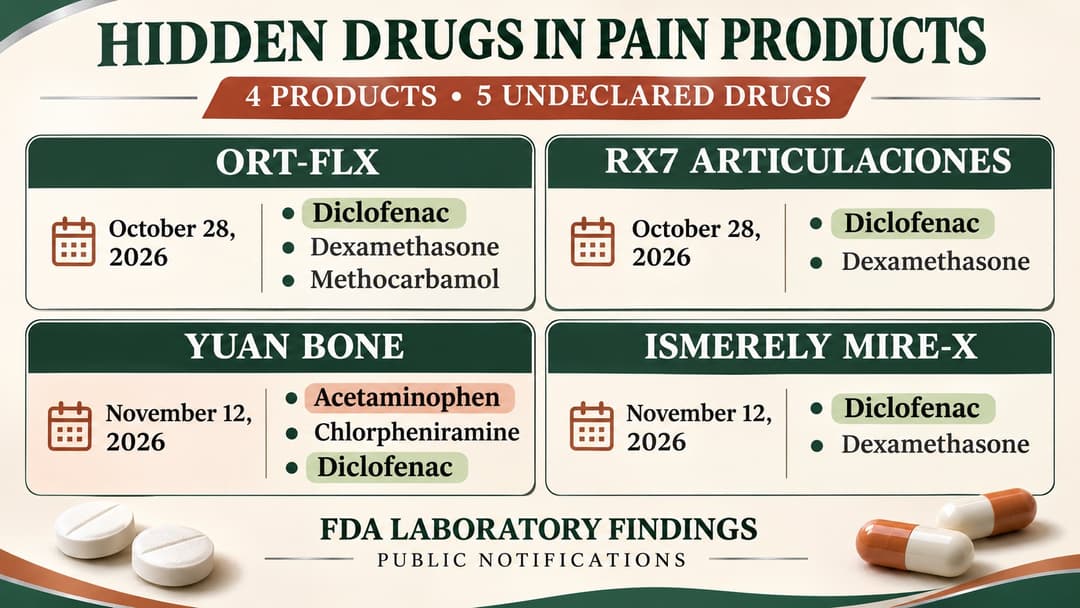
On November 12, 2026, FDA issued separate public notifications for Yuan Bone and Ismerely Mire-X. Testing identified undeclared acetaminophen, chlorpheniramine and diclofenac in Yuan Bone, and undeclared diclofenac and dexamethasone in Ismerely Mire-X. [1] [2]
These findings follow FDA's October 28 notifications concerning Ort-Flx and RX7 Articulaciones, both of which contained undeclared diclofenac and dexamethasone. Methocarbamol was additionally identified in Ort-Flx. [3] [4]
Together, the four notifications illustrate several different toxicological hazards that can arise when consumers unknowingly take medications absent from product labeling.
The October and November notifications concern four products with five distinct undeclared pharmaceutical ingredients.
Product | FDA notification date | Confirmed undeclared ingredients |
|---|---|---|
Ort-Flx | October 28, 2026 | Diclofenac, dexamethasone, methocarbamol |
RX7 Articulaciones | October 28, 2026 | Diclofenac, dexamethasone |
Yuan Bone | November 12, 2026 | Acetaminophen, chlorpheniramine, diclofenac |
Ismerely Mire-X | November 12, 2026 | Diclofenac, dexamethasone |
Source: FDA product-specific notifications. [1] [2] [3] [4]
Diclofenac is the common ingredient across all four notifications. Dexamethasone was identified in three products, while methocarbamol, acetaminophen and chlorpheniramine appear in individual product findings.
The table reflects ingredients FDA reported detecting. It should not be interpreted as a comprehensive chemical analysis excluding every other possible substance.
FDA initially identified a shared combination of a nonsteroidal anti-inflammatory drug (NSAID) and a corticosteroid in Ort-Flx and RX7 Articulaciones.
Ort-Flx was promoted for pain, arthritis and allergies. RX7 Articulaciones was marketed for musculoskeletal pain.
The additional presence of methocarbamol in Ort-Flx introduced another potential hazard involving impaired alertness, dizziness and blood pressure reduction.
FDA recommended against purchasing or using either product and included specific advice for existing users to obtain professional assistance with safe discontinuation because of possible corticosteroid withdrawal. [3] [4]
The November notifications broaden the medication-safety concerns beyond the original combination.
Yuan Bone introduces an undeclared source of acetaminophen, also known internationally as paracetamol, together with chlorpheniramine and diclofenac.
Ismerely Mire-X extends the previously identified diclofenac–dexamethasone pattern to another product promoted for joint pain.
FDA identified online distribution of these products and indicated that they might also be available through physical retail outlets.
The regulatory distinction is important.
FDA's Health Fraud Product Database identifies all four actions as public notifications. As of the November 25 review, a formal recall had not been independently confirmed for any of the four products. [5]
Laboratory confirmation of undeclared drugs supports FDA's consumer warnings. It does not, by itself, establish that a manufacturer has initiated a recall or that affected inventory has been removed from the market.
The identification of acetaminophen in Yuan Bone is a particularly important addition to the original warnings.
Acetaminophen is widely available in nonprescription analgesics, cold and influenza remedies, and prescription combination medications.
A person using Yuan Bone alongside one of these medicines may unknowingly increase their cumulative acetaminophen exposure.
Excessive exposure can produce severe hepatic injury, including acute liver failure. Early symptoms may be absent or relatively nonspecific, making symptom-based reassurance unreliable.
FDA emphasizes avoiding unintended duplication of acetaminophen-containing medications and obtaining immediate assistance when excessive intake is suspected. [6]
In this setting, the absence of acetaminophen from the product label prevents consumers and clinicians from reliably calculating total intake.
The Yuan Bone notification does not disclose the quantity of acetaminophen present. Consequently, its laboratory finding cannot establish a product-specific toxic dose or determine whether an individual consumer has received a hepatotoxic exposure.
Diclofenac is a conventional NSAID used for pain and inflammatory conditions. Its presence in all four products creates a shared risk of unrecognized therapeutic duplication.
Consumers may take these products alongside ibuprofen, naproxen, prescribed diclofenac or other NSAIDs without realizing that they are combining medications from the same drug class.
Established NSAID-related hazards include gastrointestinal injury and bleeding, cardiovascular complications and impaired renal function, particularly in susceptible individuals.
Approved diclofenac prescribing information also identifies concurrent corticosteroid use as a risk factor for gastrointestinal bleeding during NSAID treatment. [7]
This is relevant to Ort-Flx, RX7 Articulaciones and Ismerely Mire-X, where FDA identified both diclofenac and dexamethasone.
However, neither the detected combination nor the number of affected products establishes a measurable incidence of gastrointestinal bleeding, kidney injury or cardiovascular events among consumers.
Dexamethasone is a potent systemic glucocorticoid.
Unrecognized exposure can complicate the assessment of elevated blood glucose, susceptibility to infection, muscle-related adverse effects and changes in mood or behavior.
Repeated exposure also raises a distinct clinical concern: possible suppression of the hypothalamic-pituitary-adrenal axis.
The 2024 joint guideline from the European Society of Endocrinology and the Endocrine Society explains that the likelihood of glucocorticoid-induced adrenal insufficiency depends on several exposure characteristics, including treatment duration, dose and glucocorticoid potency. [8]
With adulterated products, these characteristics may be difficult to reconstruct because the consumer was not informed of the steroid exposure.
FDA specifically advises people currently using Ort-Flx, RX7 Articulaciones or Ismerely Mire-X to seek immediate professional guidance for safe discontinuation and evaluation of possible corticosteroid withdrawal.
These recommendations should not be interpreted as proof that every user has adrenal suppression or requires glucocorticoid replacement.
Because individual exposure histories and steroid quantities remain unknown, a universal tapering schedule would be inappropriate. Continued use of an adulterated product should not be treated as a substitute for medically supervised management.
Two products introduce additional concerns involving centrally acting medications.
Chlorpheniramine, identified in Yuan Bone, is a sedating antihistamine. Its effects can impair attention and alertness.
Methocarbamol, identified in Ort-Flx, is a centrally acting muscle relaxant associated with sedation, dizziness and hypotension.
These exposures may complicate the evaluation of unexpected drowsiness or impaired functioning, particularly when patients do not know that they have taken the relevant medications.
Clinicians should consider other sedating medicines and substances when assessing symptomatic individuals.
The FDA findings establish the presence of these drugs in the tested products, not the severity of their effects in any particular consumer.
The November expansion highlights a practical problem for emergency clinicians, hospital pharmacists and poison centers: a patient's reported medication list may not accurately represent their actual pharmacological exposure.
When evaluating someone who has used an implicated product, relevant information includes:
The exact product name and available packaging.
Approximate timing, frequency and duration of use.
Concurrent acetaminophen-containing medicines.
Other NSAIDs, corticosteroids or sedating medications.
Symptoms occurring during use or after discontinuation.
Depending on the history and clinical presentation, evaluation may need to consider acetaminophen exposure, hepatic or renal injury, gastrointestinal bleeding, sedation or complications of glucocorticoid exposure.
The product warning alone is not sufficient to diagnose poisoning or determine which investigations or treatments an individual requires.
FDA recommends avoiding the purchase and use of all four identified products.
The agency's product-specific recommendations differ because of the reported ingredients:
Yuan Bone: Do not purchase or use this product. Seek prompt medical or poison-center advice if excessive acetaminophen exposure is suspected, even in the absence of symptoms.
Ort-Flx, RX7 Articulaciones and Ismerely Mire-X: Current users should promptly contact a healthcare professional for individualized advice on safe discontinuation and potential corticosteroid withdrawal.
People should inform healthcare professionals about all medications and supplements they have taken, including products marketed as natural pain remedies.
In the United States, suspected poisoning can be discussed with Poison Help at 1-800-222-1222. Emergency services should be contacted immediately for collapse, seizures, breathing difficulty or an inability to awaken the affected person. [9]
Consumers and healthcare professionals can also report suspected product-related adverse reactions through FDA MedWatch.
MedicalToxic has documented other regulatory actions in which undeclared pharmaceutical ingredients created clinically relevant risks beyond the advertised purpose of a product.
The report FDA Recalls All Lots of 10 Day Forecast Capsules provides another example of hidden acetaminophen exposure, involving a product marketed for an entirely different purpose.
The investigation covered in FDA Expands Yellow Oleander Weight-Loss Product Alert also includes the identification of undeclared diclofenac in DMagic Plus alongside a separate cardiac-glycoside hazard.
These are distinct regulatory events, but they share an important medication-safety problem: consumers may receive pharmacologically active substances that their product labels do not disclose.
The November 12 notifications add two specific findings to the original October coverage.
First, Ismerely Mire-X extends the diclofenac and dexamethasone pattern to a third product.
Second, Yuan Bone introduces previously unaddressed concerns involving acetaminophen accumulation and antihistamine-related impairment.
The expanded product comparison therefore identifies several different mechanisms of potential harm rather than simply increasing the number of products under warning.
These findings remain laboratory-confirmed product alerts. They do not establish a national increase in poisoning cases or a population-level trend in adverse-event incidence.
The four FDA notifications do not provide quantitative ingredient concentrations, representative batch-level testing results, individual exposure histories or product-specific adverse-event rates.
The available findings cannot determine:
How much of each undeclared drug a consumer has received.
Whether every unit or batch contains the same substances.
Whether an individual user has developed liver injury, adrenal suppression or another complication.
Whether additional ingredients are present but were not reported in the notifications.
The four products discussed here represent the specific October 28 and November 12 notifications covered in this article, not the complete FDA inventory of pain products containing hidden ingredients.
FDA's October and November 2026 notifications identify five distinct undeclared pharmaceutical ingredients across four products marketed for pain-related symptoms.
Diclofenac was reported in all four products, dexamethasone in three, and methocarbamol, acetaminophen and chlorpheniramine in individual products.
The November expansion adds clinically important concerns involving unrecognized acetaminophen exposure and antihistamine-related sedation, while reinforcing existing concerns about duplicate NSAID exposure and corticosteroid withdrawal.
The principal toxicological challenge is the gap between the consumer's known medication history and the actual pharmacological exposure. Product-specific counseling, accurate medication reconciliation and appropriate medical assessment are essential to addressing that uncertainty.
U.S. Food and Drug Administration. (2026, November 12). Yuan Bone may be harmful due to hidden ingredients.
U.S. Food and Drug Administration. (2026, November 12). Ismerely Mire-X may be harmful due to hidden ingredients.
U.S. Food and Drug Administration. (2026, October 28). Ort-Flx may be harmful due to hidden ingredients.
U.S. Food and Drug Administration. (2026, October 28). RX7 Articulaciones may be harmful due to hidden ingredients.
U.S. Food and Drug Administration. (n.d.). Health Fraud Product Database. Retrieved November 25, 2026.
U.S. Food and Drug Administration. (n.d.). Acetaminophen.
Golden State Medical Supply, Inc. (2025, July 14). Diclofenac sodium delayed-release tablets — prescribing information. DailyMed, U.S. National Library of Medicine.
European Society of Endocrinology & Endocrine Society. (2024, May 13). Glucocorticoid-Induced Adrenal Insufficiency Guideline Resources.
National Capital Poison Center. (n.d.). What is a poison? Clarifying poison-related terms.
Keep reading
Public Health Warnings and Recalls
26 Nov 2026

Public Health Warnings and Recalls
25 Nov 2026
Public Health Warnings and Recalls
10 Nov 2026
Public Health Warnings and Recalls
09 Nov 2026
We would like to use analytics and session-replay tools to understand how this site is used. They are optional and the site works fully without them. Signing in still needs its own cookie either way. Our Privacy Policy names each one.