Dried Fish Recalled Over Potential Botulism Risk
post on 26 Nov 2026
post on 26 Nov 2026
 Medical Toxicologymedicaltoxic.com
https://medicaltoxic.com/news/dried-fish-recall-botulism-risk
Dried Fish Recalled Over Potential Botulism Risk
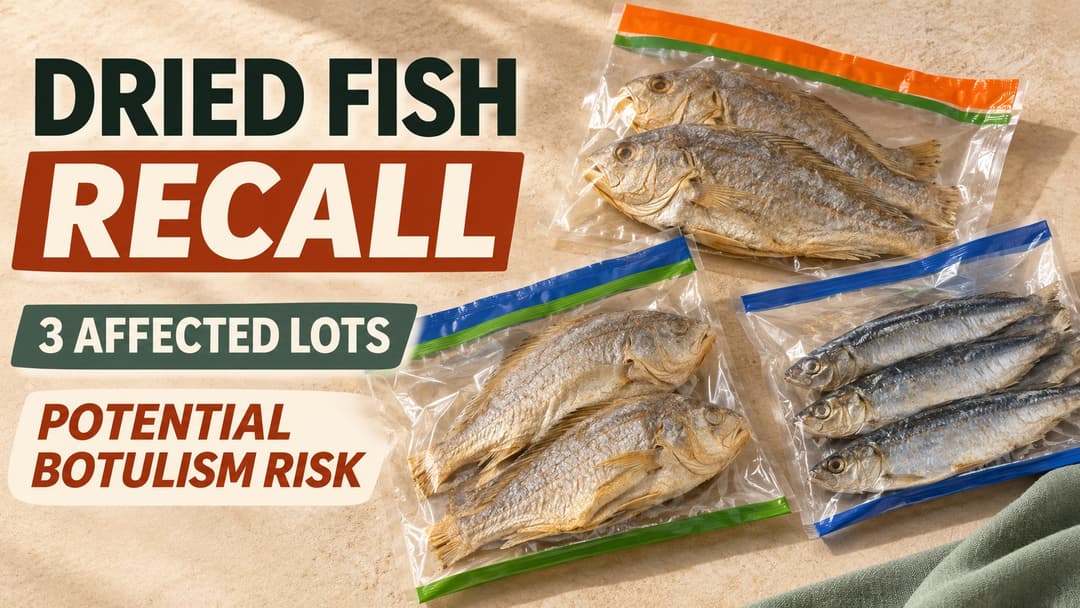
Prime Food Processing has voluntarily recalled three lots of dried croaker and herring after inadequate evisceration raised concerns about potential botulism. No associated illnesses were reported in the recall announcements.
The U.S. Food and Drug Administration (FDA) published two recall announcements on November 23, 2026, involving dried fish distributed by Prime Food Processing LLC of Brooklyn, New York.
The voluntary recalls cover 200 shipping cases of dried croaker fish and 225 shipping cases of dried herring fish. Both actions address inadequate removal of internal organs, a food-processing deficiency associated with potential Clostridium botulinum contamination. [1] [2]
Although neither announcement reported associated illnesses or adverse reactions, the potential for severe neurotoxic poisoning makes accurate product identification and timely clinical assessment important.
The two company announcements were issued on different dates:
November 10, 2026: Recall of two dried croaker fish lots.
November 23, 2026: Recall of one dried herring fish lot.
FDA published both announcements on November 23.
Routine regulatory testing by the New York Department of Agriculture and Markets prompted the recalls. Subsequent investigations traced the affected products to imported fish manufactured in Vietnam.
The notices identify inadequate evisceration as the reason for the recalls. They do not report laboratory confirmation of botulinum neurotoxin in the affected products.
All three affected lots were packaged in clear plastic packages containing 7 oz (198 g) of dried fish.
Product | Item number | Lot code | Expiration date | Packaging trim | Recalled cases |
|---|---|---|---|---|---|
Dried Croaker Fish | AF1340 | 24302 | June 24, 2027 | Orange and green | 100 |
Dried Croaker Fish | AF1420 | 24215 | February 3, 2027 | Blue and green | 100 |
Dried Herring Fish | AF4110 | 25180 | December 28, 2027 | Blue | 225 |
Sources: FDA-published company recall announcements. [1] [2]
The FDA listings identify these products as having no brand name. Consumers should therefore check the product description, item number, lot code and expiration date rather than relying on brand recognition or packaging color alone.
The official recall announcements also contain photographs of the affected packaging.
The combined quantity of 425 cases represents shipping cases included in the recalls, not 425 individual packages, contaminated units or poisoning cases.
The affected products were supplied to Asian grocery stores across multiple U.S. states. Distribution differed by item number.
Dried Croaker Fish — AF1340, lot 24302
CA, CT, FL, GA, HI, IL, KS, MA, MI, MD, MO, NC, NJ, NV, NY, OK, OR, PA, TN, TX and WA.
Dried Croaker Fish — AF1420, lot 24215
AZ, CA, CO, CT, FL, GA, IL, IN, MA, MD, MI, MO, NC, NJ, NY, OH, OR, PA, TN, TX and WA.
Dried Herring Fish — AF4110, lot 25180
AL, AR, CA, CO, FL, GA, HI, ID, IL, IN, KS, MA, MD, MI, MN, MO, NC, NJ, NV, NY, OH, OK, OR, TN, TX, UT, WA and WI.
These distribution lists describe the geographic scope reported in the respective notices. They do not establish that every grocery store in those states received recalled inventory.
Evisceration refers to the removal of a fish's internal organs during processing.
The company announcements explain that C. botulinum spores may be concentrated in the viscera. Improper removal of these organs is therefore a recognized food-safety concern.
From a toxicological perspective, the principal hazard is exposure to botulinum neurotoxin, which can disrupt communication between nerves and muscles and lead to progressive weakness and paralysis.
Foodborne botulism can occur when a person consumes food containing preformed botulinum toxin. The condition is uncommon but can become life-threatening when respiratory muscles are affected. [3]
Importantly, inadequate evisceration establishes a potential hazard. It does not prove that toxin is present in every affected product or that consumption necessarily results in poisoning.
Foodborne botulism can initially present with neurological symptoms rather than the gastrointestinal complaints commonly associated with other foodborne illnesses.
Warning signs include:
Blurred or double vision.
Drooping eyelids.
Difficulty speaking or swallowing.
Progressive muscle weakness.
Difficulty breathing.
Some patients may also develop nausea, vomiting, abdominal discomfort or other gastrointestinal symptoms.
The Centers for Disease Control and Prevention (CDC) emphasizes that patients do not necessarily develop every characteristic symptom. [4]
Suspected botulism is a medical emergency. Anyone developing compatible neurological symptoms after consuming recalled dried fish should seek emergency medical assessment immediately.
Breathing difficulty, worsening weakness or impaired swallowing should never be managed by waiting for symptoms to resolve at home.
Botulism may resemble other neurological disorders, particularly during its early stages.
For emergency clinicians, the combination of visual disturbances, bulbar weakness and progressive paralysis should prompt consideration of botulism when the exposure history is compatible.
A history of eating recalled fish may help identify a potential source, but the absence of a recognized food exposure does not exclude the diagnosis.
CDC recommends immediate consultation with the appropriate state health department when botulism is suspected.
When expert consultation supports the diagnosis, botulism antitoxin should be administered promptly rather than delayed until laboratory results become available. Antitoxin can limit further progression but does not reverse paralysis that has already developed.
Respiratory monitoring and ventilatory support may also be necessary. [5]
These are established clinical management principles, not evidence that antitoxin has been administered to consumers affected by the current recalls.
Although both conditions involve botulinum neurotoxin, the underlying exposure mechanisms differ.
Foodborne botulism generally results from consuming toxin already present in food.
Infant botulism occurs when ingested spores establish themselves within an infant's intestine and produce toxin there. The associated clinical presentation and treatment pathways differ from those of conventional foodborne botulism.
MedicalToxic explains these distinctions in greater detail in Infant Botulism: Symptoms, Diagnosis, BabyBIG Treatment, and Formula Recall Safety.
The dried fish recalls should not be interpreted as an extension of previous infant formula-associated botulism investigations.
Consumers should avoid eating the recalled fish, including products they have already opened.
Both announcements provide the same return procedure: customers should take the remaining fish and its packaging back to the retailer where it was purchased to receive a full refund.
Questions about the recalled products can be directed to Prime Food Processing LLC at 718-963-2323, Monday through Friday, between 9 a.m. and 5 p.m. Eastern Standard Time.
Consumers who have already eaten an affected product should obtain medical guidance about their potential exposure. Anyone experiencing symptoms compatible with botulism should seek emergency care immediately rather than delaying assessment to arrange a product return.
The November 23 FDA publications identify three specific lots of commercially distributed dried fish from the same company.
Combining the two announcements provides consumers and healthcare professionals with a single product-identification resource while preserving the distinct recall dates, item numbers and distribution lists.
The central public-health significance is that a potentially serious foodborne neurotoxic hazard has prompted preventive action before any associated illnesses were reported in the announcements.
Neither announcement establishes that botulinum toxin has been detected in the recalled fish.
The notices do not quantify the number of individual packages containing the processing deficiency, the proportion of products already consumed or the number of potentially exposed consumers.
They also do not document a confirmed outbreak of foodborne botulism.
The absence of reported illnesses at the time of the announcements should not be interpreted as proof that the affected products are safe to consume.
Prime Food Processing's November 2026 dried fish recalls cover three lots of croaker and herring associated with inadequate evisceration and potential botulism risk.
The two actions encompass 425 shipping cases distributed through grocery stores in multiple U.S. states.
Consumers should identify the affected products using their item numbers, lot codes and expiration dates, avoid consumption and follow the company's return instructions.
For healthcare professionals, the recalls reinforce the importance of recognizing possible foodborne botulism early, particularly when visual disturbances, swallowing difficulty and progressive muscle weakness occur after a relevant food exposure.
The recalls document a potential neurotoxic hazard, not a confirmed poisoning outbreak.
U.S. Food and Drug Administration. (2026, November 23). Prime Food Processing LLC Issues Safety Warning Regarding Two Uneviscerated Dried Fish Products. Company announcement dated November 10, 2026.
U.S. Food and Drug Administration. (2026, November 23). Prime Food Processing LLC Issues Safety Warning Regarding Uneviscerated “Dried Herring Fish”.
Centers for Disease Control and Prevention. (2026, February 26). About Botulism.
Centers for Disease Control and Prevention. (2024, April 1). Symptoms of Botulism.
Centers for Disease Control and Prevention. (2024, April 22). Clinical Overview of Botulism.
Keep reading
Public Health Warnings and Recalls
25 Nov 2026
Public Health Warnings and Recalls
10 Nov 2026

Public Health Warnings and Recalls
09 Nov 2026
Public Health Warnings and Recalls
06 Nov 2026 · Updated 26 Nov 2026

We would like to use analytics and session-replay tools to understand how this site is used. They are optional and the site works fully without them. Signing in still needs its own cookie either way. Our Privacy Policy names each one.