FDA Glutathione Endotoxin Investigation Expands With Greenwich Rx Recall
post on 02 Sept 2026 · Updated 04 Oct 2026
post on 02 Sept 2026 · Updated 04 Oct 2026
 Medical Toxicologymedicaltoxic.com
https://medicaltoxic.com/news/fda-compounded-glutathione-endotoxin-alert
FDA Glutathione Endotoxin Investigation Expands With Greenwich Rx Recall
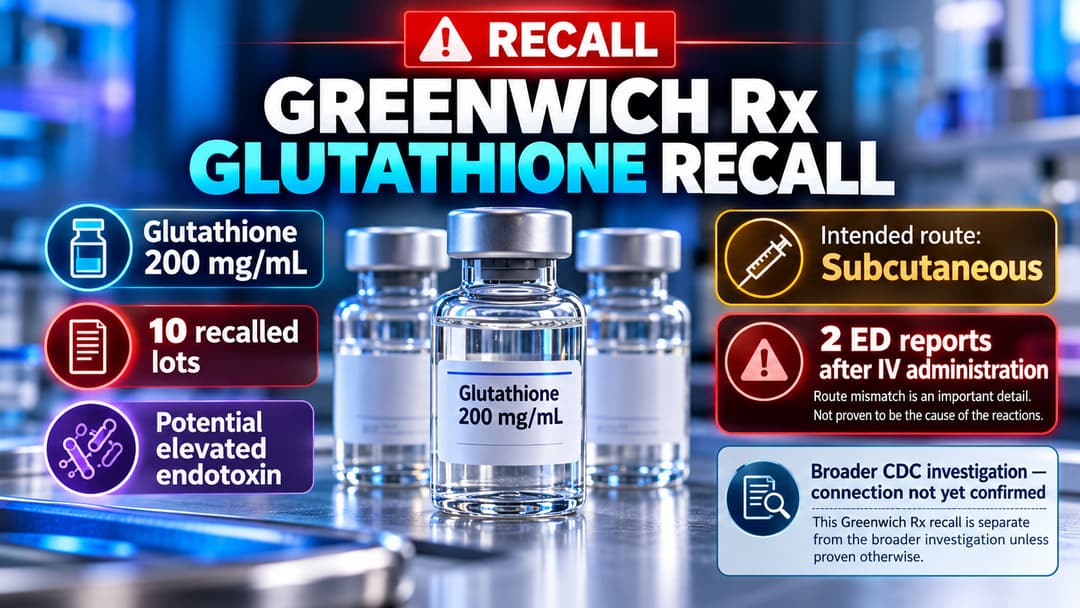
Greenwich Rx recalled 10 lots of compounded glutathione over potential elevated endotoxin levels after two patients required emergency care following IV administration of a product intended for subcutaneous use.
FDA's ongoing compounded-glutathione safety story has expanded again.
On October 1, Greenwich Rx, a 503A compounding pharmacy in Tomball, Texas, voluntarily recalled 10 lots of compounded glutathione injection 200 mg/mL because of potential elevated endotoxin levels. The affected product was dispensed in 10-mL multidose vials and was intended for subcutaneous injection. [1] U.S. Food and Drug Administration
FDA's posted announcement says Greenwich Rx received two reports involving patients who required emergency-department care after receiving the product intravenously, even though it was not formulated for IV administration. [1]
The new recall adds another compounding pharmacy to a 2026 safety problem already involving multiple glutathione products and endotoxin-associated illnesses.
But one distinction is essential:
FDA and CDC have not publicly established that Greenwich Rx's two reported patients are part of the previously reported multistate case series.
Those numbers should therefore not be combined.
The recall covers compounded Glutathione Injection 200 mg/mL, packaged in 10-mL multidose vials.
Lot number | Beyond-use date |
|---|---|
0060-062426-1 | October 2, 2026 |
0060-062726-1 | October 5, 2026 |
0060-070926-1 | October 17, 2026 |
0060-071426-1 | October 22, 2026 |
0060-071426-2 | October 22, 2026 |
0060-072026-1 | October 28, 2026 |
0060-072726-1 | November 4, 2026 |
0060-072926-1 | November 6, 2026 |
0060-073126-1 | November 8, 2026 |
0060-080426-1 | November 12, 2026 |
The recalled product was distributed to patients nationwide between June 26 and September 21, 2026. [1] U.S. Food and Drug Administration
Greenwich Rx is notifying affected customers by mail. Patients with recalled product should stop using it and follow the disposal instructions supplied with the recall notification.
Endotoxins are bacterial components that can produce rapid systemic inflammatory reactions when excessive amounts enter the body through injectable products.
CDC lists potential manifestations including:
fever and chills;
body aches;
headache;
nausea;
dizziness; and
low blood pressure. [2]
Severe reactions may require emergency care.
FDA's Greenwich Rx recall states that injectable products with elevated endotoxin levels could potentially cause serious outcomes including fever, hypotension, inflammatory reactions, anaphylactic shock and death. [1]
Those are potential consequences, not outcomes documented in Greenwich Rx's two reports.
The FDA announcement says the two patients required emergency-department evaluation. It does not report that either patient developed shock, anaphylaxis or died.
Greenwich Rx states that the recalled formulation was intended for subcutaneous injection.
The two reported patients, however, received it intravenously. [1]
That route discrepancy is clinically relevant and should be documented during exposure assessment.
It does not prove that IV administration alone caused the reactions, and it should not be interpreted to mean that subcutaneous administration of a contaminated injectable product would necessarily be safe.
CDC's broader investigation includes illnesses after glutathione administered intravenously, subcutaneously and intramuscularly. [2] CDC
CDC's current public investigation describes more than 25 people becoming ill in at least four states: Texas, Washington, Florida and New York.
At least three patients were hospitalized. All three had received glutathione intravenously, and one became critically ill and required intensive care for shock and abnormal blood-clotting findings. [2] CDC
CDC says the glutathione injections linked to those illnesses were compounded using glutathione ingredients intended for dietary-supplement use.
Separately, FDA reported on August 27 that it was aware of adverse events in at least 30 patients after compounded IV glutathione and said different pharmacies involved had obtained glutathione Lot #229536 from Medisca Inc., labeled dietary-supplement grade. [3] U.S. Food and Drug Administration
These figures come from different official reporting frames and dates.
They should not be added together or used to calculate incidence.
This is another important limitation.
The Greenwich Rx recall notice does not publicly identify:
the glutathione ingredient supplier;
an API lot number;
use of Medisca Lot #229536; or
use of dietary-supplement-grade glutathione.
MedicalToxic therefore does not assume that Greenwich Rx used the same upstream ingredient implicated in FDA's August investigation.
The similarity is the endotoxin concern.
The upstream source relationship remains unconfirmed in the public Greenwich Rx notice.
The 2026 glutathione safety story has developed in stages.
Victory Medical Center Pharmacy recalled affected glutathione lots in early August after testing found elevated bacterial endotoxin.
Optimal Balance Pharmacy followed with another glutathione recall later that month.
FDA then reported the broader Medisca Lot #229536 ingredient connection on August 27. [3]
In September, Centric Compounding recalled six lots across Glutathione, Myer's Cocktail and Tri-Immune Boost after the products were compounded using a glutathione API containing elevated endotoxin. Centric reported nine adverse-event reports. [4]
The October Greenwich Rx action is the latest pharmacy-level recall.
It should remain analytically separate from the earlier patient counts and ingredient findings unless FDA or CDC publishes a direct connection.
The following numbers describe different datasets:
FDA August alert: at least 30 patients.
CDC investigation: more than 25 illnesses across at least four states.
Centric recall: nine adverse-event reports.
Greenwich Rx recall: two reports involving emergency-department care.
Public information does not establish how much overlap exists among these groups.
Reporting them as 30 + 25 + 9 + 2 would therefore be incorrect.
Likewise, no denominator is available showing how many people received the various compounded products.
These reports cannot establish an adverse-event incidence rate or prove that reactions are increasing nationally.
When a patient becomes acutely ill after a compounded glutathione injection—or another compounded “wellness,” antioxidant or detox product—the product identity may be as important as the ingredient name.
Useful exposure information includes:
exact product name;
compounding pharmacy;
lot number;
date and time administered;
intended route;
actual route administered;
other ingredients or injections given at the same visit; and
a photograph of the vial or pharmacy label when available.
CDC recommends evaluating patients who develop fever, chills, myalgia, nausea, vomiting, hypotension, tachycardia or injection-site reactions during or after injectable glutathione and referring them to the appropriate level of care. [2]
For broader context on exposure history and consultation, see The Role of Poison Center Calls: Managing Poisoning Cases from Emergency Calls to Critical Decisions.
Patients with Greenwich Rx product from one of the recalled lots should stop using it and follow the disposal instructions provided in the recall notice. Patients who believe they developed a health problem related to the product should contact their healthcare provider. [1]
CDC advises clinics to sequester potentially implicated injectable glutathione and follow pharmacy recall instructions.
Suspected adverse events should be reported to FDA MedWatch, while suspected outbreaks or clusters should also be reported to the appropriate state or local health department. [2]
Severe hypotension, difficulty breathing, fainting or signs of shock warrant emergency evaluation.
The October 1 Greenwich Rx announcement adds three pieces of information to the existing MedicalToxic topic owner:
First, another compounding pharmacy has recalled glutathione over an endotoxin concern.
Second, the action covers 10 additional lots distributed nationwide.
Third, Greenwich Rx reports two patients requiring emergency-department care after IV administration of a product intended for subcutaneous injection. [1]
What is not new is evidence of a confirmed national increase in poisoning incidence.
Nor has FDA or CDC publicly linked the two Greenwich Rx reports to the existing CDC case series.
Several key questions remain unresolved.
The public Greenwich Rx notice does not provide:
a measured endotoxin concentration;
the upstream glutathione supplier;
the API lot used;
confirmation that dietary-supplement-grade ingredient was involved;
detailed clinical descriptions of the two patients; or
confirmation that those patients are included in the CDC investigation.
Those limitations prevent a more specific causal reconstruction.
Greenwich Rx's October 1 recall adds another significant development to the 2026 compounded-glutathione safety investigation.
Ten lots of compounded glutathione 200 mg/mL intended for subcutaneous injection were recalled because of potential elevated endotoxin levels, and two patients reportedly required emergency-department care after the product was administered intravenously. [1]
The broader CDC investigation continues to involve more than 25 illnesses across at least four states, including three hospitalizations, while FDA has separately reported at least 30 adverse-event patients in its August glutathione alert. [2] [3]
Those figures should not be combined.
Most importantly, the Greenwich Rx recall has not yet been publicly tied to the same ingredient supplier or CDC case series.
The practical toxicology lesson remains consistent:
When a patient becomes ill after a compounded injectable product, identify the compounder, lot number, ingredient source when available, and actual route of administration—not just the ingredient name.
1. U.S. Food and Drug Administration. (2026, October 1). Greenwich Rx Issues Voluntary Nationwide Recall of Compounded Glutathione Due to Elevated Endotoxin Levels.
2. Centers for Disease Control and Prevention. (2026, September 15). Adverse Events Linked to Injectable Glutathione Compounded with Dietary Supplement Grade Ingredient: Current Situation.
3. U.S. Food and Drug Administration. (2026, August 27). FDA reminds compounders not to use dietary supplement grade glutathione for injectables.
4. U.S. Food and Drug Administration. (2026, September 13). Centric Compounding Issues Nationwide Recall of Glutathione, Myer’s Cocktail, and Tri-Immune Boost Due to Elevated Endotoxin Levels.
Keep reading
Public Health Warnings and Recalls
17 Oct 2026
Public Health Warnings and Recalls
17 Oct 2026
Public Health Warnings and Recalls
09 Oct 2026
Public Health Warnings and Recalls
05 Oct 2026 · Updated 16 Oct 2026