13 Anaphylaxis Cases Reported With Unapproved Peptides
post on 28 Oct 2026

post on 28 Oct 2026
 Medical Toxicologymedicaltoxic.com
https://medicaltoxic.com/news/victoria-unapproved-peptides-anaphylaxis
13 Anaphylaxis Cases Reported With Unapproved Peptides
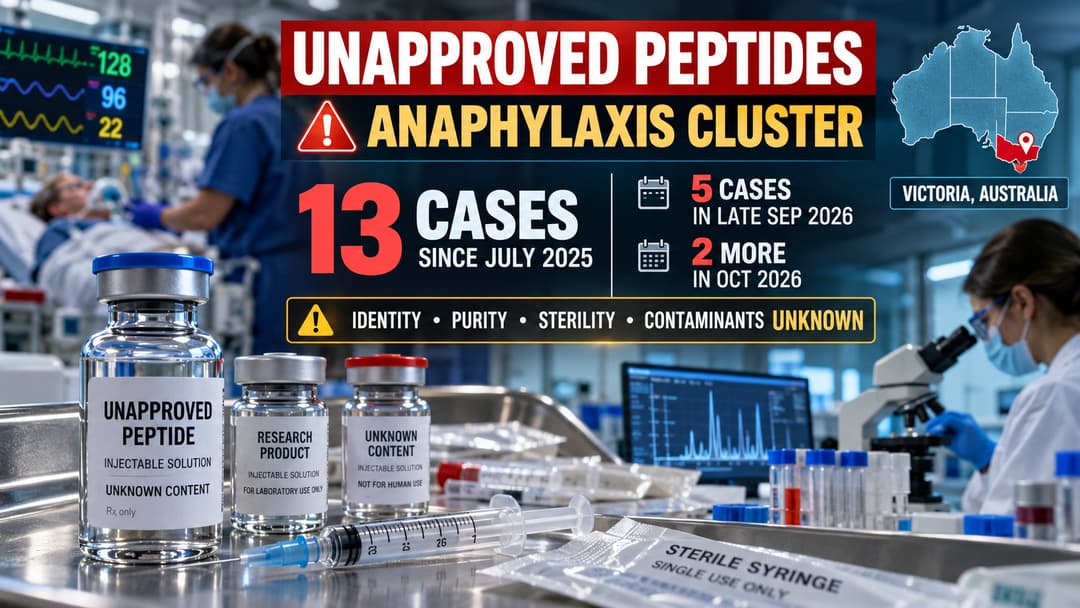
Victoria has recorded 13 anaphylaxis cases associated with unapproved peptide products since July 2025, including seven cases reported during September and October 2026.
Victoria's Department of Health issued an active public-health advisory on October 27, 2026 after a cluster of anaphylaxis notifications associated with unapproved peptide products. [1]
Health authorities report 13 cases since July 2025.
Five occurred in the second half of September 2026, with another two cases reported in October.
Twelve of the 13 apparently represented the person's first episode of anaphylaxis; the remaining case involved a second reaction after an earlier reaction to the same unapproved product. [1]
The central toxicology issue is uncertainty about what patients actually received.
Victoria's health department says unapproved peptide products have not been evaluated by Australia's Therapeutic Goods Administration for safety, quality or effectiveness.
For many products, clinicians and consumers may not know with confidence:
the actual active substance;
concentration;
excipients;
whether contaminants or toxins are present; or
whether manufacturing was sterile.
That uncertainty prevents the 13 cases from being attributed to one specific peptide, excipient or contaminant.
The correct framing is anaphylaxis associated with unapproved peptide-product exposure, not proof that a single peptide caused all cases.
Approved peptide medicines should not be conflated with unapproved products sold online, through social media or as "research" compounds.
The TGA and Australia's Chief Medical Officer warned in June about increasing use of unapproved peptide products and identified serious reported harms including liver injury, severe allergic reactions requiring hospitalization and other inflammatory complications. [2]
Examples in the unapproved market include products promoted as BPC-157, GHK-Cu, TB-500, retatrutide and CJC-1295. [2]
That does not mean each of those substances has been identified in Victoria's 13 cases.
Recent Australian testing illustrates the broader problem.
In September, TGA investigated a product sold as retatrutide after a serious adverse event. Laboratory testing found no retatrutide; instead, the vial contained undeclared semaglutide at a concentration approximately eight times that in TGA-assessed semaglutide products. [3]
That event is separate from the 13-case Victorian cluster, but it demonstrates why the label on an unapproved peptide vial cannot be assumed to establish its true contents.
MedicalToxic's GLP-1 Receptor Agonist Toxicity: Semaglutide, Tirzepatide, and Related Agents discusses online and research-compound exposures, including retatrutide, but it does not own this broader anaphylaxis-cluster intent.
The Victorian data establish a meaningful safety signal.
They do not establish an incidence rate because the total number of people using unapproved peptide products is unknown.
They also cannot determine whether the reactions were caused by:
the claimed peptide;
another active ingredient;
an excipient;
contamination;
nonsterile manufacturing; or
another product-quality problem.
Victoria specifically notes that anaphylaxis can occur after the first dose or after multiple previous uneventful doses. [1]
Victoria advises people not to purchase or use unapproved peptide products and to use products supplied through legitimate Australian pharmacy channels.
Anaphylaxis is a medical emergency, and the department advises anyone experiencing signs of anaphylaxis to call Triple Zero immediately. [1]
For clinicians, the exposure history should include online, gym, wellness, bodybuilding and "research peptide" products.
Preserving packaging, vials, syringes and labeling may also help public-health and regulatory investigation when product identity is uncertain.
Concern over unapproved peptides is not new.
The October 27 development is the documented Victorian anaphylaxis cluster:
13 notifications since July 2025
5 cases in the second half of September 2026
2 additional cases in October
12 apparent first episodes of anaphylaxis
That converts a general product-quality concern into a clinically meaningful public-health signal.
Victoria's warning should not be interpreted as evidence that one newly discovered "toxic peptide" is responsible for 13 reactions.
The more important issue is that severe allergic reactions are occurring in a market where the identity, concentration, purity, sterility and contaminants of injected products may be uncertain.
That uncertainty is itself a medical-toxicology hazard.
Victorian Department of Health. (2026, October 27). Increase in anaphylaxis notifications related to unapproved peptides in Victoria.
Therapeutic Goods Administration & Australian Chief Medical Officer. (2026, June 19). Concerns regarding the public health risks associated with unapproved peptide products.
Therapeutic Goods Administration. (2026, September 14). TGA tests counterfeit retatrutide product following serious adverse event report.
Keep reading
Public Health Warnings and Recalls
23 Oct 2026
Public Health Warnings and Recalls
21 Oct 2026

Public Health Warnings and Recalls
17 Oct 2026
Public Health Warnings and Recalls
17 Oct 2026