ToxIC Study Examines Kratom, Phenibut and Tianeptine Harms
post on 24 Nov 2026
post on 24 Nov 2026
 Medical Toxicologymedicaltoxic.com
https://medicaltoxic.com/news/toxic-registry-kratom-phenibut-tianeptine
ToxIC Study Examines Kratom, Phenibut and Tianeptine Harms
A 15-year multicenter ToxIC registry study identifies substantial morbidity, frequent co-ingestion and opportunities to strengthen addiction-focused care among patients evaluated for psychoactive supplement exposures.
A new study published in Clinical Toxicology on November 20, 2026, examines the clinical burden associated with kratom, phenibut and tianeptine—three pharmacologically distinct substances marketed in some settings as supplements or wellness products.
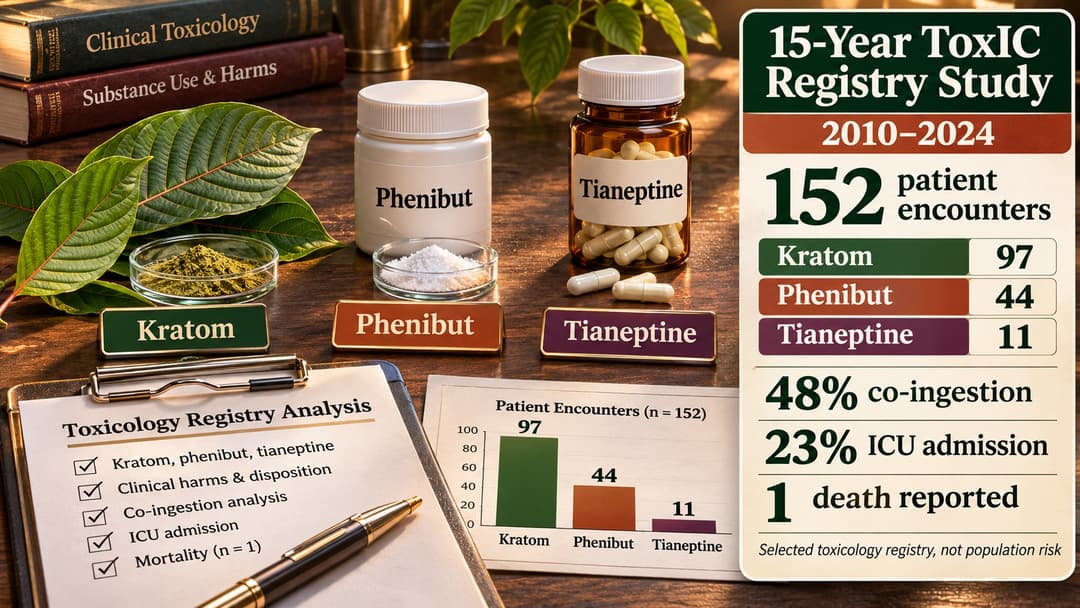
Researchers identified 152 patient encounters in the Toxicology Investigators Consortium (ToxIC) Core Registry between January 1, 2010, and December 31, 2024. Almost half involved co-ingestion, 35 resulted in intensive care admission, and one patient died. [1]
The findings highlight the importance of recognizing both acute toxicity and withdrawal, while addressing the underlying reasons patients use these substances.
Jessica T. Kent and colleagues analyzed prospectively collected registry data to characterize exposure circumstances, clinical presentations, management and outcomes.
Study measure | Reported finding |
|---|---|
Study period | 2010–2024 |
Total patient encounters | 152 |
Kratom | 97 |
Phenibut | 44 |
Tianeptine | 11 |
Encounters involving co-ingestion | 73 (48.0%) |
Intensive care admissions | 35 (23.0%) |
Reported deaths | 1 |
The median patient age was 35 years, with an interquartile range of 26–42 years. Most patients were male (83.6%). The authors also observed increasing registry case counts over time. [1]
These results describe patients evaluated by medical toxicologists. They do not establish the probability of poisoning, hospitalization or death among all people using these substances.
In particular, the aggregate ICU admission proportion cannot be assigned to any one of the three substances.
The ToxIC Core Registry, established by the American College of Medical Toxicology (ACMT), collects clinical information from participating centers where medical toxicologists formally evaluate patients. [2]
This provides valuable specialist-level information about poisoning presentations and management. However, it also creates a selected clinical population.
Patients with severe, unusual or diagnostically complex presentations may be more likely to receive specialist consultation than people with mild exposures.
Consequently, the observed 23% ICU admission proportion should not be interpreted as a population-level estimate of severe toxicity. Differences in product availability, referral practices and registry participation may also influence case counts over time.
Co-ingestion was documented in 73 encounters. Additional psychoactive supplements, stimulants and opioids were among the reported co-exposures. [1]
This is particularly important because a patient's presentation may reflect the combined effects of several pharmacologically active substances rather than toxicity from the reported supplement alone.
For example, concurrent opioid or sedative exposure may complicate the interpretation of depressed consciousness, while stimulant co-exposure may contribute to cardiovascular or behavioral manifestations.
The registry findings do not establish the independent contribution of each substance to every clinical outcome.
The single reported death also should not be attributed to a particular substance or mechanism without additional case-level evidence.
Although the study examines these substances together, their toxicological profiles differ. The following clinical context comes from established sources rather than substance-specific outcome analyses in the new study.
Kratom contains pharmacologically active alkaloids, including mitragynine and 7-hydroxymitragynine (7-OH), with opioid receptor activity.
Product formulations can differ considerably. Concentrated or modified kratom-derived preparations should not automatically be treated as equivalent to conventional botanical kratom.
Relevant concerns include opioid-type toxicity, seizures, physical dependence and withdrawal. [3]
MedicalToxic's Kratom and 7-Hydroxymitragynine Poisoning provides the existing clinical framework for differentiating formulations and evaluating poisoning.
Phenibut is a central nervous system depressant with GABA-B receptor agonist activity.
Intoxication can involve sedation, confusion, impaired consciousness and respiratory depression. Withdrawal after repeated use may produce severe agitation, anxiety, delirium or psychotic symptoms. [4]
Its pharmacology differs from that of opioid-active substances. Naloxone does not directly reverse phenibut's GABA-mediated effects, although a concurrent opioid exposure represents a separate clinical consideration.
Tianeptine is an atypical antidepressant with opioid receptor agonist activity. It is used medically in some countries but is not FDA-approved for medical use in the United States.
Toxicity and withdrawal may resemble opioid intoxication and withdrawal, including potentially serious respiratory and neurological effects. [5]
These risks are discussed in MedicalToxic's Tianeptine: FDA Warnings, Overdose and Withdrawal.
The three substances therefore cannot be managed through a single universal antidote or withdrawal-treatment strategy.
Withdrawal was common in the registry study. The authors also documented different motivations for intentional use, including recreational effects, perceived health benefits and attempts to manage withdrawal independently. [1]
This distinction matters for continuity of care.
A patient presenting after psychoactive supplement use may have an underlying pain condition, anxiety, physical dependence or an existing substance use disorder. Intentional use alone does not establish recreational misuse or an addiction diagnosis.
Acute stabilization and longer-term assessment of dependence are related but distinct clinical responsibilities.
The study reported two important observations concerning addiction treatment and overdose prevention.
Documented intervention | Number | Percentage of all 152 encounters |
|---|---|---|
Buprenorphine/naloxone as part of addiction treatment | 15 | 9.9% |
Naloxone overdose-prevention education and/or prescription at discharge | 16 | 10.5% |
Both percentages use the entire study cohort as their denominator. They are not treatment rates among patients with confirmed opioid use disorder or among those determined to be eligible for naloxone.
The publicly available abstract does not provide sufficient information about treatment eligibility, contraindications, patient preferences or complete follow-up outcomes.
These observations support further assessment of addiction-focused care and overdose-prevention opportunities. They do not establish that every patient should have received buprenorphine/naloxone or that a particular intervention was effective.
Previous poison-center reports and regulatory warnings have already documented hazards associated with these substances.
The November 20 study adds a 15-year multicenter perspective drawn from specialist medical toxicology encounters, bringing exposure circumstances, clinically significant morbidity, withdrawal and discharge-related care into the same analysis.
Its contribution is complementary to substance-specific poisoning guidance: it demonstrates the complexity of the selected clinical population rather than establishing a new treatment protocol.
The study is a descriptive observational analysis of registry data, not a population-based incidence study or randomized treatment trial.
The number of registered encounters cannot establish the prevalence of use, the risk per exposure or the comparative toxicity of kratom, phenibut and tianeptine.
The aggregate outcomes may also reflect differences in referral patterns and concurrent substance use.
Detailed substance-specific outcomes, formulation characteristics, exposure quantities, withdrawal frequencies and treatment eligibility could not be independently assessed from the publicly accessible abstract.
Additional research is needed to characterize these differences and evaluate substance-specific treatment approaches and longer-term outcomes.
The November 2026 ToxIC study provides clinically relevant evidence about psychoactive supplement exposures evaluated by medical toxicologists.
Among 152 encounters, nearly half involved co-ingestion and approximately one-quarter resulted in intensive care admission.
The findings reinforce the need to distinguish acute intoxication from withdrawal and to consider continuity of addiction-focused care when clinically appropriate.
However, the registry does not establish population incidence, comparative toxicity rankings or treatment effectiveness. Kratom, phenibut and tianeptine remain pharmacologically distinct substances requiring individualized clinical assessment.
Kent, J. T., Hacker Teper, M., Culbreth, R., & Finkelstein, Y., on behalf of the Toxicology Investigators Consortium. (2026, November 20). Clinical characteristics of unregulated psychoactive supplement exposures: a 15-year multicenter study of kratom, phenibut, and tianeptine. Clinical Toxicology, advance online publication. https://doi.org/10.1080/15563650.2026.2761523.
American College of Medical Toxicology. (n.d.). ToxIC Core Registry.
U.S. Food and Drug Administration. (n.d.). FDA and Kratom.
Klein-Schwartz, W. (n.d.). Phenibut: A recreational drug with abuse potential. National Capital Poison Center.
U.S. Food and Drug Administration. (n.d.). Tianeptine Products Linked to Serious Harm, Overdoses, Death.
Keep reading
Latest Research and Studies
18 Nov 2026

Latest Research and Studies
17 Nov 2026
Latest Research and Studies
29 Oct 2026
Latest Research and Studies
26 Oct 2026