Australian Study Reports Fewer Pregabalin Overdose Calls
post on 17 Nov 2026

post on 17 Nov 2026
 Medical Toxicologymedicaltoxic.com
https://medicaltoxic.com/news/australia-pregabalin-overdose-decline
Australian Study Reports Fewer Pregabalin Overdose Calls
An Australian study found declining pregabalin dispensing and fewer intentional-overdose poison-centre calls than projected from earlier trends, but could not establish what caused the changes.
A retrospective observational study published in The BMJ on November 11, 2026, reports that pregabalin use and overdose-related calls in Australia have plateaued or declined after years of growth. Researchers examined dispensing records and poison-centre calls from 2016 through 2024, alongside the timing of media coverage and prescribing-safety interventions. [1]
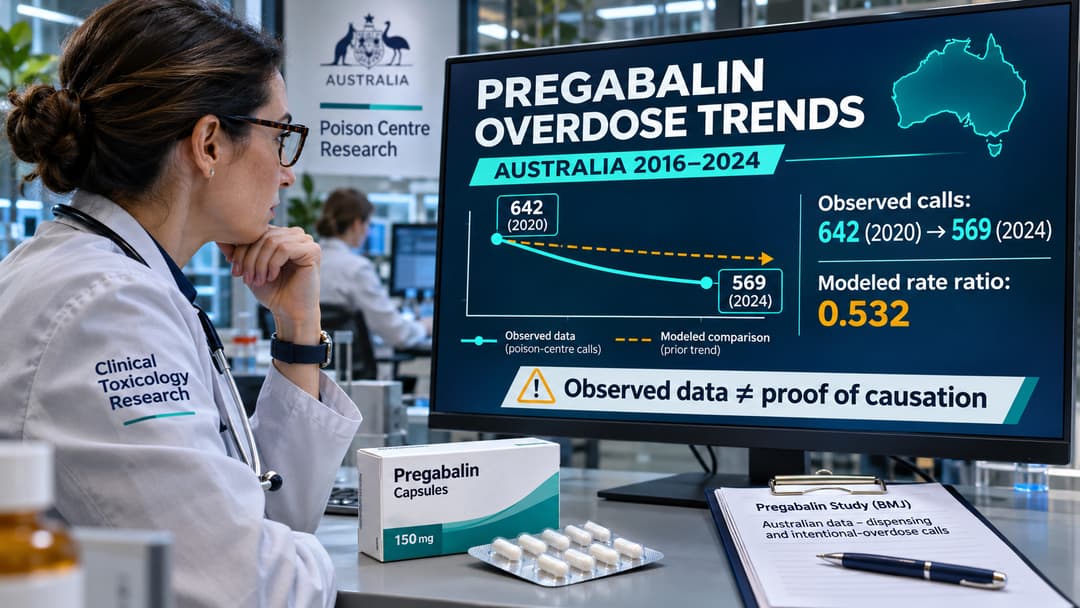
The headline result was a modelled overdose-call rate ratio of 0.532 (95% confidence interval 0.406–0.695) when trends following identified changes were compared with an extrapolation of the earlier trajectory. That corresponds to approximately 47% fewer calls than the model's counterfactual expectation, not a 47% observed year-on-year fall or proof that a particular policy prevented overdoses. [1]
Rose Cairns and colleagues combined two sources:
Australian Pharmaceutical Benefits Scheme (PBS): a 10% random sample of subsidised medicine recipients, containing 227,864 people dispensed 3,441,851 pregabalin prescriptions during the study period.
New South Wales Poisons Information Centre: 4,871 calls about intentional pregabalin overdose, including self-harm, recreational use and other non-medical use. This centre receives approximately half of Australia's poisoning calls; its records are not a complete national count. [1]
The investigators used changepoint detection, interrupted time-series models and latent class analysis. They were assessing population-level associations, not comparing randomized groups assigned to different policies.
Three distinctions are essential to interpreting the results.
Measure | Finding | What it means |
|---|---|---|
Observed overdose calls | 642 in 2020; 569 in 2024 | Actual annual calls recorded by the NSW centre, not nationwide overdose incidence |
Modelled overdose rate ratio | 0.532 (95% CI 0.406–0.695) | Approximately 47% below a projected continuation of earlier trends—not a 47% raw decrease |
Modelled dispensing rate ratio | 0.748 (95% CI 0.700–0.800) | Approximately 25% below the projected dispensing trend after the assessed changes |
In a comparison that treated the period between December 2018 and November 2021 as a washout interval, the researchers estimated 41.3 fewer NSW poison-centre overdose calls in December 2021 than the historical-trend projection. They also estimated an ongoing 1.6% monthly reduction in the modelled overdose-call rate after that point. These are statistical comparisons, not separately verified prevented poisonings. [1]
The study estimated approximately 118,390 fewer pregabalin prescriptions nationwide in December 2021 than its counterfactual, extrapolating from the PBS 10% sample. That figure is not a direct count of prescriptions stopped, nor an observed year-on-year reduction.
The dispensing analysis identified changes in December 2018, after high-profile Australian media reports about pregabalin harms; May 2020, shortly after tighter prescribing and dispensing restrictions introduced in April; and December 2021, following the February 2021 boxed warnings and around implementation of real-time prescription monitoring.
In the primary overdose time-series analysis, the authors did not find statistically significant immediate jumps at those dates. Instead, the slopes of overdose-call trends decreased. A separate modelled comparison across the broader period yielded the 0.532 rate ratio. [1]
This matters because the interventions overlapped with each other, changing prescribing practices and the COVID-19 period. The study could not isolate the effect of media coverage, scheduling restrictions, warnings or prescription monitoring. An observed association should not be presented as a causal estimate of one policy's success.
In a separate analysis of 57,744 people dispensed pregabalin during the 12 months after the final dispensing breakpoint, the researchers identified four patterns of use. A higher-risk dispensing-pattern group comprised 7,790 people (13.5%). Within that group, 5,120 (65.7%) also received opioids, while 2,455 (31.5%) received benzodiazepines. [1]
These are co-dispensing measures, not proof of simultaneous ingestion, misuse or overdose in each individual. Nor does membership in the modelled higher-risk group diagnose a substance use disorder.
For medical toxicology, the overlap matters because opioids and other sedatives can compound respiratory-depression risk. MedicalToxic's existing Gabapentin and Pregabalin Poisoning: Overdose, Respiratory Depression, and Treatment remains the clinical reference for recognizing and managing poisoning; this News focuses on the Australian population-level findings.
In an accompanying editorial, clinical pharmacologist David N. Juurlink argued for more selective pregabalin prescribing based on meaningful benefit to the individual patient. He also cautioned that the observational design cannot establish causation and that poison-centre calls are an imperfect proxy for total harm. [2]
That editorial is expert interpretation, not an additional randomized trial. Neither the study nor the editorial establishes that patients benefiting from prescribed pregabalin should stop treatment abruptly.
The PBS dataset covers subsidised dispensing, not every private prescription or non-prescribed source. Poison-centre calling is voluntary, and the NSW centre does not capture every Australian overdose. Changes in reporting behaviour could affect the results.
The models also cannot determine whether lower dispensing reduced access for patients with neuropathic pain or epilepsy, prompted switches to other medications, or improved patients' longer-term health. The authors did not directly establish changes in hospital admissions or deaths attributable to the assessed interventions. [1]
The 47% figure must therefore remain a modelled contrast with a counterfactual, not a statement that Australia documented a 47% decline in all pregabalin overdoses.
Published on November 11, the study connects nine years of Australian dispensing and poison-centre data with formal analyses of when trends changed. It quantifies both the observed burden and the divergence from a modelled continuation of previous growth, while identifying substantial opioid and benzodiazepine co-dispensing in a higher-risk group.
The findings support continued medication-safety monitoring and careful evaluation of risk communications and prescribing policies. They do not demonstrate the effectiveness of any single intervention or supply a new treatment recommendation.
Australia's recorded pregabalin overdose calls declined from their 2020 peak, and modelling suggests a greater departure from the previously rising trajectory. That is encouraging, but the 0.532 rate ratio describes an observational, counterfactual comparison, not proven prevention of individual poisonings.
The clinical and policy question is how to preserve beneficial treatment while reducing harmful use and sedative co-exposure—not whether pregabalin should be abruptly discontinued for all patients.
Cairns, R., Noghrehchi, F., Pearson, S.-A., Schaffer, A. L., Brett, J., & Buckley, N. A. (2026). Changes in pregabalin use and overdose after government interventions and media coverage: retrospective observational study. BMJ, 395, e101021. https://doi.org/10.1136/bmj-2026-101021.
Juurlink, D. N. (2026). Pregabalin: the case for dialling back on a mediocre analgesic. BMJ, 395, e101357. https://doi.org/10.1136/bmj-2026-101357.
Keep reading
Latest Research and Studies
29 Oct 2026
Latest Research and Studies
26 Oct 2026
Latest Research and Studies
29 Sept 2026 · Updated 02 Oct 2026
Latest Research and Studies
19 Sept 2026 · Updated 01 Oct 2026