Regulations in Toxicology
Tianeptine: FDA Warnings, Overdose and Withdrawal
Omid Mehrpour
Post on 20 Jul 2024 · Updated 12 Nov 2026 · 15 min read
Omid Mehrpour
Post on 20 Jul 2024 · Updated 12 Nov 2026 · 15 min read
 Medical Toxicologymedicaltoxic.com
https://medicaltoxic.com/blogs/tianeptine-fda-warnings-overdose-withdrawal
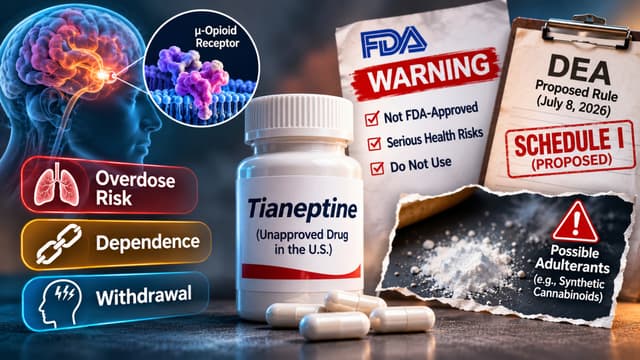
Tianeptine, sometimes called “gas station heroin,” is an atypical antidepressant sold in some countries as a prescription medicine. In the United States, however, tianeptine is not approved by the Food and Drug Administration (FDA) for any medical use.
Despite that status, products containing tianeptine have been marketed through gas stations, convenience stores, vape shops and online retailers under names such as Neptune’s Fix, ZaZa, Tianaa and Pegasus.
The FDA warns consumers not to purchase or use these products because of serious health risks, including overdose, dependence, withdrawal and potentially life-threatening adverse effects. [1]
This is more than a problem of misleading supplement marketing.
Tianeptine has clinically relevant opioid-like activity. Poison-center studies have documented severe sedation, respiratory depression and withdrawal, while direct laboratory investigations have identified unexpected synthetic cannabinoids in some products sold as tianeptine.
In July 2026, the U.S. Drug Enforcement Administration (DEA) also proposed placing tianeptine in Schedule I of the Controlled Substances Act.
The central public-health concern is therefore the combination of opioid-like pharmacology, unreliable product composition, misuse potential and uncertain exposure history.
Tianeptine is not FDA-approved for depression, anxiety, pain or any other medical indication in the United States.
Tianeptine is an atypical tricyclic antidepressant with experimentally established μ-opioid receptor agonist activity.
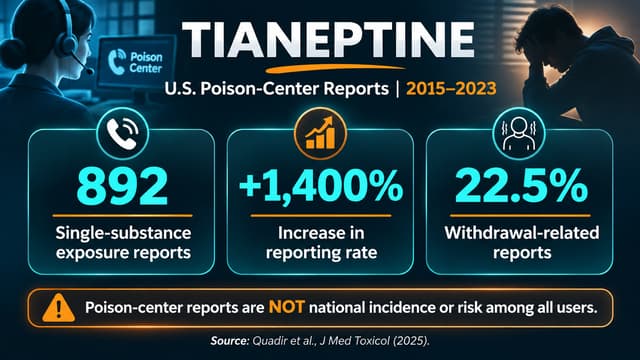
U.S. poison centers recorded 892 reported single-substance tianeptine exposures from 2015 through 2023; this figure is not the total national number of exposures.
The reported tianeptine exposure rate increased by 1,400% between 2015 and 2023.
Severe toxicity can involve altered mental status, respiratory depression and other cardiovascular or neurologic abnormalities.
Some Neptune’s Fix products contained unexpected synthetic cannabinoid receptor agonists, making attribution of severe effects to tianeptine alone difficult.
Tianeptine can produce dependence and opioid-like withdrawal.
Routine drug-screening panels may fail to identify tianeptine.
Naloxone is appropriate when opioid-mediated respiratory depression is suspected, but airway and ventilation support remain essential.
The DEA's July 2026 Schedule I action was a proposed rule, not proof that final federal scheduling had already taken effect.
Tianeptine is a chemically atypical tricyclic antidepressant developed for the treatment of depression.
It has been used as a prescription medication in parts of Europe, Asia and Latin America, under regulatory frameworks that differ from those in the United States.
Its historical classification as an antidepressant does not mean that it has the same pharmacology as conventional selective serotonin reuptake inhibitors (SSRIs).
Early theories emphasized changes in serotonin handling and downstream glutamatergic signaling. However, mechanistic research has since established another important pharmacologic property.
A 2014 experimental study by Gassaway and colleagues demonstrated that tianeptine acts as an agonist at the μ-opioid receptor. The investigators also identified δ-opioid receptor activity at substantially lower potency. [2]
This receptor activity is highly relevant to tianeptine misuse and toxicity.
It helps explain why some people experience:
opioid-like euphoria;
sedation;
tolerance;
dependence;
opioid-like withdrawal;
respiratory depression during overdose.
These findings do not establish that every effect of tianeptine is caused exclusively by opioid receptors. Other pharmacologic actions may contribute.
The nickname reflects the marketing and availability of some tianeptine-containing products in retail outlets that do not ordinarily dispense prescription medications.
It is not a chemically precise name.
Tianeptine is not heroin, and the two substances have different structures and pharmacologic characteristics.
The nickname can also obscure an important distinction: people may encounter tianeptine through products marketed as nootropics, mood enhancers, supplements or substances intended to relieve symptoms of opioid withdrawal.
The FDA has warned that these products are not approved treatments for any medical condition in the United States. [1]
A label describing a product as a supplement or cognitive enhancer does not establish that it has been evaluated for pharmaceutical quality, effectiveness or safety.
One of the strongest direct epidemiologic sources is a study published in the Journal of Medical Toxicology in 2025.
Researchers examined tianeptine exposures reported to the U.S. National Poison Data System between January 2015 and December 2023.
The analysis included 892 reported single-substance tianeptine exposures. [3]
Among those reports:
Finding | Reported result |
|---|---|
Total exposures, 2015–2023 | 892 |
Increase in exposure rate, 2015–2023 | 1,400% |
Moderate medical effects | 51.5% |
Major medical effects | 12.0% |
Medical admission | 40.1% |
Critical care admission | 22.9% |
Withdrawal-related exposures | 22.5% |
These are clinically important findings, but their denominator matters.
The study included cases reported to poison centers, not a random sample of everyone who used tianeptine.
More severe exposures are more likely to generate calls to poison centers, and exposures that are never reported are not represented.
Therefore, 40.1% medical admission does not mean that 40.1% of all people who use tianeptine require hospitalization.
Similarly, the increase in reporting rate from 2015 to 2023 should not be presented as the current growth rate in 2026.
The study reported no deaths within its analyzed group, although fatal tianeptine-associated poisonings have been documented in other reports. [3]
The Neptune’s Fix investigation provides unusually direct evidence because it combined clinical surveillance with laboratory testing of actual products.
A 2025 Journal of Medical Toxicology case series examined a cluster reported to the New Jersey Poison Information and Education System between June 2023 and February 2024.
Investigators identified:
41 poison-center exposure calls;
37 encounters involving acute toxicity;
34 unique patients among those acute encounters;
six product samples analyzed;
blood specimens from two additional patients. [4]
Among the 37 acute encounters, researchers reported:
Outcome | Observed in the outbreak |
|---|---|
Intubation | 16/37 (43%) |
ICU admission | 24/37 (65%) |
Seizures | 15/37 (41%) |
Respiratory depression | 13/37 (35%) |
These percentages describe a selected group of patients with acute illness reported to the New Jersey poison center.
They are not general estimates of the risk faced by every consumer of Neptune’s Fix or tianeptine products.
No fatalities were reported in this particular case series.
Laboratory analysis identified tianeptine in the six tested Neptune’s Fix samples, but the overall product compositions varied.
Some samples contained:
tianeptine;
kava constituents;
THC or CBD;
the synthetic cannabinoid receptor agonists MDMB-4en-PINACA and ADB-4en-PINACA.
One patient blood specimen also contained MDMB-4en-PINACA. [4]
This is significant because synthetic cannabinoid receptor agonists can produce clinical effects that do not match an uncomplicated opioid toxidrome.
They may contribute to:
agitation;
altered mental status;
seizures;
tachycardia;
other severe neurologic or cardiovascular presentations.
However, the study did not establish that every severe outcome in the outbreak was caused by a particular synthetic cannabinoid.
The investigators explicitly considered tianeptine toxicity, adulterants and mixed exposure as possible contributors.
The product testing was also limited to six samples collected in the investigation.
It cannot establish how frequently every brand or batch of tianeptine product contains synthetic cannabinoids.
Clinical pearl: The product label may describe tianeptine, while the actual exposure includes pharmacologically different substances.
Yes.
FDA continues to regard tianeptine as an unapproved drug for U.S. medical use and warns against products marketed as dietary supplements or treatments for psychiatric or substance-use conditions.
Tianeptine is not a lawful dietary ingredient under FDA's interpretation of the applicable federal framework. [1]
A more recent example occurred in January 2026.
FDA posted a company recall announcement involving Modern Warrior Ready, a product marketed as a dietary supplement.
Regulatory testing identified undeclared substances including tianeptine, 1,4-DMAA and aniracetam. The company announced a voluntary recall of all lots of the affected product. [5]
That finding demonstrates another way tianeptine can appear in consumer products.
It does not mean that all products sold under other brands contain these same substances.
On July 8, 2026, the DEA published a notice of proposed rulemaking to place tianeptine, including specified related forms, in Schedule I of the federal Controlled Substances Act.
The proposal cited several factors:
substantial abuse potential;
μ-opioid receptor activity;
documented opioid-like dependence and withdrawal;
serious poisonings and fatal overdoses;
no currently accepted medical use in treatment in the United States;
lack of accepted safety for use under medical supervision in the United States. [6]
The proposal followed a scientific and medical evaluation by the U.S. Department of Health and Human Services.
This distinction is essential.
The July 8, 2026 Federal Register document is explicitly identified as a Notice of Proposed Rulemaking.
It should not be described as a completed federal Schedule I scheduling action unless a subsequent final rule is independently confirmed.
State restrictions may also differ from the federal scheduling process.
For clinicians and readers, the durable distinction is:
FDA approval status, federal Controlled Substances Act scheduling, state restrictions and legality of specific product-marketing claims are separate regulatory questions.
Tianeptine overdose can produce findings consistent with opioid-like toxicity.
Reported manifestations include:
marked drowsiness;
reduced consciousness;
respiratory depression;
confusion;
nausea and vomiting;
cardiovascular abnormalities;
coma in severe cases.
Seizures, agitation and other atypical findings have also been described in tianeptine-associated poisonings, particularly in reports where co-exposures or product adulterants may be present. [4]
FDA's 2025 healthcare-professional communication also describes severe reactions reported after tianeptine product use, including respiratory depression, coma and death. [7]
These clinical findings do not define a unique or diagnostic tianeptine toxidrome.
Other opioids, sedatives, synthetic cannabinoids and medical conditions can produce overlapping findings.
Because tianeptine has μ-opioid receptor agonist activity, naloxone is a reasonable treatment when opioid-mediated respiratory depression is suspected.
However, the clinical evidence is not equivalent to a controlled trial demonstrating a predictable naloxone response in every tianeptine exposure.
In the New Jersey case series, responses to naloxone were variable: some patients improved, others did not, and several responses were inconclusive. [4]
This variability may reflect different contributions from tianeptine, synthetic cannabinoids and other drugs.
FDA has specifically encouraged healthcare professionals to discuss access to overdose-reversal medicines, including naloxone, when appropriate. [7]
The clinical priority is:
Recognize inadequate breathing, provide appropriate airway and ventilation support, administer naloxone when opioid toxicity is suspected, and continue reassessment.
Naloxone does not directly reverse synthetic cannabinoid receptor agonists or every other possible adulterant.
No single fixed naloxone dose should be recommended for all tianeptine-associated overdoses.
Not reliably.
Tianeptine is not routinely included in many standard urine drug-screening panels.
A conventional opiate immunoassay does not provide a dependable method for identifying tianeptine exposure.
FDA warns that tianeptine may not be identified in routine drug screens. [7]
When definitive identification is clinically or forensically important, specialized analytical testing may be required.
Mass-spectrometry methods can identify tianeptine and selected adulterants when the testing method includes those compounds.
Even broad laboratory methods have limitations, particularly when a newly emerging substance is absent from the analytical library.
A negative routine screen therefore should not override a convincing clinical history or toxidrome.
Yes.
Tolerance, dependence and withdrawal have been documented in people using tianeptine, especially with repeated high-dose nonmedical exposure.
Reported withdrawal symptoms can include:
anxiety;
restlessness;
insomnia;
sweating;
nausea;
vomiting;
diarrhea;
muscle aches;
craving;
other opioid-like withdrawal features.
A 2026 systematic review by Anand and colleagues examined human evidence concerning tianeptine misuse, overdose, withdrawal and clinical management.
The review included 53 publications, comprising 48 case reports and five retrospective series, with a combined population of 1,055. [8]
The evidence supports the existence of clinically important dependence and withdrawal.
However, because the underlying evidence consists primarily of case reports and retrospective studies, the review cannot establish the population incidence of tianeptine withdrawal or the comparative effectiveness of different treatments.
Management depends on symptom severity, other substance use, psychiatric and medical comorbidities, and whether the patient meets criteria for a substance-use disorder.
Published reports describe supportive treatment and, in selected patients, treatment involving medications used for opioid withdrawal or opioid use disorder.
A September 2026 case report described one patient with tianeptine use disorder whose cravings and withdrawal symptoms persisted despite buprenorphine treatment and who subsequently received methadone under specialist care. [9]
This is a single case report.
It is not evidence that methadone is generally superior to buprenorphine for tianeptine withdrawal.
Nor does it establish a validated dose-conversion or treatment protocol.
For clinicians assessing opioid-like withdrawal severity, ToxiCOWS: Instant Clinical Opioid Withdrawal Scoring (COWS) provides broader context on structured symptom assessment.
COWS is a general opioid-withdrawal assessment tool; it is not specifically validated to determine an optimal tianeptine-treatment regimen.
Patients with substantial dependence should seek supervised medical care rather than attempting rapid, unmonitored medication changes.
Some products have been marketed as alternatives to established treatment for opioid use disorder.
That claim is not supported by FDA approval.
FDA recognizes buprenorphine, methadone and naltrexone as approved medication options for opioid use disorder. [10]
These treatments differ in mechanism and clinical requirements.
Tianeptine should not be substituted for an evidence-based treatment plan based on marketing claims or anecdotal reports.
Patients using tianeptine to self-manage opioid withdrawal, depression, anxiety or pain may benefit from evaluation for an underlying treatable condition and access to appropriate clinical care.
If a person develops severe drowsiness, loss of consciousness, breathing difficulty, seizure or other serious symptoms after taking a tianeptine-containing product, obtain emergency medical assistance.
In the United States:
Call 911 for unconsciousness, abnormal breathing or other life-threatening symptoms.
For poisoning advice, contact Poison Help at 1-800-222-1222. [1]
Do not induce vomiting.
Do not try to manage severe sedation by taking additional medications, stimulants or other substances.
If available, preserve the product packaging, including the brand, labeled ingredients, lot number and manufacturer details.
These details can help clinicians and poison centers identify an associated safety alert or product cluster.
For broader information about poison-center services, see Poison Control: Your Lifeline in Emergencies.
When tianeptine-related poisoning or withdrawal is suspected, useful information includes:
exact product or brand name;
formulation and route of exposure;
reported quantity and time of use;
acute versus repeated exposure;
other prescribed medications;
alcohol, opioids, benzodiazepines or other co-exposures;
prior withdrawal symptoms;
seizure or cardiovascular history;
product packaging and batch information;
available toxicology results and the limitations of the ordered panel.
The patient's reported product name is an important clue, but it should not be treated as definitive chemical identification.
Despite growing evidence, several questions remain incompletely answered.
We need better information on:
the prevalence of undeclared ingredients across the retail market;
how tianeptine content varies between specific products and batches;
dose-response relationships in human overdose;
the influence of alcohol and other drug co-exposures;
optimal approaches to severe withdrawal;
long-term outcomes after repeated high-dose use;
the effects of evolving federal and state regulation.
It is also important to distinguish different evidence types.
Laboratory pharmacology establishes opioid receptor activity.
Poison-center surveillance identifies reported cases and trends, but does not measure all exposures.
Case series describe clinical presentations among selected patients.
Product analysis establishes the presence of compounds in tested samples, not the entire marketplace.
Case reports may inform treatment decisions but do not establish standard care.
These distinctions help prevent alarming data from being interpreted more broadly than the evidence allows.
Tianeptine is not a conventional SSRI.
Its μ-opioid receptor agonist activity is directly relevant to dependence, respiratory depression and withdrawal.
FDA nonapproval and DEA scheduling are different regulatory issues.
A proposed Schedule I rule is not the same as a final scheduling action.
Do not generalize selected ICU case-series percentages.
The Neptune’s Fix outbreak involved a clinically selected group of severe exposures, not a representative sample of all users.
Unexpected agitation or seizures warrant a broad differential.
Adulterants and mixed exposures may contribute.
Naloxone can address the opioid component.
It does not directly reverse every non-opioid substance that may be present in a mislabeled product.
A negative routine drug screen does not rule out tianeptine.
Specialized methods may be required for confirmation.
Withdrawal treatment evidence remains limited.
Individual successful cases do not establish a universal medication or dosing regimen.
No. Tianeptine is not FDA-approved for any medical indication in the United States, including depression, anxiety, pain or opioid use disorder.
Tianeptine is chemically classified as an atypical tricyclic antidepressant, but it has μ-opioid receptor agonist activity and can produce clinically important opioid-like effects.
On July 8, 2026, the DEA published a proposal to place tianeptine in Schedule I. A proposed rule should not be represented as a final scheduling order without confirmation of a subsequent action.
Naloxone may reverse opioid-mediated respiratory depression. However, clinical response can vary, particularly when other substances or adulterants are involved. Airway and ventilation support remain essential.
Yes. Repeated use can lead to dependence and opioid-like withdrawal. Treatment should be individualized under appropriate medical supervision.
Many routine drug-screening panels do not detect it. Specialized testing may be needed when definitive identification is required.
Tianeptine demonstrates how an unapproved drug can create a substantial toxicology problem when marketed through poorly controlled consumer-product channels.
Its μ-opioid receptor activity helps explain the potential for overdose, dependence and withdrawal.
Direct poison-center surveillance documents significant reported toxicity, while laboratory investigation of Neptune’s Fix products demonstrates that some tianeptine-associated illnesses have involved unexpected synthetic cannabinoids and other substances.
These findings are strengthened by more recent evidence, including a 2026 systematic review and DEA's proposed Schedule I action.
The evidence does not justify assuming that every tianeptine product has the same composition or that every associated clinical outcome is caused by tianeptine alone.
The most important clinical and public-health priorities are:
recognize opioid-like respiratory depression, provide appropriate supportive care, consider hidden co-exposures, avoid reliance on routine drug screens alone, identify dependence and withdrawal, and connect patients with evidence-based treatment.
© All copyright of this material is absolute to Medical toxicology
Dr. Omid Mehrpour (MD, FACMT) is a senior medical toxicologist and physician-scientist with over 15 years of clinical and academic experience in emergency medicine and toxicology. He founded Medical Toxicology LLC in Arizona and created several AI-powered tools designed to advance poisoning diagnosis, clinical decision-making, and public health education. Dr. Mehrpour has authored over 250 peer-reviewed publications and is ranked among the top 2% of scientists worldwide. He serves as an associate editor for several leading toxicology journals and holds multiple U.S. patents for AI-based diagnostic systems in toxicology. His work brings together cutting-edge research, digital innovation, and global health advocacy to transform the future of medical toxicology.
Keep reading
 Regulations in Toxicology

Amir Mohammad Mottaghi
 Regulations in Toxicology
Omid Mehrpour
 Regulations in Toxicology
Omid Mehrpour
 Regulations in Toxicology
Omid Mehrpour