Overdose Survivors Face Higher Long-Term Mortality
post on 29 Oct 2026
post on 29 Oct 2026
 Medical Toxicologymedicaltoxic.com
https://medicaltoxic.com/news/accidental-overdose-long-term-mortality-pavlova
Overdose Survivors Face Higher Long-Term Mortality
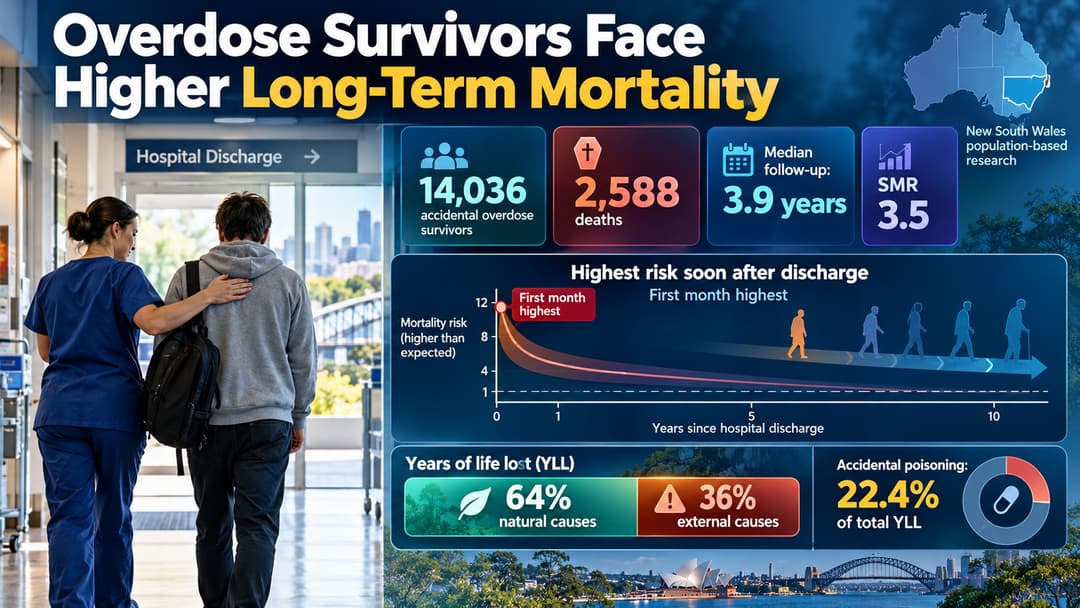
A NSW cohort of 14,036 people hospitalized after accidental overdose found mortality 3.5 times higher than expected, with risk highest soon after discharge.
Surviving an accidental overdose admission does not mark the end of the risk period, according to a large Australian linked-data cohort published in Addiction on October 25, 2026.
The PAVLOVA 4 study followed 14,036 people after an index nonfatal accidental poisoning admission in New South Wales.
During a median follow-up of 3.9 years, 2,588 people died. Overall mortality was 3.5 times that expected in the general population after standardization for population mortality patterns. [1]
The relative mortality burden was particularly high in the period immediately after discharge, with the study identifying the first month as the highest-risk interval. [1]
The cohort used population-linked records from all public and private hospitals in New South Wales between 2011 and 2020.
Participants had an index accidental poisoning involving prescription or illicit drugs associated with nonmedical use and dependence, including opioids and benzodiazepines. [1]
This was therefore a selected population of hospitalized accidental drug poisonings.
It should not be generalized to every overdose, every poison-center exposure or every person who uses drugs.
The standardized mortality ratio for all-cause mortality was:
SMR 3.5; 95% CI 3.4–3.7. [1]
External causes showed particularly high relative mortality.
Accidental poisoning itself had an SMR of 59.5, while suicide had an SMR of 10.5.
Natural-cause mortality was also substantially elevated, including deaths from infectious and respiratory diseases. [1]
The SMR should not be interpreted as an individual patient's probability of dying.
It compares observed mortality in the cohort with expected mortality in the broader population.
One of the most important findings concerns years of life lost, or YLL.
Natural causes accounted for 64.0% of total YLL, including:
neoplasms: 19.5%;
circulatory disease: 12.2%; and
respiratory disease: 11.1%.
External causes accounted for 36.0% of YLL.
Accidental poisoning accounted for 22.4% of total YLL. [1]
These percentages describe the distribution of years of life lost.
They are not percentages of patients and should not be described as percentages of all deaths.
The authors concluded that excess mortality persisted for years but was particularly pronounced during the first month after the index overdose admission. [1]
A University of Sydney summary of the study likewise identifies the period immediately after discharge as the time of greatest relative vulnerability. [2]
That observation is clinically important, but the study does not validate a specific discharge protocol or follow-up interval.
MedicalToxic's Drug Self-Intoxication Deaths Rose Far Faster Than Suicide Deaths During the US Opioid Epidemic examines long-term U.S. mortality trends.
PAVLOVA 4 answers a different question:
What happens after a person survives an accidental overdose admission?
The answer is not simply "some experience another overdose."
Subsequent mortality extends across repeat poisoning, suicide and a broad range of natural diseases.
That finding suggests the index overdose may identify a population with substantial underlying health vulnerability rather than representing an isolated acute event.
This was an observational linked-data cohort.
The index accidental overdose cannot be assumed to have caused every later death.
People hospitalized for overdose may differ from the general population in multiple ways, including underlying disease, substance-use patterns, psychiatric illness, social determinants and healthcare access.
The study also relied on administrative coding to define the index poisoning cohort.
The study's major contribution is its combination of:
14,036 hospitalized accidental overdose survivors
2,588 subsequent deaths
median follow-up 3.9 years
all-cause SMR 3.5
and
64% of YLL from natural causes
It reframes accidental overdose survival as a marker of broader premature-mortality risk.
PAVLOVA 4 suggests that the period after an accidental overdose admission deserves attention well beyond prevention of another overdose.
Mortality was substantially higher than expected, risk was greatest soon after hospital discharge, and most years of life lost were ultimately attributable to natural disease rather than accidental poisoning alone.
The study does not prescribe a new post-discharge pathway.
It does show that surviving the overdose is not necessarily the end of the clinical risk window.
Noghrehchi, F., Cairns, R., Roberts, D. M., Morley, K. C., Haber, P. S., & Buckley, N. A. (2026). Accidental overdose admissions and premature death: A large population-based data-linkage cohort study in New South Wales, Australia (PAVLOVA 4). Addiction. Advance online publication. https://doi.org/10.1111/add.70604
University of Sydney. (2026, October 27). Accidental drug overdose a major warning sign for premature death: new research.
Keep reading
Latest Research and Studies
26 Oct 2026
Latest Research and Studies
29 Sept 2026 · Updated 02 Oct 2026
Latest Research and Studies
19 Sept 2026 · Updated 01 Oct 2026
Latest Research and Studies
05 Aug 2026 · Updated 01 Oct 2026