CDC Finds AKI in 34.5% of Selected Overdose Admissions
post on 26 Oct 2026
post on 26 Oct 2026
 Medical Toxicologymedicaltoxic.com
https://medicaltoxic.com/news/cdc-overdose-aki-hospitalizations
CDC Finds AKI in 34.5% of Selected Overdose Admissions
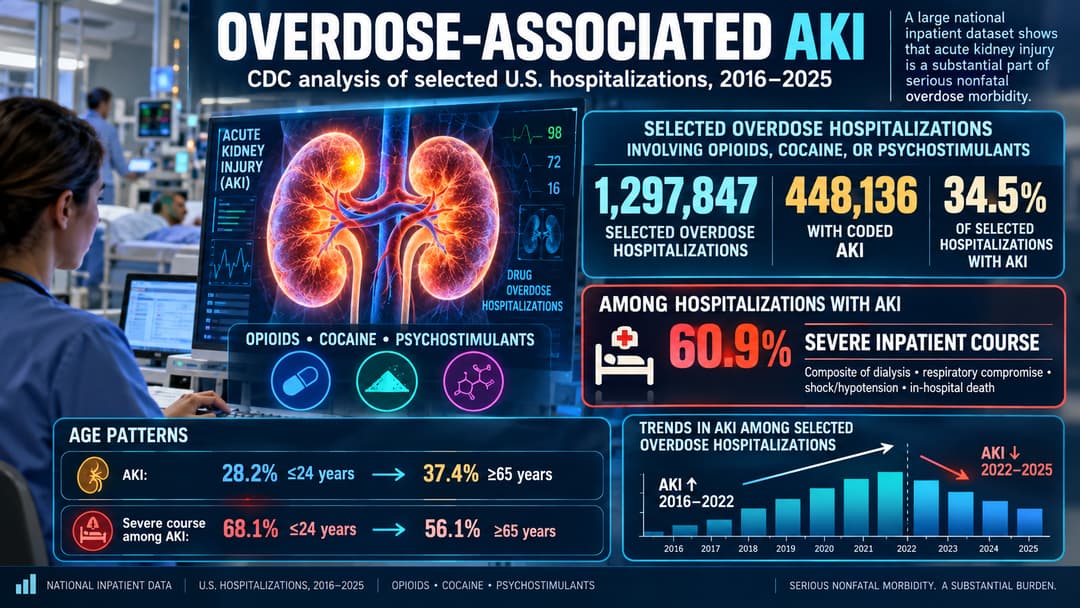
A CDC analysis of nearly 1.3 million selected overdose hospitalizations found coded acute kidney injury in 34.5%; among those with AKI, 60.9% had a severe inpatient course.
Acute kidney injury appears to be a major component of serious nonfatal morbidity among patients hospitalized with selected drug overdoses, according to a new U.S. Centers for Disease Control and Prevention analysis.
The study, published October 22 in CDC's Morbidity and Mortality Weekly Report, examined 1,297,847 hospitalizations involving overdoses of opioids, cocaine and/or psychostimulants from 2016 through 2025.
AKI was documented in 448,136 hospitalizations, corresponding to an adjusted percentage of 34.5%. [1]
Among the overdose hospitalizations with AKI, 273,093—60.9%—met the study's definition of a severe inpatient course. [1]
Those figures add an important dimension to overdose surveillance, which often focuses primarily on deaths, emergency department visits and naloxone response.
The findings suggest that among patients sick enough to require inpatient admission after selected overdoses, kidney injury and other serious in-hospital complications represent a substantial burden.
The denominator matters.
This was not a study of every person experiencing an overdose in the United States.
Researchers analyzed 2016–2025 discharge records from the Premier Healthcare Database, which includes approximately 1,400 hospitals and health systems and represents roughly one quarter of annual U.S. inpatient admissions.
The analysis included hospitalizations with diagnosis codes indicating poisoning involving:
opioids;
cocaine; or
psychostimulants.
The overdose diagnosis had to be coded as present on admission. All available intent categories—including unintentional overdose, intentional self-harm, assault and undetermined intent—were eligible. Patients with end-stage kidney disease or chronic dialysis dependence were excluded. [1]
CDC used weighting and multivariable modeling to produce adjusted national estimates.
The headline 34.5% figure therefore applies to this selected hospitalization population, not to all overdose exposures, poison-center calls or emergency department patients.
Across the 10-year period, AKI was coded in:
448,136 of 1,297,847 overdose-involved hospitalizations.
The adjusted proportion was 34.5%, with a 95% confidence interval of 34.0%–35.1%. [1]
The percentage differed by age.
Among patients aged 24 years or younger, AKI was documented in an adjusted 28.2% of overdose hospitalizations.
Among those aged 65 years or older, the corresponding figure was 37.4%.
Men also had a higher adjusted percentage of AKI than women: 38.1% versus 29.4%. [1]
Those patterns describe associations within the hospital dataset. They do not establish that age or sex independently caused the kidney injury.
The 60.9% severe-course figure requires especially careful interpretation.
CDC did not define severe inpatient course solely by dialysis or advanced kidney failure.
A hospitalization with AKI entered the severe-course category if the patient experienced at least one of the following:
acute dialysis;
respiratory compromise;
shock or hypotension; or
in-hospital death.
Therefore, saying that 60.9% of patients had "severe kidney failure" or "required dialysis" would be incorrect.
The correct interpretation is:
among selected overdose hospitalizations with coded AKI, 60.9% also involved at least one marker of a severe inpatient course.
The composite captures broader physiologic severity, not renal severity alone.
One of the study's more striking findings was the opposing age pattern.
AKI became more common with increasing age:
28.2% among patients aged ≤24 years;
33.8% among those aged 25–44;
35.4% among those aged 45–64; and
37.4% among those aged ≥65.
But among hospitalizations already complicated by AKI, younger patients were more likely to meet the severe-course definition.
The adjusted severe-course percentage was:
68.1% among patients aged ≤24 years;
62.5% among those aged 25–44;
61.0% among those aged 45–64; and
56.1% among those aged ≥65.
CDC highlighted this pattern because younger patients may have more years ahead in which incomplete kidney recovery or subsequent chronic kidney disease could matter.
The data do not show that younger age causes a more severe toxicologic syndrome. They show that, within this administrative dataset, the subgroup with AKI had a higher prevalence of the study's composite severe course.
The study also identified a change in trend over time.
The adjusted percentage of overdose-involved hospitalizations with AKI increased from 2016 through 2022, with an annual percentage change of +2.69%.
From 2022 through 2025, the trend reversed, with an annual percentage change of −5.11%. [1]
The severe-course measure followed a slightly different timeline.
Among overdose hospitalizations with AKI, the adjusted percentage with a severe inpatient course increased during 2016–2023 at an annual rate of +1.82%, then declined during 2023–2025 at −2.89% per year. [1]
The decline in recent years is encouraging, but it should not be interpreted as proof that a specific prevention or treatment intervention caused the change.
The study was designed to describe trends, not establish why those trends occurred.
CDC notes several plausible pathways by which AKI can occur after drug overdose.
These include:
rhabdomyolysis;
ischemic kidney injury; and
substance-specific nephrotoxicity.
Different substances and clinical circumstances can involve different combinations of these mechanisms.
For example, prolonged unconsciousness can contribute to muscle injury and rhabdomyolysis, while hypotension or shock can reduce renal perfusion.
Some xenobiotics also have more direct renal effects.
But this MMWR analysis cannot determine the mechanism of AKI in an individual hospitalization.
The administrative dataset did not provide the level of detail needed to reconstruct dose, route, adulterants, timing, drug combinations or the exact pathophysiologic pathway in each case.
The finding should therefore not be converted into a claim that opioids, cocaine or psychostimulants caused AKI through one uniform mechanism.
MedicalToxic recently covered the CDC-linked finding that many overdose deaths occur while people are isolated in Most U.S. Overdose Deaths Occurred in Isolation, CDC Study Finds.
The new MMWR analysis focuses on a different part of the overdose burden:
patients who survive long enough to be hospitalized but experience serious organ injury.
That distinction matters.
Deaths remain the most visible endpoint in overdose surveillance, but mortality does not capture the full clinical burden of poisoning.
AKI can prolong hospitalization, occur alongside respiratory or hemodynamic compromise, and potentially contribute to longer-term kidney morbidity.
The findings therefore broaden the overdose story from:
Did the patient survive?
to:
What organ injury followed the overdose, and what morbidity may persist after discharge?
The study does not establish a new laboratory schedule, disposition rule or mandatory renal-monitoring protocol.
It does reinforce that kidney injury is common enough among selected hospitalized overdose cases to deserve clinical attention as part of the broader organ-injury assessment.
MedicalToxic's Comprehensive Guidelines for Managing Poisoning in Adults already emphasizes renal-function assessment as part of the laboratory evaluation of significantly poisoned patients.
The new CDC data add population-level context to that principle.
They show that renal morbidity is not confined to isolated case reports or a small number of classically nephrotoxic substances.
At the same time, the study cannot determine which individual overdose patients require admission, serial creatinine testing, nephrology consultation or postdischarge follow-up based solely on these percentages.
Those decisions remain patient-specific.
AKI was identified through ICD-10-CM diagnosis codes, not by researchers prospectively applying serum-creatinine and urine-output criteria to every hospitalization.
CDC notes that this approach could actually underestimate AKI if cases were present clinically but not coded. [1]
It also means the analysis is different from a prospective study using standardized KDIGO laboratory adjudication.
Other limitations include:
participating hospitals may differ from nonparticipating hospitals;
the analysis operated at the hospitalization level rather than accounting fully for repeated admissions by the same patient;
not all relevant medical conditions could be assessed;
ICU admission and hospital length of stay were not analyzed;
the coding approach could not fully characterize dose, route, timing, adulterants or multidrug exposures; and
changing naloxone availability may have affected which opioid overdoses ultimately reached inpatient care.
These limitations are important because they prevent the study from establishing a population incidence of overdose-associated AKI or attributing kidney injury to a single drug class.
AKI after drug overdose is well recognized clinically.
What is new is the scale and longitudinal perspective.
CDC analyzed almost 1.3 million selected overdose-involved hospitalizations across 10 years and quantified both kidney injury and a broader severe inpatient course.
The central findings were:
34.5% had documented AKI.
Among those with AKI, 60.9% met the severe inpatient-course composite.
AKI became more common with age, but severe inpatient courses among AKI cases were proportionally highest in the youngest age group.
Adjusted AKI prevalence rose through 2022 before declining through 2025.
This provides a national-scale view of serious nonfatal overdose morbidity, an area that receives less public attention than overdose death counts.
The 34.5% figure is not the incidence of AKI among all people who overdose.
It applies to a selected inpatient population with coded opioid, cocaine and/or psychostimulant poisoning.
Likewise, 60.9% does not mean that 60.9% required dialysis or developed severe renal failure. It represents a composite of dialysis, respiratory compromise, shock or hypotension, or inpatient death.
The dataset cannot determine which drug caused AKI in multidrug exposures, whether the kidney injury preceded some inpatient complications, or which specific mechanism was responsible.
Finally, the study identifies associations and trends. It does not prove that the decline after 2022 resulted from naloxone, changes in the illicit drug supply, clinical practice or another specific intervention.
CDC's new analysis shows that the overdose burden extends well beyond mortality.
Among nearly 1.3 million selected U.S. hospitalizations involving opioid, cocaine or psychostimulant overdose from 2016 through 2025, AKI was documented in 448,136—34.5%. [1]
Among the hospitalizations with AKI, 60.9% also met a composite definition of severe inpatient course.
The findings do not establish AKI incidence among all overdose patients, nor do they identify one drug or mechanism as responsible.
They do show that kidney injury is a substantial component of serious nonfatal overdose morbidity in hospitalized patients—and that understanding overdose burden requires looking beyond deaths alone.
1. Han, S., Xu, F., Xie, H., Guy, G., & Pavkov, M. E. (2026, October 22). Acute Kidney Injury Among Patients with Drug Overdose–Involved Hospitalizations — United States, 2016–2025. Morbidity and Mortality Weekly Report, 75(41), 614–621.
DOI: 10.15585/mmwr.mm7541a1
Keep reading
Latest Research and Studies
29 Oct 2026
Latest Research and Studies
29 Sept 2026 · Updated 02 Oct 2026
Latest Research and Studies
19 Sept 2026 · Updated 01 Oct 2026
Latest Research and Studies
05 Aug 2026 · Updated 01 Oct 2026