CDC Finds Cannabis in 1 in 5 Overdose Deaths—but Rarely as a Cause
post on 09 Sept 2026 · Updated 01 Oct 2026
post on 09 Sept 2026 · Updated 01 Oct 2026
 Medical Toxicologymedicaltoxic.com
https://medicaltoxic.com/news/cdc-cannabis-detection-overdose-deaths
CDC Finds Cannabis in 1 in 5 Overdose Deaths—but Rarely as a Cause
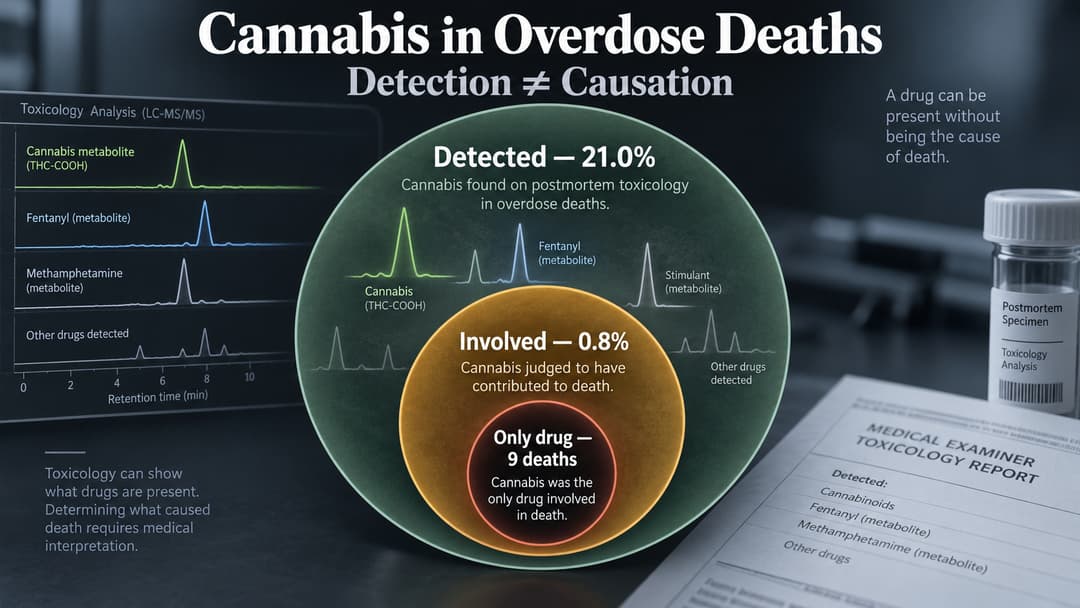
Cannabis was detected in 21% of overdose deaths studied by CDC, but it was listed as contributing to death in just 0.8% and was the only drug involved in only nine cases.
Cannabis appeared on postmortem toxicology testing in approximately one in five overdose deaths examined in a new CDC analysis—but that does not mean cannabis caused one in five fatal overdoses.
That distinction is the central finding of a September 3, 2026 report in CDC's Morbidity and Mortality Weekly Report.
Among 209,166 unintentional or undetermined-intent overdose deaths occurring from January 2021 through June 2025, cannabis was detected in 43,880 deaths, or 21.0%. But medical examiners or coroners listed cannabis as having contributed to the cause of death in only 0.8% of all overdose deaths, or 1,687 cases. Cannabis was the only drug involved in just nine deaths, representing 0.004% of the full dataset. [1]
For medical toxicology, this is an unusually clear demonstration of an important principle:
A drug detected after death is not automatically a drug that caused the death.
CDC's State Unintentional Drug Overdose Reporting System, or SUDORS, deliberately separates these concepts.
SUDORS captures drugs identified through postmortem toxicology even when the medical examiner or coroner does not determine that the drug contributed to the fatal overdose. [1]
That produces three very different numbers:
CDC measure | Finding |
|---|---|
Cannabis detected | 21.0% — 43,880 deaths |
Cannabis listed as involved in causing death | 0.8% — 1,687 deaths |
Cannabis was the only drug involved | 0.004% — 9 deaths |
The difference between 21.0% and 0.8% is not a technical footnote. It changes the interpretation of the entire report.
A headline saying “cannabis caused one in five overdose deaths” would directly contradict CDC's findings.
CDC's own conclusion is that fatal overdoses caused by cannabis are rare and that cannabis detection among overdose deaths is primarily indicative of polysubstance use. [1]
Among overdose deaths in which cannabis was detected, most also involved other high-risk drugs.
CDC reported that:
73.5% involved illegally manufactured fentanyls; and
60.4% involved stimulants such as cocaine or methamphetamine. [1]
Those categories are not mutually exclusive, meaning a death could involve cannabis, fentanyl, and a stimulant simultaneously.
That context is essential.
Cannabis appearing in postmortem testing does not make it the dominant toxicologic mechanism in a death where fentanyl, methamphetamine, cocaine, or other drugs were also determined to have contributed.
MedicalToxic's Most U.S. Overdose Deaths Occurred in Isolation, CDC Study Finds examines another recent SUDORS-based analysis showing how circumstances surrounding fatal overdose can be clinically important without automatically identifying a single causal drug.
For broader context on the potency and respiratory toxicity of illicit synthetic opioids, see The Alarming Rise of Synthetic Opioids: What Healthcare Professionals Should Know.
The age pattern was one of the report's most notable findings.
Among 1,028 overdose deaths in adolescents aged 12–17 years, cannabis was detected in 439 cases, or 42.7%—the highest proportion of any age group studied. [1]
The percentage changed over time:
49.2% in 2021;
35.9% in 2024; and
44.6% during January–June 2025.
But again, cannabis detection does not establish that cannabis caused those adolescent deaths.
Among cannabis-positive overdose deaths in adolescents:
88.6% involved illegally manufactured fentanyls; and
69.0% involved stimulants. [1]
This is arguably the more important adolescent finding.
The data identify a group with high cannabis detection inside a much more dangerous polysubstance overdose environment, particularly one involving illicit fentanyl and stimulants.
CDC's cannabis definition was broader than delta-9-THC alone.
The analysis included cannabinoids derived from cannabis, including THC, cannabidiol, tetrahydrocannabivarin, and dronabinol. It excluded synthetic cannabinoids, which are chemically distinct substances and can have very different toxicity profiles. [1]
Among deaths with cannabis detected:
delta-9-THC was identified in 73.1%;
delta-8-THC in 1.1%;
other specified cannabis derivatives in 0.1%;
and cannabis not otherwise specified, such as a marijuana metabolite, in 26.6%.
The categories were not completely mutually exclusive. [1]
CDC also notes that commonly used cannabinoid immunoassays cannot reliably distinguish delta-8-THC from delta-9-THC without confirmatory testing.
That laboratory limitation is another reason not to extract more specificity from a positive cannabinoid result than the underlying testing supports.
The new report is especially useful because SUDORS records both toxicology detection and causal involvement.
Those are fundamentally different data fields.
A postmortem toxicology report answers one question:
What substances were detected?
The medical examiner or coroner determination addresses another:
Which substances were considered involved in causing the overdose death?
SUDORS preserves both rather than treating them as interchangeable. [1]
This distinction also applies beyond cannabis.
Forensic toxicology frequently identifies several substances in the same person. Interpreting a fatal poisoning requires integrating toxicology findings with the death investigation rather than simply counting every detected compound as an independent cause.
That is why the 21.0% cannabis-detection figure and the 0.8% involvement figure can both be correct.
They answer different questions.
The CDC report does not show that cannabis caused 21% of overdose deaths.
It also does not establish that:
cannabis use increases the risk of fatal overdose by 21%;
one in five people who use cannabis will experience an overdose;
cannabis caused the fentanyl- or stimulant-involved deaths in which it was detected;
cannabis-related overdose mortality increased during the study period; or
cannabis detection represents a rising national trend.
In fact, CDC found that the percentage of overdose deaths with cannabis detected was relatively stable over time. [1]
The report is therefore a cross-sectional surveillance finding about the presence of cannabis in fatal-overdose toxicology—not evidence of an emerging epidemic of cannabis-caused fatal overdoses.
The new contribution is not a claim that cannabis alone commonly causes fatal overdose.
CDC explicitly states the opposite.
What the new analysis provides is a large multijurisdictional estimate of how often cannabis appears in postmortem toxicology during fatal overdoses and how dramatically that frequency differs from formal causal involvement.
Across 209,166 overdose deaths:
21.0% detected → 0.8% involved → 9 cannabis-only deaths. [1]
That three-step comparison is the central information gain.
It also shows that cannabis-positive overdose deaths frequently occurred in a setting of fentanyl and stimulant involvement, especially among adolescents.
Several limitations matter when interpreting the findings.
First, this was not a census of every U.S. overdose death.
The analysis included 31 states and the District of Columbia. Jurisdictions had to meet reporting and toxicology-completeness thresholds, and analyses were restricted to deaths with available toxicology reports. [1]
Second, SUDORS in this analysis included unintentional and undetermined-intent drug overdose deaths, not every manner of drug-related death.
Third, cannabinoid testing is not universally performed in overdose death investigations because cannabinoids are rarely implicated as the cause of death. CDC therefore says cannabis detection is likely underestimated. [1]
Fourth, screening methods can differ. CDC notes that cannabinoid immunoassays cannot distinguish delta-8-THC from delta-9-THC without confirmatory testing.
Finally, a detected substance is not automatically equivalent to a causal exposure. SUDORS depends on death certificates, medical examiner and coroner records, scene information, and postmortem toxicology to characterize fatal overdoses. [2]
These limitations reinforce rather than weaken the report's central lesson: detection and causation must be interpreted separately.
The report does not make cannabis risk-free.
CDC notes that cannabis use is associated with recognized adverse health effects and identifies youth cannabis use as an opportunity for early intervention. [1]
But accurate risk communication requires distinguishing those established concerns from claims the overdose data do not support.
The strongest interpretation is not:
“Cannabis caused one in five overdose deaths.”
It is:
Cannabis was commonly detected among people who died from overdoses, but it was rarely determined to be a causal drug and almost never the only drug involved.
For medical toxicology, that is more than a cannabis finding.
It is a reminder that laboratory detection, exposure, association, and causal attribution are different levels of evidence—and collapsing them into one number can radically distort what surveillance data actually show.
CDC's new SUDORS analysis found cannabis in 21.0% of 209,166 overdose deaths, but cannabis was listed as contributing to death in only 0.8%, and it was the sole drug involved in only nine cases. [1]
Among cannabis-positive deaths, illegally manufactured fentanyl and stimulants were far more commonly involved, including among adolescents.
The data therefore should not be used to claim that cannabis causes one in five overdose deaths.
Their more important toxicology message is methodological:
Postmortem detection tells us that a substance was found. It does not, by itself, tell us that the substance caused the fatal overdose.
Tanz, L. J., Quader, Z. S., Mattson, C. L., & Vivolo-Kantor, A. M. (2026). Notes from the Field: Cannabis Detection Among Overdose Deaths — United States, 2021–2025. Morbidity and Mortality Weekly Report, 75(34), 539–541. https://doi.org/10.15585/mmwr.mm7534a2
Centers for Disease Control and Prevention. (2026, August 7). SUDORS Dashboard: Fatal Drug Overdose Data.
Keep reading
Substance Abuse and Overdose
07 Oct 2026 · Updated 09 Oct 2026
Substance Abuse and Overdose
05 Oct 2026
Substance Abuse and Overdose
25 Sept 2026 · Updated 01 Oct 2026
Substance Abuse and Overdose
20 Sept 2026 · Updated 01 Oct 2026