Fentanyl Purity Alone Does Not Explain the U.S. Overdose Decline, Study Finds
post on 20 Sept 2026 · Updated 01 Oct 2026

post on 20 Sept 2026 · Updated 01 Oct 2026
 Medical Toxicologymedicaltoxic.com
https://medicaltoxic.com/news/fentanyl-purity-us-overdose-decline-study
Fentanyl Purity Alone Does Not Explain the U.S. Overdose Decline, Study Finds
A new Science Advances analysis challenges a single-cause explanation for falling U.S. overdose deaths, finding that national fentanyl purity trends alone do not adequately account for the decline.
U.S. overdose deaths have fallen sharply from their recent peak.
One proposed explanation has been straightforward: illicit fentanyl became less pure, reducing the amount of fentanyl reaching people who use the unregulated drug supply.
A new peer-reviewed analysis suggests the story is considerably more complicated.
Researchers writing in Science Advances reexamined the relationship between fentanyl powder purity and overdose mortality and concluded that national fentanyl purity alone does not provide a sufficient explanation for the recent decline in U.S. overdose deaths. [1]
The finding does not mean declining fentanyl purity had no effect.
Instead, it challenges a much stronger claim: that a national fentanyl “supply shock” beginning in 2023 can, by itself, explain why overdose mortality subsequently fell.
That distinction matters.
For toxicology and public health, two variables falling at roughly the same time do not automatically establish that one caused the other.
The hypothesis starts with a real observation.
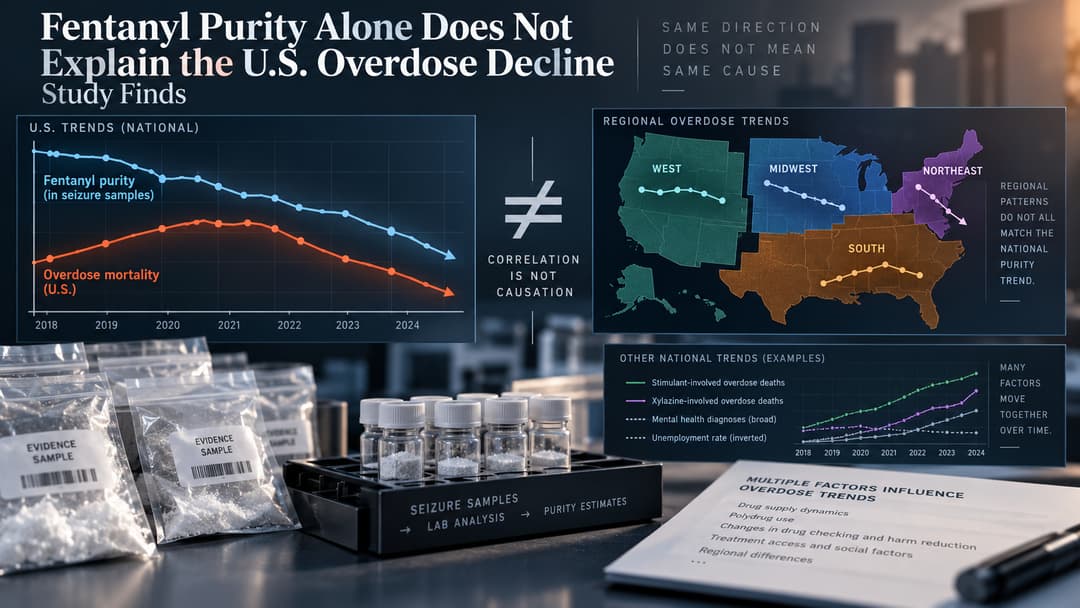
DEA data show that average fentanyl powder purity declined during 2024 after rising during the preceding period. The agency's 2025 National Drug Threat Assessment described declining fentanyl purity alongside falling overdose mortality. [2]
That temporal overlap created an intuitively plausible explanation:
less fentanyl in the illicit supply → less fentanyl exposure → fewer fatal overdoses.
The new study, led by Nabarun Dasgupta and colleagues, tested whether the available data actually support that explanation at national and regional levels. [1]
Rather than relying on a single national correlation, the researchers examined U.S. Census regions, accounted for time trends and autocorrelation, and used unrelated economic indicators as negative controls to test whether apparent relationships could arise simply because several variables were moving through similar post-pandemic trends.
One of the strongest challenges to a simple purity explanation appeared before fentanyl purity began falling.
From July 2022 to September 2023, the national fentanyl powder purity series used in the analysis rose from 12.8% to 25.8%—an increase of about 101.5%. [1]
If national fentanyl purity were a strong and consistent driver of overdose mortality, rising purity might be expected to track rising deaths across regions.
That is not what the researchers observed.
During the same period:
U.S. Census Region | Change in fentanyl overdose mortality |
|---|---|
Northeast | −20.3% |
Midwest | −45.4% |
South | −15.1% |
West | +9.0% |
The national purity series therefore rose sharply while fentanyl-related overdose mortality was already declining in three of four major Census regions. [1]
After adjustment for the statistical structure of the time series, the researchers found little evidence that month-to-month changes in the national purity measure explained mortality in the Northeast, Midwest, or South during this rising-purity period.
The West showed the clearest positive relationship, but even there the association was modest.
The picture looked very different during the next period.
Between October 2023 and September 2024, national fentanyl powder purity in the reconstructed DEA series fell from 24.7% to 11.2%, a decline of approximately 54.6%. [1]
During roughly the same period, monthly fentanyl overdose mortality rates fell between 44.2% and 48.8% across the four Census regions.
On the surface, that looks like strong support for the purity hypothesis.
But this is where the study's methodological argument becomes important.
When two variables share a broad rise-and-fall pattern over time, ordinary correlation can make them appear causally connected even when they are not.
The researchers therefore asked whether similarly impressive associations could be produced using variables with no plausible pharmacologic pathway to fentanyl overdose.
They could.
The investigators used two negative-control variables:
retail price inflation; and
consumer sentiment.
Neither is a measure of fentanyl exposure.
Yet before adjustment for time trends and autocorrelation, overdose mortality showed strong correlations with both.
The raw correlation was approximately +0.63 with inflation and −0.73 with consumer sentiment—associations comparable to or larger than some of the apparent fentanyl purity relationships. [1]
After appropriate time-series adjustment, both relationships changed substantially and even reversed direction.
The point is not that inflation or consumer sentiment caused overdose deaths.
It is the opposite.
If unrelated variables that happen to share the same historical pattern can generate strong correlations, then a simple correlation between national fentanyl purity and overdose mortality cannot, by itself, establish a causal supply-shock mechanism.
Monthly overdose mortality does not reset independently every 30 days.
Neither does drug purity.
Values in one month tend to resemble values in nearby months. Both measures also respond to longer social, epidemiologic, and market trends.
That is autocorrelation.
Ignoring it can make statistical relationships look much stronger than they really are.
The new analysis used ARIMA-based transfer-function models designed to account for these time-series properties rather than treating every monthly observation as statistically independent. [1]
This is one reason the study reaches a more cautious conclusion than a simple visual comparison of two declining curves.
Two lines moving downward together are evidence of temporal association.
They are not automatically evidence that one line caused the other.
The study also raises concerns about what the national fentanyl purity series actually represents.
DEA purity information comes from fentanyl seized by law enforcement.
That is not the same as a random sample of fentanyl being consumed across the United States.
The authors note that sampling practices changed during 2023–2024, including increased emphasis on larger, wholesale-level seizures.
They cite DEA information indicating that higher-volume samples submitted through the Fentanyl Profiling Program could have considerably higher average purity than ordinary field-laboratory samples. [1]
That creates a potential selection problem.
If the types of seizures being tested change over time, an apparent change in average national purity may partly reflect a change in what was sampled—not only a change in the fentanyl available to people at street level.
The researchers also identified inconsistencies between purity values reconstructed from the DEA figure and other reported DEA estimates for the same years.
None of this makes DEA data useless.
It means they must be interpreted according to how the samples were obtained.
There is another problem with treating one national purity estimate as the explanation for overdose trends across the entire country.
Illicit drug markets are highly regional.
Fentanyl concentration, adulterants, form, distribution networks and market dynamics can vary substantially between cities and regions.
Yet the main purity series analyzed was a single national measure, while overdose mortality was examined separately across the Northeast, Midwest, South and West. [1]
The study also reviewed Canadian evidence and found that relationships between fentanyl purity and mortality varied in both strength and direction at smaller geographic levels.
That supports a more nuanced interpretation:
Local changes in fentanyl purity may matter even if one national purity series cannot explain the national mortality decline.
The study does not rule out local supply effects.
The researchers do not identify one replacement explanation.
That is important.
Showing that national fentanyl purity is insufficient does not prove that another single factor caused the decline.
The authors discuss several possibilities that may contribute simultaneously, including:
changes elsewhere in the illicit drug supply;
expanded public-health and harm-reduction interventions;
behavioral changes among people who use drugs;
demographic shifts;
post-pandemic social changes;
changes in trafficking and cartel dynamics; and
fewer people newly initiating illicit opioid use. [1]
MedicalToxic previously reviewed the broader decline and several competing explanations in Thanksgiving 2025: Overdose Death Trends in the United States and What We Are Thankful For.
The new study strengthens the argument for a multifactorial explanation, but it does not establish the relative contribution of each factor.
There is also a risk of drawing the wrong practical conclusion from falling purity.
DEA itself cautioned in its 2025 assessment that declining average fentanyl purity does not mean street-level fentanyl has become safe. The illicit supply remains unpredictable and may contain fentanyl alongside substances such as xylazine, other synthetic opioids or additional adulterants. [2]
A national average also says little about the dose in a specific bag, pill or exposure.
For an individual patient, overdose risk depends on the actual exposure, route, opioid tolerance, co-exposures, access to naloxone, presence of another person and time to recognition and treatment.
MedicalToxic's recent analysis Most U.S. Overdose Deaths Occurred in Isolation, CDC Study Finds illustrates how circumstances surrounding exposure can materially influence whether an overdose becomes fatal.
The new study should not be interpreted as showing that fentanyl purity is irrelevant.
It does not establish that:
lower fentanyl purity cannot reduce overdose risk locally;
purity changes have no effect on individual exposure;
harm-reduction programs are the proven cause of the national decline;
demographic or behavioral changes are the proven cause;
DEA data are invalid;
the recent overdose decline is an artifact; or
researchers have identified the true cause of the decline.
The analysis is ecological and geographic.
It examines population-level relationships between a national drug-supply indicator and regional mortality trends. It cannot determine the fentanyl concentration actually encountered by an individual who experienced an overdose.
That limits causal inference.
The central contribution is methodological.
The study takes a compelling one-cause explanation—falling fentanyl purity caused falling overdose mortality—and asks whether that explanation survives more demanding tests.
Several findings weaken the simple national supply-shock interpretation:
overdose mortality was already falling in most regions while the national purity series was rising;
the later simultaneous decline in purity and mortality occurred alongside other unrelated variables with similar time trends;
time-series adjustment substantially changed apparent correlations;
one national purity estimate may not represent highly localized illicit drug markets; and
law-enforcement seizure data may be affected by changes in sampling and seizure selection. [1]
The result is not that purity does not matter.
It is that purity alone is not currently an adequate national explanation.
The study has limitations of its own.
The analysis relies on geographically aggregated rather than individual-level data.
The fentanyl purity series was reconstructed from a DEA figure rather than a complete public dataset of individual samples.
The same national purity measure was compared with multiple regional mortality series.
Law-enforcement seizure data are not random samples of the consumer drug supply.
Changes in testing priorities, geography, seizure size or enforcement activity could change the composition of samples over time.
The researchers also could not measure every potential factor influencing overdose mortality.
These limitations mean the study is better understood as a challenge to a causal explanation than as proof of an alternative one.
The recent decline in U.S. overdose deaths is real and important.
So is the decline in average fentanyl purity reported in national DEA data.
But the new Science Advances analysis finds that the second observation, by itself, cannot adequately explain the first.
National fentanyl purity rose while overdose mortality was already declining in much of the country. Later, when purity and mortality fell together, unrelated economic indicators produced similarly strong correlations because they shared broader time trends. [1]
Local reductions in fentanyl purity may still contribute to local reductions in overdose.
What the study challenges is the leap from correlation to a single national cause.
For public-health toxicology, that is the most useful takeaway:
The U.S. overdose decline should not currently be reduced to one drug-supply metric.
Dasgupta, N., Sibley, A., Gildner, P., Combs, K. G., Post, L. A., Tobias, S., Kral, A. H., & Pacula, R. L. (2026). Fentanyl purity and overdose decline: A reexamination of geographic trends. Science Advances, 12(38), eaei7742. https://doi.org/10.1126/sciadv.aei7742
U.S. Drug Enforcement Administration. (2025). 2025 National Drug Threat Assessment.
Keep reading
Substance Abuse and Overdose
07 Oct 2026 · Updated 09 Oct 2026
Substance Abuse and Overdose
05 Oct 2026
Substance Abuse and Overdose
25 Sept 2026 · Updated 01 Oct 2026
Substance Abuse and Overdose
09 Sept 2026 · Updated 01 Oct 2026