Iatrogenic Acetylcysteine Overdose: New Review Maps Severe Medication Errors
post on 05 Aug 2026
post on 05 Aug 2026
 Medical Toxicologymedicaltoxic.com
https://medicaltoxic.com/news/iatrogenic-acetylcysteine-overdose-medication-errors
Iatrogenic Acetylcysteine Overdose: New Review Maps Severe Medication Errors
A 2026 scoping review describes cerebral edema, seizures, hemolytic uremic syndrome, and deaths after major acetylcysteine administration errors—and points to failures extending beyond a single prescription or infusion pump.
Acetylcysteine is administered to prevent an acetaminophen overdose from destroying the liver.
But when the antidote itself is delivered at several times the intended dose, a second toxic emergency may begin.
A new scoping review published in Clinical Toxicology examined reported cases of iatrogenic acetylcysteine overdose. The authors identified severe neurologic, hematologic, renal, and metabolic complications, including cerebral edema, seizures, hemolysis, hemolytic uremic syndrome, hyponatremia, and death. [A]
The findings should not be interpreted as evidence that routine acetylcysteine treatment is unsafe.
Acetylcysteine—also called N-acetylcysteine or NAC—remains a standard antidote for potentially hepatotoxic acetaminophen exposure. The new review concerns a fundamentally different situation: major, preventable errors in prescribing, preparation, dilution, or administration.
The central patient-safety message is not “avoid NAC.”
It is:
Treat acetylcysteine as a high-risk infusion that requires reliable safeguards from the electronic order to the bedside pump.
The review was published online on June 29, 2026.
Researchers searched the peer-reviewed literature for reports in which an iatrogenic acetylcysteine error was followed by clinically significant toxicity.
Sixteen reports met the inclusion criteria:
14 described toxicity attributed to overdose of acetylcysteine itself; and
two described hyponatremia caused by excessive administration of diluent. [A]
The review did not include cases involving only expected adverse reactions during an otherwise correctly administered infusion. It focused on errors that produced clinical deterioration.
The mistakes did not occur at one isolated point in care.
Reported failures involved:
electronic medical record orders;
dose calculation;
prescribing;
pharmacy preparation;
dilution;
nursing administration; and
infusion delivery.
The review therefore presents acetylcysteine overdose as a system-level medication-safety problem, not simply an individual calculation error. [A]
An estimated acetylcysteine exposure of at least 1,000 mg/kg was statistically associated with cerebral edema in the small group of published cases with sufficient dosing information. [A]
That finding requires careful wording.
The review supports saying:
Very large reported acetylcysteine exposures were associated with cerebral edema.
It does not support saying:
Every patient who receives 1,000 mg/kg will develop cerebral edema.
The reported dose should not be treated as a validated clinical threshold, a treatment cutoff, or proof that lower exposures cannot cause harm.
Six fatal cases were identified in the review. Four involved patients treated through three-bag regimens, while two involved two-bag protocols. [A]
Those numbers cannot be used to conclude that either regimen is safer.
They come from a small and highly selected collection of published case reports—not from a controlled comparison of all patients treated with acetylcysteine.
The official U.S. prescribing information for intravenous ACETADOTE lists a total recommended acetylcysteine dose of 300 mg/kg.
That total can be administered as:
three separate doses over 21 hours; or
two separate doses over 20 hours. [C]
An accumulated exposure of 1,000 mg/kg is therefore more than three times the labeled total dose.
This comparison provides context, but it should not be converted into a simple toxicity formula.
Patients in the published reports differed in:
body weight;
infusion timing;
total exposure;
duration of the error;
underlying acetaminophen toxicity;
pre-existing liver injury; and
time between error recognition and clinical deterioration.
Some manifestations of severe acetaminophen poisoning or acute liver failure can also resemble complications attributed to acetylcysteine overdose.
Case reports can identify concerning patterns, but they cannot fully eliminate every competing explanation.
Intravenous acetylcysteine treatment has historically involved several variables:
weight-based calculations;
multiple infusion stages;
different bag concentrations;
changing infusion rates;
varying diluent volumes;
prolonged treatment;
electronic order sets;
pharmacy compounding; and
handoffs between clinical teams.
Every transition creates another opportunity for:
use of an incorrect weight;
misplaced decimal points;
duplicated orders;
wrong concentrations;
inappropriate diluent volumes;
incorrect pump programming; or
confusion about which stage of treatment is active.
MedicalToxic’s RumackCalc: Fast, Accurate Acetaminophen Overdose Assessment addresses the earlier clinical question of whether acetylcysteine is indicated after a single acute acetaminophen ingestion with a known time.
For more complex scenarios, Acetaminophen Toxicity Calculator: A handy Tool for Healthcare Professionals describes the use of timing, acetaminophen concentrations, and liver-test results in treatment assessment.
Those resources focus on deciding when treatment is needed.
The new review raises a different question:
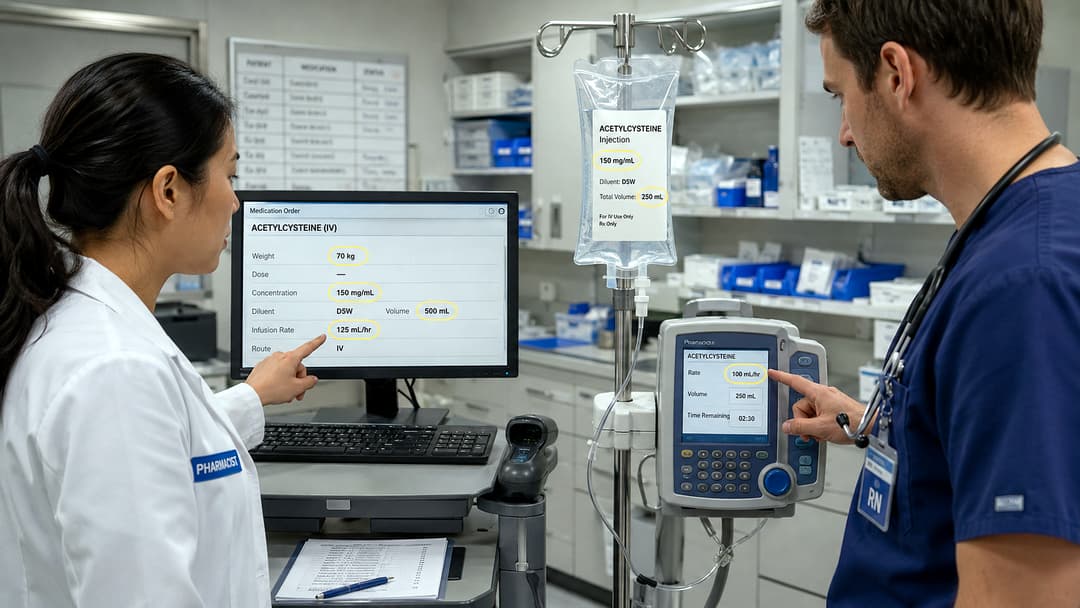
How can hospitals ensure that the treatment ordered is the treatment the patient actually receives?
Severe neurologic injury was one of the most concerning patterns in the published reports.
A 2023 case report described a 15-year-old patient with acetaminophen toxicity who unintentionally received approximately six times the intended acetylcysteine infusion because of a prescribing error.
The patient developed worsening headache and agitation, followed by seizure, cerebral edema, brain herniation, and brain death. [D]
Acute liver failure could not be completely excluded as a contributor. However, several markers associated with hepatic deterioration had improved by the time the patient developed fixed, dilated pupils, strengthening concern that the massive acetylcysteine exposure contributed to the neurologic outcome. [D]
The case also illustrates an important timing issue.
Clinical decline did not necessarily occur at the exact moment the infusion error began. Headache and agitation developed first, followed later by seizure and severe cerebral edema.
Stopping an incorrect infusion is essential, but recognizing the error does not necessarily end the period of clinical risk.
The reported toxicity pattern was not exclusively neurologic.
Published cases have described:
hemolysis;
thrombocytopenia;
acute kidney injury;
hematuria;
hemolytic uremic syndrome; and
need for renal replacement therapy or plasma exchange. [A]
These complications may emerge after the initial overdose rather than immediately during the infusion.
After a major confirmed acetylcysteine error, clinical monitoring may therefore need to include:
serial neurologic examinations;
seizure surveillance;
evaluation for cerebral edema;
hemoglobin;
platelet count;
hemolysis markers;
serum creatinine;
urine output;
electrolytes; and
fluid balance.
The available literature is too limited to define a universal observation period or laboratory schedule.
Case-specific consultation with a poison center or medical toxicologist is appropriate, especially when the estimated exposure is large, timing is uncertain, or the patient is already critically ill.
The role of specialist toxicology communication is discussed in The Role of Poison Center Calls: Managing Poisoning Cases from Emergency Calls to Critical Decisions.
Two of the 16 included reports did not describe toxicity from an excessive mass of acetylcysteine.
Instead, the patients developed hyponatremia after receiving excessive volumes of diluent. [A]
This represents a separate pathway of harm.
A small patient—particularly an infant or young child—may receive a clinically significant free-water load when adult infusion volumes are used without appropriate adjustment.
The official ACETADOTE label advises weight-based dilution and states that patients weighing 40 kg or less should receive the three-bag regimen. It also emphasizes calculating both the drug dose and the recommended dilution volume according to patient weight. [C]
Medication verification must therefore evaluate both:
the amount of acetylcysteine; and
the volume and composition of the diluent.
A correct drug dose in an inappropriate fluid volume is not a fully correct order.
Simplifying an infusion regimen may reduce some opportunities for error, but the new scoping review does not establish that any one protocol eliminates severe acetylcysteine overdose.
A systematic review of two-bag intravenous NAC regimens found broadly similar liver outcomes compared with traditional three-bag treatment.
Two-bag protocols were also associated with:
fewer non-allergic anaphylactoid reactions;
fewer medications used to treat those reactions; and
fewer interruptions or delays in antidotal therapy. [B]
Evidence regarding medication errors was less definitive.
Three included articles evaluated NAC-related errors:
two found no difference; and
one pediatric study reported fewer errors with a two-bag regimen. [B]
Several cautions remain:
Most two-bag studies evaluated routine acetaminophen treatment, not outcomes after massive NAC overdose.
A simpler protocol cannot prevent an incorrect weight, duplicated order, wrong concentration, or pump-programming error.
The current U.S. label directs patients weighing 40 kg or less to the three-bag regimen. [C]
The most defensible conclusion is that regimen simplification may be one useful safeguard—but it cannot replace the rest of the medication-safety system.
The review points toward safeguards across the entire medication-use pathway.
Order sets should:
require a current weight in kilograms;
block implausible doses;
distinguish drug mass from diluent volume;
identify the active treatment stage;
prevent overlapping or duplicated infusions; and
minimize manual transcription.
Pharmacy-prepared labels should clearly display:
patient weight;
total acetylcysteine amount;
final concentration;
diluent type;
total volume;
infusion rate;
duration; and
treatment stage.
A second qualified clinician should independently verify:
patient weight;
dose calculation;
selected regimen;
concentration;
infusion volume;
pump settings; and
treatment stage.
Independent verification should involve a separate calculation—not simply reading the same numbers aloud.
Infusion-pump libraries should contain clinically appropriate limits for acetylcysteine concentrations and rates.
Pump settings, electronic orders, and pharmacy labels must use the same standardized regimen.
Transfers between the emergency department, intensive care unit, pharmacy, and nursing shifts should clearly communicate:
when treatment began;
which bag or phase is running;
how much acetylcysteine has already been delivered;
the current infusion rate; and
when reassessment is required.
Medical toxicologists can help:
design safer order sets;
review errors and near misses;
distinguish expected adverse reactions from overdose toxicity;
guide monitoring after a confirmed error; and
advise on continuation or modification of antidotal therapy.
Their broader role is explained in The Role of Medical Toxicology in Drug Safety.
The scoping review found severe outcomes because it deliberately searched for published reports of clinically important acetylcysteine errors.
That creates substantial publication bias.
A catastrophic case is much more likely to be written and published than an error that is quickly corrected and causes no symptoms.
The review therefore cannot determine:
how often acetylcysteine overdose occurs;
what proportion of errors cause clinical harm;
the absolute risk of cerebral edema;
the fatality rate of all NAC administration errors; or
whether one infusion regimen is safer overall.
This is similar to a central limitation of spontaneous drug-safety reporting: reports may identify a signal, but they do not provide a reliable denominator.
MedicalToxic’s What Is FAERS and Why It Matters in Medical Toxicology explains why reported events must be interpreted in the context of missing denominators, reporting bias, incomplete information, and uncertainty about causality.
The new review is valuable because it identifies credible patterns of preventable harm.
It is not a population-risk study.
Individual cases of massive acetylcysteine overdose, cerebral edema, seizures, hemolysis, and kidney injury have been reported before.
The new contribution is a structured synthesis of the available reports, including:
estimated dose;
timing;
error source;
neurologic outcomes;
hematologic and renal complications;
diluent-related hyponatremia; and
failures across multiple stages of hospital care.
The review reframes each event as more than an isolated arithmetic mistake.
An incorrect dose may pass through the electronic health record, prescribing process, pharmacy, nursing workflow, and infusion device before reaching the patient.
That systems perspective is the most clinically actionable finding.
Acetylcysteine remains a critical and generally safe antidote for acetaminophen poisoning when it is prescribed, prepared, and administered correctly.
The new review does not challenge that standard of care.
It shows what can happen when a complex infusion pathway fails.
Published cases describe cerebral edema, seizures, hemolysis, kidney injury, hemolytic uremic syndrome, hyponatremia, and death after major iatrogenic errors.
At the same time, the evidence comes from a small, selected collection of case reports. It cannot establish incidence, define a universally safe dose boundary, or prove the superiority of one infusion protocol.
The appropriate response is not fear of the antidote.
It is stronger system design:
standardized electronic orders;
verified patient weights;
dose and concentration limits;
weight-appropriate diluent volumes;
independent checks;
smart-pump safeguards;
accurate clinical handoffs; and
early toxicology consultation after a suspected error.
A lifesaving antidote should not depend on one person catching every possible mistake.
[A] Baker, M. B., Young, J., Binda, D. D., & Kennedy, J. M. (2026). Safety of acetylcysteine: A scoping review of iatrogenic overdose cases and their associated complications. Clinical Toxicology. Advance online publication. https://doi.org/10.1080/15563650.2026.2673132
[B] Cole, J. B., Oakland, C. L., Lee, S. C., Considine, K. A., Rudis, M. I., Swanson, A. L., & Olives, T. D. (2023). Is two better than three? A systematic review of two-bag intravenous N-acetylcysteine regimens for acetaminophen poisoning. Western Journal of Emergency Medicine, 24(6), 1131–1145. https://doi.org/10.5811/westjem.59099
[C] DailyMed. (2025, April 30). ACETADOTE—acetylcysteine injection, solution: Prescribing information. U.S. National Library of Medicine.
[D] Spence, E. E. M., Shwetz, S., Ryan, L., Anton, N., & Joffe, A. R. (2023). Non-intentional N-acetylcysteine overdose associated with cerebral edema and brain death. Case Reports in Gastroenterology, 17(1), 96–103. https://doi.org/10.1159/000529169
Keep reading
Latest Research and Studies
29 Sept 2026
Latest Research and Studies
19 Sept 2026
Latest Research and Studies
27 Jul 2026

Latest Research and Studies
27 Jul 2026