Wearable Naloxone Patch Detects and Reverses Fentanyl Overdose in Mice
post on 29 Sept 2026 · Updated 02 Oct 2026

post on 29 Sept 2026 · Updated 02 Oct 2026
 Medical Toxicologymedicaltoxic.com
https://medicaltoxic.com/news/wearable-naloxone-patch-fentanyl-overdose-study
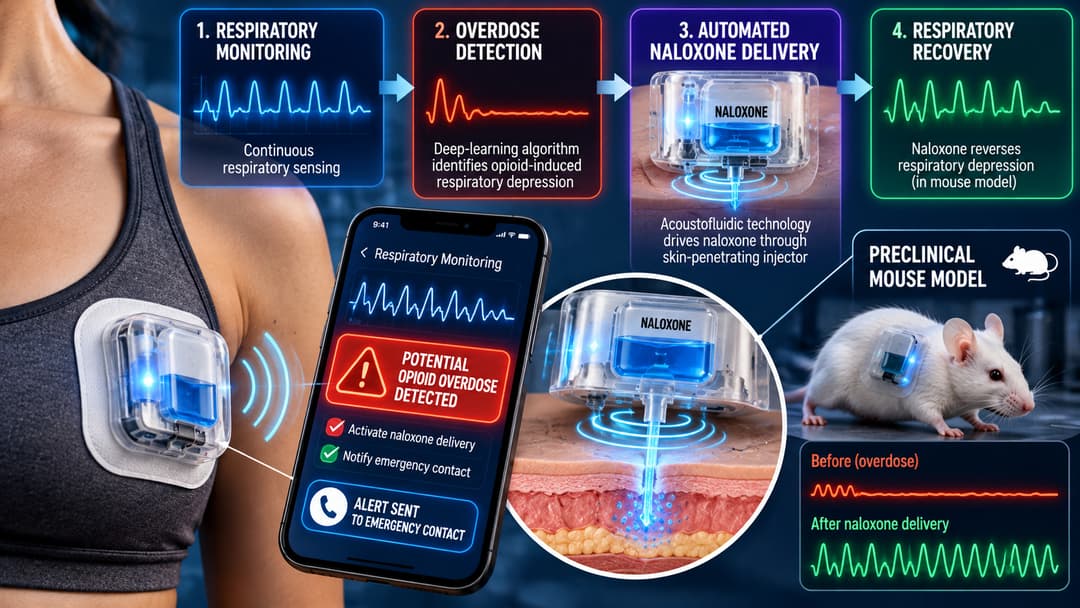
Wearable Naloxone Patch Detects and Reverses Fentanyl Overdose in Mice
A Nature Communications study combined respiratory sensing, deep learning and automated naloxone delivery to reverse fentanyl-induced respiratory depression in mice—but the system has not been tested in humans.
A naloxone kit can reverse an opioid overdose.
It cannot act if nobody recognizes that the overdose is happening.
Researchers have now demonstrated an experimental wearable system designed to address that gap by continuously monitoring breathing, identifying opioid-induced respiratory depression and automatically triggering naloxone delivery.
The study, published August 24, 2026, in Nature Communications, showed that the closed-loop system could detect and reverse fentanyl overdose in a mouse model. [1]
The result is an important engineering proof of concept.
It is not a human clinical trial, and it does not show that the device can safely prevent overdose deaths in people.
Opioid overdose becomes life-threatening when respiratory depression is not recognized and treated in time.
That is particularly relevant when an overdose occurs without an immediately available responder.
MedicalToxic previously examined this problem in Most U.S. Overdose Deaths Occurred in Isolation, CDC Study Finds, which found that most overdose deaths in a large multistate analysis occurred while the person was isolated.
That surveillance study did not test wearable technology.
The new Nature Communications paper addresses the problem from a different direction by attempting to automate the sequence that normally depends on another person:
monitor breathing → detect respiratory depression → trigger naloxone → alert another person. [1]
The experimental device integrates respiratory sensors, a smartphone-based deep-learning system and an acoustofluidic naloxone-delivery module.
Respiratory signals are monitored continuously.
A convolutional neural network analyzes the breathing pattern and attempts to distinguish normal respiration from fentanyl-induced respiratory depression.
When the algorithm identifies an overdose pattern, the system can activate the drug-delivery component.
That component uses surface acoustic waves and acoustic streaming to move naloxone from a small reservoir through a 3D-printed injector that penetrates the skin. [1]
This distinction matters.
Despite being described as a wearable transdermal patch, the prototype is not a passive adhesive patch that simply allows naloxone to diffuse through intact skin.
It actively drives drug delivery through a small skin-penetrating injector.
The system can also transmit an identified overdose event to an emergency contact as part of the proposed closed-loop workflow. [1]
The researchers trained their overdose-classification system using respiratory recordings from mice.
Among the tested machine-learning approaches, the convolutional neural network performed best.
In held-out mouse respiratory data, the model achieved 95.0% overall classification accuracy, and its receiver-operating-characteristic analysis produced an area under the curve of 0.986. [1]
The investigators also compared the deep-learning approach with a simpler method that triggered treatment when minute ventilation fell below a predefined threshold.
In the controlled mouse experiments, the deep-learning approach identified developing respiratory depression significantly earlier than the threshold-based strategy. [1]
Those numbers should not be interpreted as human sensitivity, specificity or real-world false-alarm rates.
The model was trained and tested in an experimental animal setting.
The next question was whether the system could move beyond detection and actually complete the rescue loop.
Researchers induced fentanyl-related respiratory depression in mice and connected overdose detection to automated naloxone delivery.
Both the deep-learning system and the comparison threshold-based system used the same acoustofluidic naloxone-delivery hardware.
In groups of six mice per closed-loop strategy, the deep-learning-triggered system initiated treatment earlier and significantly reduced both the duration and study-defined severity of respiratory depression compared with the threshold-triggered approach. [1]
The investigators also showed that patch-delivered naloxone could restore breathing in the animal model.
This establishes that the experimental system could complete the sequence:
sensing → classification → treatment activation → naloxone delivery → respiratory recovery
under controlled preclinical conditions.
It does not establish the same performance in humans.
The main innovation is not simply another way to administer naloxone.
The system attempts to automate three separate functions:
Detection: identify abnormal respiration.
Decision: determine whether the pattern is consistent with opioid overdose.
Treatment: administer naloxone without waiting for a bystander.
That makes the technology a closed-loop therapeutic system.
The potential use case is especially relevant to unwitnessed overdose, where a person may have naloxone nearby but no one available to recognize respiratory depression and administer it.
Nothing in this animal study changes current overdose-response recommendations.
CDC advises that when opioid overdose is suspected, responders should administer naloxone if available, call 911, support breathing, place the person on their side when appropriate and remain with them until emergency assistance arrives. [2]
More than one naloxone dose may sometimes be required, particularly with potent opioids such as fentanyl. [2]
The experimental wearable has not been shown to replace any of these steps.
For clinical context on naloxone response with potent synthetic opioids and mixed exposures, see Naloxone in Xylazine, Nitazenes, and Fentanyl Analogue Overdose.
The translational gap is substantial.
The study does not establish:
human overdose-detection accuracy;
real-world false-positive or false-negative rates;
performance during sleep, exercise or ordinary movement;
discrimination between opioid toxicity and other causes of abnormal breathing;
an appropriate human naloxone dose;
reliable delivery across different skin characteristics;
repeated dosing if respiratory depression returns;
performance during polysubstance overdose;
long-term wearability or adherence;
reliability after sweat, movement or partial device displacement;
clinically validated emergency-service integration; or
prevention of overdose death in humans.
These limitations are central rather than peripheral.
A false negative could delay treatment.
A false positive could trigger unnecessary naloxone and potentially precipitate acute withdrawal in a person who is opioid-dependent.
Mechanical, sensor or software failure could also create false reassurance if a user assumes the device will reliably rescue them.
The controlled mouse model provides a much cleaner signal environment than everyday human use.
Human breathing varies with:
sleep;
activity;
body position;
underlying lung disease;
medications;
anxiety;
pain; and
many other physiologic factors.
Wearable sensors are also vulnerable to motion artifacts and inconsistent contact.
The authors identify adaptation to human respiratory data and more robust sensing as necessary future steps. [1]
A clinically useful system would need to distinguish genuine opioid-induced hypoventilation from many other respiratory patterns without producing an unacceptable number of missed or false alarms.
The pharmacologic side of the system presents a separate challenge.
The study demonstrated controlled naloxone delivery through mouse skin.
Human skin differs in thickness, structure and drug-transfer characteristics, and human naloxone pharmacokinetics cannot be inferred directly from the mouse experiments.
Before clinical use, researchers would need to establish at minimum:
appropriate human dosing;
delivery consistency;
pharmacokinetics;
repeat-dose capability;
skin and injector safety;
naloxone stability;
device reliability; and
safe behavior if any part of the system fails.
The mouse dosing used in the experiment should therefore not be interpreted as a proposed human dose.
The value of the study becomes clearer when placed beside the overdose-isolation data.
The existing MedicalToxic News on isolation identified a structural problem:
Many overdoses occur when nobody is immediately available to recognize the emergency and give naloxone.
The wearable study moves one step further by experimentally linking:
automated recognition + automated rescue medication delivery.
That is a genuine advance over a sensor that merely sounds an alarm.
But it remains an engineering and animal proof of concept.
Whether that approach can become a safe, acceptable and reliable human rescue system is still unknown.
The study reports a relevant competing interest.
Authors Feng Guo, Ken Mackie and Hongwei Cai are inventors on a patent application related to the technology described in the paper. [1]
The remaining authors reported no competing interests.
The patent does not invalidate the findings, but it is appropriate context for an early-stage translational device study.
Wearable overdose detection is not a new idea.
The key information gain here is integration.
The researchers combined:
continuous respiratory monitoring → deep-learning classification → automated acoustofluidic naloxone delivery
into one closed-loop experimental system and demonstrated the full sequence in fentanyl-exposed mice. [1]
That makes the paper more than another wearable sensor study.
It demonstrates a technical pathway by which overdose recognition and first-line opioid reversal could eventually be automated.
The word eventually matters.
There is currently no evidence from this study that the system works safely or reliably in humans.
A new wearable acoustofluidic patch successfully detected fentanyl-induced respiratory depression and automatically delivered naloxone in a mouse model.
The deep-learning approach identified respiratory depression earlier than a conventional threshold trigger, and the resulting closed-loop treatment reduced the duration and severity of experimental overdose episodes. [1]
The technology addresses a real weakness in overdose rescue:
Naloxone cannot act if nobody recognizes the overdose in time.
But the study remains preclinical.
Human detection accuracy, false alarms, dosing, skin delivery, long-term device reliability, emergency integration and clinical outcomes all remain unproven.
For now, the wearable is best understood as a promising experimental platform—not a clinically available replacement for naloxone kits, emergency response or evidence-based treatment for opioid use disorder.
Xing, Y., Yang, Y., Li, X., et al. (2026). A wearable acoustofluidic patch for rapid reversal of opioid overdose. Nature Communications, 17(1), 10092. https://doi.org/10.1038/s41467-026-77033-x
Centers for Disease Control and Prevention. (2024, April 2). What to Do If You Think Someone Is Overdosing.
Keep reading
Latest Research and Studies
19 Sept 2026 · Updated 01 Oct 2026
Latest Research and Studies
05 Aug 2026 · Updated 01 Oct 2026
Latest Research and Studies
27 Jul 2026 · Updated 01 Oct 2026

Latest Research and Studies
27 Jul 2026 · Updated 01 Oct 2026