Clinical Toxicology
GLP-1 Overdose and Dosing Errors: Why Poison Control Calls Are Rising
Amirhosein Shabrang
Post on 02 Aug 2026 · Updated 02 Oct 2026 · 15 min read

Amirhosein Shabrang
Post on 02 Aug 2026 · Updated 02 Oct 2026 · 15 min read
 Medical Toxicologymedicaltoxic.com
https://medicaltoxic.com/blogs/glp-1-overdose-dosing-errors-poison-control-calls
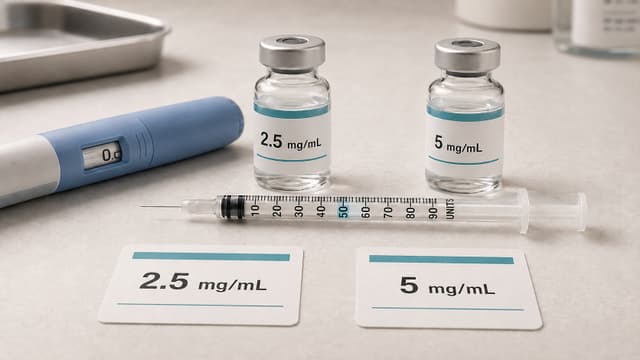
A practical guide to semaglutide and tirzepatide measurement errors, overdose symptoms, long half-lives, Poison Control guidance, and prevention.
Consider a common scenario. A patient is told to inject 20 “units” from a vial of a GLP-1 medication. The syringe is filled to the correct line, the injection is given, and nothing appears unusual—until persistent nausea and vomiting begin several hours later.
The mistake may not be the number on the syringe. It may be the concentration in the vial. If a replacement vial contains more milligrams of medication in every milliliter, the same syringe volume can deliver several times the intended dose. The number was followed correctly, but the drug dose was not.
This is one reason calls to U.S. poison centers involving glucagon-like peptide-1 medications have risen. Semaglutide is used in products such as Ozempic and Wegovy. Tirzepatide, sold as Mounjaro and Zepbound, activates both GIP and GLP-1 receptors but creates many of the same practical concerns when a dose is measured, changed, restarted, or repeated.
A national study identified 10,033 GLP-1 receptor agonist exposures reported to U.S. poison centers from 2012 through 2023. Of these, 6,920 occurred after semaglutide was approved for weight management in 2021. Semaglutide accounted for 64.2% of post-approval exposures, most cases involved unintentional therapeutic errors, and semaglutide reports increased an additional 9.9% per quarter after approval. The proportion managed in or referred to a healthcare facility also rose from 23.0% to 33.5%. [E]
These figures do not mean GLP-1 medications suddenly became inherently unsafe. Poison-center databases record reported exposures, not every dose used nationwide, and rapidly expanding use creates more opportunities for mistakes. The important signal is that many errors are preventable—and that a small number become clinically significant.
For a broader overview of semaglutide adverse effects, clinical evaluation, and treatment considerations, see Ozempic Toxicity: What You Need to Know About Risks, Symptoms, and Safe Use.
Emergency note
In the United States, call Poison Help at 1-800-222-1222 after a suspected double dose, wrong concentration, measurement error, or unexpected reaction. Call 911 immediately if a person collapses, has a seizure, has trouble breathing, or cannot be awakened. [A]
“Units” on a U-100 insulin syringe measure volume, not the milligram dose of semaglutide or tirzepatide.
The same syringe marking can deliver very different drug doses when vial concentrations differ.
Common errors include double dosing, using the wrong concentration, restarting at a high dose, skipping titration steps, and confusing milligrams, milliliters, and syringe units.
Most reported effects are gastrointestinal, especially nausea and vomiting, but dehydration, abnormal glucose, severe abdominal pain, and other complications require assessment.
Semaglutide and tirzepatide remain in the body for days, so symptoms and monitoring needs may outlast the initial injection.
There is no specific antidote; treatment is supportive and tailored to symptoms, glucose risk, hydration, kidney function, and co-medications.
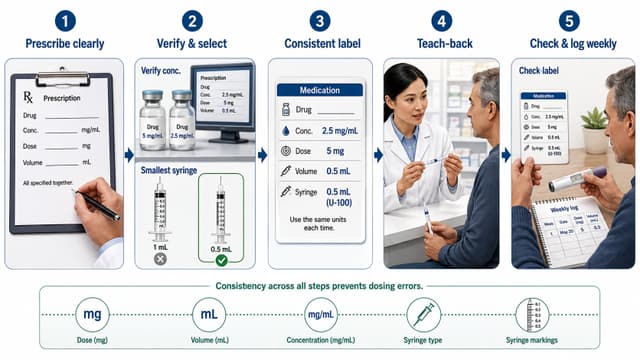
Clear prescriptions should state the drug, concentration, dose in milligrams, volume in milliliters, syringe type, and exact syringe marking when a syringe is required.
The most important misconception is that “20 units” tells you the dose of a GLP-1 medication. By itself, it does not.
On a U-100 insulin syringe, 100 syringe units equal 1 milliliter. Therefore, 10 units equal 0.1 milliliter, 20 units equal 0.2 milliliter, and 50 units equal 0.5 milliliter. These markings describe how much liquid is drawn into the syringe. The amount of medication in that liquid depends on the concentration printed on the vial.
The essential equation
Dose in milligrams = volume in milliliters × concentration in milligrams per milliliter
Suppose one vial contains 1 mg/mL and another contains 5 mg/mL. Drawing 10 units on a U-100 syringe means drawing 0.1 mL. From the first vial, that volume contains 0.1 mg. From the second vial, the same volume contains 0.5 mg—five times as much medication.
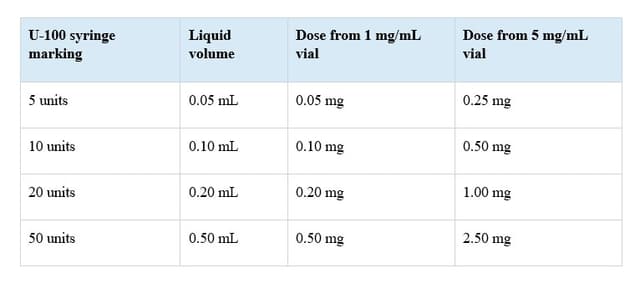
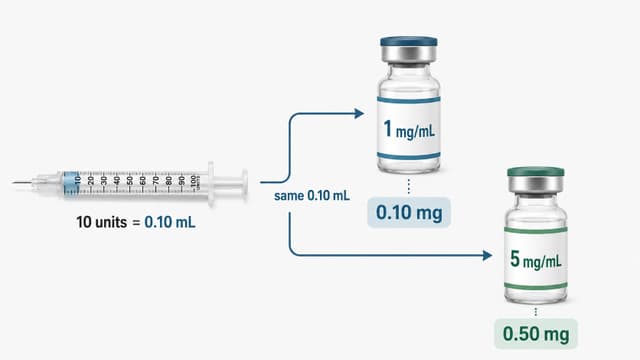
The FDA has described compounded semaglutide errors in which patients administered five to 20 times the intended amount. Some confused 5 units with 50 units; other errors occurred when clinicians or pharmacies converted incorrectly among milligrams, milliliters, and units. Variable concentrations, oversized syringes, and unclear instructions increased the risk. [F]
A three-patient poison-center case series described administration errors involving semaglutide obtained from compounding pharmacies or an aesthetic spa. Two patients gave themselves tenfold overdoses, and all three developed nausea, vomiting, and abdominal pain; symptoms in some cases lasted for days. [D]
A safe instruction therefore needs more than a syringe number. It should identify the medication, the concentration, the intended dose in milligrams, the matching volume in milliliters, the syringe type, and the precise marking to use.
Not every vial is compounded. FDA-approved tirzepatide is available in certain standardized vial presentations, while FDA-approved injectable semaglutide products are supplied in manufacturer-controlled prefilled devices. The key distinction is whether the product has an FDA-reviewed formulation, concentration, device, and labeling—or whether it is a compounded preparation that may vary by pharmacy and prescription. [F] [G] [H]
Patients should never infer concentration from container size. A 2 mL vial describes the capacity of the container, not the number of milligrams in each milliliter. The concentration must be stated explicitly on the label.
Some errors are simple double doses. A patient forgets whether the weekly injection was taken and repeats it. A family member administers a dose without knowing someone else already gave it. Or a dose is taken late in one calendar week and again early in the next because “once weekly” is interpreted as once during each named week rather than at an appropriate interval.
Other errors happen during dose escalation. GLP-1 medications are commonly started at a low dose and increased gradually to improve tolerability. A patient may begin at the maintenance dose, skip several titration steps, use the wrong pen or vial, or restart an old high dose after a treatment interruption.
Concentration changes create another high-risk moment. A new vial may contain 1 mg/mL, 2.5 mg/mL, 5 mg/mL, or another concentration. If the written or remembered instruction remains “inject 20 units,” the hand movement stays the same while the delivered dose changes.
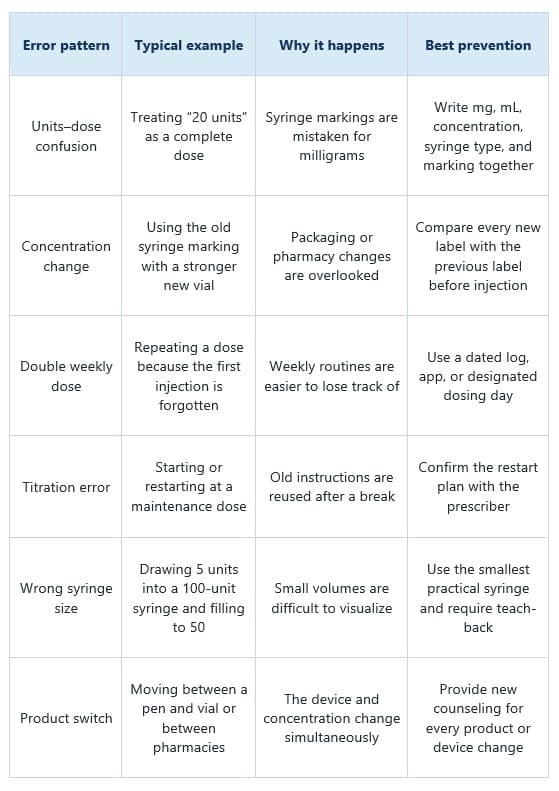
The goal is not to make every patient perform dimensional analysis at the kitchen table. The goal is to design prescribing, dispensing, labeling, and counseling systems that make the correct dose obvious.
The rise in poison-center reports is best understood as a combination of rapidly expanding use and recurring medication-system errors. An earlier national analysis of 5,713 single-substance GLP-1 receptor agonist cases reported from 2017 through 2022 found that 79.9% involved therapeutic errors. Most produced no or minimal effects, but 22.4% were evaluated in a healthcare facility and 6.2% had a serious medical outcome. [C]
The newer 2012–2023 analysis found a sharp post-2021 increase and greater healthcare utilization, even though most cases still involved mild gastrointestinal effects. [E]
Poison-center data are valuable because they can reveal emerging patterns quickly, but they have limits. A report does not prove that the medication caused every symptom, not every exposure is reported, and case severity can influence whether someone calls. For a closer look at how these calls are gathered, triaged, and translated into clinical decisions, read The Role of Poison Center Calls: Managing Poisoning Cases from Emergency Calls to Critical Decisions.
GLP-1 is a hormone involved in glucose regulation, appetite, and digestion. GLP-1 receptor agonists enhance glucose-dependent insulin release, reduce glucagon secretion, slow gastric emptying, and reduce food intake. Tirzepatide also activates the GIP receptor.
The glucose-dependent mechanism helps explain why isolated GLP-1 overdose does not behave like a classic insulin or sulfonylurea poisoning. Severe hypoglycemia is not inevitable, but it is still possible—especially when insulin, glipizide, glyburide, glimepiride, or another glucose-lowering medication is also being used. Reduced food intake, vomiting, alcohol use, frailty, kidney disease, and diabetes can further change the risk.
In a multicenter study of 152 poison-center patients evaluated in emergency departments, nausea occurred in 92% of symptomatic patients, vomiting in 76%, and hypoglycemia in 9%, even after important hypoglycemic co-ingestants were excluded. Most clinical effects lasted 8 to 24 hours, and treatment most often involved intravenous fluids and anti-nausea medication. [B]
The gastrointestinal tract usually dominates the clinical picture. Slower gastric emptying and central appetite effects can cause nausea, repeated vomiting, abdominal discomfort, bloating, diarrhea, constipation, early satiety, and inability to tolerate food or fluids. Repeated vomiting can then lead to dehydration, electrolyte disturbance, fainting, and acute kidney injury due to volume depletion.
Persistent or severe abdominal pain needs medical assessment because pancreatitis, gallbladder disease, bowel problems, and other conditions can present with overlapping symptoms. FDA adverse-event reports involving compounded semaglutide have included dehydration, pancreatitis, gallstones, fainting, and hospitalization, but spontaneous reports alone cannot prove that semaglutide caused every event. [F]
That distinction matters. The strengths and limitations of spontaneous safety reports are explained in What Is FAERS and Why It Matters in Medical Toxicology.
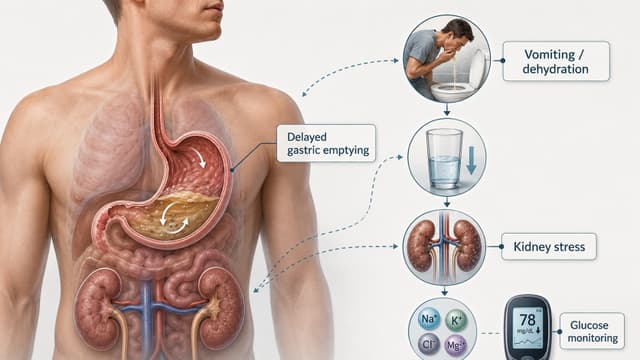
Semaglutide has an elimination half-life of approximately one week, while tirzepatide has a half-life of approximately five days. A half-life is the time required for the amount of drug in the body to fall by about half. [G] [H]
These drugs therefore do not disappear when the first wave of nausea settles. FDA prescribing information advises that a prolonged period of observation or treatment may be necessary after overdose because of their long half-lives. [G] [H]
This does not mean every patient will remain ill for five to seven days. In the multicenter emergency-department cohort, most effects resolved within 8 to 24 hours. Duration depends on the medication, amount, baseline tolerance, recent titration, co-medications, hydration, kidney function, and the patient’s ability to keep fluids down. [B]
Ongoing early satiety, vomiting, or marked gastric slowing after therapeutic use may raise a different clinical question from a single dosing error. Readers seeking a focused discussion of delayed gastric emptying can review GLP-1 Gastroparesis: Hidden Dangers Beyond Common Side Effects.
Do not wait for severe symptoms before gathering the details. Write down or photograph:
the exact product name and active ingredient;
the concentration in mg/mL;
the amount injected, including the syringe size and marking;
the time of injection and the usual scheduled dose;
whether a previous dose was taken recently;
all other diabetes medications, especially insulin and sulfonylureas;
current symptoms and any available blood-glucose readings;
the vial, pen, box, prescription label, and syringe used.
Contact Poison Help promptly for a confirmed or possible double dose, wrong concentration, wrong syringe measurement, or unexpectedly large dose. In the United States, call 1-800-222-1222. The service is free, confidential, and available 24 hours a day. [A]
MedicalToxic.com’s Poison Control: Your Lifeline in Emergencies explains how the national hotline connects callers with specialized poison-center guidance.
repeated vomiting or inability to keep liquids down;
very low urine output, marked dry mouth, dizziness, or fainting;
confusion, sweating, shakiness, unusual weakness, or another possible sign of low blood glucose;
severe, persistent, or worsening abdominal pain;
bloody or coffee-ground vomit;
chest pain, breathing difficulty, facial swelling, or widespread hives;
collapse, seizure, severe confusion, or inability to awaken.
Call 911 immediately for collapse, seizure, trouble breathing, or inability to awaken. Children, older adults, people using insulin or sulfonylureas, patients with significant kidney disease, and anyone with prolonged vomiting deserve a lower threshold for professional evaluation.
There is no specific antidote that removes semaglutide or tirzepatide from the body. Management is supportive and guided by the patient’s symptoms, dose history, co-medications, and medical conditions. Evaluation may include glucose monitoring, hydration assessment, kidney function, electrolytes, and testing directed at severe or persistent abdominal symptoms. [G] [H]
Treatment can include oral rehydration when tolerated, anti-nausea medication, intravenous fluids, electrolyte correction, and management of confirmed hypoglycemia. The decision between home observation and emergency evaluation should be individualized with Poison Control or a clinician.
Do not induce vomiting. It cannot reverse a medication that has already been injected and may worsen dehydration or increase aspiration risk.
Do not consume a large amount of sugar “just in case.” Check glucose when appropriate and treat confirmed low glucose according to a clinician’s advice or the patient’s established diabetes plan.
Do not automatically take the next scheduled injection after a large dosing error or while significant symptoms continue. The timing of future doses should be discussed with the prescriber or poison center.
Do not guess a concentration from the size or appearance of a vial. Use only the concentration printed on the current label, and stop before injecting if the instructions do not reconcile mathematically.
The most effective safeguards are straightforward, but they must be consistent across the prescription, pharmacy label, portal message, and verbal counseling.
Write the dose in milligrams and the corresponding volume in milliliters. If syringe units are included, present them only as an additional administration aid tied to one specific concentration and one specific syringe.
Make the concentration prominent. It should not be buried among lot numbers, beyond-use dates, or dense auxiliary text.
Use the smallest practical syringe for the prescribed volume. A 100-unit syringe is a poor visual tool for a 5-unit dose when a smaller syringe is available.
Provide new counseling whenever the product, concentration, syringe, device, pharmacy, or dose changes.
Require teach-back. The patient should demonstrate the dose with the actual device or syringe rather than simply confirm that the instructions sound familiar.
Use the same units across all communication channels. Patients should not receive milligrams from the prescriber, milliliters from the pharmacy, and unexplained “units” in a portal message.
Create a clear restart plan after missed doses or treatment interruptions. Do not assume the old maintenance dose remains appropriate.
FDA guidance specifically emphasizes appropriate syringe selection, counseling on dose measurement, vigilance when different compounded concentrations are available, and contacting the compounder when calculations are uncertain. [F]
Clinical pearl
A prescription that says only “inject 25 units weekly” is incomplete. A safer instruction names the medication, concentration, milligram dose, milliliter volume, syringe type, and syringe marking.
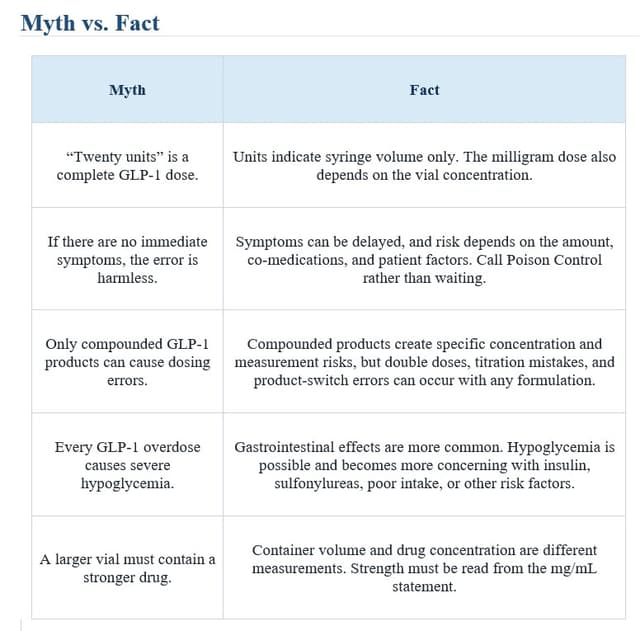
MythFact“Twenty units” is a complete GLP-1 dose.Units indicate syringe volume only. The milligram dose also depends on the vial concentration.If there are no immediate symptoms, the error is harmless.Symptoms can be delayed, and risk depends on the amount, co-medications, and patient factors. Call Poison Control rather than waiting.Only compounded GLP-1 products can cause dosing errors.Compounded products create specific concentration and measurement risks, but double doses, titration mistakes, and product-switch errors can occur with any formulation.Every GLP-1 overdose causes severe hypoglycemia.Gastrointestinal effects are more common. Hypoglycemia is possible and becomes more concerning with insulin, sulfonylureas, poor intake, or other risk factors.A larger vial must contain a stronger drug.Container volume and drug concentration are different measurements. Strength must be read from the mg/mL statement.
GLP-1 poison-center calls are rising largely because more people use these medications and more opportunities now exist for double dosing, concentration mix-ups, titration errors, product switches, and confusion among milligrams, milliliters, and syringe units. National data suggest that most reported exposures are unintentional and produce mild gastrointestinal effects, but healthcare referrals have increased and a smaller group develops clinically important dehydration, abnormal glucose, severe abdominal symptoms, or other complications. [C] [E]
The core safety message is simple: syringe units tell you how much liquid is drawn up. They do not independently tell you how much semaglutide or tirzepatide is in that liquid.
Verify the concentration every time a new vial, device, or prescription arrives.
Call Poison Control after a suspected double dose, wrong concentration, or measurement error instead of waiting for severe symptoms.
Seek urgent care for persistent vomiting, dehydration, severe abdominal pain, concerning glucose symptoms, collapse, seizure, breathing difficulty, or inability to awaken.
Yes. The clinical effect depends on the product, dose, timing, recent titration, baseline tolerance, and other medications. A small accidental extra dose may remain mild, while a large concentration error can cause persistent vomiting, dehydration, or abnormal glucose. Call Poison Control for individualized guidance.
Many poison-center patients evaluated in emergency departments had effects lasting 8 to 24 hours, but symptoms can last longer. Semaglutide has an approximately one-week half-life and tirzepatide an approximately five-day half-life, so observation or treatment may need to continue beyond the initial presentation. [B] [G] [H]
Not every double dose requires emergency treatment, but the decision should not be guessed. Contact Poison Control promptly. Emergency evaluation is more likely to be needed for repeated vomiting, inability to drink, severe abdominal pain, fainting, concerning glucose symptoms, high-risk co-medications, or significant medical comorbidity.
Provide the exact medication, concentration, dose or syringe marking, injection time, usual dose, other diabetes medications, current symptoms, and any blood-glucose readings. Keep the vial, pen, box, prescription label, and syringe nearby.
Do not make that decision automatically after a substantial error or while symptoms continue. Ask the prescriber or poison center when to resume treatment and whether the dose-escalation schedule needs to be restarted.
© All copyright of this material is absolute to Medical toxicology
As the Growth & Content Lead at MedicalToxic.com, I work on content strategy, development, and digital growth. My focus is on making MedicalToxic’s content clear, practical, and accessible, while helping expand the platform’s reach and strengthen its position as a trusted resource in clinical toxicology.
[A] America’s Poison Centers. (n.d.). Poison Control. Poison Help. Retrieved August 1, 2026.
[B] Gartner, H. T., Simmons, R. E., Wan, H. Z., Sollee, D. R., & Sheikh, S. (2025). Clinical outcomes of glucagon-like peptide-1 receptor agonist (GLP-1 RA) and glucagon-like peptide-1/glucose-dependent insulinotropic polypeptide receptor agonist (GLP-1/GIP RA) exposures presenting to the emergency department. The Annals of Pharmacotherapy, 59(12), 1057–1068. https://doi.org/10.1177/10600280251334642
[C] Gaw, C. E., Hays, H. L., Kemp, C. A., Kistamgari, S., Spiller, H. A., Rine, N. I., Rhodes, A. L., Zhu, M., & Smith, G. A. (2024). Glucagon-like peptide-1 receptor agonist cases reported to United States poison centers, 2017–2022. Journal of Medical Toxicology, 20(2), 193–204. https://doi.org/10.1007/s13181-024-00999-x
Keep reading
 Clinical Toxicology
Amirhosein Shabrang
 Clinical Toxicology
Amirhosein Shabrang
 Clinical Toxicology
Amirhosein Shabrang
 Clinical Toxicology
Amirhosein Shabrang