When Does the Rumack-Matthew Nomogram Not Apply?

Amirhosein Shabrang
Post on 24 Oct 2026

Amirhosein Shabrang
Post on 24 Oct 2026
 Medical Toxicologymedicaltoxic.com
https://medicaltoxic.com/tox-spotlight/when-rumack-matthew-nomogram-does-not-apply
When Does the Rumack-Matthew Nomogram Not Apply?
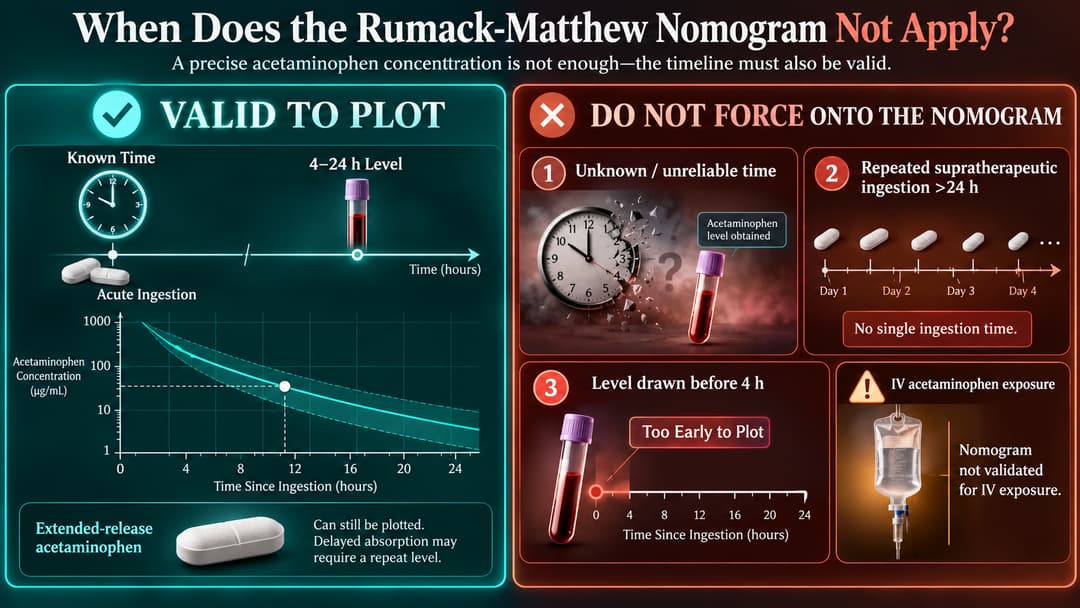
The Rumack-Matthew nomogram is useful only when the acetaminophen concentration has a reliable time point. Plotting the wrong exposure pattern can create false reassurance.
The Rumack-Matthew nomogram is designed to interpret an acetaminophen concentration obtained 4–24 hours after an acute ingestion when the ingestion time is reliable. A level drawn before 4 hours cannot be used for nomogram risk stratification, and the nomogram should not be used for repeated supratherapeutic ingestion spanning more than 24 hours or when the ingestion time is unknown or unreliable. [1]
Before plotting the level, first ask whether the exposure has a valid time–concentration relationship.
The nomogram estimates risk by relating the serum acetaminophen concentration to time since ingestion.
If the time is wrong, the plotted point is wrong.
An apparently reassuring concentration can therefore be misleading when the patient cannot provide a reliable ingestion time. Likewise, repeated supratherapeutic ingestion over more than 24 hours has no single meaningful starting point and requires a different assessment pathway. [1]
A concentration obtained before 4 hours is also too early for nomogram risk stratification. [1]
Not automatically.
For extended-release products, the nomogram can still be used, but delayed absorption may make one concentration insufficient. Current consensus guidance recommends a repeat level in selected patients whose first 4–12-hour concentration is below the treatment line but remains above 10 μg/mL. Similar caution applies when opioid or anticholinergic coingestants may delay absorption. [1]
The distinction is:
invalid timing or repeated exposure → do not force the case onto the nomogram
versus
possible delayed absorption → the nomogram may remain useful, but one level may not be enough.
The Rumack-Matthew nomogram has also not been validated for interpreting acetaminophen concentrations after intravenous acetaminophen overdose. [1]
When the exposure does not fit the nomogram, management should follow the appropriate laboratory- and clinical-assessment pathway rather than creating an artificial time point.
For a straightforward acute ingestion with reliable timing, see RumackCalc: Fast, Accurate Acetaminophen Overdose Assessment.
For delayed, repeated, or otherwise complex acetaminophen exposures, see Apaptox | Integrated Risk Assessment for Acetaminophen Toxicity — Beyond the Nomogram.
Never invent a time just to create a nomogram point.
A precise acetaminophen level is only useful on the Rumack-Matthew nomogram when the timeline itself is valid.
Dart RC, Mullins ME, Matoushek T, et al. Management of Acetaminophen Poisoning in the US and Canada: A Consensus Statement. JAMA Network Open. 2023;6(8). doi:10.1001/jamanetworkopen.2023.27739
As the Growth & Content Lead at MedicalToxic.com, I work on content strategy, development, and digital growth. My focus is on making MedicalToxic’s content clear, practical, and accessible, while helping expand the platform’s reach and strengthen its position as a trusted resource in clinical toxicology.
Keep reading
Clinical Toxicology
21 Sept 2026 · Updated 02 Oct 2026
Amirhosein Shabrang
Clinical Toxicology
16 Sept 2026 · Updated 26 Sept 2026
Amirhosein Shabrang
Clinical Toxicology
16 Sept 2026 · Updated 02 Oct 2026
Amirhosein Shabrang