Why Isn’t WBI Routine After Sustained-Release CCB Overdose?

Amirhosein Shabrang
Post on 29 Oct 2026
Amirhosein Shabrang
Post on 29 Oct 2026
 Medical Toxicologymedicaltoxic.com
https://medicaltoxic.com/tox-spotlight/wbi-sustained-release-ccb-overdose
Why Isn’t WBI Routine After Sustained-Release CCB Overdose?
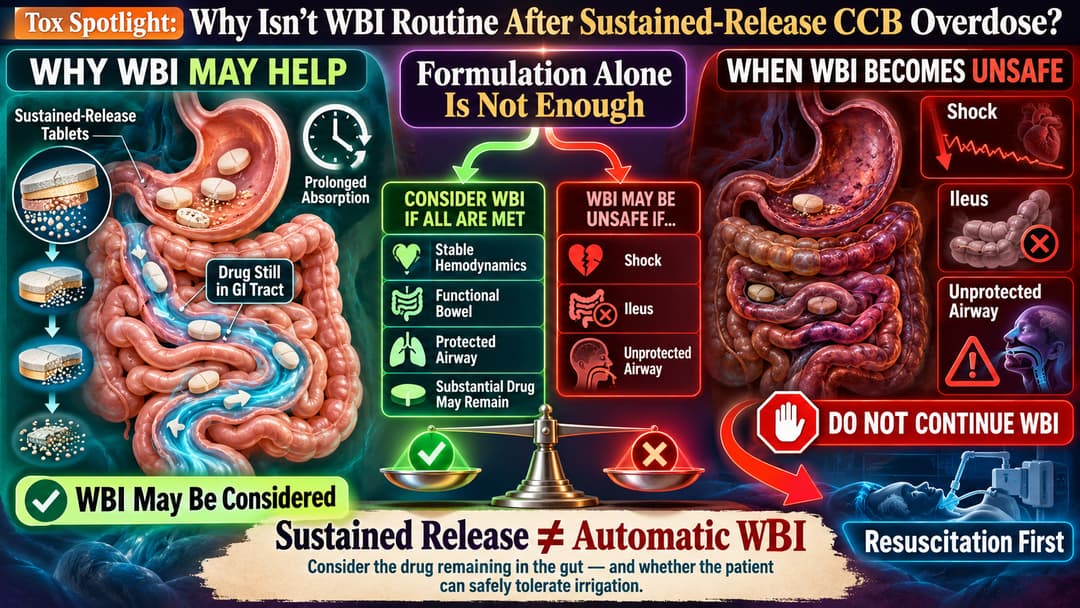
A sustained-release calcium channel blocker overdose does not automatically mean whole-bowel irrigation is indicated. WBI may reduce ongoing gastrointestinal drug availability in selected patients, but its benefit must be weighed against rapidly changing hemodynamics, airway risk, and impaired gut motility.
Whole-bowel irrigation (WBI) can be considered after a potentially toxic sustained-release or enteric-coated ingestion when a substantial amount of drug may still remain in the gastrointestinal tract. However, controlled clinical evidence showing that WBI improves outcomes is lacking. [1]
In calcium channel blocker poisoning, the decision is especially important because the same patient who initially appears stable may later develop hypotension, altered mental status, or ileus—all of which can make WBI unsafe or inappropriate.
The sustained-release formulation creates a reason to consider WBI, not an automatic indication to perform it.
Modified-release verapamil, diltiazem, and some other calcium channel blockers can continue releasing drug for many hours.
If a large amount of sustained-release medication remains in the gut, removing unabsorbed tablets before further absorption is theoretically attractive. WBI uses polyethylene glycol–electrolyte solution to move intestinal contents through the gastrointestinal tract.
That rationale is why toxicology guidance allows WBI to be considered for selected sustained-release ingestions. [1]
But pharmacologic plausibility is not the same as proven clinical benefit.
No convincing controlled clinical evidence shows that WBI routinely improves patient-centered outcomes after poisoning. [1]
WBI is contraindicated when the gastrointestinal tract cannot safely move the irrigation solution or when the patient cannot tolerate the procedure.
Important contraindications include:
bowel obstruction;
perforation;
ileus;
hemodynamic instability;
a compromised, unprotected airway. [1]
Those limitations matter particularly in severe CCB poisoning.
Progressive shock can reduce gastrointestinal perfusion and motility, while altered mental status increases aspiration risk. Two published sustained-release CCB cases with poor outcomes were complicated by WBI that continued after hypotension developed. These cases cannot prove that WBI caused the outcomes, but they reinforce why hemodynamic instability is a major stop signal. [2]
The most reasonable WBI candidate is not simply “someone who swallowed a sustained-release tablet.”
The decision should consider:
formulation;
estimated pill burden;
time since ingestion;
likelihood that substantial drug remains in the gut;
current hemodynamics;
bowel function;
mental status and airway protection;
whether decontamination would interfere with resuscitation or transfer.
Once significant shock develops, cardiovascular resuscitation takes priority over gastrointestinal decontamination.
For the full formulation-specific decontamination, observation, high-dose insulin, calcium, vasopressor, and ECMO framework, see Calcium Channel Blocker Poisoning: High-Dose Insulin, Vasopressors, Calcium, and VA-ECMO.
Sustained release creates an opportunity for WBI—not permission to ignore physiology.
If shock, ileus, or airway risk is developing, the decontamination strategy must change.
Thanacoody R, Caravati EM, Troutman B, et al. Position paper update: whole bowel irrigation for gastrointestinal decontamination of overdose patients. Clinical Toxicology. 2015;53(1):5–12. doi:10.3109/15563650.2014.989326
Cumpston KL, Aks SE, Sigg T, Pallasch E. Whole bowel irrigation and the hemodynamically unstable calcium channel blocker overdose: primum non nocere. Journal of Emergency Medicine. 2010;38(2):171–174. doi:10.1016/j.jemermed.2007.11.100
As the Growth & Content Lead at MedicalToxic.com, I work on content strategy, development, and digital growth. My focus is on making MedicalToxic’s content clear, practical, and accessible, while helping expand the platform’s reach and strengthen its position as a trusted resource in clinical toxicology.
Keep reading

Clinical Toxicology
21 Sept 2026 · Updated 02 Oct 2026
Amirhosein Shabrang
Clinical Toxicology
16 Sept 2026 · Updated 26 Sept 2026
Amirhosein Shabrang