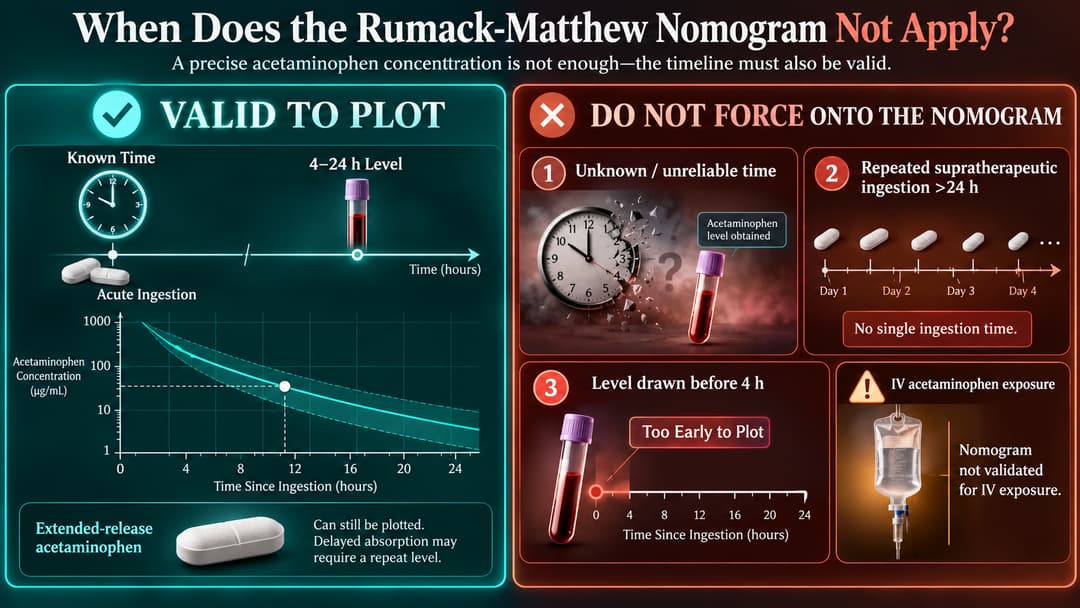
Clinical graphic comparing valid and invalid scenarios for using the Rumack-Matthew acetaminophen nomogram.

Amirhosein Shabrang
Post on 24 Oct 2026

Amirhosein Shabrang
Post on 24 Oct 2026
 Medical Toxicologymedicaltoxic.com
https://medicaltoxic.com/tox-spotlight/bupropion-xl-delayed-seizures
Clinical graphic comparing valid and invalid scenarios for using the Rumack-Matthew acetaminophen nomogram.
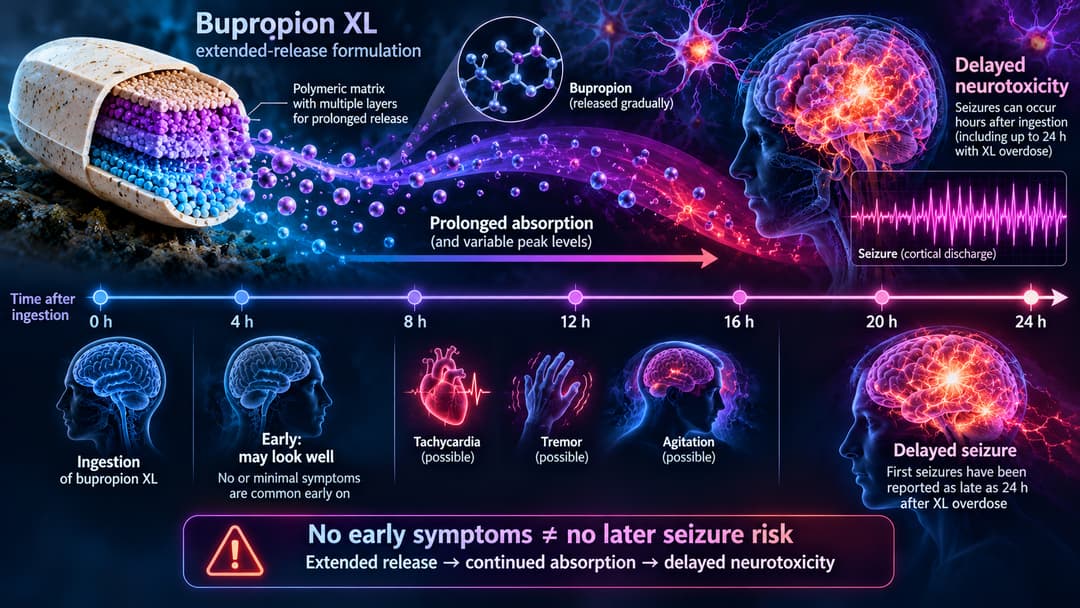
An initially well patient after bupropion XL overdose may still be at risk because clinically important neurotoxicity can emerge many hours after ingestion.
Extended-release bupropion can cause delayed seizures, even after a relatively quiet early course. In a multicenter study of XL overdoses, first seizures occurred from 30 minutes to 24 hours after ingestion, and about one-third of patients who seized had their first seizure more than 8 hours after ingestion. [1]
Agitation and tremor increase concern, but seizures can occur without those warning signs.
Early stability does not mean the toxicity window is over.
The XL formulation is designed to release bupropion gradually.
After overdose, continued gastrointestinal drug release can separate the time of ingestion from the time of peak neurotoxicity. The patient may therefore appear relatively well while additional bupropion is still being absorbed.
The clinically important distinction is simple:
the clock on the exposure starts at ingestion, but the toxic effect may not peak early.
That formulation-dependent delay is why the early examination alone cannot determine that seizure risk has passed. [1]
No.
In the XL cohort, agitation and tremor were more common among patients who seized, but some patients developed seizures without preceding central nervous system toxicity. [1]
Newer retrospective data add useful nuance. In a 2024 cohort, delayed adverse effects were uncommon and all patients with delayed events had developed tachycardia within the first five hours of emergency-department observation. However, the study was retrospective, ingestion timing was often uncertain, and the authors' proposed early risk-stratification approach has not become a universal discharge rule. [2]
So an early reassuring examination—or one normal vital sign—should not be treated as proof that delayed toxicity is impossible.
For the full formulation-specific observation, seizure, ECG, cardiovascular, and disposition framework, see Bupropion Poisoning: An Evidence-Informed Clinical Guideline.
Bupropion XL can remain quiet before it becomes convulsive.
Do not let an initially normal neurologic examination erase the delayed risk created by the extended-release formulation.
Starr P, Klein-Schwartz W, Spiller H, Kern P, Ekleberry SE, Kunkel S. Incidence and onset of delayed seizures after overdoses of extended-release bupropion. American Journal of Emergency Medicine. 2009;27(8):911–915. doi:10.1016/j.ajem.2008.07.004
Idowu D, Ezema K, Corcoran J, Farkas A. The predictive value of heart rate in determining clinical course after a bupropion overdose. Clinical Toxicology. 2024;62(5):296–302. doi:10.1080/15563650.2024.2347514
As the Growth & Content Lead at MedicalToxic.com, I work on content strategy, development, and digital growth. My focus is on making MedicalToxic’s content clear, practical, and accessible, while helping expand the platform’s reach and strengthen its position as a trusted resource in clinical toxicology.
Keep reading
Clinical Toxicology
21 Sept 2026 · Updated 02 Oct 2026
Amirhosein Shabrang

Clinical Toxicology
16 Sept 2026 · Updated 26 Sept 2026
Amirhosein Shabrang

Clinical Toxicology
16 Sept 2026 · Updated 02 Oct 2026
Amirhosein Shabrang