Why Can Intubation Worsen Salicylate Toxicity?

Amirhosein Shabrang
Post on 21 Sept 2026 · Updated 02 Oct 2026

Amirhosein Shabrang
Post on 21 Sept 2026 · Updated 02 Oct 2026
 Medical Toxicologymedicaltoxic.com
https://medicaltoxic.com/tox-spotlight/intubation-salicylate-toxicity
Why Can Intubation Worsen Salicylate Toxicity?
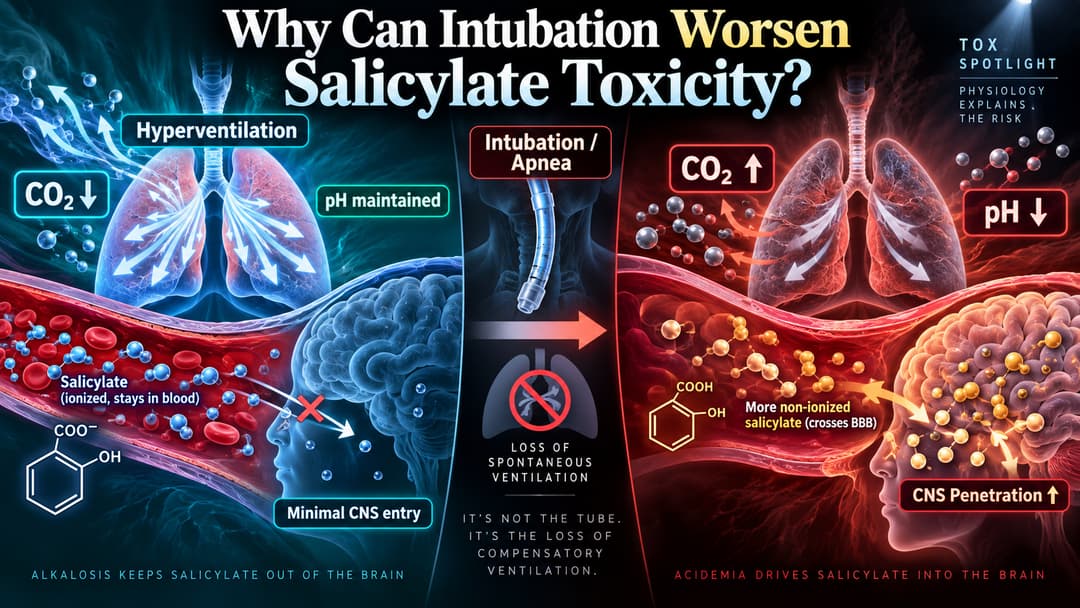
In severe salicylate poisoning, rapid breathing may be protective. Intubation becomes dangerous when apnea or inadequate ventilation raises CO₂, lowers blood pH, and promotes salicylate movement into tissues.
Salicylate poisoning stimulates hyperventilation, helping maintain a low PaCO₂ and an alkalemic or near-alkalemic blood pH. If sedation, paralysis, apnea, or inadequate mechanical ventilation abruptly raises CO₂, pH can fall and a greater fraction of salicylate becomes non-ionized and able to enter tissues, including the central nervous system. [1] [2]
The endotracheal tube is not the primary problem. The danger is losing the patient's compensatory ventilation.
Salicylates directly stimulate the respiratory center while also producing metabolic acidosis. The resulting tachypnea and hyperpnea lower PaCO₂ and help defend blood pH. [1]
That matters because falling pH increases the proportion of salicylate present as non-ionized salicylic acid, which crosses cell membranes and the blood–brain barrier more readily. [2]
A very high respiratory rate may therefore represent essential compensation—not simply respiratory distress that should be normalized.
Before intubation, a severely poisoned patient may be generating an unusually high minute ventilation.
Sedation and paralysis remove that respiratory drive. Even brief apnea can allow CO₂ to rise, and conventional ventilator settings may provide less minute ventilation than the patient was producing spontaneously.
The dangerous sequence is:
ventilation falls → CO₂ rises → pH falls → tissue penetration of salicylate increases.
This is why ACMT guidance warns that intubation and mechanical ventilation can rapidly worsen salicylate toxicity unless low PaCO₂ and a normal-to-slightly alkalemic pH are maintained. [1]
No.
Severe encephalopathy, seizures, respiratory failure, inability to protect the airway, or another compelling indication may still make intubation necessary.
Importantly, a 2024 single-center retrospective study of adults with severe salicylate poisoning found no substantial overall pre-to-post-intubation pH change or severe procedural complications in the intubated group. The findings argue against treating intubation itself as inherently harmful when ventilation is managed appropriately. [3]
The practical distinction is therefore:
avoid unnecessary intubation—but when it is necessary, preserve the patient's compensatory physiology and avoid hypercapnia and acidemia.
In salicylate poisoning, hyperventilation may be protective physiology.
If intubation is unavoidable, the critical hazard is not the tube itself—it is allowing CO₂ to rise and pH to fall.
American College of Medical Toxicology. Guidance Document: Management Priorities in Salicylate Toxicity. Journal of Medical Toxicology. 2015;11(1):149–152. doi:10.1007/s13181-013-0362-3
Palmer BF, Clegg DJ. Salicylate Toxicity. New England Journal of Medicine. 2020;382(26):2544–2555. doi:10.1056/NEJMra2010852
McDonald BA, Conlon M, Ulici A, et al. Tracheal Intubation and Mechanical Ventilation in Adults with Severe Salicylate Poisoning. Journal of Emergency Medicine. 2024;67(3):e268–e276. doi:10.1016/j.jemermed.2024.04.004
As the Growth & Content Lead at MedicalToxic.com, I work on content strategy, development, and digital growth. My focus is on making MedicalToxic’s content clear, practical, and accessible, while helping expand the platform’s reach and strengthen its position as a trusted resource in clinical toxicology.
Keep reading
Clinical Toxicology
16 Sept 2026 · Updated 26 Sept 2026
Amirhosein Shabrang
Clinical Toxicology
16 Sept 2026 · Updated 02 Oct 2026
Amirhosein Shabrang