Calcium Channel Blocker Poisoning: High-Dose Insulin, Vasopressors, Calcium, and VA-ECMO
Published on 09 Sept 2026
Published on 09 Sept 2026
 Medical Toxicologymedicaltoxic.com
https://medicaltoxic.com/guidelines/calcium-channel-blocker-poisoning
Calcium channel blocker (CCB) poisoning can cause rapidly progressive hypotension, bradycardia, conduction disturbance, myocardial depression, vasoplegia, or mixed shock. Severe toxicity requires early recognition, continuous reassessment, and parallel treatment rather than a rigid stepwise sequence.
The 2025 American Heart Association (AHA) guideline recommends high-dose insulin and vasopressors for hypotension in adults and children with life-threatening CCB poisoning; intravenous calcium is reasonable as an early concurrent therapy, and extracorporeal life support (ECLS) is reasonable when poisoning remains refractory to pharmacologic treatment. [1]
Bedside echocardiography can help define whether shock is predominantly vasodilatory, cardiogenic, or mixed, but it must not delay life-saving treatment. A 2026 echocardiography-centered CCB algorithm proposed phenotype-directed therapy; this framework is clinically useful but has not been prospectively validated. [2]
In life-threatening CCB poisoning with hypotension, administer high-dose insulin and vasopressors while reassessing perfusion and cardiac function. [1]
Intravenous calcium is reasonable as early concurrent therapy but is rarely sufficient as sole treatment in severe poisoning. [1]
Use bedside echocardiography to help identify vasoplegic, cardiogenic, or mixed shock when feasible, without delaying treatment. [2]
Hyperglycemia can increase concern for clinically significant toxicity, but it is not a validated standalone treatment, ICU, ECMO, or discharge threshold. A 2025 analysis of US poison-center cases found an association between reported hyperglycemia and severe outcomes, but the evidence is observational. [3]
Glucagon, methylene blue, and intravenous lipid emulsion (ILE) have uncertain usefulness in life-threatening CCB poisoning under current AHA guidance and should not delay established therapy. [1]
Begin poison-center or medical-toxicology consultation early in severe or potentially severe poisoning.
If the trajectory suggests refractory shock or peri-arrest physiology, begin ECMO-center consultation and transfer planning while active resuscitation continues; do not wait to exhaust a fixed drug sequence.
VA-ECMO supports circulation; it does not meaningfully enhance CCB elimination.
EXTRIP recommends against extracorporeal toxin removal to enhance elimination in severe amlodipine, diltiazem, or verapamil poisoning. [4]
Potentially significant sustained-release exposures require conservative, formulation-aware observation because toxicity may be delayed or prolonged.
Clinical warning
Life-threatening CCB poisoning is a dynamic cardiovascular emergency. Do not delay resuscitation for gastrointestinal decontamination, serum drug concentrations, or echocardiography. Use concurrent hemodynamic support, frequent reassessment, and early poison-center or medical-toxicology involvement. For worsening shock or peri-arrest physiology, contact an ECMO-capable center early while pharmacologic resuscitation continues. No single glucose value, lactate, pH, blood pressure, insulin dose, or vasopressor dose is a validated universal trigger for ECMO or disposition.
Common CCBs can be divided into two clinically useful groups:
Class | Examples | Predominant therapeutic effect | Typical overdose pattern |
|---|---|---|---|
Dihydropyridines | Amlodipine, nifedipine, felodipine, nicardipine | Peripheral arterial vasodilation | Vasoplegic hypotension often dominates; severe overdose can also cause myocardial depression and bradycardia |
Nondihydropyridines | Verapamil, diltiazem | AV-nodal blockade, negative chronotropy and inotropy | Bradycardia, AV block, myocardial depression, cardiogenic or mixed shock |
The distinction is useful but not absolute. At toxic concentrations, normal pharmacologic selectivity may be lost. Severe dihydropyridine poisoning can therefore produce myocardial dysfunction, while severe nondihydropyridine poisoning may include important vasodilation. [1]
Formulation matters. Modified- or sustained-release diltiazem, verapamil, and nifedipine can cause delayed or prolonged absorption. Amlodipine can produce prolonged toxicity because of its long half-life even without a modified-release formulation. [1]
CCBs inhibit L-type calcium channels in vascular smooth muscle and cardiac tissue. Excessive blockade can impair:
vascular smooth-muscle contraction;
myocardial contractility;
sinoatrial-node activity;
atrioventricular conduction;
pancreatic insulin release.
The resulting cardiovascular failure may combine reduced systemic vascular resistance, impaired cardiac output, bradycardia, and conduction disturbance. CCB poisoning also decreases insulin secretion and disrupts normal myocardial carbohydrate utilization. Hyperglycemia and insulin resistance can therefore accompany severe poisoning and contribute to the physiologic rationale for high-dose insulin therapy. [1]
As perfusion worsens, patients may develop lactic acidosis, renal dysfunction, altered mental status, pulmonary edema, respiratory failure, and multiorgan dysfunction.
There is no single universal ingested-dose threshold that reliably predicts severe toxicity across all CCBs, formulations, ages, and patients.
Assess:
exact CCB;
tablet strength;
immediate- versus modified-release formulation;
estimated and maximum possible dose;
time of ingestion;
intentional versus accidental exposure;
single versus repeated ingestion;
co-ingestants;
baseline cardiovascular disease;
baseline bradycardia or conduction disease;
renal or hepatic dysfunction where relevant;
age and body weight;
evolving vital signs, ECG findings, glucose, lactate, and organ perfusion.
Co-ingestion with beta-blockers, other antihypertensives, renin-angiotensin system inhibitors, or additional cardiotoxic drugs can substantially alter the phenotype and severity.
All stated or suspected deliberate self-poisonings require emergency medical evaluation regardless of the reported dose. Older poison-center guidance also demonstrates that formulation materially affects the timing of symptom development. [5]
In young children, even apparently small exposures deserve careful assessment because reliable universal pediatric toxic-dose cutoffs are lacking.
Possible findings include:
dizziness;
fatigue or weakness;
nausea or vomiting;
mild hypotension;
sinus bradycardia;
PR prolongation;
hyperglycemia.
Features of severe or life-threatening poisoning include:
persistent or worsening hypotension;
poor peripheral perfusion;
escalating vasopressor requirements;
marked bradycardia;
high-grade AV block;
reduced ventricular contractility;
altered mental status from hypoperfusion;
rising lactate;
worsening metabolic acidosis;
oliguria or acute kidney injury;
pulmonary edema;
respiratory failure;
recurrent cardiovascular collapse;
cardiac arrest.
Hyperglycemia can occur because calcium-channel blockade interferes with insulin release and glucose handling. A 2025 retrospective analysis of 49,576 isolated CCB exposures reported to US poison centers from 2007 through 2017 found that reported hyperglycemia was associated with a substantially higher risk of severe medical outcome. Because this was observational poison-center data, hyperglycemia should increase clinical concern but must not be converted into a universal numerical treatment, ICU, ECMO, or discharge threshold. [3]
Determine:
drug name;
formulation;
strength per tablet or capsule;
number potentially missing;
maximum possible ingestion;
time of exposure;
access to other cardiovascular medications;
co-ingestants;
underlying cardiovascular disease;
baseline blood pressure and heart rate when known;
symptoms since exposure;
treatments already administered;
circumstances suggesting intentional self-harm.
When the ingestion history is uncertain but the clinical syndrome strongly suggests CCB toxicity, resuscitation should not be delayed while awaiting confirmation.
Obtain:
continuous cardiac monitoring;
frequent blood-pressure measurements;
12-lead ECG;
serial ECGs when abnormalities or significant toxicity are present;
peripheral perfusion assessment;
urine-output monitoring in severe toxicity;
bedside echocardiography or focused cardiac ultrasound when shock is present.
Point-of-care echocardiography can help distinguish substantial myocardial dysfunction from predominantly vasodilatory shock and can be repeated during treatment to reassess the phenotype. The specific echo-guided pathway proposed in 2026 remains a clinical framework rather than a prospectively validated decision rule. [2]
For clinically significant poisoning, obtain and serially reassess as appropriate:
serum glucose;
potassium;
magnesium;
phosphate;
ionized calcium;
sodium and bicarbonate;
creatinine;
lactate;
venous or arterial blood gas in severe illness.
Additional testing should be directed by clinical context and suspected co-ingestants.
Serum CCB concentrations generally do not become available rapidly enough to direct emergency management and should not delay treatment.
A patient with severe dihydropyridine poisoning, particularly amlodipine, may have profound vasodilatory shock without dramatic bradycardia.
At high concentrations, class selectivity becomes less reliable. Severe dihydropyridine poisoning can produce myocardial dysfunction. [1]
Assess:
mentation;
peripheral perfusion;
lactate trend;
urine output;
ventricular function;
overall clinical trajectory.
A numerical blood pressure should not be the sole treatment endpoint.
Hyperglycemia is a diagnostic and prognostic clue, not an independent indication for high-dose insulin, ECMO, or prolonged hospitalization. [3]
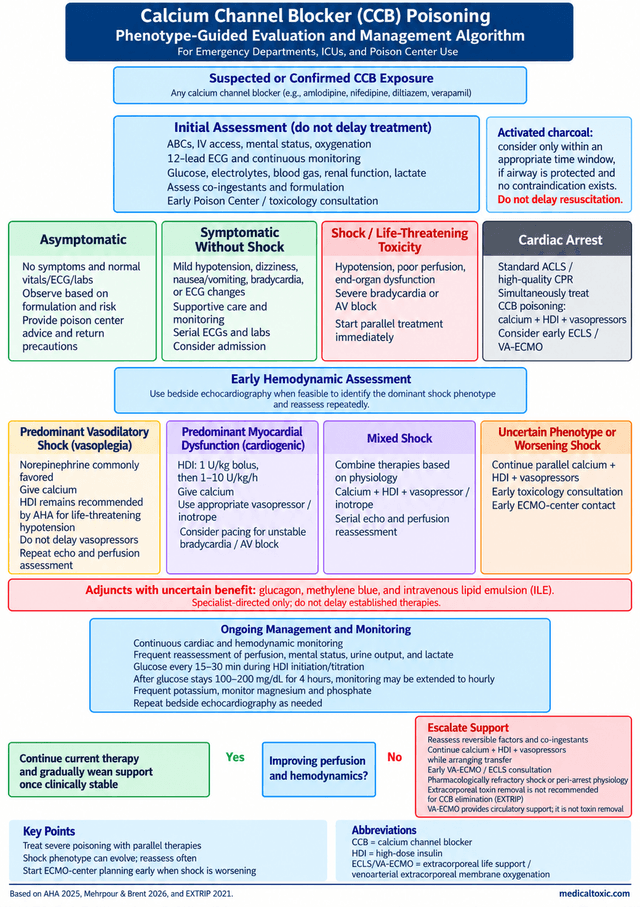
Life-threatening CCB poisoning should usually be treated with parallel rather than rigidly sequential interventions.
1. Suspected significant CCB poisoning
Continuous ECG.
Frequent blood pressure.
Glucose and electrolytes.
Lactate and acid-base assessment.
Assess cardiac function when shock is present.
2. Hypotension, shock, clinically significant bradycardia, or conduction disturbance
Begin appropriate measures concurrently:
cautious IV fluid assessment;
intravenous calcium;
high-dose insulin for life-threatening hypotension;
vasopressor support for life-threatening hypotension;
repeated hemodynamic assessment. [1]
3. Define the dominant shock phenotype without delaying treatment
Predominantly vasodilatory shock: vasopressor support is central. Norepinephrine is commonly favored by expert consensus, but the 2025 AHA guideline does not establish one universally optimal vasopressor. [1,8]
Predominantly cardiogenic shock / myocardial dysfunction: high-dose insulin has a clear physiologic rationale as an inotropic and metabolic therapy, with appropriate vasopressor or inotropic support. [1]
Mixed shock: combine therapies according to physiology and repeated reassessment.
4. Worsening or likely refractory shock / peri-arrest physiology
Begin ECMO-center consultation and transfer planning early while calcium, high-dose insulin, vasopressors, and other indicated resuscitative measures are still being optimized. ECLS should not be delayed until every possible adjunct has been tried. Actual ECLS use is reasonable when CCB poisoning remains refractory to pharmacologic interventions. [1]
Do not postpone established therapy while repeatedly trialing glucagon, methylene blue, or ILE, whose usefulness remains uncertain. [1]
Use standard high-quality CPR and ACLS while simultaneously treating the underlying CCB poisoning. High-dose insulin, vasopressors, and calcium remain relevant CCB-specific therapies, and early ECLS discussion is appropriate when the exposure is potentially reversible and conventional resuscitation is failing. The usefulness of ILE in refractory CCB-associated shock remains uncertain. [1]
Prioritize airway, breathing, and circulation while initiating CCB-specific cardiovascular treatment.
Establish reliable IV access.
Use continuous ECG monitoring.
Consider invasive arterial blood-pressure monitoring in severe or rapidly evolving shock.
Give cautious isotonic fluid boluses when appropriate and reassess frequently.
Avoid indiscriminate large-volume crystalloid administration in toxin-induced myocardial dysfunction or vasoplegia because pulmonary edema and fluid overload may develop without correcting the underlying shock.
If endotracheal intubation is required in profound shock, anticipate peri-intubation cardiovascular deterioration and optimize hemodynamics before induction when possible.
Contact a poison center or medical toxicologist early.
Escalate severe poisoning to critical care.
The 2026 Clinical Toxicology Recommendations Collaborative provides drug-, formulation-, dose-, and time-specific recommendations for single-dose activated charcoal (SDAC) after CCB ingestion. These recommendations are based on limited-quality evidence and should be applied with individualized assessment of aspiration risk, expected toxicity, symptoms, and transfer or resuscitation priorities. [6]
For the specifically evaluated agents and dose thresholds:
Exposure | 2026 recommendation |
|---|---|
Immediate-release amlodipine, at least 5 therapeutic doses | Recommend SDAC up to 2 hours (1, D) |
Immediate-release diltiazem or verapamil, at least 3 therapeutic doses | Recommend SDAC up to 2 hours (1, D); suggest SDAC up to 3 hours (2, D) |
Modified-release amlodipine, at least 5 therapeutic doses | Recommend SDAC up to 2 hours (1, D) |
Modified-release diltiazem or verapamil, at least 3 therapeutic doses | Recommend SDAC up to 3 hours (1, D); suggest SDAC up to 5 hours (2, D) |
The Collaborative suggests against SDAC beyond 6 hours for immediate- or modified-release amlodipine and for immediate-release diltiazem or verapamil. For other doses, time points, and other CCBs, an individualized risk assessment is required. [6]
Do not administer activated charcoal when aspiration risk is unacceptable unless the airway is adequately protected. Do not delay cardiovascular resuscitation or urgent transfer to perform gastrointestinal decontamination.
Whole-bowel irrigation (WBI) may be considered for a potentially toxic sustained-release or enteric-coated ingestion, particularly when substantial drug may remain in the gastrointestinal tract. However, controlled clinical evidence demonstrating improved outcomes is lacking. [7]
WBI is contraindicated in:
bowel obstruction;
perforation;
ileus;
hemodynamic instability;
a compromised, unprotected airway. [7]
Because severe CCB toxicity frequently causes hypotension, altered mental status, and gastrointestinal hypomotility, WBI should not be initiated reflexively simply because a sustained-release formulation was ingested.
The 2025 AHA guideline states that calcium administration is reasonable in adults and children with life-threatening CCB poisoning. Most severely poisoned patients require additional treatments; calcium should not be regarded as definitive monotherapy. [1]
Therapy | Adult initial dose | Pediatric initial dose | Maintenance infusion |
|---|---|---|---|
Calcium chloride 10% (100 mg/mL) | 2,000 mg = 20 mL = 28 mEq Ca²⁺ | 20 mg/kg = 0.2 mL/kg = 0.28 mEq Ca²⁺/kg | 20–40 mg/kg/h = 0.2–0.4 mL/kg/h |
Calcium gluconate 10% (100 mg/mL) | 6,000 mg = 60 mL = 28 mEq Ca²⁺ | 60 mg/kg = 0.6 mL/kg = 0.28 mEq Ca²⁺/kg | 60–120 mg/kg/h = 0.6–1.2 mL/kg/h |
Titrate calcium to hemodynamic response. The AHA advises not exceeding an ionized calcium concentration approximately 1.5–2 times the upper limit of normal. Calcium chloride should be administered through central access, especially in children. [1]
Monitor:
blood pressure and tissue perfusion;
ECG;
serial ionized calcium;
IV access site;
response to concurrent therapies.
The MedicalToxic report Successful Use of Calcium Chloride in Acute Calcium Channel Blocker Overdose With Shock: A Case Report. describes an individual response to calcium chloride. A single case must not be interpreted as evidence that calcium chloride is universally superior to calcium gluconate or should replace high-dose insulin or vasopressor therapy.
The 2025 AHA guideline gives a Class 1 recommendation that high-dose insulin should be administered for hypotension in adults and children with life-threatening CCB poisoning. [1]
High-dose insulin is an inotropic and metabolic therapy rather than a competitive antidote. It can improve myocardial carbohydrate utilization and cardiac performance, but it also has vasodilatory effects that matter when vasoplegia predominates.
Regular human insulin
Initial dose: 1 U/kg IV/IO
Maintenance infusion: 1–10 U/kg/h, titrated to clinical response. [1]
The AHA notes that ideal antidote doses in critical poisoning are not always known and therapy should be titrated to control critical signs and symptoms.
Obtain:
bedside glucose;
serum potassium;
adequate vascular access;
capacity for frequent glucose testing;
IV dextrose immediately available.
Do not delay insulin solely because the patient is hyperglycemic. Marked hyperglycemia may initially reduce or eliminate the need for supplemental dextrose.
Dextrose should be administered and titrated as needed to prevent hypoglycemia. A commonly used poison-center operational target is approximately 100–200 mg/dL (5.6–11.1 mmol/L), although local protocols vary. [9]
A practical monitoring approach based on the Utah Poison Control Center protocol is:
check blood glucose every 15–30 minutes during initiation and active insulin/dextrose titration;
after any major insulin or dextrose adjustment, return to frequent checks;
once blood glucose has remained consistently 100–200 mg/dL for 4 hours, checks may be extended to hourly. [9]
Concentrated dextrose through appropriate vascular access can reduce the free-water burden associated with dilute solutions. Supplemental glucose may remain necessary after the insulin infusion is stopped. [9]
High-dose insulin commonly shifts potassium intracellularly.
Check potassium frequently during initiation and active titration; shorter intervals are appropriate during rapid dose changes or instability.
Monitor magnesium and phosphate during prolonged therapy.
Hypokalemia reflects redistribution to a substantial degree. Replace clinically significant hypokalemia carefully and avoid unnecessary aggressive normalization because rebound hyperkalemia may occur as the insulin effect resolves.
Assess the whole perfusion state rather than blood pressure alone:
improving mental status;
improved peripheral perfusion;
declining or stabilizing lactate;
adequate urine output;
improving ventricular contractility;
decreasing vasoactive requirements.
Some hypotension or bradycardia may persist despite adequate tissue perfusion.
The 2025 AHA guideline gives a Class 1 recommendation for high-dose insulin in adults and children with life-threatening CCB-associated hypotension and does not create a separate exclusion for dihydropyridine-predominant vasoplegia. [1]
Separate literature urges more caution. Isoardi, Chan, and Chiew characterize high-dose insulin as an inodilator rather than a specific antidote and argue that its vasodilatory effect may be counterproductive in isolated vasoplegic shock. [11]
Chan and colleagues retrospectively studied 50 adults with deliberate dihydropyridine overdose and hypotension; only 10 received high-dose insulin, and those patients were generally more hypotensive and frequently required more concurrent vasoactive support. High-dose insulin was used mainly in patients with left-ventricular dysfunction. Because treatment was not randomized and the groups differed in baseline severity, the cohort cannot establish benefit or harm from high-dose insulin or define a routine indication for every hypotensive dihydropyridine exposure. [10]
Clinically, do not delay vasopressor treatment when vasoplegia predominates. Use serial echocardiography when available to identify myocardial dysfunction, reassess the phenotype as treatment evolves, and involve a poison center or medical toxicologist when deciding how aggressively to escalate high-dose insulin in predominantly vasodilatory shock. This approach distinguishes the broad AHA recommendation from the limitations of the observational and expert-opinion literature. [1,10,11]
There is no universally validated high-dose insulin weaning protocol. Once shock has resolved and other vasoactive requirements are falling, reduce therapy cautiously with continued glucose and electrolyte monitoring.
The 2025 AHA guideline states that vasopressors should be administered for hypotension in adults and children with life-threatening CCB poisoning. Current evidence does not establish one universally optimal vasopressor. [1]
The 2017 international expert consensus supports:
norepinephrine and/or epinephrine in shock;
preferential use of norepinephrine when vasodilatory shock predominates;
epinephrine or dobutamine when cardiogenic shock is prominent. [8]
Shock phenotype | Vasoactive strategy |
|---|---|
Predominantly vasodilatory | Norepinephrine is commonly favored by expert consensus; current AHA evidence does not establish a universally superior agent |
Significant myocardial depression | Epinephrine or another appropriate inotropic strategy may be required alongside high-dose insulin |
Mixed vasoplegic/cardiogenic | Combine vasoconstrictor and inotropic support according to repeated hemodynamic assessment |
Do not repeatedly escalate catecholamines while delaying calcium or high-dose insulin when those therapies are indicated.
Current AHA evidence is insufficient to recommend routine use of nonadrenergic vasoactive agents such as vasopressin, angiotensin II, or hydroxocobalamin specifically for CCB poisoning. [1]
Symptomatic bradycardia and conduction abnormalities are particularly common after verapamil and diltiazem poisoning.
Atropine may be attempted for symptomatic bradycardia or conduction disturbance, but response may be incomplete. Expert consensus supports its use as an adjunct rather than as a substitute for treatment of the underlying shock. [8]
Pacing may be considered in selected patients with:
unstable bradycardia;
high-grade AV block;
inadequate response to pharmacologic therapy;
particularly when major loss of myocardial contractility is not the principal mechanism of instability. [8]
Electrical capture alone does not ensure adequate cardiac output in a profoundly poisoned myocardium. Continue to assess mechanical capture and perfusion.
The 2025 AHA guideline classifies the usefulness of a glucagon bolus followed by continuous infusion in life-threatening CCB poisoning as uncertain. Reported responses are inconsistent, vomiting is common, and tachyphylaxis may occur. [1]
If a specialist-directed trial is considered, the AHA critical-poisoning dosing table lists:
Adults: 2–10 mg IV/IO initially
Children: 0.05–0.15 mg/kg IV/IO initially
Adult maintenance infusion: 1–15 mg/h [1]
A trial of glucagon must not delay:
calcium;
high-dose insulin;
vasopressors;
ECLS evaluation in refractory shock.
Because vomiting is common, aspiration risk should be considered.
The 2025 AHA guideline considers the usefulness of methylene blue uncertain for refractory vasodilatory shock caused by CCB poisoning. Published evidence consists predominantly of case reports and small case series, particularly involving amlodipine; responses are inconsistent and may be transient. Pediatric evidence is particularly limited. [1]
Methylene blue should therefore not be incorporated into the routine first-line sequence.
If contemplated for exceptional refractory vasoplegia, use should be directed by a medical toxicologist and critical-care team after reviewing patient-specific contraindications and drug interactions.
The usefulness of ILE in adults and children with refractory CCB-associated shock remains uncertain under the 2025 AHA guideline. [1]
Case reports describe both apparent benefit and serious adverse hemodynamic events, and expert consensus has advised against routine administration. [1,8]
ILE should not delay or replace:
calcium;
high-dose insulin;
vasopressors;
appropriate ECLS escalation.
Its use, if contemplated after failure of established therapies, should be specialist-directed.
The 2025 AHA guideline states that ECLS is reasonable for adults and children with CCB poisoning refractory to pharmacologic interventions. [1]
For severe circulatory failure, this generally means VA-ECMO rather than venovenous ECMO.
There is no validated pH, lactate, blood-pressure, insulin-dose, or vasopressor-dose threshold that mandates VA-ECMO.
Referral planning should begin before a fixed checklist of drug therapies has been exhausted. When the clinical trajectory suggests likely refractory circulatory failure, contact an ECMO-capable center while active pharmacologic resuscitation continues. This allows transport and candidacy decisions to occur before cardiovascular collapse makes transfer more difficult.
Features that should prompt early ECMO-center discussion include:
persistent or worsening shock despite active calcium, high-dose insulin, and appropriate vasopressor therapy;
progressive myocardial dysfunction;
rapidly escalating vasoactive requirements with worsening perfusion;
recurrent cardiovascular collapse;
peri-arrest physiology;
selected cases of cardiac arrest from a potentially reversible CCB exposure. [1]
These findings trigger individualized assessment, not an automatic cannulation rule.
A multicenter ELSO registry analysis of 157 patients with CCB toxicity treated with ECMO from 2015 through 2023 reported VA-ECMO use in 90% of cases. Survival to discharge was 80% in pediatric patients and 63% in adults. Lower arterial pH and cardiac arrest before ECMO were associated with worse survival in unadjusted analyses. Because this was a retrospective registry of selected ECMO-treated patients, these findings cannot establish a numerical indication threshold for ECMO. [12]
VA-ECMO supports circulation and systemic oxygen delivery while the poisoning resolves. It does not function as an effective method of removing the CCB.
EXTRIP found amlodipine, diltiazem, verapamil, nifedipine, and several other CCBs to be poorly or non-dialyzable and strongly recommends against extracorporeal treatment to enhance elimination of amlodipine, diltiazem, or verapamil in severe poisoning, although the quality of evidence is very low. [4]
Kidney replacement therapy may still be required for conventional critical-care indications such as severe kidney failure, electrolyte abnormalities, acid-base disorders, or volume management. That is fundamentally different from using dialysis to clear the CCB.
For general toxin-removal principles, see Hemodialysis in Poisoning: A Comprehensive Guide for Healthcare Providers.
Patients require ICU-level or equivalent monitored care when they have:
hypotension;
shock;
vasopressor or inotrope requirement;
significant bradycardia;
clinically important conduction disturbance;
myocardial dysfunction;
rising lactate or significant metabolic acidosis;
respiratory failure;
need for high-dose insulin;
need for continuous calcium therapy;
evolving end-organ hypoperfusion.
Patients receiving high-dose insulin need a setting capable of frequent glucose and electrolyte measurements and rapid management of hypoglycemia, potassium shifts, and fluid burden.
Observation should be based on:
specific CCB;
estimated dose;
formulation;
intent;
co-ingestants;
age;
cardiovascular reserve;
reliability of the ingestion history.
The 2017 adult expert consensus recommends hospital observation for approximately 24 hours after a potentially toxic CCB ingestion, while acknowledging very low-quality evidence. [8]
Older 2005 out-of-hospital consensus guidance reported that new symptoms become unlikely after approximately:
6 hours for immediate-release products;
18 hours for modified-release products other than verapamil;
24 hours for modified-release verapamil. [5]
These were Grade D recommendations designed primarily for poison-center and out-of-hospital triage and should not be interpreted as rigid contemporary inpatient discharge rules.
A more conservative approach is warranted for:
deliberate self-poisoning;
uncertain ingestion time or dose;
major overdose;
modified-release preparations;
amlodipine;
significant co-ingestants;
evolving glucose or ECG abnormalities;
vulnerable children;
patients with limited cardiovascular reserve.
Before discharge, confirm as clinically appropriate:
completion of an adequate agent- and formulation-specific observation period;
no evolving symptoms;
stable blood pressure and perfusion without pharmacologic support;
stable rhythm and reassuring ECG;
stable metabolic findings;
no concern for ongoing or delayed gastrointestinal absorption;
appropriate poison-center or toxicology input after significant exposure;
psychiatric and safety assessment following deliberate self-poisoning.
Do not use one serum glucose value, one estimated ingested dose, or a serum CCB concentration as a universal discharge criterion.
The 2025 AHA recommendations apply to children as well as adults with life-threatening CCB poisoning. Specifically:
high-dose insulin should be administered for hypotension;
vasopressors should be administered for hypotension;
calcium is reasonable;
ECLS is reasonable when poisoning remains refractory to pharmacologic therapy. [1]
Use the weight-based calcium and insulin regimens above with meticulous independent dose checking.
A 2026 retrospective poison-center study identified 36 children treated with high-dose insulin for beta-blocker and/or CCB poisoning over 25 years. Sixteen had CCB poisoning and six had combined beta-blocker/CCB exposure. The median peak insulin infusion was 1 U/kg/h, with a range of 0.5–11 U/kg/h. The authors emphasized that more evidence is needed to define safety and effectiveness in small children. [13]
Important pediatric priorities include:
accurate current weight;
independent verification of insulin calculations;
independent verification of calcium calculations;
prevention of concentration and infusion-pump errors;
frequent glucose monitoring;
close potassium and electrolyte surveillance;
avoidance of unnecessary fluid volume;
early consultation with a poison center and pediatric critical-care team;
early transfer planning if pediatric ECLS may become necessary.
Small accidental ingestions in young children should not automatically be considered benign.
Severe CCB poisoning may produce vasoplegic, cardiogenic, bradycardic/conduction-related, or mixed shock.
In life-threatening hypotension, the 2025 AHA guideline recommends high-dose insulin and vasopressors. [1]
Intravenous calcium is an important concurrent therapy but is often insufficient alone. [1]
High-dose insulin requires frequent glucose, potassium, hemodynamic, and cardiac-function monitoring.
Vasopressor choice should follow the shock phenotype; current evidence does not establish one universally superior agent.
In dihydropyridine-predominant vasoplegia, do not interpret observational data or expert commentary as proof that HDI should always be given or always withheld; distinguish the broad AHA recommendation from the unresolved phenotype-specific evidence. [1,10,11]
Glucagon, methylene blue, and ILE have uncertain usefulness and should not displace established therapy. [1]
Sustained-release formulations and amlodipine may produce delayed or prolonged toxicity.
For deteriorating shock, begin ECMO-center consultation and transfer planning while resuscitation continues rather than waiting for an arbitrary numerical threshold or exhaustion of every drug therapy.
VA-ECMO is circulatory support, not toxin removal.
EXTRIP recommends against extracorporeal toxin removal for severe amlodipine, diltiazem, or verapamil poisoning. [4]
Observation and disposition must be individualized according to drug, formulation, dose, intent, trajectory, and patient vulnerability.
Early poison-center or medical-toxicology involvement is recommended in severe or potentially severe exposures.