Why Can Lithium Levels Rebound After Hemodialysis?

Amirhosein Shabrang
Post on 16 Sept 2026 · Updated 26 Sept 2026
Amirhosein Shabrang
Post on 16 Sept 2026 · Updated 26 Sept 2026
 Medical Toxicologymedicaltoxic.com
https://medicaltoxic.com/tox-spotlight/lithium-rebound-after-hemodialysis
Why Can Lithium Levels Rebound After Hemodialysis?
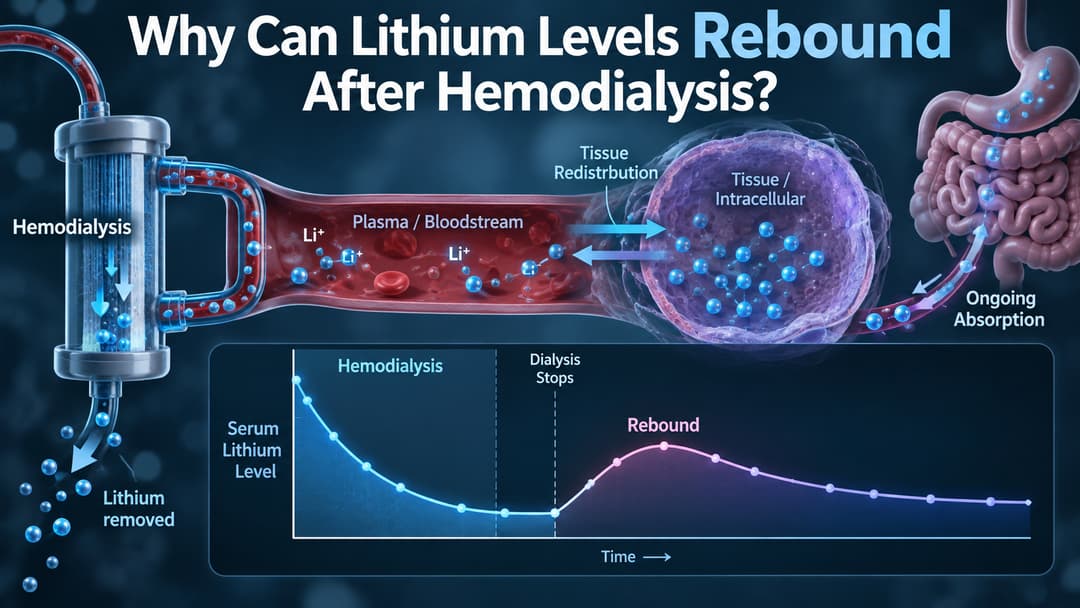
Hemodialysis can rapidly lower serum lithium, but lithium in tissues equilibrates more slowly. After dialysis stops, lithium may redistribute back into plasma—or additional lithium may continue to be absorbed from the gastrointestinal tract—causing the measured concentration to rise again.
A post-dialysis rise in lithium does not automatically mean dialysis failed.
There are two main causes:
Redistribution rebound: lithium remaining in tissues moves back into plasma after dialysis.
Ongoing-absorption rebound: additional lithium continues to enter the bloodstream from the gastrointestinal tract.
The distinction matters. Redistribution rebound is usually modest and is not typically associated with recurrent toxicity. A larger or sustained rise—particularly after extended-release lithium ingestion—raises concern for continued absorption and possible clinical deterioration. [1]
Hemodialysis removes lithium from plasma faster than lithium can equilibrate from deeper tissue compartments.
Once dialysis stops, lithium remaining in those compartments redistributes into the bloodstream, causing the serum concentration to rise again. [1] [2]
EXTRIP describes typical redistribution rebound as becoming maximal approximately 6–12 hours after extracorporeal treatment stops, often increasing serum lithium by about 0.5–1.0 mEq/L. This pattern is generally not associated with recurrent symptoms. [1]
Rebound is more concerning when lithium is still being absorbed from the gastrointestinal tract.
This can occur particularly with:
Extended-release lithium
Large ingestions
Delayed gastrointestinal transit
Ongoing-absorption rebound may be substantially larger than redistribution rebound and can be associated with recurrent symptoms or clinical deterioration. In the cases reviewed by EXTRIP in which rebound was associated with deterioration, ongoing absorption of extended-release lithium was implicated. [1]
Not necessarily.
Rebound alone does not establish dialysis failure or the need for another session.
Interpret the lithium trend alongside the patient's neurologic findings, renal function, exposure history, formulation, and clinical trajectory.
EXTRIP recommends obtaining serial lithium concentrations over 12 hours after extracorporeal treatment is stopped to assess rebound and determine whether additional treatment may be needed. Longer observation is appropriate when ongoing absorption is suspected. [1]
A rising lithium level after hemodialysis is not automatically treatment failure.
A modest rebound may reflect redistribution without recurrent toxicity. A larger or sustained rise—especially after extended-release ingestion—should raise concern for ongoing gastrointestinal absorption.
Interpret the trend with the patient's neurologic findings, renal function, and exposure history.
Hemodialysis in Poisoning: A Comprehensive Guide for Healthcare Providers
Decker BS, Goldfarb DS, Dargan PI, et al. Extracorporeal Treatment for Lithium Poisoning: Systematic Review and Recommendations from the EXTRIP Workgroup. Clinical Journal of the American Society of Nephrology. 2015;10(5):875–887. doi:10.2215/CJN.10021014
Jacobsen D, Aasen G, Frederichsen P, Eisenga B. Lithium intoxication: pharmacokinetics during and after terminated hemodialysis in acute intoxications. Journal of Toxicology: Clinical Toxicology. 1987;25(1–2):81–94. doi:10.3109/15563658708992615
As the Growth & Content Lead at MedicalToxic.com, I work on content strategy, development, and digital growth. My focus is on making MedicalToxic’s content clear, practical, and accessible, while helping expand the platform’s reach and strengthen its position as a trusted resource in clinical toxicology.
Keep reading
Clinical Toxicology
21 Sept 2026 · Updated 02 Oct 2026
Amirhosein Shabrang
Clinical Toxicology
16 Sept 2026 · Updated 02 Oct 2026
Amirhosein Shabrang