Why Can Digoxin Levels Rise After Digoxin Immune Fab?

Amirhosein Shabrang
Post on 16 Sept 2026 · Updated 02 Oct 2026

Amirhosein Shabrang
Post on 16 Sept 2026 · Updated 02 Oct 2026
 Medical Toxicologymedicaltoxic.com
https://medicaltoxic.com/tox-spotlight/digoxin-levels-rise-after-immune-fab
Why Can Digoxin Levels Rise After Digoxin Immune Fab?
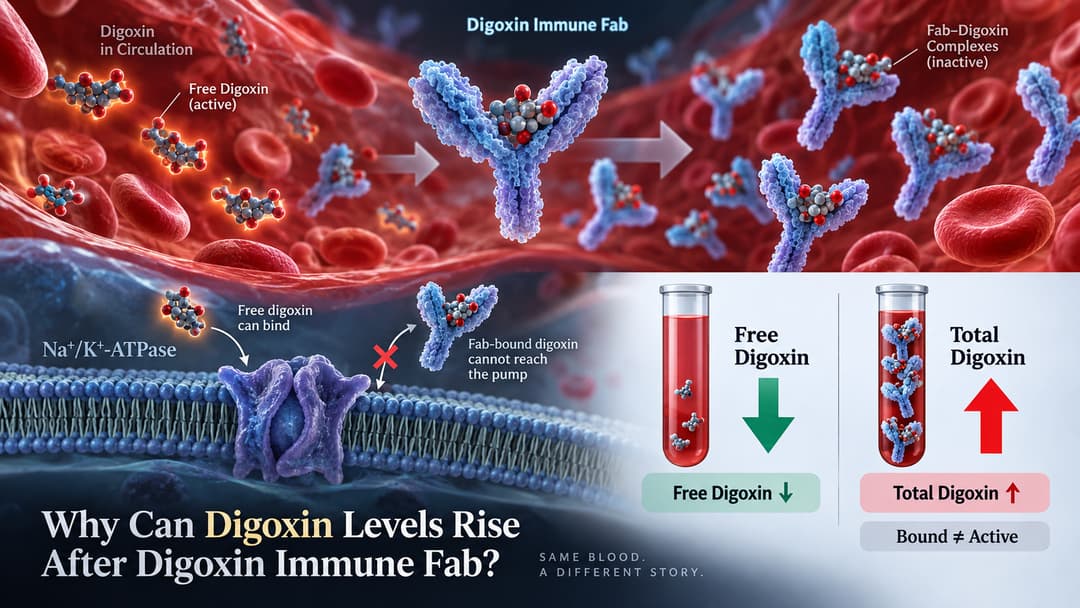
After digoxin immune Fab, the reported serum digoxin concentration may rise even while the amount of free, pharmacologically active digoxin falls sharply. Post-Fab digoxin levels therefore should not be interpreted like pretreatment levels.
Digoxin immune Fab binds circulating digoxin with high affinity, rapidly reducing the free, pharmacologically active fraction responsible for toxicity. At the same time, digoxin redistributes from tissues into the bloodstream and binds to Fab, so the measured total serum digoxin concentration can rise substantially after treatment. [1] [2]
There is another problem: routine digoxin immunoassays interact variably with Fab-bound digoxin. Depending on the assay, the reported post-Fab concentration may not reliably represent either total or free digoxin. [3]
A rising digoxin level after Fab therefore does not, by itself, establish treatment failure or justify additional antidote.
Before Fab is given, most measurable serum digoxin is unbound.
After administration, Fab rapidly binds free digoxin. This lowers the concentration available to interact with the Na⁺/K⁺-ATPase and creates a concentration gradient that promotes movement of digoxin from tissues back into the vascular compartment.
The result can appear paradoxical:
Free active digoxin falls while total circulating digoxin rises.
The DigiFab prescribing information specifically notes that total serum digoxin may rise precipitously after treatment, but that the increase consists almost entirely of digoxin bound to Fab and therefore unavailable to bind its pharmacologic receptors. [1]
Standard digoxin assays were not designed to provide straightforward interpretation in the presence of large amounts of digoxin-Fab complexes.
Assay studies have demonstrated variable interference after Fab administration. Different immunoassays may overestimate or underestimate digoxin concentrations to different degrees, and some results may correspond poorly with either the true total or free digoxin concentration. [3]
That means a conventional post-Fab digoxin result cannot simply be compared with a pretreatment value or therapeutic reference range.
The number may rise while the patient is improving.
Response to digoxin immune Fab should primarily be assessed clinically.
Follow:
Symptoms and mental status
ECG and cardiac rhythm
Heart rate and hemodynamics
Serum potassium
Renal function
Potassium deserves particular attention. Digoxin toxicity can shift potassium out of cells. When Fab reverses digoxin's toxic effect, potassium may move back intracellularly and the serum potassium concentration can fall rapidly. [1]
For an example of how impaired renal clearance can contribute to clinically important digoxin toxicity, see Chronic Digoxin Toxicity Triggered by Acute Kidney Injury: A Case of Confusion and Bradycardia.
Renal dysfunction changes the post-Fab picture.
Digoxin-Fab complexes are cleared more slowly in severe renal impairment, and delayed recurrence of free digoxin has been described. Pharmacokinetic studies have also found delayed free-digoxin rebound in patients with advanced renal dysfunction. [2]
The DigiFab prescribing information therefore recommends prolonged monitoring for possible recurrent toxicity in patients with severe renal failure. When recurrent toxicity is clinically suspected, measurement of free (unbound) digoxin may be useful if a validated assay is available. [1]
The laboratory should be consulted regarding the assay method because Fab interference is assay-dependent.
After digoxin immune Fab, do not chase the total digoxin number.
Free active digoxin may fall while the reported level rises, and routine assays can be misleading.
Judge response by symptoms, ECG, hemodynamics, and potassium. If recurrent toxicity is suspected—especially with severe renal impairment—a validated free-digoxin assay may help.
Chronic Digoxin Toxicity Triggered by Acute Kidney Injury: A Case of Confusion and Bradycardia
Plant Cardiac Glycoside Poisoning: Oleander, Foxglove, ECG Findings, and Treatment
BTG International Inc. DigiFab (Digoxin Immune Fab [Ovine]) Prescribing Information. DailyMed. U.S. National Library of Medicine.
Ujhelyi MR, Robert S, Cummings DM, et al. Influence of digoxin immune Fab therapy and renal dysfunction on the disposition of total and free digoxin. Annals of Internal Medicine. 1993;119(4):273-277.
Rainey PM. Effects of Digoxin Immune Fab (ovine) on Digoxin Immunoassays. American Journal of Clinical Pathology. 1989;92(6):779-786. doi:10.1093/ajcp/92.6.779
As the Growth & Content Lead at MedicalToxic.com, I work on content strategy, development, and digital growth. My focus is on making MedicalToxic’s content clear, practical, and accessible, while helping expand the platform’s reach and strengthen its position as a trusted resource in clinical toxicology.