Bupropion Poisoning: An Evidence-Informed Clinical Guideline
Published on 13 Dec 2024 · Updated 02 Oct 2026

Published on 13 Dec 2024 · Updated 02 Oct 2026
 Medical Toxicologymedicaltoxic.com
https://medicaltoxic.com/guidelines/bupropion-poisoning-clinical-guideline
Bupropion poisoning is a delayed-seizure problem: seizures can begin up to 24 hours after an extended-release overdose, often without warning signs. Clinical course, formulation, and time since ingestion should drive decisions more than the reported dose alone. [1–4]
This guideline is for poison center specialists, emergency physicians, and critical care clinicians. It synthesizes current literature but is not a society consensus statement. Much of the treatment evidence is observational or case-based.
Label | Meaning |
|---|---|
[Number] | Supported by the cited reference |
[Expert] | MedicalToxic operational choice or expert toxicology practice, not directly established by a cited study |
[Operational] | MedicalToxic operational threshold, observation period, or callback schedule; not a validated safety boundary. Poison centers may apply their own protocols where these differ |
Clinical warning
An asymptomatic patient after an extended-release overdose is not a safe patient. In one multicenter study, about one third of first seizures after XL overdose occurred more than 8 hours after ingestion. [2]
Seizures can occur without preceding agitation, tremor, or tachycardia. [2]
Severe poisoning can mimic brain death. Do not make prognostic or withdrawal-of-care decisions during the toxic phase. [Expert]
Referral thresholds: children >10 mg/kg; adolescents and adults >600 mg. Any intentional ingestion, any symptoms, or an unknown dose is referred regardless of amount. [4] [Operational]
Formulation sets the observation period. Above threshold, observe at least 12 hours after immediate-release and at least 24 hours after SR or XL ingestion. [2,3] [Operational]
Seizures are the dominant toxicity. Treat with benzodiazepines first, then phenobarbital or propofol with airway control. Phenytoin is not recommended. [Expert]
QRS widening is mainly a gap-junction effect, so sodium bicarbonate often has little effect. A bicarbonate trial is reasonable for significant QRS widening or ventricular dysrhythmia; plan early for refractory cardiovascular toxicity. [9,15]
Activated charcoal (CTRC 2026): for ≥20 mg/kg, recommended within 1 h and suggested up to 2 h after immediate-release; recommended within 2 h and suggested up to 3 h after modified-release. Only with an intact or protected airway. Additional-dose and multiple-dose charcoal require individualized assessment. [6]
Lipid emulsion is a last-line therapy, suggested only when other therapies fail. VA-ECMO should be considered early in refractory shock or arrest. [8] [Expert]
Hemodialysis is not expected to help because of the large volume of distribution. [Expert]
Discharge requires the full observation window, not just resolution of early symptoms. XL toxicity can persist beyond 48 hours. [2] [Expert]
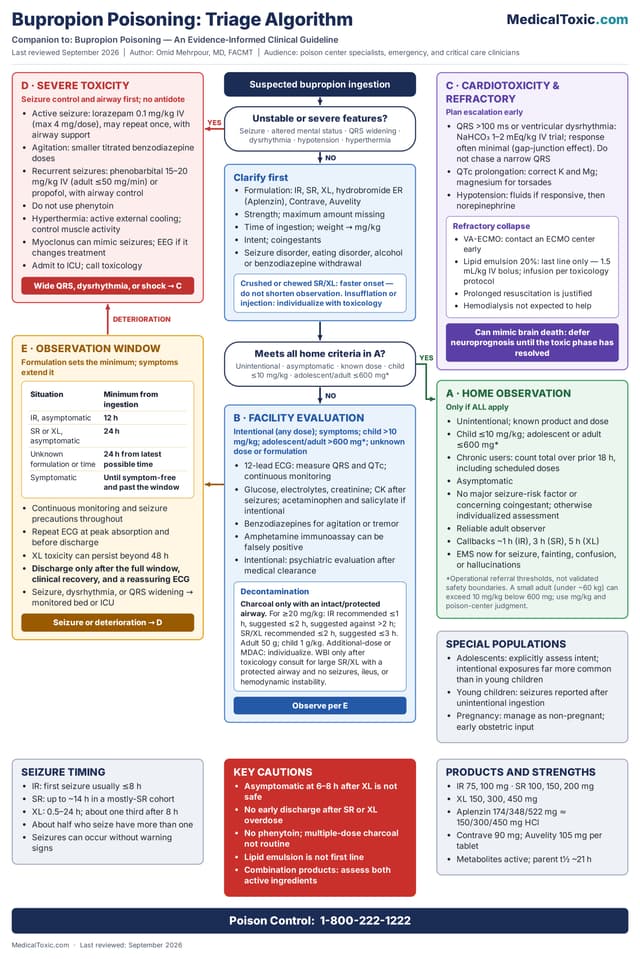
Unstable or severe features? Seizure, altered mental status, dysrhythmia, QRS widening, hypotension, or hyperthermia → emergency department now; treat seizures and airway first.
Clarify the exposure: product, formulation (IR, SR, XL, hydrobromide ER, combination), strength, maximum amount missing, time, weight, intent, and coingestants.
Meets home criteria? Unintentional, asymptomatic, known dose ≤10 mg/kg in a child or ≤600 mg in an adolescent or adult, reliable observer, and meets all criteria in the Home Management section → home with poison center callbacks.
Otherwise refer: observe at least 12 h (IR) or 24 h (SR/XL or unknown formulation), with ECG and seizure precautions.
Severe toxicity: benzodiazepines, then phenobarbital or propofol; a bicarbonate trial for wide QRS, often with limited effect; escalate to lipid emulsion or VA-ECMO for refractory cardiovascular collapse.
Therapy or target | Dose or action | Key point |
|---|---|---|
Activated charcoal | 50 g adult; 1 g/kg child, up to 50 g | Only with an intact or protected airway. For ≥20 mg/kg: immediate-release recommended ≤1 h, suggested ≤2 h; modified-release recommended ≤2 h, suggested ≤3 h. Immediate-release beyond 2 h: suggested against (2D); otherwise individualize. [6] |
Benzodiazepines | Active seizure: lorazepam 0.1 mg/kg IV, max 4 mg per dose, may repeat once. Agitation: smaller titrated doses, adult lorazepam 1–2 mg, or midazolam | First line for agitation, tremor, and seizures; give an adequate first dose for an active seizure. [16] [Expert] |
Phenobarbital | 15–20 mg/kg IV, infused at ≤50 mg/min in adults | Second line for recurrent seizures; anticipate airway support. [Expert] |
Propofol | Infusion with airway control | Refractory seizures or status epilepticus. [Expert] |
Sodium bicarbonate | 1–2 mEq/kg IV bolus as a trial | Reasonable for significant QRS widening or ventricular dysrhythmia, especially if a sodium-channel-blocking coingestant is possible; response in isolated bupropion toxicity is often minimal. [9,15] |
Lipid emulsion 20% | 1.5 mL/kg IV bolus; subsequent infusion per toxicology or local ILE protocol | Last line when other therapies fail; neutral evidence in arrest. [8] |
VA-ECMO | Early referral to an ECMO-capable center | Refractory shock, recurrent ventricular dysrhythmia, or arrest. [Expert] |
Phenytoin | Do not use | Not effective for toxin-induced seizures. [Expert] |
Formulation determines time to peak and the observation window, so identify it on every call. [2,14]
Product | Strengths | Time to peak | Note |
|---|---|---|---|
Bupropion HCl immediate-release (IR) | 75, 100 mg | ~2 h | Dosed two to three times daily |
Bupropion HCl SR, including Zyban | 100, 150, 200 mg | ~3 h | Zyban is marketed for smoking cessation |
Bupropion HCl XL, Wellbutrin XL, Forfivo XL | 150, 300, 450 mg | ~5 h | Seizures reported up to 24 h after overdose [2] |
Bupropion hydrobromide ER, Aplenzin | 174, 348, 522 mg | ~5 h | Equivalent to 150, 300, 450 mg HCl; not mg-for-mg interchangeable |
Naltrexone/bupropion ER, Contrave | 8/90 mg | Extended | Weight-loss product; count the bupropion content |
Dextromethorphan/bupropion ER, Auvelity | 45/105 mg | Extended | Antidepressant; consider serotonergic coingestant effects |
Crushing or chewing may accelerate release and increase seizure risk. Do not shorten SR or XL observation because tablets were altered. Individualize insufflation or injection exposures with toxicology. [14] [Expert]
Metabolism: hepatic. CYP2B6 forms hydroxybupropion; threohydrobupropion and erythrohydrobupropion arise through carbonyl reduction. All three metabolites are active. [14]
Half-life: parent about 21 hours; metabolites roughly 20–37 hours. Metabolite exposure exceeds parent exposure and may prolong toxicity. [14]
Distribution: large volume of distribution and about 84% protein binding, so extracorporeal removal is not expected to help. [14] [Expert]
Interaction: bupropion inhibits CYP2D6, which can raise concentrations of coingested tricyclics, some beta-blockers, and antipsychotics. [14]
Overdose kinetics: large SR or XL ingestions can form pharmacobezoars and prolong absorption. [12] [Expert]
CNS: inhibition of norepinephrine and dopamine reuptake lowers the seizure threshold and produces agitation, tremor, hallucinations, and seizures.
Sympathomimetic: tachycardia, hypertension, mydriasis, and hyperthermia.
Cardiac: QRS widening appears to result mainly from inhibition of gap-junction intercellular coupling rather than fast sodium-channel blockade, which explains the poor response to bicarbonate. QTc prolongation is associated with IKr (hERG) potassium-channel blockade. [9,15]
Refer children after >10 mg/kg and adolescents or adults after >600 mg; these are operational referral thresholds, not validated safety boundaries. [4] [Operational]
Population | Refer to a healthcare facility if | Basis |
|---|---|---|
Child, unintentional | >10 mg/kg, any symptom, or unknown dose | In 407 children under 6 years, isolated ingestions ≤10 mg/kg rarely needed facility care. [4] |
Adolescent or adult, unintentional | >600 mg, any symptom, or unknown dose | Operational referral threshold. The XL seizure-timing cohort enrolled only adults at ≥600 mg, so it does not establish 600 mg as a toxicity threshold. [2] [Operational] |
Any age, intentional or malicious | Any amount | Intent predicts severity; adolescents have more seizures than young children. [5] |
Any age, misuse by insufflation or injection | Any symptom or large amount | Onset may be rapid; individualize with toxicology. [Expert] |
A small adult, under about 60 kg, can exceed 10 mg/kg below 600 mg. Use poison center judgment and consider the mg/kg dose. [Expert]
An extra therapeutic dose in an adult on chronic therapy, with a total under 600 mg and no symptoms, can usually be managed at home. Count the total bupropion over the preceding ~18 hours, including scheduled doses, not the extra dose alone; for example, a second 450 mg XL dose in a patient on 450 mg daily is 900 mg. [17] [Expert]
This is not a guarantee against seizures: in 637 adult therapeutic errors, most managed at home, four patients seized after reported doses of 600–3,000 mg, with onset up to 21.5 hours. [17]
Dose correlates only loosely with outcome. In adolescents and adults with XL overdose, median dose was 4,350 mg in those who seized and 2,400 mg in those who did not, with wide overlap. [2]
Exact product, formulation, and strength; maximum amount missing
Time of ingestion, or the latest possible time if unknown
Weight, age, and intent
Coingestants, especially other serotonergic, sympathomimetic, or seizure-threshold-lowering drugs
Seizure disorder, eating disorder, or alcohol or benzodiazepine withdrawal, all of which raise seizure risk
Symptoms so far: tremor, agitation, hallucinations, vomiting, palpitations, seizure
Treatments already given
Seizures occurred in about one third of hospitalized XL overdoses, and about half of those patients had more than one seizure. [2]
Severity | Typical findings |
|---|---|
Mild | Sinus tachycardia, tremor, agitation, nausea or vomiting, dizziness, mild hypertension |
Moderate | Single or self-limited seizure, hallucinations, marked agitation, persistent tachycardia |
Severe | Recurrent seizures or status epilepticus, coma, hyperthermia, QRS widening, QTc prolongation, ventricular dysrhythmia, hypotension, cardiac arrest |
IR: first seizures usually within 8 hours. [3]
SR: delayed seizures can occur; in a cohort largely involving sustained-release products, first seizures occurred as late as 14 hours. [3]
XL: first seizures from 0.5 to 24 hours; about one third after 8 hours. [2]
Myoclonus is common in severe poisoning and may be mistaken for ongoing seizures; use EEG when the distinction changes treatment. [Expert]
ECG on arrival and repeated with symptoms, at peak absorption, and before discharge. Measure QRS and QTc. [Expert]
Continuous cardiac monitoring and seizure precautions for the full observation period.
Laboratory tests: glucose, electrolytes, creatinine, CK after seizures or agitation, and acetaminophen and salicylate levels if intentional. [Expert]
Serum bupropion concentrations are not available quickly enough to guide care.
Urine drug screen: bupropion metabolites can cause false-positive amphetamine immunoassays; confirm before acting on the result. [10]
Temperature and mental status at least hourly while symptomatic. [Expert]
No antidote exists. Treatment is seizure control, airway protection, and support of cardiovascular function. [Expert]
Activated charcoal (CTRC 2026): for ingestions ≥20 mg/kg, single-dose charcoal is recommended (1D) within 1 h and suggested (2D) up to 2 h after immediate-release, and recommended (1D) within 2 h and suggested (2D) up to 3 h after modified-release (SR, XL). For immediate-release ingestion beyond 2 h, CTRC suggests against single-dose charcoal (2D); in other scenarios outside these windows, individualize. No published clinical study has shown benefit specifically in bupropion poisoning. Dose: 50 g adult; 1 g/kg child, up to 50 g. [6]
Airway first: give charcoal only with an intact or protected airway. Many patients seize without warning, so weigh aspiration risk before every dose. [6]
Additional-dose and multiple-dose charcoal require individualized risk assessment under CTRC; neither is routine. Consider only with toxicology input, for example with suspected ongoing absorption after a large XL ingestion. [6]
Do not intubate solely to give charcoal in a patient not expected to develop significant toxicity. [6]
Whole bowel irrigation is not routine. Consider it after toxicology consultation for a large SR or XL ingestion when the airway is protected and there is no seizure activity, ileus, or hemodynamic instability. [7]
Endoscopic removal of pharmacobezoars has been described in massive ingestions above 10 g. In a six-patient series, gastroscopy within about 6 hours recovered several grams of active drug, while material retrieved after 24 hours contained little. Consider only with toxicology and gastroenterology input. [12]
Do not induce emesis. Routine gastric lavage is not recommended. [Expert]
Benzodiazepines are first line for agitation, tremor, and seizures. For an active seizure, give lorazepam 0.1 mg/kg IV, maximum 4 mg per dose, and repeat once if needed, with airway support; titrate smaller doses separately for agitation. [16] [Expert]
For recurrent seizures, add phenobarbital 15–20 mg/kg IV, adult infusion rate ≤50 mg/min, or propofol, with airway support. [Expert]
Do not use phenytoin; it is not effective for toxin-induced seizures. [Expert]
Treat hyperthermia with active external cooling and control of muscle activity. [Expert]
QRS >100 ms or ventricular dysrhythmia: a trial of sodium bicarbonate 1–2 mEq/kg IV is reasonable, particularly when a sodium-channel-blocking coingestant cannot be excluded. In a multicenter retrospective cohort, bicarbonate produced little or no QRS narrowing in bupropion poisoning. [15]
Do not escalate bicarbonate to chase a narrow QRS; repeated doses risk alkalemia, hypernatremia, and hypokalemia, which can worsen QT prolongation. [Expert]
QTc prolongation: correct potassium and magnesium; give magnesium for torsades. [Expert]
Hypotension: fluids if volume responsive, then norepinephrine. [Expert]
Tachycardia and hypertension usually respond to benzodiazepine sedation. [Expert]
Lipid emulsion: the Lipid Emulsion Workgroup suggests against it as first line, suggests it only if other therapies fail, and is neutral in cardiac arrest. [8]
VA-ECMO: contact an ECMO-capable center early for refractory shock, recurrent ventricular dysrhythmia, or arrest, rather than after prolonged resuscitation. [Expert]
Prolonged resuscitation is justified; recovery after prolonged arrest has been reported. [Expert]
Hemodialysis is not expected to remove meaningful amounts because of the large volume of distribution. [Expert]
Observe referred patients for at least 12 hours after immediate-release and at least 24 hours after SR, XL, or unknown formulations, and until symptom-free. [2,3] [Operational]
Situation | Minimum observation | Discharge when |
|---|---|---|
IR, above threshold, asymptomatic | 12 h from ingestion | No symptoms, normal ECG, reliable follow-up |
SR or XL, above threshold, asymptomatic | 24 h from ingestion | No symptoms, normal ECG |
Unknown formulation or unknown time | 24 h from the latest possible ingestion time | No symptoms, normal ECG |
Any intentional ingestion | As above by formulation, and 24 h if uncertain | Medically clear, then psychiatric evaluation |
Symptomatic | Until symptom-free and past the formulation window | XL effects may persist beyond 48 h [Expert] |
Seizure, dysrhythmia, QRS widening, or unstable | Admit to a monitored bed or ICU | Clinical recovery |
These periods are MedicalToxic operational minimums. Published practice varies; some poison centers observe immediate-release ingestions for 8 hours. [11] [Operational]
There is no validated seizure-risk percentage to support earlier discharge after an SR or XL overdose. [2]
Home observation is appropriate only when all of these apply:
unintentional ingestion;
known product and dose at or below threshold;
for chronic users, total over the preceding ~18 hours including scheduled doses is at or below threshold;
no symptoms;
no major seizure-risk factor such as seizure disorder, eating disorder, or alcohol or sedative withdrawal;
no concerning coingestant, otherwise obtain individualized poison-center assessment;
reliable adult observer.
Suggested callbacks, timed to peak absorption:
approximately 1 hour after IR;
approximately 3 hours after SR;
approximately 5 hours after XL ingestion.
[Operational]
Advise immediate EMS for:
seizure;
fainting;
confusion;
hallucinations.
Return precautions:
tremor;
agitation;
vomiting;
racing heart.
Young children: most exposures are exploratory. Seizures have occurred in children after unintentional ingestion, so apply the 10 mg/kg threshold strictly. [2,4,13]
Adolescents: explicitly assess intent; intentional exposures are much more common than in young children, with more seizures and prolonged tachycardia. [5]
Pregnancy: no pregnancy-specific threshold exists. Manage as for non-pregnant patients, prioritize maternal seizure control, and involve obstetrics early. [Expert]
Misuse: insufflated or injected crushed tablets cause rapid-onset toxicity, including seizures. [Expert]
An asymptomatic patient 6–8 hours after an XL overdose is still at risk of a first seizure. [2]
Seizures can occur without preceding tremor, agitation, or tachycardia. [2]
A false-positive amphetamine screen is not proof of amphetamine use. [10]
Severe poisoning can look like brain death; defer neuroprognosis until the drug has cleared. [Expert]
In combination products such as Contrave and Auvelity, count the bupropion and assess the second active ingredient separately. [Expert]
Therapy | Position |
|---|---|
Phenytoin | Do not use for toxin-induced seizures. [Expert] |
Multiple-dose activated charcoal | Not routine; CTRC requires individualized risk assessment. [6] |
Repeated bicarbonate to normalize QRS | Unlikely to work in isolated bupropion toxicity; risks alkalemia and hypokalemia. [15] [Expert] |
Induced emesis | Never. [Expert] |
Routine gastric lavage | Not recommended. [Expert] |
Hemodialysis | Not expected to be effective. [Expert] |
Lipid emulsion as first line | Suggested against. [8] |
No randomized trials guide bupropion poisoning treatment.
Referral thresholds come from retrospective poison center series, and seizure timing comes from one multicenter observational study of XL overdose. [2,4]
Lipid emulsion and ECMO evidence is limited to case reports and consensus. [8]
Recommendations labeled [Expert] or [Operational] should be applied with poison center or medical toxicology input.
Keep reading