Organophosphate Poisoning: Recognition, Atropine, Oximes, and Emergency Management
Published on 21 Sept 2026 · Updated 02 Oct 2026

Published on 21 Sept 2026 · Updated 02 Oct 2026
 Medical Toxicologymedicaltoxic.com
https://medicaltoxic.com/guidelines/organophosphate-poisoning
This is an evidence-informed guideline, not a systematic evidence-based guideline. It synthesizes current guidance and key supporting evidence for clinicians managing acute organophosphorus (OP) insecticide poisoning in emergency, critical care, prehospital, and poison-center settings.
Military nerve agents are outside the scope of this guideline.
Version 2.0 · Revised September 2026 · Next scheduled review September 2027
No new systematic review, de novo literature-search protocol, or independent GRADE appraisal of individual recommendations was undertaken for this document. Recommendations are drawn from the primary sources cited below and are graded only when those sources themselves assigned an evidence grade or recommendation strength. Where guidance conflicts or the supporting evidence is limited, this is stated explicitly rather than presenting uncertain recommendations as settled.
Source | Role in this guideline |
|---|---|
AHA 2025 Part 10, Special Circumstances of Resuscitation [1] | Principal source for atropine, oxime, airway, benzodiazepine and decontamination recommendations, adult and pediatric |
Clinical Toxicology Recommendations Collaborative, activated charcoal, 2026 [4] | Primary source for activated-charcoal recommendations |
Eddleston & Chowdhury 2016, pharmacological treatment review [3] | Atropine titration practice, obidoxime, compound-specific variation |
Eddleston et al. 2008, Lancet seminar [9] | Atropinization endpoints, cumulative atropine requirement, resource-limited practice |
Worek et al. 2005 [5] | Cholinesterase assay interpretation |
AHA Class of Recommendation (COR) and Level of Evidence (LOE), used for recommendations attributed to [1]:
Class 1 — strong; benefit >>> risk; “is recommended”
Class 2a — moderate; benefit >> risk; “is reasonable”
Class 3: No Benefit — no demonstrated benefit; “is not recommended”
Level A — high-quality evidence from more than one RCT or meta-analysis
Level B-R — moderate-quality evidence from randomized studies
Level B-NR — moderate-quality evidence from non-randomized studies
Level C-LD — limited data; observational studies, registries, or mechanistic reasoning
Level C-EO — consensus of expert opinion based on clinical experience
CTRC grading, used only in the activated-charcoal section, is reported as strength and certainty:
Strength 1 — recommend
Strength 2 — suggest
Certainty A — high
Certainty B — moderate
Certainty C — low
Certainty D — very low
Thus, “2, D” means a suggestion, or weak recommendation, based on very-low-certainty evidence; clinicians may reasonably decline it in an individual patient.
This guideline does not replace institutional protocols, regional poison-center advice, or bedside clinical judgment. For any significant or uncertain exposure, consult a poison center or medical toxicologist. In the United States, call 1-800-222-1222.
Dose figures are stated with their source. Where source recommendations conflict with established toxicology practice or published clinical experience, this document identifies the discrepancy and provides a practical clinical synthesis — see Atropine Maintenance.
Clinical warning
Life-threatening organophosphate insecticide poisoning is a respiratory and cholinergic emergency. Administer atropine immediately when clinically indicated; do not delay atropine, airway support, ventilation, or resuscitation while waiting for product identification, cholinesterase testing, oxime preparation, decontamination, or activated charcoal.
Atropine treats muscarinic toxicity but does not reverse nicotinic paralysis. A patient whose bronchorrhea is improving but whose neck flexion, tidal volume, or respiratory effort is worsening still requires ventilatory assessment and support.
Avoid succinylcholine and mivacurium. Butyrylcholinesterase inhibition can prolong their neuromuscular blockade for hours.
Immediate atropine and airway/ventilatory support are central to management of life-threatening OP insecticide poisoning. Benzodiazepines are first-line for seizures and severe agitation; pralidoxime is reasonable but its clinical benefit is inconsistent. Apparent recovery at 24 hours does not exclude intermediate syndrome with respiratory-muscle weakness developing over the next 24–96 hours.
Recognize the combined muscarinic, nicotinic and CNS pattern rather than relying on a single mnemonic. Miosis may be absent and tachycardia does not exclude severe poisoning. [1] [3]
Give atropine immediately in life-threatening cholinergic toxicity — Class 1, Level A. Adults: 1–2 mg IV/IO, doubled every 5 minutes; children: 0.02 mg/kg IV/IO, doubled every 5 minutes, with each pediatric dose not exceeding the corresponding adult dose at the same escalation step. [1]
Titrate to the chest and the circulation, not the pupils. The endpoints are clearing bronchorrhea and bronchospasm with adequate perfusion. Persistent miosis is not an indication to keep escalating. [1] [3] [9]
Expect to use far more atropine than in bradycardia management. Cumulative doses of tens to hundreds of milligrams in the first 24 hours are well described in severe poisoning. Underdosing is the common error in the first hour. [3] [9]
Atropine does not reverse nicotinic paralysis. A patient with a drying chest but failing neck flexion or tidal volume still needs ventilatory support. [1]
Intubate early when respiratory status is threatened — Class 1. [1]
Avoid succinylcholine and mivacurium; butyrylcholinesterase inhibition can prolong their block for hours. [1]
Pralidoxime is reasonable in life-threatening OP insecticide poisoning, Class 2a, but oxime efficacy is compound-, dose- and timing-dependent, and randomized evidence has not demonstrated a mortality benefit. Do not let oxime preparation delay atropine or the airway. [1] [6]
Benzodiazepines are first-line for OP insecticide-associated seizures and severe agitation. [1]
Protect yourself first. Use appropriate PPE, remove contaminated clothing, and wash skin with soap and copious water; secondary contamination of unprotected staff is documented. [1] [2]
Cholinesterase assays support the diagnosis but never gate treatment and should not be the sole discharge criterion. [5]
Keep watching after the crisis resolves. Intermediate syndrome typically emerges 24–96 hours after exposure with neck-flexor, proximal and respiratory-muscle weakness. [7]
Delayed polyneuropathy may follow selected OP compounds after 1–3 weeks or longer; there is no antidote once established. [8]
The specific compound changes the clinical course, so identify the product — but never delay treatment to do it.
Clinically important OP insecticide poisoning most often follows intentional pesticide ingestion, accidental ingestion, occupational mixing or spraying, dermal contamination, inhalation of aerosol or vapor, contact with contaminated clothing or equipment, or agricultural and industrial spills.
Individual OP insecticides differ in lipid solubility, potency, rate of acetylcholinesterase aging, duration of absorption and responsiveness to oximes. Highly lipophilic agents such as fenthion may produce delayed-onset, prolonged toxicity requiring days to weeks of atropine. Commercial formulations also contain solvents and surfactants that contribute independently to aspiration pneumonitis and hypotension. [3]
Many organophosphorus insecticides are thions (P=S) that require metabolic conversion to the active oxon (P=O). The rate of bioactivation differs substantially among compounds and can contribute to delayed or prolonged toxicity; highly lipophilic agents may additionally redistribute from tissue stores and cause recurrent cholinergic toxicity. [3] [9]
Product name, active ingredient, formulation and concentration
Safety Data Sheet or pesticide label where available
Route, estimated amount, and time and duration of exposure
Single versus repeated or prolonged exposure
Intentional versus accidental exposure
Possible co-ingestants, including ethanol
Prehospital atropine or oxime already given
Whether other workers or family members were exposed
OP insecticides phosphorylate the active site of acetylcholinesterase, preventing hydrolysis of acetylcholine and producing muscarinic, nicotinic and central overstimulation.
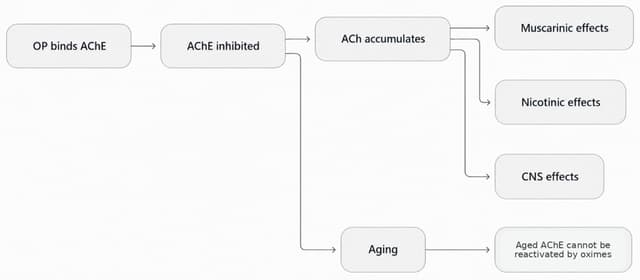
Read the pathway left to right: enzyme inhibition drives the toxidrome along parallel receptor pathways, while a separate time-dependent process, aging, progressively closes the therapeutic window for oximes.
After phosphorylation, the OP–enzyme complex loses an alkyl group and becomes irreversibly bound — aging. Once aged, oxime-mediated reactivation is no longer possible.
Aging kinetics vary substantially among organophosphorus insecticides. Acetylcholinesterase inhibited by many dimethyl OPs has an aging half-time of approximately 3–4 hours, whereas aging after many diethyl OPs is substantially slower, approximately 30–33 hours. These differences contribute to compound- and time-dependent variation in oxime responsiveness. [3] [9]
Two processes prolong illness beyond the initial inhibition.
First, continuing absorption — particularly from the lower gastrointestinal tract after ingestion, and from fat stores with lipophilic agents — re-inhibits enzymes that oxime has reactivated.
Second, endogenous enzyme regeneration is slow, taking weeks in untreated patients.
Both explain why atropine and oxime requirements can persist for days. [3] [9]
For broader mechanistic context, see How Mechanistic Medical Toxicology Is Shaping Next-Generation Patient Care.
The diagnosis rests on recognition of a compatible cholinergic pattern involving muscarinic, nicotinic, and/or central manifestations rather than any single sign.
Receptor class | Features | Responds to atropine? |
|---|---|---|
Muscarinic | Bronchorrhea, bronchospasm, bradycardia, salivation, lacrimation, diaphoresis, miosis, vomiting, diarrhea, abdominal cramping, urinary incontinence | Yes |
Nicotinic | Fasciculations, cramps, proximal weakness, respiratory-muscle weakness, progressive paralysis, tachycardia, hypertension, sometimes mydriasis | No |
Central | Anxiety, agitation, confusion, altered consciousness, seizures, coma, central apnea | Partially; seizures require benzodiazepines |
Bronchorrhea and bronchospasm deserve particular emphasis because they directly threaten oxygenation and are the findings that atropine reverses most reliably. [1]
Muscarinic stimulation slows the heart while nicotinic stimulation at sympathetic ganglia accelerates it. The two may cancel, so heart rate alone neither confirms nor excludes severe poisoning. The same competition applies to pupil size.
Children may present without a classic excitation prodrome. Seizures, apnea, or flaccid weakness can be the first manifestation, and CNS depression tends to predominate over the peripheral features seen in adults. [1]
Respiratory failure in severe OP insecticide poisoning is usually multifactorial, and atropine addresses only part of it.
Mechanism | Reversed by atropine? | Primary treatment |
|---|---|---|
Bronchorrhea | Yes | Atropine, titrated to a clear chest |
Bronchospasm | Yes | Atropine; bronchodilators as adjunct |
Central respiratory depression or apnea | No | Ventilatory support |
Nicotinic respiratory-muscle weakness | No | Ventilatory support; oxime may help |
Aspiration | No | Airway protection, supportive care |
Intermediate syndrome, delayed | No | Ventilatory support |
The practical consequence: a patient whose secretions are drying but whose neck flexion, tidal volume or respiratory effort is deteriorating is not improving. Escalating atropine further will not correct neuromuscular failure. [1]
Assessment and resuscitation run in parallel; history-taking never precedes atropine in a patient with life-threatening cholinergic toxicity.
Assess:
airway patency;
work of breathing;
volume of respiratory secretions;
bronchospasm;
oxygenation and ventilation;
mental status;
heart rate and rhythm;
blood pressure and perfusion;
muscle strength, particularly neck flexion;
fasciculations;
pupil size;
temperature.
Use continuous cardiac monitoring, continuous pulse oximetry and frequent structured reassessment. Capnography is useful where hypoventilation is suspected.
Beyond the product details above, establish:
vomiting before arrival;
respiratory symptoms;
excessive secretions;
fasciculations or weakness;
seizure or loss of consciousness;
occupational circumstances, including mixing concentrate, spraying, re-entry to treated areas, and handling contaminated equipment;
psychiatric context in suspected intentional exposure.
Individualize, but consider:
arterial or venous blood gas;
electrolytes and bicarbonate;
glucose;
creatinine;
hepatic panel;
lactate where shock or severe respiratory failure is present;
creatine kinase where prolonged seizures or major muscle injury have occurred;
red-cell acetylcholinesterase where available;
plasma butyrylcholinesterase.
Obtain an ECG. QTc prolongation and, less commonly, polymorphic ventricular tachycardia have been reported in OP insecticide poisoning, and many of these patients receive other QT-prolonging drugs.
No laboratory result replaces bedside assessment, and none should delay atropine.
Cholinesterase assays can support cholinesterase-inhibitor exposure; they do not determine treatment or disposition.
Assay | What it reflects | Practical limits |
|---|---|---|
Red-cell acetylcholinesterase | Structurally analogous to synaptic AChE; better proxy for biologically relevant inhibition | Often unavailable acutely; methods vary between laboratories; pre-exposure baseline almost never available |
Plasma butyrylcholinesterase | Easier and faster to measure; supports exposure | Correlation with severity varies substantially by compound and patient; falls with liver disease, pregnancy, malnutrition and genetic variants |
Low activity supports exposure.
Normal or near-normal activity does not justify withholding emergency therapy when the clinical syndrome fits cholinergic poisoning.
Serial measurements may help track recovery, but clinical trajectory governs management.
A single cholinesterase value must not be used as a stand-alone discharge criterion.
Requiring miosis. Nicotinic sympathetic effects, co-ingestants and advanced illness can leave pupils normal or dilated. Miosis is supportive, not necessary.
Excluding OP insecticide poisoning because of tachycardia. Nicotinic stimulation commonly produces tachycardia and hypertension despite severe muscarinic toxicity. Tachycardia is not a reason to stop atropine.
Using a dry mouth as the atropinization endpoint. The target is the lower airway and circulation, not the oral mucosa.
Reading persistent weakness as under-treated bronchorrhea. Atropine has no effect at the neuromuscular junction; escalating it for weakness adds antimuscarinic toxicity without benefit.
Waiting for a cholinesterase result. Treat the syndrome.
Consider:
carbamate poisoning;
nicotine and neonicotinoid toxicity;
muscarinic Inocybe or Clitocybe mushroom poisoning;
opioid poisoning;
sedative-hypnotic intoxication;
pyrethroid poisoning;
primary aspiration;
myasthenic crisis;
Guillain–Barré syndrome.
Carbamylation of acetylcholinesterase is spontaneously reversible and does not age, so carbamate poisoning is typically shorter-lived.
Atropine remains the primary antidote.
The AHA notes that evidence is insufficient to recommend oximes for carbamate poisoning, but oximes should not be withheld solely because it is unclear whether the exposure was an OP or a carbamate in a life-threatening cholinesterase-inhibitor syndrome. [1]
Severe OP insecticide poisoning requires parallel resuscitation, not a sequential ladder. The sequence below is a priority ordering, not a set of steps to complete one at a time.
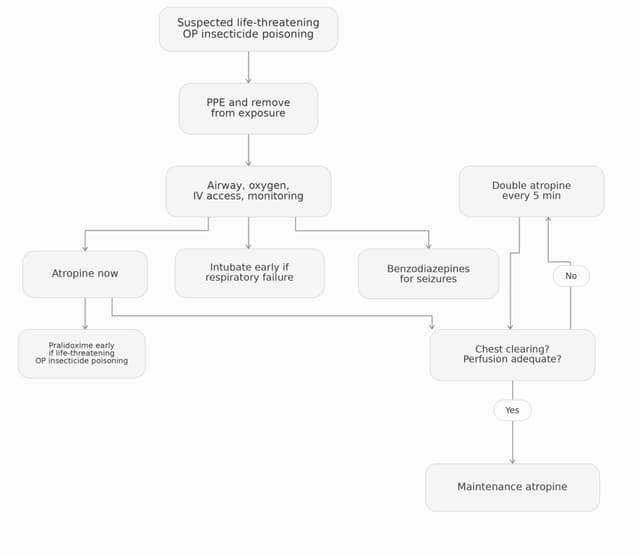
Atropine and airway management proceed together; oxime, decontamination and charcoal are downstream of both and must never delay them.
Protect healthcare personnel with appropriate PPE.
Remove the patient from ongoing exposure.
Support airway, ventilation and circulation.
Give atropine immediately when clinically indicated.
Intubate early when respiratory failure is developing.
Treat seizures and severe agitation with benzodiazepines.
Decontaminate external pesticide using protected personnel.
Consider pralidoxime early in life-threatening OP insecticide poisoning.
Reassess repeatedly for recurrent cholinergic toxicity and evolving neuromuscular weakness.
Monitor for intermediate syndrome and delayed neurological complications.
For broader management of critically poisoned patients, see Comprehensive Guide to Managing Poisoning in the Intensive Care Unit: Best Practices and Protocols.
Place the Organophosphate Poisoning clinical infographic here — after the 10-point priority sequence and before Responder Safety and Decontamination.
The AHA recommends appropriate PPE when caring for patients with life-threatening OP insecticide or carbamate exposure; secondary symptoms in unprotected healthcare workers have been reported. [1]
PPE requirements depend on the physical form of the pesticide, extent of dermal contamination, aerosolization, compound potency, quantity involved, ventilation, and local hazardous-materials protocols.
Do not create additional casualties by entering a contaminated environment without appropriate protection.
For significant external contamination:
Remove all contaminated clothing and contain it appropriately.
Wash skin and hair thoroughly with soap and copious water.
Irrigate contaminated eyes with clean water or isotonic saline.
Prevent wash runoff from contaminating staff or other patients.
Maintain protective barriers throughout.
Decontamination proceeds concurrently with life-saving resuscitation and must not delay atropine or airway management. [1] [2]
Avoid hypochlorite and other harsh agents on skin; soap and water is both effective and safe. Do not scrub abraded skin, which increases absorption.
Early endotracheal intubation is recommended, Class 1, for adults and children with life-threatening OP insecticide or carbamate poisoning when respiratory status is threatened.
Observational data suggest that patients intubated earlier have shorter durations of mechanical ventilation than those intubated later; whether this reflects prevention of aspiration pneumonia, differences in the pathophysiology of respiratory failure, or other factors is uncertain. [1]
Inability to protect the airway
Uncontrolled bronchorrhea
Severe bronchospasm
Hypoventilation
Progressive respiratory-muscle weakness
Severe altered consciousness
Recurrent seizures
Apnea
Do not wait for profound hypoxemia when progressive weakness is evident. Declining neck flexion and a weak cough are earlier and more reliable warnings than oxygen saturation.
Avoid succinylcholine and mivacurium — AHA Class 3: No Benefit, C-EO.
Both depend on butyrylcholinesterase for metabolism, and their neuromuscular blockade may be prolonged for hours in OP insecticide poisoning. [1]
Use a non-depolarizing agent metabolized independently of cholinesterase — rocuronium is a commonly used choice — according to institutional airway practice.
Expect copious secretions and high airway resistance early; frequent suctioning is often needed.
Avoid routine hyperventilation.
Standard lung-protective ventilation applies where aspiration pneumonitis or ARDS develops.
Atropine is the core antidote and carries a Class 1, Level A recommendation in life-threatening OP insecticide or carbamate poisoning. It should be administered immediately in life-threatening cholinergic toxicity. [1]
Atropine competitively antagonizes muscarinic acetylcholine receptors, improving:
bronchorrhea;
bronchospasm;
bradycardia;
muscarinic hypotension;
secretions.
It has no effect on:
fasciculations;
neuromuscular paralysis;
nicotinic respiratory-muscle weakness. [1]
Patient | Initial dose | Escalation |
|---|---|---|
Adult | 1–2 mg IV/IO | Double every 5 min until adequate atropinization |
Child | 0.02 mg/kg IV/IO | Double every 5 min; each pediatric dose should not exceed the corresponding adult dose at the same escalation step |
The AHA recommends 0.02 mg/kg IV/IO, doubled every 5 minutes until adequate atropinization, with pediatric doses not exceeding the corresponding adult dose at the same escalation step.
Some toxicology references describe 0.05 mg/kg as an initial pediatric dose; this guideline follows the AHA 2025 regimen and emphasizes rapid dose escalation to clinical endpoints. [1] [13]
Titrate to the chest and circulation:
Clear chest on auscultation — resolution of bronchorrhea and bronchospasm. This is the primary endpoint.
Adequate perfusion, with systolic blood pressure improving above approximately 80 mmHg in adults.
Heart rate improving above approximately 80/min in adults. [1] [9]
In children, interpret heart rate and blood pressure against age-appropriate norms and treatment response rather than fixed adult thresholds.
Do not titrate to pupil size.
Miosis resolves slowly, may be affected by local ocular exposure, and is an unreliable endpoint. Continuing to escalate atropine to normalize pupils produces antimuscarinic toxicity without benefit. [3]
Do not stop for tachycardia.
Tachycardia frequently originates from nicotinic stimulation by the poison itself, not from atropine, and is not a contraindication to further atropine in a patient with ongoing bronchorrhea.
Severe poisoning commonly requires cumulative doses far exceeding those familiar from bradycardia management.
Tens of milligrams within the first few hours is routine; totals exceeding 100 mg in the first 24 hours are well described, and cumulative doses of several grams over days to weeks have been reported with lipophilic compounds. [3] [9]
In the first hour, underdosing is the more dangerous error in a patient with life-threatening bronchorrhea.
Two figures circulate, and they are not compatible in severely poisoned patients:
Approach | Figure | Behavior at a 50 mg load |
|---|---|---|
Proportional rule — toxicology practice | 10–20% of dose required for initial atropinization per hour | 5–10 mg/h |
AHA antidote table — adults | 10–20% of total loading dose/h, capped at 2 mg/h | 2 mg/h AHA cap |
Maintenance infusion: AHA 2025 Table 4 lists 10–20% of the total atropine loading dose per hour, capped at 2 mg/h in adults. Toxicology treatment protocols commonly use approximately 10–20% of the atropine dose required for initial atropinization per hour and titrate to recurrent muscarinic toxicity; in severely poisoned patients this may exceed 2 mg/h.
Because these approaches differ, bedside clinical response should govern dosing, with additional atropine boluses for recurrent bronchorrhea, bronchospasm, bradycardia, or hypotension. [1] [3] [9]
For pediatric maintenance, use a poison-center, medical-toxicology or institution-specific protocol rather than extrapolating a fixed adult rate.
After initial resuscitation, watch for:
delirium;
agitation;
hyperthermia;
urinary retention;
absent bowel sounds;
ileus;
excessive tachycardia.
Hyperthermia in a patient who is also paralyzed or sedated is easily missed and can be fatal.
Continue atropine as long as muscarinic features recur.
After prolonged high-dose therapy, taper gradually rather than stopping abruptly, and reinstate if cholinergic features return.
Abrupt discontinuation after days of high-dose therapy is a recognized cause of rebound bronchorrhea. [3] [9]
Pralidoxime is reasonable, Class 2a, in adults and children with life-threatening OP insecticide poisoning, but it is an adjunct to atropine and airway management, never a substitute. [1]
Oximes reactivate phosphorylated acetylcholinesterase before aging occurs and may improve nicotinic features, including skeletal and respiratory-muscle weakness — the part of the syndrome atropine cannot reverse.
Patient | Loading dose | Maintenance |
|---|---|---|
Adult | 2 g IV over 15–30 min | 1 g/h infusion |
Child | 20–50 mg/kg IV over 15–30 min | 10–20 mg/kg/h infusion |
The pediatric dose should not exceed the corresponding adult dose.
An adult intramuscular option of 0.6 g, up to three doses, exists where IV access is unavailable or in mass-casualty settings. [1]
Pediatric maintenance figures vary between sources; some references cite 5–10 mg/kg/h. The AHA figures are used here, and pediatric evidence is substantially extrapolated from adult data. Verify against the institutional protocol.
Do not give pralidoxime by rapid IV push.
Rapid administration causes hypertension, and laryngospasm, muscle rigidity and cardiac arrest have been reported.
Infuse the loading dose over 15–30 minutes, and slow or stop the infusion if marked hypertension develops.
The source guidance specifies a loading dose and infusion rate but no discontinuation criterion. The following reflects standard toxicology practice rather than a graded recommendation.
Continue oxime infusion while any of the following persist:
ongoing atropine requirement;
fasciculations or muscle weakness;
continued mechanical ventilation attributable to the poisoning.
A reasonable stopping point is at least 12–24 hours after the patient is free of cholinergic features and no longer requires atropine.
Because lipophilic compounds and continued gastrointestinal absorption cause re-inhibition of reactivated enzyme, oxime may need to continue for several days, and recurrence after discontinuation should prompt reinstatement.
Discuss duration with a poison center or medical toxicologist. [3] [9]
Obidoxime is used in parts of Europe as an alternative reactivator.
A described adult regimen is:
250 mg IV over approximately 30 minutes, followed by approximately 30 mg/h continuous infusion. [3]
Availability, salt formulation and approved labeling differ by country.
Do not substitute obidoxime for pralidoxime by milligram equivalence.
Use the locally stocked formulation and a regional protocol.
No pediatric obidoxime regimen is recommended in this guideline.
The biological rationale for oximes is strong; the clinical evidence is not.
A meta-analysis of three randomized trials cited in the AHA guideline did not demonstrate a mortality benefit, though the trials were heterogeneous and many used relatively low pralidoxime doses. [1]
Two trials comparing high-dose with low-dose regimens favored higher dosing. [1]
A 2020 systematic review and meta-analysis of six randomized trials involving 646 patients found no statistically significant reduction in mortality or ventilator requirement with pralidoxime, with substantial methodological variation between trials. [6]
A placebo-controlled randomized trial of 235 symptomatic patients using pralidoxime 2 g followed by 0.5 g/h likewise found no improvement in survival or need for intubation; the trial was stopped early and should be interpreted alongside the heterogeneous oxime literature. [11]
Benefit plausibly depends on the specific compound, aging kinetics, timing of administration, dose, and re-inhibition from ongoing absorption. [1] [3]
The defensible bedside position: pralidoxime is reasonable in life-threatening OP insecticide poisoning under current AHA guidance and should be given early when chosen, but it must not be described as uniformly effective, and it never justifies any delay in atropine, oxygenation or ventilation.
Benzodiazepines are recommended for seizures and agitation in adults and children with life-threatening OP insecticide or carbamate poisoning; diazepam and midazolam are specifically cited. [1]
Treat toxin-induced status epilepticus promptly using established emergency seizure protocols.
Atropine alone does not terminate seizures.
Persistent seizure activity increases oxygen demand, lactate production, aspiration risk, hyperthermia and secondary neurological injury.
OP insecticide poisoning can produce:
bradycardia or tachycardia;
hypotension or transient hypertension;
conduction abnormalities;
dysrhythmias;
shock.
Atropine treats the muscarinic component but will not correct every hemodynamic abnormality.
Provide continuous ECG monitoring, isotonic fluid resuscitation where indicated, and vasopressor support for shock persisting after adequate volume resuscitation and atropinization.
Correct severe electrolyte and acid-base derangement.
QTc prolongation and torsades de pointes have been reported. Check magnesium and potassium, review concurrent QT-prolonging drugs, and treat torsades with magnesium sulfate per standard protocols.
When shock persists despite adequate atropinization, actively evaluate alternative causes:
hypovolemia;
aspiration pneumonitis;
solvent cardiotoxicity;
co-ingestants;
acute coronary events.
Several adjuncts appear in the literature and in local protocols. None is recommended as routine therapy, and none should displace atropine, airway management or oximes.
Therapy | Status |
|---|---|
Magnesium sulfate | Proposed to reduce acetylcholine release and ganglionic stimulation; small trials suggest possible benefit but evidence is insufficient to recommend routine use. Retains its standard indication for torsades de pointes. |
Clonidine | Proposed to reduce central acetylcholine synthesis; human evidence is limited to small studies. Not recommended routinely. |
Sodium bicarbonate | Studied for metabolic acidosis in OP insecticide poisoning with inconsistent results; no established role beyond standard correction of severe acidosis. |
Fresh frozen plasma / albumin | Proposed as a source of exogenous butyrylcholinesterase; evidence limited to small series. Not recommended routinely. |
Extracorporeal life support | The AHA addresses ECLS for poisoning generally; it may be considered in refractory cardiogenic shock or arrest at capable centers, as rescue rather than OP-specific therapy. [1] |
Hemodialysis / hemoperfusion | No established role for OP removal; not recommended. |
None of these should be started before atropine requirements, ventilation and oxime dosing have been fully optimized, and each should be discussed with a medical toxicologist.
The Clinical Toxicology Recommendations Collaborative reviewed activated charcoal across 43 poisons and found organophosphorus insecticides to be among those for which charcoal may be appropriate within a narrow early window and only when the airway is secure. [4]
A large Sri Lankan randomized trial of 4,632 self-poisoned patients, including a prespecified organophosphorus/carbamate pesticide subgroup, found no mortality benefit from routine single- or multiple-dose activated charcoal versus no charcoal. [12]
Time after ingestion | Recommendation | Grade |
|---|---|---|
≤2 hours | Suggest single-dose activated charcoal | 2, D |
2–6 hours | Individualized risk assessment | — |
>6 hours | Suggest against single-dose activated charcoal | 2, D |
Additional dose | Suggest against | 2, D |
Multiple-dose charcoal | Suggest against | 2, D |
Grades read as strength, certainty: 2 = suggestion, or weak recommendation; D = very-low certainty.
Every recommendation here rests on very-low-certainty evidence and may reasonably be declined in an individual patient. [4]
These weak recommendations reflect rapid absorption, frequent early vomiting, and the substantial aspiration risk intrinsic to this poisoning.
Never delay atropine, intubation, ventilation or resuscitation to administer charcoal.
Do not give charcoal to a patient with an unprotected airway when aspiration risk is unacceptable — which is most symptomatic patients with OP insecticide poisoning.
The CTRC adopted a good-practice statement that nasogastric or orogastric tube insertion for charcoal administration should not be performed without endotracheal intubation. [4]
Gastric lavage is not routinely recommended for organophosphorus insecticide ingestion. [14]
Intermediate syndrome is a delayed neuromuscular complication that emerges 24–96 hours after exposure, characteristically as the acute cholinergic crisis is resolving. [7]
Neck-flexor weakness
Proximal limb weakness
Cranial-nerve weakness
Impaired respiratory-muscle strength
Respiratory failure
Muscarinic features are typically no longer prominent when it develops, which is precisely what makes it dangerous — the patient appears to be recovering.
Ability to lift the head off the pillow — neck flexion is the earliest and most useful bedside sign
Cough strength
Bulbar function and swallow
Respiratory effort and tidal volume
Rising PaCO₂
New or increasing ventilatory requirement
Treatment is early recognition and ventilatory support.
There is no specific antidote, and atropine does not treat it.
Continue poison-center or medical-toxicology involvement and prevent aspiration and usual ICU complications.
The role of oximes in preventing or treating established intermediate syndrome remains uncertain. [7]
The disposition implication is direct: resolution of muscarinic features does not establish readiness for discharge after moderate or severe poisoning.
OPIDP is mechanistically distinct from both the acute cholinergic syndrome and intermediate syndrome.
It follows inhibition and aging of neuropathy target esterase, not acetylcholinesterase, and occurs only with selected OP compounds.
Onset is typically 1–3 weeks or longer after exposure, with:
distal paresthesia;
distal sensory abnormalities;
leg pain;
progressive weakness;
gait disturbance;
foot drop;
later upper-limb involvement in severe cases. [8]
There is no antidote that reverses established delayed neuropathy.
Management consists of neurological assessment, electrophysiological evaluation, rehabilitation planning and functional support.
Recovery is variable and often incomplete.
Syndrome | Onset | Pathophysiologic basis | Treatment |
|---|---|---|---|
Acute cholinergic crisis | Minutes–hours | Acetylcholinesterase inhibition | Atropine, oxime, airway |
Intermediate syndrome | 24–96 h | Persistent neuromuscular-junction dysfunction after severe cholinesterase inhibition; mechanism incompletely defined | Ventilatory support |
OPIDP | 1–3 weeks or later | Neuropathy target esterase inhibition and aging | Supportive care, rehabilitation |
Delayed CNS manifestations have been described but are far less predictable and rest largely on case reports.
A 2026 case report described a patient who recovered from cholinergic crisis and intermediate syndrome, then developed myoclonus 3–4 weeks later with bilateral globus pallidus signal abnormality on MRI. The authors explicitly stated that causality could not be established, and neither steroids nor IVIG were effective in that patient. [10]
Accordingly:
Bilateral globus pallidus abnormality is not a typical or expected imaging finding in OP insecticide poisoning and should not be presented as one.
Delayed myoclonus should not be attributed to OP exposure without a full neurological differential, including hypoxic-ischemic injury, metabolic causes and structural disease.
Steroids and IVIG are not standard treatment for delayed neurological toxicity after OP insecticide poisoning.
New neurological symptoms after apparent recovery warrant formal neurological reassessment, not extrapolation from isolated case reports.
There is no single validated observation period for every OP exposure.
Duration depends on:
compound;
route;
dose;
formulation;
lipid solubility;
intentional versus occupational context;
atropine requirement;
respiratory status;
neuromuscular findings;
recurrence of cholinergic features;
reliability of follow-up.
Appropriate for:
significant bronchorrhea or bronchospasm;
repeated high-dose atropine or atropine infusion;
respiratory-muscle weakness;
intubation;
oxygenation or ventilation failure;
seizures;
substantial altered mental status;
hemodynamic instability;
clinically important dysrhythmia;
evolving intermediate syndrome.
Continue monitored care where there is:
recurrent secretion burden;
unresolved absorption;
significant ingestion;
ongoing atropine requirement;
weakness or fasciculations;
unidentified compound;
concern for a lipophilic or long-acting agent;
abnormal respiratory mechanics.
Because intermediate syndrome develops 24–96 hours after poisoning, apparent resolution of muscarinic features does not establish readiness for discharge after moderate or severe poisoning. [7]
Patients with a nontrivial exposure who remain asymptomatic should generally be monitored for 6–12 hours.
Major toxicity is unlikely to first develop after 12 hours in most patients, but longer observation is appropriate for:
unidentified compounds;
lipophilic or slowly activated agents;
substantial dermal exposure;
intentional ingestion;
evolving cholinergic findings;
evolving neuromuscular findings. [15]
A truly trivial, well-characterized, non-intentional exposure may be managed outside the hospital after poison-center risk assessment.
Confirm, as clinically appropriate:
☐ No recurrent cholinergic symptoms
☐ No ongoing atropine requirement, with atropine successfully tapered rather than abruptly stopped
☐ Stable respiratory status and normal respiratory mechanics
☐ No progressive neck, proximal, bulbar or respiratory-muscle weakness
☐ Stable hemodynamics
☐ Able to ambulate and function appropriately
☐ Psychiatric evaluation completed after intentional poisoning
☐ Occupational safety plan in place where exposure occurred at work
☐ Explicit return instructions covering delayed weakness, sensory symptoms and other neurological change
Do not use a single cholinesterase result as a discharge criterion.
The 2025 AHA recommendations explicitly include children.
For life-threatening OP insecticide poisoning:
give atropine immediately;
intubate early when airway or breathing is threatened;
use benzodiazepines for seizures and severe agitation;
decontaminate using protected personnel;
pralidoxime is reasonable. [1]
Drug | Pediatric dose | Notes |
|---|---|---|
Atropine | 0.02 mg/kg IV/IO, doubled every 5 min | Each pediatric dose should not exceed the corresponding adult dose at the same escalation step |
Pralidoxime | 20–50 mg/kg IV over 15–30 min, then 10–20 mg/kg/h | Do not exceed the corresponding adult dose; some references cite 5–10 mg/kg/h maintenance |
Children may lack an excitation prodrome; apnea or seizure can be the presenting sign, and CNS depression often predominates.
Children with severe OP insecticide poisoning may require repeated escalating atropine doses and cumulative atropine exposure far greater than that typically used during routine pediatric resuscitation; tachycardia alone is not a reason to withhold atropine when clinically indicated.
Pediatric oxime evidence is limited and substantially extrapolated from adult data.
Accurate weight, independent double-checking of doses, verified concentrations and infusion-pump checks are essential. Dose errors at low body weight are an important avoidable harm.
For pediatric atropine maintenance infusion, use a pediatric-specific protocol rather than an adult fixed rate.
Consider non-accidental exposure and household pesticide storage in young children and involve child-protection services where indicated.
Prevention must address both acute poisoning and chronic workplace exposure.
WHO guidance emphasizes worker training, correct handling technique, PPE, prompt removal of contaminated clothing, and washing exposed skin with soap and water. [2]
Correct pesticide identification, labeling and storage
Substitution of less hazardous products where feasible
Engineering controls and adequate ventilation, particularly when mixing concentrate
Gloves, protective clothing, eye protection and respiratory protection appropriate to the label and task
No eating, drinking or smoking while handling pesticides
Immediate removal of contaminated clothing
Safe handling and separate laundering
Observance of re-entry intervals for treated areas
No transfer of contaminated clothing or equipment into the home
Worker education on early cholinergic symptoms and when to seek care
Rapid access to emergency services and poison-center advice
Store pesticides in original labeled containers, away from children, food and beverages.
Never decant pesticides into drink bottles — this is a recurring and preventable cause of pediatric and adult poisoning.
Intentional exposure requires psychiatric assessment and a safety plan before discharge, alongside consideration of means restriction.
In agricultural regions, pesticide access is itself a modifiable risk factor, and community-level storage interventions have been studied as suicide-prevention measures.