Eastern Coral Snake (Micrurus fulvius) Envenomation: Clinical Management Guideline
Published on 01 Oct 2026

Published on 01 Oct 2026
 Medical Toxicologymedicaltoxic.com
https://medicaltoxic.com/guidelines/eastern-coral-snake-envenomation-guideline
Scope. Suspected or confirmed bites by the Eastern coral snake (Micrurus fulvius), from first contact through prehospital care, emergency and inpatient management, antivenin therapy, disposition and poison center follow-up. The Texas coral snake (M. tener) and the Sonoran coral snake (Micruroides euryxanthus) are addressed only where management differs. Bites by pit vipers (Crotalinae) follow a separate guideline.
Audience. Poison center specialists, medical toxicologists, and emergency, critical care and hospital clinicians.
Evidence approach. Evidence is weighted by applicability, judged on four tests: venom and species match, product match, health-system match, and the type of question.
Venom-specific questions (onset, frequency of envenomation, observation duration, the empiric versus expectant strategy) rest primarily on Florida M. fulvius data: Simmons et al. 2026, Wood et al. 2013 and Kitchens and Van Mierop 1987.
Product questions (dose, reconstitution, dilution, infusion) rest on the current North American Coral Snake Antivenin prescribing information.
Questions with no M. fulvius evidence (skin testing, infusion rate, pressure immobilization) rest on the best indirect evidence, which is named against each question.
The two Florida cohorts (Simmons and Wood) draw on overlapping Florida poison center data (1998-2021 and 1998-2010) and are not independent datasets. No randomized trial has compared empiric with expectant management for coral snake bites.
Methods. This guideline was built from the North American Coral Snake Antivenin prescribing information, FDA supply notices through 1 July 2026, and the peer-reviewed literature on M. fulvius and North American coral snake envenomation, searched through September 2026. Primary sources were read directly where available. Evidence was weighted by the applicability tests above; no formal GRADE rating was performed because the evidence base is almost entirely observational.
Review and conflicts of interest. Author: Omid Mehrpour, MD, FACMT. Conflict of interest: the author is the founder of MedicalToxic.com, where this guideline is published; no industry funding was received. Last reviewed: September 2026. Next scheduled review: September 2027, or earlier if antivenin supply or labeling changes.
Recommendation strength. Recommendations use three verbs. Must marks a safety requirement. Should marks the standard of care supported by the evidence above. Consider marks an option for clinical judgment in consultation with the toxicologist.
Clinical warning
Asymptomatic patients bitten by an Eastern coral snake receive monitored expectant management, not prophylactic antivenin. North American Coral Snake Antivenin (Equine) is given when clinical envenomation appears. This is the central recommendation of this guideline.
Evidence basis: FL cohort = Florida M. fulvius observational data; Label = antivenin prescribing information; Guideline = external guideline; Indirect = other antivenoms, species or diseases; Consensus = expert operational judgment.
# | Recommendation | Strength | Evidence basis | Section |
|---|---|---|---|---|
1 | Contact the poison center for every suspected coral snake bite; toxicologist consultation recommended | Must | Consensus | 7, 15 |
2 | Refer every confirmed or suspected bite to a healthcare facility, even if asymptomatic | Must | FL cohort (delayed onset) | 6 |
3 | Never delay intubation or stabilization to obtain antivenin | Must | Consensus | 11 |
4 | Do not give prophylactic antivenin to an asymptomatic patient | Should | FL cohort; Label | 9, 10.2 |
5 | Observe asymptomatic patients in a monitored bed for at least 24 h from a reliably known bite time and at least 12 h in the facility; extend if bite time is uncertain | Should | FL cohort (Kitchens 1987); 12 h floor: Consensus | 9 |
6 | Give antivenin at the first new or progressive neurologic, bulbar or respiratory finding beyond the bite site | Should | FL cohort; Label | 8, 10 |
7 | Adults and adolescents: generally 3-5 vials initially; children receive the same starting dose; never calculate vial count by weight | Should | Label; Consensus (pediatric starting dose) | 10.4 |
8 | Infuse the first 1-2 mL over 3-5 min with epinephrine and airway equipment at the bedside | Must | Label | 10.5 |
9 | Verify current FDA extended-use dating at every case | Must | Label; FDA notice | 10.1 |
10 | Do not let skin testing delay indicated antivenin | Must | Indirect (WHO SEARO 2016) | 10.6 |
11 | Consider serial FVC and NIF; do not rely on pulse oximetry alone | Consider (FVC, NIF); Must (oximetry caution) | Indirect | 7, 11 |
12 | Use acetaminophen or NSAIDs; avoid opioids | Should | Consensus | 11 |
13 | No routine pressure-immobilization bandage | Should | Guideline (AHA/ARC 2024) | 6 |
14 | After antivenin, observe at least 24 h after the last dose, with symptoms needing intervention resolved | Should | Consensus | 13 |
15 | Consider low-dose epinephrine premedication for known horse-serum allergy or previous equine antivenin, without delaying treatment | Consider | Indirect (de Silva 2011) | 10.6 |
16 | FVC below about 20 mL/kg or NIF weaker than about -30 cm H2O should prompt airway planning with the toxicologist | Consider | Indirect | 7 |
17 | After anaphylaxis with respiratory compromise, resuming antivenin under close observation is usually appropriate once the reaction is controlled | Consider | Consensus | 10.6 |
18 | In pregnancy, treat the mother by the same criteria and involve obstetrics | Should | Consensus | 12 |
19 | During observation, check neurologic, bulbar and respiratory status at least hourly | Should | Consensus | 9 |
The algorithm below is the bedside summary of this guideline. Start at the top of the center column; the lettered panels hold the detail for each branch.
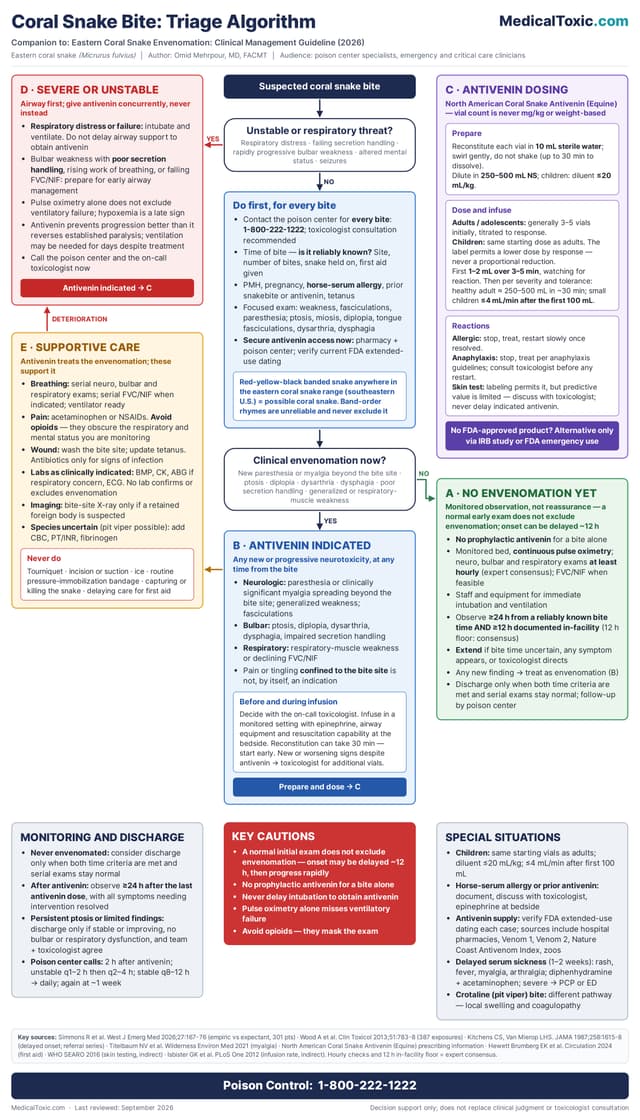
How to read it. Two questions drive the pathway. First: is there a respiratory threat or instability (panel D, airway first)? Second: is there clinical envenomation (panel B, antivenin) or not yet (panel A, monitored observation)? Panel C gives antivenin preparation and dosing; panel E gives supportive care for every patient. A full-pathway version, including prehospital care and poison center follow-up, is in the appendix (Section 17).
Coral snake bites are rare but carry a risk of respiratory paralysis that can start hours after a benign-looking bite. That delay, not the bite wound, drives every decision in this guideline.
Epidemiology. Coral snakes (Elapidae) are the only native elapids in North America. Elapids accounted for about 2% of native venomous snake exposures reported to U.S. poison centers in 2001-2005 [8]. The National Poison Data System recorded roughly 1,380 coral snake bites from 2006 to 2022, about 80 per year [7]. Antivenin was given in 21% and 37% were admitted to a critical care unit. No deaths were reported, and declining antivenin use over the period was not associated with more morbidity. Florida reports the largest number of U.S. coral snake bites [9].
Three species occur in the United States:
Species | Range | Clinical significance |
|---|---|---|
Eastern coral snake, Micrurus fulvius | Southeastern coastal plain, including all of Florida | Potent neurotoxin; the focus of this guideline |
Texas coral snake, M. tener | West of the Mississippi River (Texas, Louisiana, Arkansas) | Neurotoxic but generally milder course |
Sonoran coral snake, Micruroides euryxanthus | Arizona, New Mexico | Minimal human toxicity; antivenin not used |
Venom composition. M. fulvius venom is dominated by two toxin families. In venom-gland transcriptome analysis, phospholipases A2 (PLA2) made up about 65% and three-finger toxins (3FTx) about 21% of toxin transcripts [10]. This PLA2-predominant pattern is typical of North American Micrurus [11].
Mechanism. The venom produces a descending, flaccid neuromuscular paralysis through two actions:
Postsynaptic block. Alpha-neurotoxins (3FTx) bind the nicotinic acetylcholine receptor at the motor end plate. This block is competitive and potentially reversible.
Presynaptic injury. Neurotoxic PLA2 enzymes damage the motor nerve terminal and stop acetylcholine release. Recovery depends on regeneration of the terminal, which can take days. Antivenin cannot reverse injury that has already occurred.
This two-part mechanism explains three clinical realities. Onset can be delayed while venom is absorbed from the bite site. Antivenin prevents progression more reliably than it reverses established weakness. And a patient with established paralysis may need ventilation for days despite antivenin [3,19].
Other venom effects. In animal models, M. fulvius PLA2s cause myotoxicity and intravascular hemolysis. In humans, mild creatine kinase rises are reported, but clinically important rhabdomyolysis and hemolysis are uncommon. Unlike pit viper venom, coral snake venom causes little local tissue injury and no clinically significant coagulopathy.
Mortality. Death is now very rare with modern airway care. The most recent well-documented U.S. death, confirmed by venom ELISA, occurred in a man who did not seek care after an Eastern coral snake bite and died within hours; it was the first so documented in more than 40 years [12].
A normal examination soon after the bite does not exclude envenomation. In the Florida series of Kitchens and Van Mierop, neurologic onset was delayed by up to about 12 hours and then progressed precipitously, and about 75% of people bitten were envenomated [3].
Local findings are minimal. Fang marks may be absent or hard to see. Pain, paresthesia at the site, and mild erythema or swelling are typical. Tissue necrosis and coagulopathy are not features of M. fulvius envenomation.
Systemic neurotoxicity follows a recognizable sequence, although stages may overlap or be skipped:
Early, nonspecific: nausea, vomiting, headache, diaphoresis, paresthesia or myalgia spreading beyond the bite site. Clinically significant myalgia can be an early sign of systemic envenomation [4].
Cranial nerve and bulbar: ptosis, diplopia and extraocular palsy, miosis, tongue fasciculations, dysarthria, dysphagia, excessive oral secretions and poor secretion handling.
Generalized: limb weakness and fasciculations.
Respiratory: weakness of the diaphragm and accessory muscles, leading to ventilatory failure. Bulbar weakness adds a risk of aspiration and airway loss.
Altered mental status and seizures are uncommon signs of neurotoxicity.
The two Florida case series show how often each finding occurs:
Finding | Kitchens 1987 (n = 39) | Wood 2013 (n = 387) |
|---|---|---|
No symptoms | not reported | 56% |
Pain | not reported | 41% |
Paresthesia | 35% | 28% |
Nausea or emesis | 25% (emesis) | 13% nausea; 11% emesis |
Weakness | 15% | 7% |
Diplopia | 10% | not reported |
Respiratory compromise | 10% (dyspnea) | 3% (respiratory depression) |
Intubation | 15% | 3% |
The gap between the 75% envenomation rate of Kitchens and the 56% asymptomatic rate of Wood reflects differences in case selection and era. Kitchens studied patients referred to a tertiary center, most of whom received antivenin. Wood captured all poison center calls, including many uncertain exposures. Neither figure justifies reassurance.
Duration. Most neurologic findings resolve within days with or without antivenin. Patients with presynaptic injury may need ventilation for several days. Transient loss of taste lasting weeks has been described in isolated case reports.
Any red, yellow and black banded snake anywhere in the Eastern coral snake's range (the southeastern United States) should be managed as a possible coral snake until an expert says otherwise.
Use the history and, when it can be obtained safely, a photograph or expert identification.
Do not rely on band-order rhymes (“red touches yellow”). They are unreliable, have exceptions, and must never be used to exclude a coral snake.
Do not capture, kill or transport the snake, and do not ask the patient or bystanders to do so. Recently killed snakes can still bite reflexively, and the attempt causes additional bites.
A small snake is still dangerous. Coral snakes have short fixed fangs and may need to hold on to envenomate. Ask whether the snake held on and had to be pulled off, but do not use a brief strike to exclude envenomation.
Every confirmed or suspected Eastern coral snake bite must be referred to a healthcare facility, even if the patient has no symptoms.
Any one:
Confirmed bite by an Eastern coral snake.
Suspected bite based on history, photograph or description, when expert identification is not yet available.
Any sign of neurotoxicity: weakness or fasciculations, paresthesia, diplopia or ptosis, dysphagia, dysarthria or slurred speech, altered mental status, respiratory distress, or seizures.
Do | Do not |
|---|---|
Remove rings, jewelry and constrictive clothing from the bitten limb | Apply any tourniquet |
Rest and immobilize the limb in a comfortable position | Cut or suck the bite site |
Minimize exertion | Apply ice |
Photograph the snake only if safe and without delay | Capture, kill or transport the snake |
Go to emergency care without delay | Delay emergency care for first aid |
Pressure immobilization. Routine pressure immobilization bandaging is not recommended for North American snakebites. The 2024 American Heart Association and American Red Cross first aid guideline advises against it, and correct field application is unreliable [14]. The theoretical benefit (slowing lymphatic absorption of a neurotoxin) has not been shown for M. fulvius in humans.
Monitor vital signs and signs of neurotoxicity frequently.
Manage the airway according to established protocols.
Stable patient: coordinate early with the poison center to choose a facility with access to coral snake antivenin.
Unstable patient, or evolving respiratory or other life-threatening findings: go to the closest appropriate facility and stabilize first.
Evaluation has two goals: detect neurotoxicity as early as possible, and secure antivenin before it is needed. Contact the poison center (1-800-222-1222) for every coral snake bite; consultation with a medical toxicologist is recommended.
Time of bite, and whether it is reliably known. This sets the observation clock (Section 9).
Number and site of bites; appearance of the site (fang marks, abrasions, swelling, ecchymosis); whether the snake held on and had to be pulled off.
First aid used.
Past medical history, pregnancy status, allergies (especially to horse serum), previous snakebites, and any previous antivenin.
Tetanus status.
Vital signs, including respiratory rate and pulse oximetry.
Neurologic: numbness, weakness, fasciculations, paresthesia, myalgia or cramping.
Bulbar and cranial nerve: ptosis, miosis, diplopia, extraocular palsy, tongue fasciculations, dysarthria, dysphonia, dysphagia, handling of secretions.
General: headache, nausea and vomiting, diaphoresis, seizures.
Respiratory: rate, effort, accessory muscle use, ability to count aloud in one breath, and cough strength.
Serial assessment is the core of monitoring, because a normal first examination does not exclude envenomation. Repeat the examination with attention to cranial nerve and bulbar function, muscle strength, secretion handling and respiratory effort.
Objective respiratory measurement. Consider serial forced vital capacity (FVC) and negative inspiratory force (NIF) when clinically indicated. Pulse oximetry alone does not exclude evolving ventilatory failure, because oxygen saturation often stays normal until late, particularly with supplemental oxygen. No validated numeric intubation thresholds exist for coral snake envenomation. Values used in neuromuscular respiratory failure from other causes (for example FVC below about 20 mL/kg or NIF weaker than about -30 cm H2O) are reasonable prompts for toxicologist discussion and airway planning, but they are extrapolated, not validated in coral snake envenomation.
No laboratory test confirms or excludes Eastern coral snake envenomation, and no venom assay is clinically available. Obtain studies as clinically indicated:
Study | Purpose |
|---|---|
Basic metabolic panel | Baseline; renal function before fluids and antivenin |
Creatine kinase | Detects myotoxicity (usually mild) |
Arterial blood gas | Only if there is concern for respiratory failure; hypercapnia is the key finding |
Electrocardiogram | Baseline |
Bite-site radiograph | Only if a retained foreign body or alternative injury is suspected |
Coagulation studies are not needed to diagnose coral snake envenomation. They help only if the species is uncertain and a pit viper bite is possible.
Secure antivenin access now. If coral snake antivenin is not immediately available, contact the poison center and the facility pharmacy early. Identify regional inventory, verify current FDA extended-use dating, and coordinate transfer or emergency access. Regional sources include other hospital pharmacies, antivenom banks and suppliers such as Venom 1, Venom 2 and the Nature Coast Antivenom Index, and zoological collections. Airway support and stabilization must never wait for antivenin.
Antivenin is indicated when clinical evidence of envenomation develops: new or progressive neurologic, bulbar or respiratory findings. The bite itself, however certain the identification, is not an indication.
Counts as envenomation | Does not count by itself |
|---|---|
New paresthesia or clinically significant myalgia beyond the immediate bite site | Pain or tingling confined to the bite site |
Ptosis or diplopia | A confirmed or presumed bite with no findings |
Dysarthria or dysphagia | Anxiety-related symptoms without objective findings |
Impaired secretion handling | |
Generalized weakness | |
Respiratory-muscle weakness |
Rationale for the threshold. The threshold is set low on purpose. Spreading paresthesia and myalgia can precede cranial nerve signs [4]. Because antivenin prevents progression better than it reverses established presynaptic injury, treatment should start at the first reliable sign of systemic spread, not at the onset of respiratory compromise.
Ambiguous findings. Nausea, vomiting, headache or diaphoresis alone are nonspecific. They should shorten the interval between examinations and prompt toxicologist discussion, but do not by themselves trigger antivenin.
Worsening after antivenin. If findings progress despite treatment, contact the on-call toxicologist about additional vials.
An asymptomatic patient after a confirmed or presumed Eastern coral snake bite should not receive prophylactic antivenin. The patient should instead be observed in a monitored setting for at least 24 hours from a reliably known bite time, and never less than 12 hours of documented in-facility observation.
Expectant management means monitored observation, not discharge or reassurance. A normal early examination does not exclude envenomation. In a Florida referral series, about 75% of people bitten were envenomated, with onset delayed up to about 12 hours [3]; the unselected Florida poison center cohort found 56% asymptomatic [2], so the true rate depends on case mix.
A monitored bed with continuous pulse oximetry.
Neurologic, bulbar and respiratory assessment at least hourly (expert consensus; no study defines the interval); objective FVC and NIF when feasible.
Immediate availability of personnel and equipment for airway management and mechanical ventilation.
A confirmed plan for timely antivenin access (Section 7).
ICU admission is not required for an asymptomatic patient solely on the basis of a bite, provided the monitoring above is available. This reflects poison center operational judgment informed by the difference in ICU use between strategies (below). It is not itself a tested endpoint, and institutions without such monitoring outside the ICU should use the ICU.
Situation | Minimum observation |
|---|---|
Bite time reliably known | 24 h from the bite and at least 12 h documented in the facility |
Bite time uncertain | Extend beyond 24 h, as directed by the toxicologist |
Any symptom develops | Reassess for envenomation (Section 8); extend observation |
Toxicologist concern | Extend as directed |
The 12-hour in-facility floor matters most for late presenters. A patient arriving 20 hours after a known bite would otherwise meet the 24-hour criterion after only 4 hours of observation, before a delayed onset could be reliably excluded.
The strongest evidence is the Florida poison center comparison of 301 patients who were asymptomatic on arrival, 1998-2021 [1]:
Outcome | Empiric antivenin (n = 171) | Expectant (n = 130) | Adjusted comparison |
|---|---|---|---|
ICU admission | 75.2% | 56.8% | OR 3.05 (95% CI 1.02-9.57), p = 0.05 |
Intubation | 2 (1.2%) | 1 (<1%) | OR 2.49, p = 0.63 |
Adverse antivenin reaction | 20.5% | 2.3% | Not significant after adjustment |
Of the 191 patients who received antivenin in either group, 38 (19.9%) had an adverse reaction, and 8 of those 38 (21%) had anaphylaxis. ICU length of stay did not differ significantly (OR 0.49, p = 0.08).
Interpreting this evidence. The study is retrospective and observational. Treatment choice was not random and partly reflected the national antivenin shortage after production stopped in 2003, which the authors adjusted for. The small number of intubations means the study cannot exclude a modest difference in serious respiratory outcomes. The conclusion that expectant management is safe therefore depends on the monitoring and antivenin access described above being in place. It is consistent with national data showing no rise in morbidity as antivenin use declined [7], and with a delayed-onset case in the earlier Florida cohort that underlines why observation, not discharge, is required [2].
Historical note. Kitchens and Van Mierop recommended early antivenin after a positively identified bite [3]. That recommendation predates modern data on antivenin reaction rates and current labeling, and is superseded on that point by Simmons 2026 and the current prescribing information.
When clinical envenomation develops, give North American Coral Snake Antivenin (Equine) in consultation with the on-call toxicologist: generally 3-5 vials initially in adults and adolescents, titrated to response. Vial count is never calculated on a weight basis.
The antivenin is a lyophilized preparation of equine serum globulins from horses immunized with M. fulvius venom. It is labeled for envenomation by the Eastern and Texas coral snakes. It was manufactured by Wyeth, now part of Pfizer, and there is no alternative product licensed in the United States.
Supply depends on FDA expiration-date extensions granted after stability testing. As of 1 July 2026, FDA extended Lot CL6814 (printed expiry 06/2022) through 31 December 2026 [6]. Extensions and supply can change at any time, so verify current dating at every case. Current notices are posted at fda.gov/vaccines-blood-biologics (search “coral snake antivenin expiration date extension”).
Give when clinical evidence of envenomation develops (Section 8).
Do not give prophylactically to an asymptomatic patient solely because a confirmed or presumed bite occurred.
Place the patient in a monitored environment with resuscitation and vital sign equipment immediately available. Epinephrine and airway equipment must be at the bedside.
Reconstitute each vial with 10 mL of sterile water. Swirl gently; do not shake, to avoid foaming. Dissolution can take up to 30 minutes, so start as soon as antivenin is anticipated.
Add the reconstituted vials to 250-500 mL of normal saline. In children, reduce the diluent to a maximum of 20 mL/kg.
Patient | Initial dose | Further doses |
|---|---|---|
Adults and adolescents | Generally 3-5 vials, titrated to clinical response | Per severity, response and toxicologist recommendation |
Children | Same starting dose as adults; the label permits a lower dose by response | Per severity, response and toxicologist recommendation |
The lower pediatric dose permitted by the label is not a proportional weight-based reduction. Venom dose is set by the snake, not the patient, and a child receives a larger venom load per kilogram. Do not calculate vial count on a mg/kg or weight basis. For this reason, starting children on the adult dose is common expert practice.
Give the first 1-2 mL over 3-5 minutes and watch closely for an allergic reaction.
If tolerated, continue at a rate appropriate to severity, body weight, general condition and tolerance, consistent with the prescribing information and toxicologist advice.
For a previously healthy adult, 250-500 mL may be infused over about 30 minutes when clinically appropriate.
In small children, after the first 100 mL, do not exceed 4 mL/min.
Admit to a monitored setting.
Evidence on infusion rate. No study has tested infusion rate with this product. The only randomized evidence, from a different antivenom and species, found that a slower 2-hour infusion did not reduce reactions compared with a 20-minute infusion [16]. The labeled approach is therefore retained; there is no evidence that slowing the whole infusion adds safety.
Early reactions are common with this whole-IgG equine product. In the Florida cohort, 19.9% of treated patients reacted and about one in five reactions was anaphylaxis [1].
Reaction | Action |
|---|---|
Allergic reaction (urticaria, pruritus, flushing, mild bronchospasm) | Stop the infusion; treat according to standard guidelines; once resolved, restart slowly and keep monitoring |
Severe reaction or anaphylaxis | Stop the infusion; treat per anaphylaxis guidelines (intramuscular epinephrine first); consult the toxicologist before any restart |
The decision to restart after anaphylaxis weighs the reaction against the risk of progressive paralysis. With respiratory compromise, antivenin can usually be resumed under close observation once the reaction is controlled.
Skin testing. The current label states that a skin test may be considered before intravenous administration. General antivenom guidance notes that skin testing predicts early reactions poorly, may delay treatment, and may itself sensitize the patient [15]. If skin testing is contemplated, discuss it with the toxicologist. It must never delay indicated antivenin, particularly with evolving neurologic, bulbar or respiratory toxicity.
Premedication. Routine premedication is not recommended. In a randomized trial of 1,007 patients given a highly reactogenic South Asian antivenom, subcutaneous epinephrine 0.25 mg (0.25 mL of 1:1,000) before infusion reduced severe reactions by 38% over 48 h. Promethazine and hydrocortisone alone did not help, and adding hydrocortisone appeared to cancel the epinephrine benefit [17]. These data are indirect. Consider discussing premedication with the toxicologist for patients with known horse-serum allergy or previous equine antivenin, without delaying treatment.
An unapproved alternative antivenin may be used only within an IRB-approved study or through an FDA emergency-use mechanism.
Poison center staff can help locate a suitable alternative.
Candidates studied in the United States include an equine F(ab')2 anti-Micrurus antivenom evaluated in a single-arm trial (NCT01337245) and Coralmyn. Neither is FDA-approved. The crotaline F(ab')2 product Anavip is approved for pit vipers only and has no role here.
Without antivenin, supportive care with mechanical ventilation until recovery remains effective; paralysis is reversible with time.
The airway comes first. Respiratory failure is the cause of death in coral snake envenomation, and it is fully treatable with ventilation.
Intubate and ventilate for respiratory distress or failure. Do not delay airway support or stabilization to obtain antivenin.
Anticipate the airway early in patients with bulbar weakness and poor secretion handling, rising work of breathing, or falling FVC or NIF. Aspiration risk rises before ventilatory failure does.
Pulse oximetry alone does not exclude ventilatory failure; hypercapnia and falling vital capacity come before desaturation.
Expect ventilation for days in severe cases, especially when antivenin was delayed or unavailable. Recovery is usually complete.
Pain. Use acetaminophen or NSAIDs. Avoid opioids where possible: they depress ventilation and mental status, the two signs being monitored. This differs from pit viper envenomation, where NSAIDs are avoided because of coagulopathy; coral snake venom does not cause clinically significant coagulopathy.
Wound care. Wash the bite site if not already done. Give tetanus immunization if not up to date. Give antibiotics only for signs of infection; prophylactic antibiotics are not indicated.
Anticholinesterases (for example neostigmine) have been used for postsynaptic toxicity in other elapid envenomations. They are not routinely recommended and have little rationale for the presynaptic injury that dominates M. fulvius envenomation. Use only on toxicologist advice.
Varespladib, an oral and intravenous PLA2 inhibitor, reversed severe M. fulvius neurotoxicity in animal models [18]. It remains investigational in humans.
Population | Key point |
|---|---|
Children | Same starting vial count as adults, never weight-based; diluent at most 20 mL/kg; infusion no faster than 4 mL/min after the first 100 mL. Smaller respiratory reserve means earlier airway planning. |
Pregnancy | Record pregnancy status. Pregnancy-specific data are lacking; treat the mother by the same criteria, because maternal respiratory failure is the main threat to the fetus. Involve obstetrics. |
Horse-serum allergy or previous equine antivenin | Record it, discuss with the toxicologist, and have epinephrine and airway equipment ready. It does not by itself contraindicate indicated antivenin. |
Texas coral snake (M. tener) | Covered by the antivenin label. Illness is usually milder: in 14 registry cases (2015-2019), painful paresthesia, mild swelling and erythema were common, and no patient developed neurotoxicity needing antivenin or ventilation [13]. Manage with the same observation principles. |
Sonoran coral snake (Micruroides euryxanthus) | Minimal human toxicity; antivenin is not used. |
Exotic or non-native elapids | Different venoms and antivenoms. Contact the poison center for species-specific advice and antivenom sourcing. |
Discharge rests on time and serial examination, not on a single normal examination.
Patient | May be considered for discharge when |
|---|---|
Never envenomated | At least 24 h from a reliably known bite time and at least 12 h documented in-facility observation, with no neurologic, bulbar or respiratory abnormality on serial assessment |
Bite time uncertain, or symptoms developed | Observation extended as recommended by the on-call toxicologist |
Treated with antivenin, symptoms resolved | At least 24 h after the last antivenin dose, with all symptoms requiring intervention resolved |
Persistent ptosis or other limited neurologic findings after antivenin | Findings stable or improving, no bulbar or respiratory dysfunction, and discharge agreed by the treating team and the on-call toxicologist; follow-up arranged until complete resolution |
Discharge instructions should cover return precautions for any new weakness, swallowing or breathing difficulty, and, after antivenin, the symptoms of serum sickness (Section 14).
Case | Frequency |
|---|---|
Every case receiving antivenin | Call at 2 h to check for an adverse reaction |
Unstable | Every 1-2 h initially, then every 2-4 h |
Stable | Every 8-12 h, progressing to daily |
After discharge | About 1 week; counsel on serum sickness up to 14 days after antivenin |
Each call should assess vital signs (blood pressure, heart rate, respiratory rate, oxygen saturation), mental status, respiratory status, any new or worsening systemic effects, signs of bite-site infection, and adverse effects of antivenin.
Serum sickness is a type III (immune complex) reaction to foreign equine protein. It usually appears 1-2 weeks after antivenin and is more likely with larger doses of whole-IgG product.
Symptoms: rash or pruritus, fever, myalgia, arthralgia, lymphadenopathy, malaise, edema.
Course: usually self-limited, lasting several days up to about two weeks.
Treatment: patients may self-treat with diphenhydramine and acetaminophen.
Escalation: moderate, severe, persistent or protracted symptoms need evaluation by the primary physician or an emergency department, where systemic corticosteroids are commonly used.
Any presumed coral snake bite.
Anticipated use of coral snake antivenin.
Worsening symptoms despite antivenin.
Allergic reaction to antivenin, and before restarting after anaphylaxis.
Request from the treating physician.
No U.S. or foreign antivenin available, to discuss other treatment.
The central recommendation rests on retrospective data from one poison center network, and several key numbers are extrapolated.
Question | Current basis | What would resolve it |
|---|---|---|
Is expectant management as safe as empiric antivenin for serious respiratory outcomes? | One retrospective cohort, 3 intubations total [1] | Prospective multicenter registry with standardized monitoring |
Optimal observation duration | 1987 case series [3]; no later study tests a different duration | Time-to-onset analysis in pooled poison center data |
Objective intubation thresholds (FVC, NIF) | Extrapolated from other neuromuscular diseases | Serial respiratory mechanics in envenomated patients |
Premedication and skin testing | Indirect evidence from other antivenoms | Trials with the equine coral snake product |
Antivenin supply beyond the current lot | FDA extensions of one aging lot | A licensed replacement product |
Adjunctive PLA2 inhibition (varespladib) | Animal models | Human trials |
This printable one-page version follows the full pathway step by step, from first contact to poison center follow-up. It carries the same clinical content as the algorithm in Section 2, plus prehospital care, the ICU statement, the full follow-up schedule and the key sources.
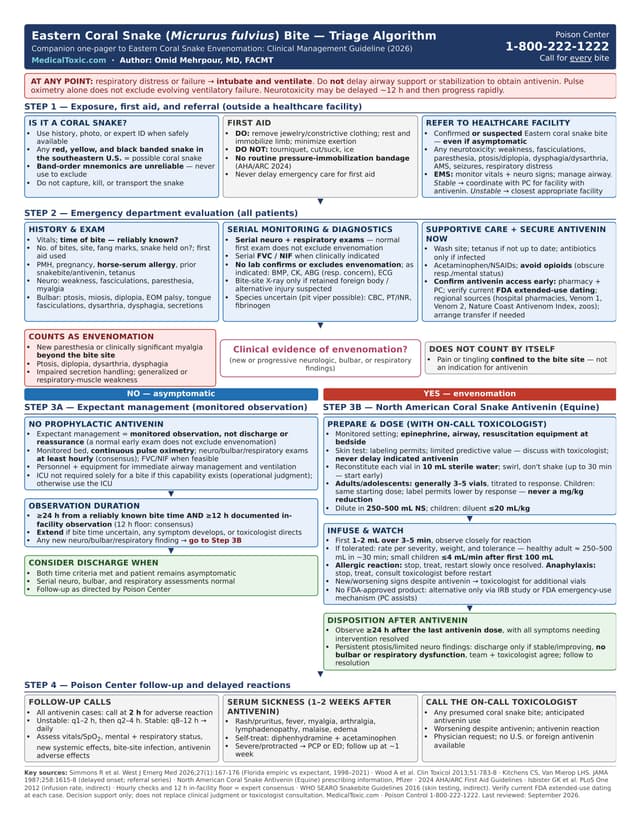
Both charts must be updated together whenever recommendations, dosing or antivenin supply change.
Keep reading