Brad's Kale Snacks Recalled Over Potential Thallium
post on 05 Nov 2026
post on 05 Nov 2026
 Medical Toxicologymedicaltoxic.com
https://medicaltoxic.com/news/brads-kale-snacks-thallium-recall
Brad's Kale Snacks Recalled Over Potential Thallium
A nationwide recall covers specific Brad's kale snack lots after public-health testing found elevated thallium in multiple products.
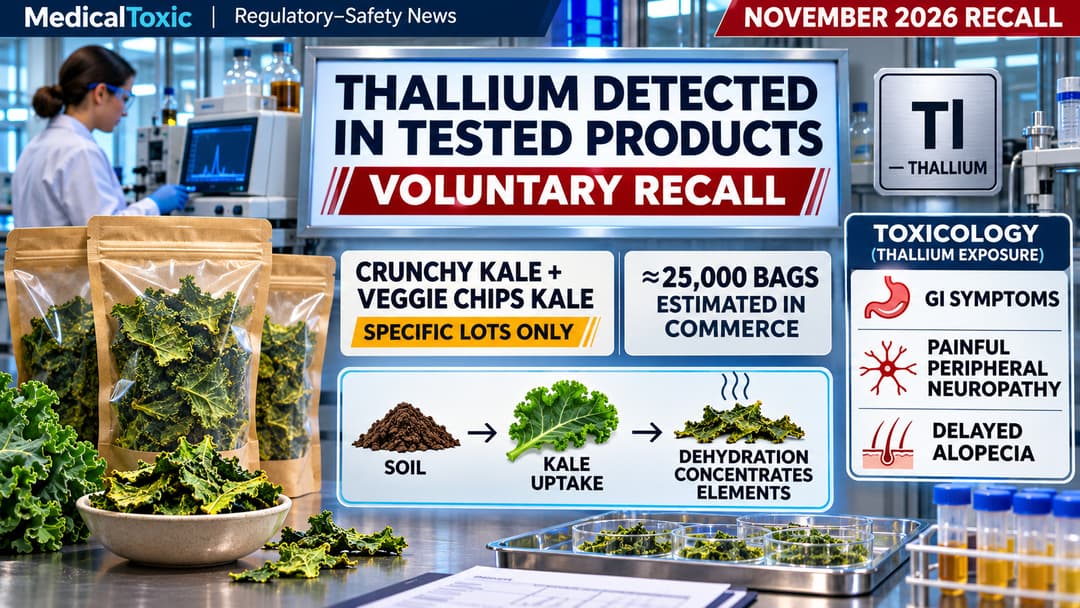
Snack Right Super Foods, doing business as Brad's Raw Chips, is recalling specific Brad's Plant Based Crunchy Kale and Veggie Chips Kale products because they may contain thallium, a toxic metal capable of causing gastrointestinal, neurologic and dermatologic effects at sufficiently high exposure levels.
The company announced the recall on November 2, 2026, and FDA published it on November 3. FDA says approximately 25,000 bags, or about 2,097 cases, of the recalled products are estimated to be in commerce. [1]
The products were distributed nationwide through KeHE Distributors and United Natural Foods, Inc. (UNFI) and were also sold directly to five individual consumers. Distribution occurred between October and December 2025. [1]
The recall follows a months-long investigation that began after the California Department of Public Health received an inquiry involving an individual with elevated thallium levels and subsequently found elevated thallium in multiple Brad's Plant Based products.
The November recall is lot-specific.
Product | UPC | Recalled lot(s) | Best By |
|---|---|---|---|
Brad's Crunchy Kale Original, 2 oz | 813104021679 | 33525-1, 33525-2, 33525-3 | Feb. 1, 2027 |
34525-1 | Feb. 11, 2027 | ||
35125-2 | Feb. 17, 2027 | ||
Brad's Crunchy Kale Cheeze It Up, 2 oz | 813104021877 | 35025-3 | Feb. 16, 2027 |
Brad's Crunchy Kale Radical Ranch, 2 oz | 813104020726 | 29425-1 | Dec. 21, 2026 |
Brad's Veggie Chips Kale, 3 oz | 854615002054 | 33225-3 | Jan. 28, 2027 |
33325-2 | Jan. 29, 2027 | ||
33425-1 | Jan. 30, 2027 | ||
33525-1 | Feb. 1, 2027 |
These identifiers were rechecked against FDA's current recall announcement. [1]
The recall should not be interpreted as evidence that every bag of Brad's kale snacks contains the same amount of thallium—or that every Brad's product is part of this November recall.
The November recall is the latest development in an investigation that became public in May.
On May 19, 2026, CDPH warned consumers not to eat several Brad's Plant Based Crunchy Kale and Salad Snack products after state laboratory testing detected elevated thallium in multiple varieties. [2]
CDPH said its investigation began in response to a January inquiry involving an individual with an elevated thallium level who had consumed Brad's Plant Based kale products.
That history is important—but it does not by itself prove that Brad's products caused the individual's elevated thallium concentration.
The public-health investigation established a reason to test the products. Subsequent laboratory testing then independently confirmed concerning thallium levels in multiple varieties. [2]
At the time of the May advisory, CDPH said the manufacturer had not recalled the products.
The November action is therefore a material change: the company is now conducting a voluntary recall with FDA's knowledge. [1]
Thallium is a naturally occurring metal that can occur in soil and sulfur-containing minerals.
Certain plants can take up elements present in soil. FDA's posted recall specifically notes that Brassica crops, which include kale and related vegetables, can accumulate certain elements. [1]
The recall announcement says the manufacturing process did not introduce the thallium.
Instead, dehydration appears to be an important part of the exposure pathway: the process removes approximately 85%–90% of the product's water, which can concentrate elements already present in the fresh kale. [1]
That distinction matters.
This recall should not be turned into a claim that kale in general is unsafe or that all kale naturally contains hazardous thallium concentrations.
The confirmed issue involves specific Brad's products and tested product lots.
Thallium toxicity can be diagnostically difficult because different manifestations may develop at different times.
CDC/NIOSH describes a typical acute pattern in which gastrointestinal symptoms may occur first, followed later by neurologic manifestations and then alopecia. [3]
Early symptoms after significant ingestion can include:
nausea;
vomiting;
abdominal pain; and
diarrhea.
Neurologic effects may emerge over the following days and can include painful or burning sensations, paresthesias, weakness and peripheral neuropathy.
Alopecia is characteristically delayed and may become apparent weeks after exposure, rather than immediately. [3]
This evolving timeline is one reason thallium poisoning can initially resemble more common gastrointestinal or neurologic illnesses.
MedicalToxic's clinical case study Toxic Enigma: Jaundice, Neuropathy, and Hair Loss illustrates how gastrointestinal symptoms, neuropathy and alopecia can eventually point toward an otherwise hidden thallium exposure.
The health effects of thallium are dose- and exposure-dependent.
With a sufficiently large acute ingestion, gastrointestinal illness can occur relatively early. Painful peripheral neurologic findings may follow days later, while hair loss can emerge after a longer delay. [3]
Repeated or ongoing exposure can be harder to recognize because symptoms may accumulate gradually.
ATSDR identifies gastrointestinal effects, neurologic injury and alopecia among the most consistently described manifestations of human thallium poisoning.
The current recall does not provide enough quantitative information to predict which symptoms, if any, a particular consumer would develop.
FDA has not published a thallium concentration for each recalled lot, and the recall notice does not provide a dose received by individual consumers.
This distinction is central to the story.
Public-health testing confirmed elevated thallium in multiple Brad's products.
That establishes a product-contamination problem.
It does not establish that every person who consumed those products developed thallium poisoning.
Likewise, the individual who prompted the original investigation had an elevated thallium level, but the available public record does not establish that Brad's products were definitively the sole source of that person's exposure.
The evidence should therefore be separated into two levels:
confirmed product testing: elevated thallium detected in multiple products;
clinical investigation: an individual with elevated thallium had consumed Brad's kale products.
Those findings are related but not equivalent.
Another important distinction is product scope.
CDPH's May warning covered a broader list of Brad's Plant Based products, including additional kale and salad-snack varieties.
The current FDA-posted November recall identifies specific lots of four product groups: Crunchy Kale Original, Cheeze It Up, Radical Ranch and Veggie Chips Kale. [1]
Consumers should therefore follow the identifiers in the current recall rather than assuming that every product named in an earlier advisory has the same current recall status.
FDA's posted recall tells consumers who have one of the affected products to stop eating it immediately and discard it. [1]
The company says recalled product should not be returned to the place of purchase, and refunds are not being offered under the current recall instructions.
Consumers who believe they have experienced adverse health effects after consuming the affected products should contact a healthcare professional. [1]
Because thallium toxicity can evolve over time, clinicians evaluating a plausible exposure history should not assume that absence of immediate hair loss or neurologic symptoms rules out clinically important exposure.
This News does not establish a new diagnostic threshold or treatment protocol.
The thallium finding itself is not entirely new.
California publicly warned about Brad's products in May after laboratory testing detected elevated thallium.
The important new development is the formal nationwide voluntary recall announced November 2 and posted by FDA November 3.
The recall now provides:
specific recalled products;
exact lot numbers;
UPCs and expiration dates;
nationwide distribution information;
an estimate of approximately 25,000 bags in commerce; and
current consumer disposal instructions.
It also provides a plausible processing explanation: dehydration concentrated elements already present in the kale rather than introducing the contaminant during manufacturing.
Several important quantitative questions remain unanswered.
FDA has not published:
a thallium concentration for every recalled lot;
evidence that every bag contains the same concentration;
the number of consumers actually exposed;
a product-specific thallium dose;
the number of clinically confirmed poisoning cases attributable to the recalled lots; or
evidence of a national thallium-poisoning outbreak.
The recall also should not be generalized to kale as a food category.
The current evidence supports a specific product-safety conclusion:
certain Brad's kale snack lots are being recalled after public-health testing identified elevated thallium in multiple products.
The Brad's recall represents a genuine heavy-metal toxicology event rather than a routine food-quality issue.
Approximately 25,000 bags of specified Crunchy Kale and Veggie Chips Kale products are estimated to be in commerce, and consumers with the listed lots should stop eating them and discard them. [1]
Laboratory testing confirmed elevated thallium in multiple Brad's products, while the recall announcement indicates that dehydration may concentrate elements already present in fresh kale.
The toxicology concern is clinically important because significant thallium exposure can produce an evolving pattern of gastrointestinal illness, painful peripheral neuropathy and delayed alopecia. [3]
But the available evidence does not justify assuming that every recalled bag contains the same amount of thallium, that every consumer was poisoned, or that the individual who prompted the investigation was definitively poisoned by Brad's products.
1. U.S. Food and Drug Administration. (2026, November 3).
Snack Right Super Foods, Inc. dba Brad's Raw Chips Recalls Brad's Crunchy Kale & Veggie Chips Due to Potential Thallium Contamination
2. California Department of Public Health. (2026, May 19).
CDPH Warns Consumers Not to Eat Brad’s Plant Based Products
3. Centers for Disease Control and Prevention, National Institute for Occupational Safety and Health.
Thallium: Systemic Agent
Keep reading
Public Health Warnings and Recalls
06 Nov 2026
Public Health Warnings and Recalls
28 Oct 2026
Public Health Warnings and Recalls
23 Oct 2026
Public Health Warnings and Recalls
21 Oct 2026