FDA Expands Yellow Oleander Weight-Loss Product Alert
post on 16 Aug 2026 · Updated 16 Oct 2026

post on 16 Aug 2026 · Updated 16 Oct 2026
 Medical Toxicologymedicaltoxic.com
https://medicaltoxic.com/news/fda-yellow-oleander-weight-loss-products
FDA Expands Yellow Oleander Weight-Loss Product Alert
FDA added Easy Forte Natural Fiber and two Niwali products after testing confirmed toxic yellow oleander; the two Niwali products were later voluntarily recalled.
The U.S. Food and Drug Administration has expanded its warning about weight-loss and botanical supplements contaminated or substituted with toxic yellow oleander, adding three products beyond those MedicalToxic originally reported in August.
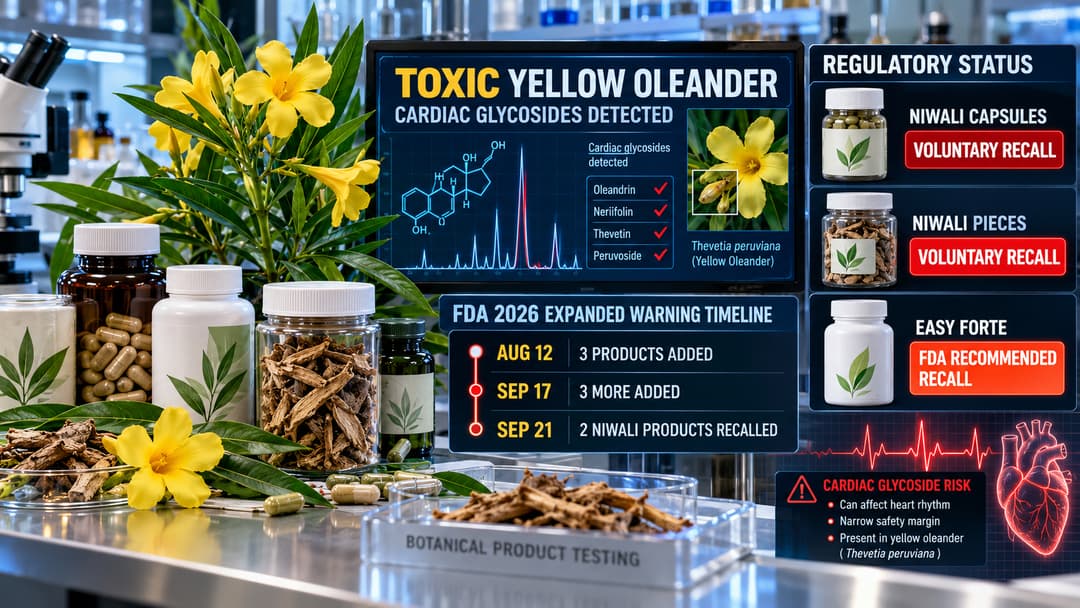
On September 17, 2026, FDA added Easy Forte Natural Fiber, Niwali Tejocote Capsules and Niwali Tejocote Pieces after laboratory testing found toxic yellow oleander. [1] FDA's current alert says a state partner tested Easy Forte through the agency's Laboratory Flexible Funding Model, while FDA itself tested the two Niwali products. U.S. Food and Drug Administration
Four days later, on September 21, Global Mix Inc. voluntarily recalled the two Niwali products after FDA analysis determined that products labeled as tejocote were actually yellow oleander. [2] U.S. Food and Drug Administration
Easy Forte remains in a different regulatory position: FDA's current table says the agency recommended that the firm initiate a recall, and Amazon removed the product listing. As of this update, FDA does not list a completed Easy Forte recall. U.S. Food and Drug Administration
MedicalToxic's original August coverage centered on Slim Elixir, DMagic Plus and B. Magi.
FDA's September 17 update expands the current article's 2026 product set to six:
Product | FDA finding | Date added | Current FDA status |
|---|---|---|---|
Slim Elixir | Toxic yellow oleander | Aug. 12 | Selling firm had not responded to FDA |
DMagic Plus | Yellow oleander; undeclared diclofenac, neriifolin and thevetin B | Aug. 12 | Selling firm had not responded to FDA |
B. Magi | Yellow oleander; undeclared phenolphthalein, neriifolin and thevetin B | Aug. 12 | Selling firm had not responded to FDA |
Easy Forte Natural Fiber | Toxic yellow oleander | Sept. 17 | FDA recommended a recall; Amazon removed listing |
Niwali Tejocote Capsules | Toxic yellow oleander | Sept. 17 | Voluntarily recalled Sept. 21 |
Niwali Tejocote Pieces | Toxic yellow oleander | Sept. 17 | Voluntarily recalled Sept. 21 |
The table above covers the six products added during the August and September 2026 developments central to this News owner. FDA's broader yellow-oleander alert includes additional products identified in earlier years. U.S. Food and Drug Administration
The September 21 Global Mix recall adds product-level details that were not available in the September 17 FDA alert.
Niwali Tejocote Capsules are sold as a 90-count herbal supplement under lot RM500925, with a best-by date of March 3, 2028.
Niwali Tejocote Pieces are sold as a 90-day-supply herbal supplement under lot RM400925, also with a best-by date of March 3, 2028. [2] U.S. Food and Drug Administration
Global Mix states that the products were distributed nationwide through eBay and Everymarket. Only five units were reported sold—two bottles of capsules and three bottles of pieces—but the company said it could not identify every purchaser because the online marketplaces did not provide buyer contact information. U.S. Food and Drug Administration
The company reported no illnesses or adverse events associated with the recalled products at the time of the recall. That statement should not be generalized to other products in FDA's broader yellow-oleander investigation. U.S. Food and Drug Administration
Easy Forte Natural Fiber should not be described as recalled.
FDA says Comercializadora Naturista del Bajio was associated with the product and that Easy Forte was purchased through the Jaola Store on Amazon.
The current FDA status is:
FDA has recommended the firm initiate a recall; Amazon removed the listing. U.S. Food and Drug Administration
That is materially different from the two Niwali products, for which a voluntary recall announcement is already published.
This distinction matters because an FDA laboratory finding, an FDA recommendation to recall, and a completed voluntary recall are separate regulatory stages.
Yellow oleander contains cardiac glycosides, compounds capable of producing a clinical syndrome resembling digitalis toxicity.
FDA warns that consuming yellow oleander can cause neurologic, gastrointestinal and cardiovascular effects that may be severe or fatal. [1] U.S. Food and Drug Administration
Historical CDC work provides clinical context. A child exposed to a different mislabeled tejocote product developed vomiting, bradycardia, hypotension and ECG abnormalities consistent with cardenolide toxicity. That historical case did not involve Easy Forte, the newly recalled Niwali products or the August 2026 products. [3] CDC
For detailed clinical background, see Plant Cardiac Glycoside Poisoning: Oleander, Foxglove, ECG Findings, and Treatment. MedicalToxic clinical review
The September update does not replace the August findings.
FDA laboratory analysis of DMagic Plus confirmed undeclared diclofenac, neriifolin and thevetin B. [4] FDA warns that hidden diclofenac introduces additional risks including gastrointestinal bleeding and cardiovascular complications. U.S. Food and Drug Administration
FDA testing of B. Magi identified undeclared phenolphthalein, neriifolin and thevetin B. FDA notes that phenolphthalein is not an active ingredient in an approved U.S. drug and that studies suggest it may increase cancer risk. [5] U.S. Food and Drug Administration
These findings reinforce a broader toxicology problem: the product label may not identify the patient's actual exposure.
FDA has analytically confirmed toxic yellow oleander in all three products added September 17.
That evidence establishes product adulteration or substitution.
It does not establish that each product caused a poisoning case, that every purchaser became symptomatic or that poisoning incidence has increased.
The distinction is especially important for Easy Forte: FDA testing supports the warning, but there is no completed recall listed and FDA's public alert does not report a new Easy Forte-specific poisoning cluster. U.S. Food and Drug Administration
Likewise, the Niwali recall reports no illnesses or adverse events to the company at the time of publication. U.S. Food and Drug Administration
Historical yellow-oleander cases can explain the potential toxidrome, but they should not be reassigned to these newly identified products.
FDA advises consumers to stop using and dispose of products included in its yellow-oleander alert and to contact a healthcare professional if they have used one of the affected products. Serious symptoms warrant emergency medical care. U.S. Food and Drug Administration
For the two recalled Niwali products specifically, Global Mix instructs consumers to stop use immediately and return remaining product to the place of purchase or contact the company for a refund. U.S. Food and Drug Administration
Consumers who are uncertain about an exposure can also contact a poison center.
Unexpected yellow-oleander exposure can be difficult to recognize because consumers may believe they are taking tejocote root, fiber, or another botanical weight-loss product.
A history of nausea, vomiting, dizziness or abdominal symptoms accompanied by bradycardia, conduction abnormalities, dysrhythmias or hypotension should prompt consideration of cardiac-glycoside exposure when these products are involved.
A conventional medication list alone may miss the relevant exposure.
The ongoing FDA surveillance also shows that the issue has expanded beyond products explicitly labeled as tejocote. FDA says its investigation now includes other botanical products marketed for weight loss. U.S. Food and Drug Administration
The August story is no longer complete.
The major September development is that FDA laboratory surveillance identified three additional products containing toxic yellow oleander:
Easy Forte Natural Fiber, Niwali Tejocote Capsules and Niwali Tejocote Pieces.
The two Niwali products then moved from laboratory-confirmed warning status to a formal voluntary recall on September 21. Easy Forte has not yet reached that same published recall status; FDA says it recommended a recall and Amazon removed the listing. U.S. Food and Drug Administration
The current timeline is therefore:
August 12: three products added → September 17: three more products added → September 21: two Niwali products voluntarily recalled.
FDA does not provide quantitative cardiac-glycoside concentrations for the six products central to this News update.
The alert also does not provide exposure denominators or product-specific incidence rates.
For the Niwali recall, only five units were reported sold, but that figure should not be used to estimate the broader prevalence of yellow-oleander contamination in botanical weight-loss supplements.
FDA states that its investigation remains ongoing and that additional products may be added as testing continues. U.S. Food and Drug Administration
FDA's yellow-oleander investigation has expanded beyond the three products MedicalToxic originally covered in August.
Testing added Easy Forte Natural Fiber, Niwali Tejocote Capsules and Niwali Tejocote Pieces on September 17. Global Mix subsequently recalled the two Niwali products on September 21 after FDA testing determined they were toxic yellow oleander rather than the labeled tejocote product. U.S. Food and Drug Administration
Easy Forte remains under a different status: FDA recommended that the firm initiate a recall, and Amazon removed the listing, but a completed recall is not currently listed.
The clinical concern remains cardiac-glycoside poisoning, but the evidence should stay precise: FDA has confirmed the hazardous product contents; it has not documented a new poisoning outbreak involving these September additions.
1. U.S. Food and Drug Administration. (2026, updated September 17).
FDA Issues Warning About Certain Products Containing Toxic Yellow Oleander
2. U.S. Food and Drug Administration. (2026, September 21).
Global Mix Inc. Recalls Niwali Tejocote Capsules and Niwali Tejocote Pieces Because of Possible Health Risk
3. Berland, N., Kababick, J., Santos, C., & Calello, D. P. (2023). Notes from the Field: Online Weight Loss Supplements Labeled as Tejocote Root, Substituted with Yellow Oleander — United States, 2022. MMWR, 72(37), 1016–1017.
CDC MMWR article
4. U.S. Food and Drug Administration. (2026, August 12).
DMagic Plus may be harmful due to hidden ingredients
5. U.S. Food and Drug Administration. (2026, August 12).
B. MAGI may be harmful due to hidden ingredients
Keep reading
Public Health Warnings and Recalls
17 Oct 2026
Public Health Warnings and Recalls
17 Oct 2026

Public Health Warnings and Recalls
09 Oct 2026
Public Health Warnings and Recalls
05 Oct 2026 · Updated 16 Oct 2026