Saline Recall After Potassium Chloride Bag Found Inside Wrong Overwrap
post on 25 Sept 2026 · Updated 02 Oct 2026
post on 25 Sept 2026 · Updated 02 Oct 2026
 Medical Toxicologymedicaltoxic.com
https://medicaltoxic.com/news/saline-recall-potassium-chloride-wrong-overwrap
Saline Recall After Potassium Chloride Bag Found Inside Wrong Overwrap
Otsuka ICU Medical recalled one lot of 0.9% sodium chloride after a potassium chloride IV bag was found inside a saline-labeled overwrap, creating a potentially fatal wrong-drug administration risk.
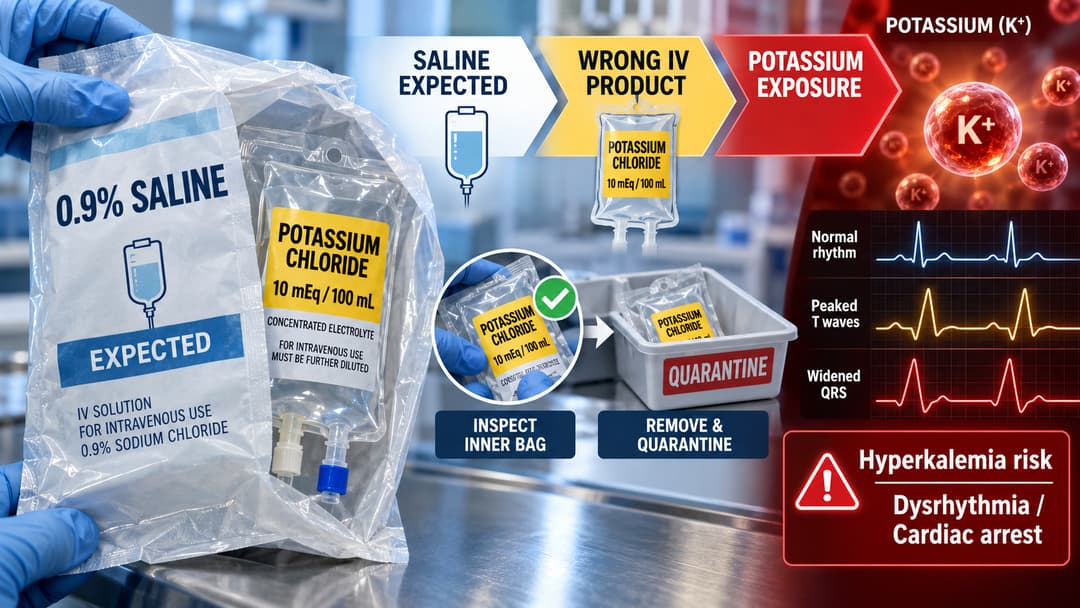
A customer expecting a routine 100 mL bag of normal saline instead found a Potassium Chloride Injection 10 mEq/100 mL bag inside an overwrap labeled 0.9% Sodium Chloride Injection, USP.
Otsuka ICU Medical announced a nationwide voluntary recall on September 17, 2026, and FDA posted the company announcement on September 21. The recall covers one lot of 0.9% Sodium Chloride Injection, USP, 100 mL, at the user level. [1]
FDA states that inadvertent administration of the potassium chloride product could cause serious and potentially fatal adverse events, including cardiac dysrhythmias and death from cardiac arrest. As of the recall announcement, no adverse events related to the recall had been reported. [1]
For medical toxicology, the pathway is unusually direct:
saline expected → potassium chloride administered unintentionally → acute potassium exposure → hyperkalemia and cardiac conduction toxicity.
Recall detail | Verified information |
|---|---|
Expected product | 0.9% Sodium Chloride Injection, USP, 100 mL |
Company | Otsuka ICU Medical LLC |
Saline NDC | 0990-7984-23 |
Recalled lot | 1042188 |
Expiration | October 31, 2027 |
Product potentially inside | Potassium Chloride Injection 10 mEq/100 mL |
Potassium chloride NDC | 0990-7074-26 |
KCl lot found in complaint | 1035181 |
The affected saline lot was manufactured on November 13, 2025 and distributed in the United States from December 30, 2025 through June 22, 2026.
The company is asking customers and distributors to check inventory, quarantine affected units, discontinue use, and arrange return of recalled product. [1]
Importantly, FDA does not say that every bag in lot 1042188 contains potassium chloride.
The recall was initiated because the lot may contain the wrong product inside the saline overwrap. [1]
The outer package identifies the product as normal saline.
In the reported mix-up, the actual inner bag was potassium chloride.
FDA notes that the potassium chloride bag itself is correctly labeled as Potassium Chloride Injection 10 mEq, but that label is not visible while the incorrect saline overwrap remains in place. [1]
That creates a wrong-drug hazard, rather than a simple wrong-strength discrepancy.
If the saline overwrap is trusted without verifying the inner bag, a medication containing potassium could enter a workflow intended for routine crystalloid administration.
This is also why the event is toxicologically different from particulate or sterility recalls.
The unintended exposure is a pharmacologically active electrolyte.
The implicated potassium chloride product contains 10 mEq in 100 mL, equivalent to 100 mEq/L, and its official labeling identifies it as highly concentrated. [2]
Potassium has a central role in cardiac membrane potential and conduction.
Excess extracellular potassium can progressively alter the electrocardiogram and destabilize cardiac conduction.
The official product labeling describes ECG abnormalities that can include peaked T waves and prolonged PR intervals, followed at higher potassium concentrations by disappearance of P waves, widening of the QRS complex, and eventual asystole. [2]
FDA's recall notice warns that significant inadvertent potassium administration may cause:
muscle weakness;
ascending paralysis;
listlessness;
vertigo;
mental confusion;
hypotension;
cardiac dysrhythmias; and
potentially death from cardiac arrest. [1]
The risk statement does not mean that every unintended 10 mEq exposure will cause severe hyperkalemia or cardiac arrest.
Clinical consequences depend on factors including the patient's baseline potassium status, kidney function, cardiac vulnerability, concurrent medications, and how the product is administered.
FDA specifically identifies several populations at increased risk of serious or potentially fatal outcomes from inadvertent potassium chloride administration:
premature infants;
patients receiving chronic parenteral nutrition;
patients with a history of cardiac arrhythmias;
patients with chronic renal insufficiency;
patients with acute renal failure; and
patients receiving potassium-sparing diuretics. [1]
These populations are particularly important because impaired potassium handling or pre-existing cardiac vulnerability can narrow the margin for an unintended potassium load.
Potassium chloride has long been a major medication-safety concern.
The Institute for Safe Medication Practices specifically includes potassium chloride for injection concentrate on its list of high-alert medications used in acute-care settings. [3]
The product implicated in this recall is a premixed 10 mEq/100 mL potassium chloride injection, and its own official labeling identifies it as Highly Concentrated, 100 mEq/L. [2]
The notable feature of this recall is that the error can enter the medication-use pathway before many usual safeguards are activated.
The prescriber may have ordered saline correctly.
The pharmacy may believe it supplied saline correctly.
The bedside clinician may see an outer package identifying saline.
Yet the physical product inside may be potassium chloride.
Once the overwrap is removed, the correctly labeled inner potassium chloride bag provides an opportunity to identify the mismatch before administration.
MedicalToxic previously examined another system-level medication error in Iatrogenic Acetylcysteine Overdose: New Review Maps Severe Medication Errors, where harm arose when failures propagated across prescribing, preparation, and administration.
The current recall illustrates the same broader principle from the supply-chain side:
A correct clinical plan cannot fully protect a patient if the physical product does not match its packaging.
The FDA-posted company announcement instructs customers and distributors with affected inventory to:
check inventory locations for the recalled product;
quarantine affected units;
discontinue use; and
arrange return of recalled product. [1]
The key identifier is:
0.9% Sodium Chloride Injection, USP, 100 mL — Lot 1042188 — Expiration October 31, 2027.
This is therefore an actionable inventory recall, not simply a general safety advisory.
MedicalToxic's Weekly Safety Pulse: FAERS & Recalls previously covered a 2025 Otsuka ICU Medical recall involving a 20 mEq potassium chloride bag inside an overwrap that could incorrectly identify the product as 10 mEq potassium chloride. [4]
That earlier event created a potential potassium overdose because the strength indicated on the overwrap could be lower than the actual bag strength.
The September 2026 event is different:
2025: potassium chloride expected → wrong potassium strength
2026: saline expected → potassium chloride present
The new recall therefore represents a wrong-drug product mix-up, not merely a potassium-strength labeling error.
The recall does not establish that:
every unit in lot 1042188 contains potassium chloride;
other saline lots are affected;
all ICU Medical saline products are unsafe;
all potassium chloride products are affected;
a patient has developed hyperkalemia, dysrhythmia, or cardiac arrest from this recall; or
a broader national cluster of medication errors has occurred.
As of the company announcement, no adverse events related to the recall had been reported. [1]
Keeping those distinctions explicit prevents a potential hazard from being reported as an observed clinical outcome.
This is not another particulate or sterility recall.
The central defect is that the product inside the overwrap may be a different drug from the one identified on the outside.
That creates a clear toxicologic chain:
normal saline expected → potassium chloride unintentionally administered → possible hyperkalemia → conduction disturbance → potentially fatal dysrhythmia or cardiac arrest.
The event also demonstrates why medication safety extends beyond prescribing and dosing.
Manufacturing, packaging, inventory controls, and bedside product verification can all become barriers—or failure points—between a patient and an unintended toxic exposure.
Otsuka ICU Medical's recall involves one lot of 100 mL 0.9% sodium chloride because a customer found a 10 mEq potassium chloride bag inside a saline-labeled overwrap. [1]
FDA warns that inadvertent potassium chloride administration can cause serious and potentially fatal outcomes, including cardiac dysrhythmias and cardiac arrest, particularly in vulnerable patients.
No adverse events related to the recall had been reported when the announcement was issued. [1]
For hospitals and infusion settings, the immediate action is straightforward:
Identify lot 1042188, quarantine affected inventory, and discontinue its use.
For medical toxicology, the broader lesson is equally important:
When the drug inside the package is not the drug clinicians believe they are administering, a routine infusion can become an unintended toxic exposure.
U.S. Food and Drug Administration. (2026, September 21). Otsuka ICU Medical LLC Issues Voluntary Nationwide Recall of 0.9% Sodium Chloride Injection, USP Due To a Product Mix-up with 10 mEq Potassium Chloride Injection.
National Library of Medicine. Potassium Chloride Injection, Solution. DailyMed.
Institute for Safe Medication Practices. (2024). ISMP List of High-Alert Medications in Acute Care Settings.
U.S. Food and Drug Administration. (2025, November 3). Otsuka ICU Medical LLC Issues Voluntary Nationwide Recall of 20 mEq Potassium Chloride Injection Due To Overwrap Mislabeled As 10 mEq Potassium Chloride Injection.
Keep reading
Public Health Warnings and Recalls
17 Oct 2026
Public Health Warnings and Recalls
17 Oct 2026
Public Health Warnings and Recalls
09 Oct 2026
Public Health Warnings and Recalls
03 Oct 2026